Page 344 of 576
Vacation Storage
Any time you store your vehicle or keep it out of service
(i.e., vacation) for two weeks or more, run the air
conditioning system at idle for about five minutes in the
fresh air and high blower setting. This will ensure
adequate system lubrication to minimize the possibility
of compressor damage when the system is started again.
Window Fogging
Interior fogging on the windshield can be quickly re-
moved by turning the mode selector to Defrost. The
Defrost/Floor mode can be used to maintain a clear
windshield and provide sufficient heating. If side win-
dow fogging becomes a problem increase blower speed.
Vehicle windows tend to fog on the inside in mild but
rainy or humid weather.
NOTE:
•Recirculate without A/C should not be used for long
periods, as fogging may occur.
•Automatic Temperature Controls (ATC) will automati-
cally adjust the climate control settings to reduce or
eliminate window fogging on the front windshield.
Outside Air Intake
Make sure the air intake, located directly in front of the
windshield, is free of obstructions such as leaves. Leaves
collected in the air intake may reduce airflow, and if they
enter the plenum, they could plug the water drains. In
Winter months, make sure the air intake is clear of ice,
slush, and snow.
A/C Air Filter
The climate control system filters outside air containing
dust, pollen and some odors. Strong odors cannot be
totally filtered out. Refer to “Maintenance Procedures” in
“Maintaining Your Vehicle” for filter replacement
instructions.
342 UNDERSTANDING YOUR INSTRUMENT PANEL
Page 348 of 576
▫General Information.................. 419
�Fuel Requirements..................... 420
▫3.6L Engine – If Equipped.............. 420
▫5.7L Engine – If Equipped.............. 420
▫Reformulated Gasoline................ 421
▫Gasoline/Oxygenate Blends............. 421
▫E-85 Usage In Non-Flex Fuel Vehicles...... 421
▫MMT In Gasoline.................... 422
▫Materials Added To Fuel............... 423
▫Fuel System Cautions................. 423
▫Carbon Monoxide Warnings............ 424
�Flexible Fuel (3.6L Engine Only) —
If Equipped.......................... 424▫E-85 General Information............... 424
▫Ethanol Fuel (E-85)................... 425
▫Fuel Requirements................... 425
▫Selection Of Engine Oil For Flexible Fuel
Vehicles (E-85) And Gasoline Vehicles...... 426
▫Starting........................... 427
▫Cruising Range...................... 427
▫Replacement Parts................... 427
▫Maintenance........................ 427
�Adding Fuel......................... 428
▫Emergency Fuel Filler Door Release....... 430
�Vehicle Loading...................... 431
▫Vehicle Certification Label.............. 431
346 STARTING AND OPERATING
Page 411 of 576
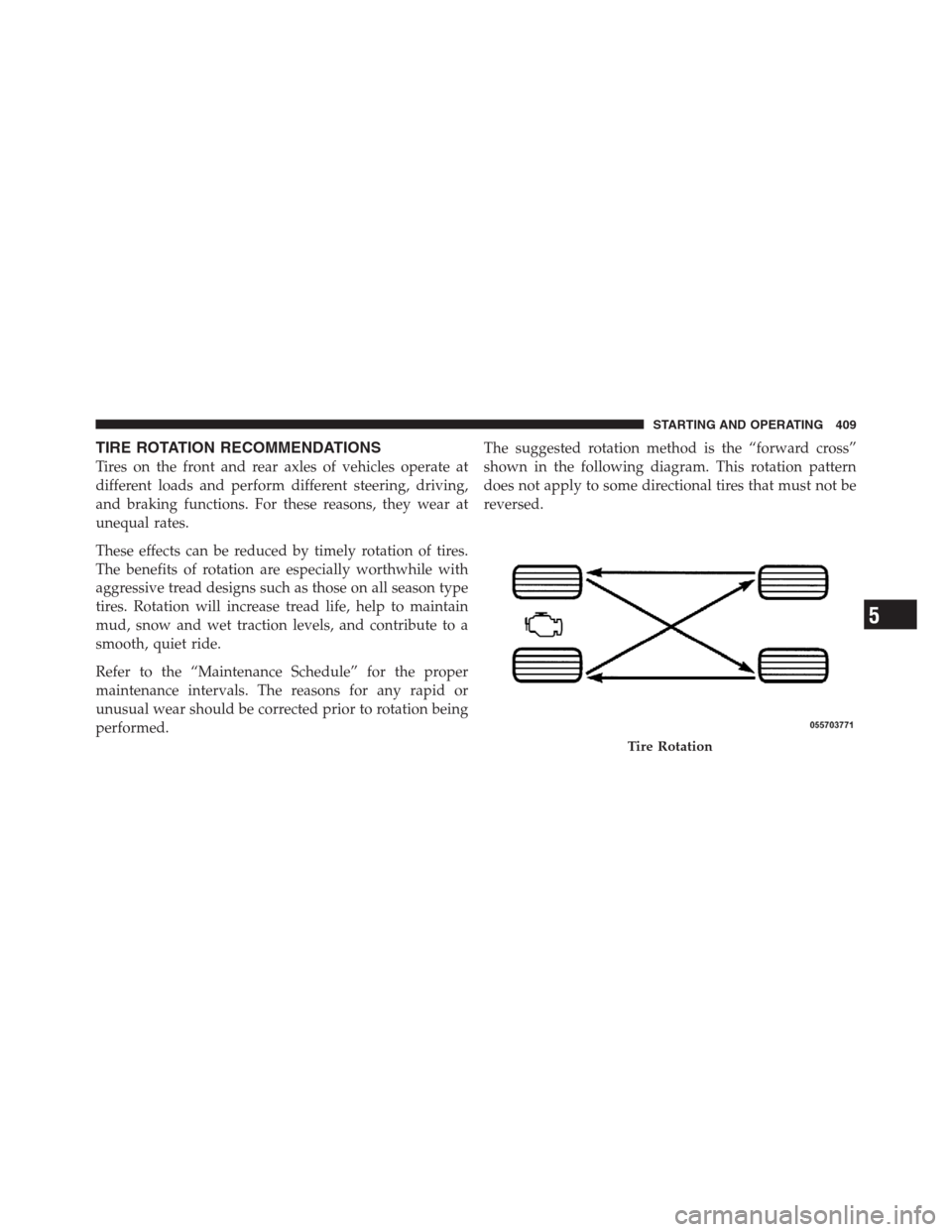
TIRE ROTATION RECOMMENDATIONS
Tires on the front and rear axles of vehicles operate at
different loads and perform different steering, driving,
and braking functions. For these reasons, they wear at
unequal rates.
These effects can be reduced by timely rotation of tires.
The benefits of rotation are especially worthwhile with
aggressive tread designs such as those on all season type
tires. Rotation will increase tread life, help to maintain
mud, snow and wet traction levels, and contribute to a
smooth, quiet ride.
Refer to the “Maintenance Schedule” for the proper
maintenance intervals. The reasons for any rapid or
unusual wear should be corrected prior to rotation being
performed.The suggested rotation method is the “forward cross”
shown in the following diagram. This rotation pattern
does not apply to some directional tires that must not be
reversed.
Tire Rotation
5
STARTING AND OPERATING 409
Page 414 of 576

NOTE:
•The TPMS is not intended to replace normal tire care
and maintenance or to provide warning of a tire failure
or condition.
•The TPMS should not be used as a tire pressure gauge
while adjusting your tire pressure.
•Driving on a significantly under-inflated tire causes
the tire to overheat and can lead to tire failure.
Under-inflation also reduces fuel efficiency and tire
tread life, and may affect the vehicle’s handling and
stopping ability.
•The TPMS is not a substitute for proper tire mainte-
nance, and it is the driver ’s responsibility to maintain
correct tire pressure using an accurate tire pressure
gauge, even if under-inflation has not reached the
level to trigger illumination of the TPM Telltale Light.
•Seasonal temperature changes will affect tire pressure,
and the TPMS will monitor the actual tire pressure in
the tire.
Base System
The Tire Pressure Monitor System (TPMS) uses wireless
technology with wheel rim mounted electronic sensors to
monitor tire pressure levels. Sensors mounted to each
wheel as part of the valve stem transmit tire pressure
readings to the receiver module.
NOTE:It is particularly important for you to check the
tire pressure in all of the tires on your vehicle monthly
and to maintain the proper pressure.
The TPMS consists of the following components:
•Receiver module,
•Four TPM sensors, and
•TPM Telltale Light
412 STARTING AND OPERATING
Page 426 of 576
Carbon Monoxide Warnings
WARNING!
Carbon monoxide (CO) in exhaust gases is deadly.
Follow the precautions below to prevent carbon
monoxide poisoning:
•Do not inhale exhaust gases. They contain carbon
monoxide, a colorless and odorless gas, which can
kill. Never run the engine in a closed area, such as
a garage, and never sit in a parked vehicle with the
engine running for an extended period. If the
vehicle is stopped in an open area with the engine
running for more than a short period, adjust the
ventilation system to force fresh, outside air into
the vehicle.
(Continued)
WARNING! (Continued)
•Guard against carbon monoxide with proper
maintenance. Have the exhaust system inspected
every time the vehicle is raised. Have any abnor-
mal conditions repaired promptly. Until repaired,
drive with all side windows fully open.
FLEXIBLE FUEL (3.6L ENGINE ONLY) — IF
EQUIPPED
E-85 General Information
The information in this section is for Flexible Fuel ve-
hicles only. These vehicles can be identified by a unique
fuel filler door label that statesEthanol (E-85) or Un-
leaded Gasoline Only.This section only covers those
subjects that are unique to these vehicles. Please refer to
the other sections of this manual for information on
features that are common between Flexible Fuel and
gasoline-only powered vehicles.
424 STARTING AND OPERATING
Page 429 of 576
Starting
The characteristics of E-85 fuel make it unsuitable for use
when ambient temperatures fall below 0°F (-18°C). In the
range of 0°F (-18°C) to 32°F (0°C), you may experience an
increase in the time it takes for your engine to start, and
a deterioration in driveability (sags and/or hesitations)
until the engine is fully warmed up.
NOTE:Use of the engine block heater (if equipped) is
beneficial for E-85 startability when the ambient tempera-
ture is less than 32°F (0°C).
Cruising Range
Because E-85 fuel contains less energy per gallon/liter
than gasoline, you will experience an increase in fuel
consumption. You can expect your miles per gallon
(mpg)/miles per liter and your driving range to decrease
by about 30%, compared to gasoline operation.
Replacement Parts
Many components in your Flexible Fuel Vehicle (FFV) are
designed to be compatible with ethanol. Always be sure
that your vehicle is serviced with correct ethanol com-
patible parts.
CAUTION!
Replacing fuel system components with non-ethanol
compatible components can damage your vehicle.
Maintenance
If you operate the vehicle using E-85 fuel, follow the
maintenance schedule section of this manual.
CAUTION!
Do not use ethanol mixture greater than 85% in your
vehicle. It will cause difficulty in cold starting and
may affect driveability.
5
STARTING AND OPERATING 427
Page 446 of 576
Towing Tips
Before setting out on a trip, practice turning, stopping,
and backing up the trailer in an area located away from
heavy traffic.
Automatic Transmission
The DRIVE range can be selected when towing. How-
ever, if frequent shifting occurs while in this range, select
a lower gear range using the AutoStick�shift control (if
equipped).
NOTE:Selecting a lower gear range while operating the
vehicle under heavy operating conditions will improve
performance and extend transmission life by reducing
excessive shifting and heat buildup. This action will also
provide better engine braking.
If you REGULARLY tow a trailer for more than 45 min-
utes of continuous operation, then change the automatic
transmission fluid and filter according to the intervalspecified for “police, taxi, fleet, or frequent trailer tow-
ing.” Refer to “Maintenance Schedule” for the proper
maintenance intervals.
Electronic Speed Control – If Equipped
Do not use in hilly terrain or with heavy loads.
When using the speed control, if you experience speed
drops greater than 10 mph (16 km/h), disengage until
you can get back to cruising speed.
Use speed control in flat terrain and with light loads to
maximize fuel efficiency.
AutoStick�– If Equipped
By using the AutoStick�mode and selecting a specific
gear range, frequent shifting can be avoided. Select the
highest gear range that allows for adequate perfor-
mance and avoids frequent downshifts.
444 STARTING AND OPERATING
Page 473 of 576
MAINTAINING YOUR VEHICLE
CONTENTS
�Engine Compartment — 3.6L............. 473
�Engine Compartment — 5.7L............. 474
�Onboard Diagnostic System — OBD II...... 475
�Emissions Inspection And Maintenance
Programs............................ 475
�Replacement Parts..................... 477
�Dealer Service........................ 477
�Maintenance Procedures................. 478
▫Engine Oil......................... 479▫Engine Oil Filter..................... 482
▫Engine Air Cleaner Filter............... 482
▫Maintenance-Free Battery.............. 483
▫Air Conditioner Maintenance............ 485
▫A/C Air Filter...................... 486
▫Body Lubrication.................... 488
▫Windshield Wiper Blades............... 488
▫Adding Washer Fluid................. 489
▫Exhaust System..................... 489
7