Page 376 of 517

WARNING! (Continued)
•Never add fuel when the engine is running. This is
in violation of most state and federal fire regula-
tions and doing so may cause the MIL to turn on.
•A fire may result if gasoline is pumped into a
portable container that is inside of a vehicle. You
could be burned. Always place gas containers on
the ground while filling.
NOTE:
•Tighten the gas cap until you hear a “clicking” sound.
This is an indication that the gas cap is tightened
properly. The MIL in the instrument cluster may turn
on if the gas cap is not secured properly. Make sure
that the gas cap is tightened each time the vehicle is
refueled.
•When the fuel nozzle “clicks” or shuts off, the fuel
tank is full.
Loose Filler Cap Message
If the vehicles diagnostic system determines that the fuel
filler cap in loose, improperly installed, or damaged, a
“gASCAP” message will be displayed in the instrument
cluster. Tighten the gas cap until a “clicking” sound is
heard. This is an indication that the gas cap is properly
tightened. Press the trip odometer reset button to turn off
the message. If the problem persists, the message will
appear the next time the vehicle is started. This might
indicate a damaged cap. If the problem is detected twice
in a row, the system will turn on the MIL. Resolving the
problem will turn the MIL off.
374 STARTING AND OPERATING
Page 382 of 517
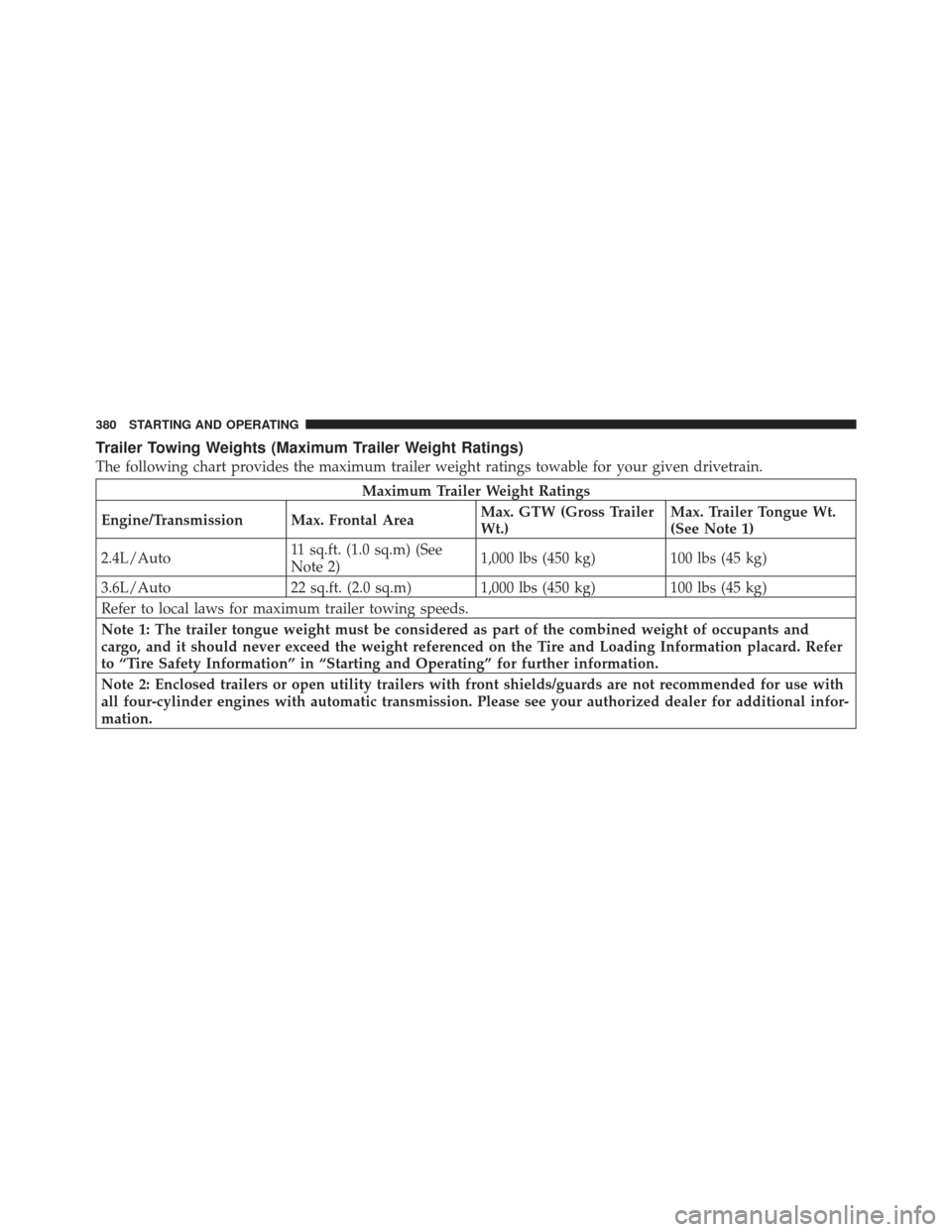
Trailer Towing Weights (Maximum Trailer Weight Ratings)
The following chart provides the maximum trailer weight ratings towable for your given drivetrain.
Maximum Trailer Weight Ratings
Engine/Transmission Max. Frontal Area Max. GTW (Gross Trailer
Wt.)Max. Trailer Tongue Wt.
(See Note 1)
2.4L/Auto 11 sq.ft. (1.0 sq.m) (See
Note 2)1,000 lbs (450 kg)
100 lbs (45 kg)
3.6L/Auto 22 sq.ft. (2.0 sq.m) 1,000 lbs (450 kg) 100 lbs (45 kg)
Refer to local laws for maximum trailer towing speeds.
Note 1: The trailer tongue weight must be considered as part of the combined weight of occupants and
cargo, and it should never exceed the weight referenced on the Tire and Loading Information placard. Refer
to “Tire Safety Information” in “Starting and Operating” for further information.
Note 2: Enclosed trailers or open utility trailers with front shields/guards are not recommended for use with
all four-cylinder engines with automatic transmission. Please see your authorized dealer for additional infor-
mation.
380 STARTING AND OPERATING
Page 383 of 517
CAUTION!
Towing a trailer with a larger than recommended
frontal area could cause the engine to overheat or
cause severe engine damage under extreme condi-
tions.
Trailer And Tongue Weight
Always load a trailer with 60% to 65% of the weight in
the front of the trailer. This places 10% of the Gross Trailer
Weight (GTW) on the tow hitch of your vehicle. Loads
balanced over the wheels or heavier in the rear can cause
the trailer to swayseverelyside to side which will cause
loss of control of vehicle and trailer. Failure to load
trailers heavier in front is the cause of many trailer
collisions.
Never exceed the maximum trailer tongue weight
stamped on your bumper or trailer hitch. Consider the following items when computing the
weight on the rear axle of the vehicle:
•The trailer tongue weight of the trailer.
•The weight of any other type of cargo or equipment
put in or on your vehicle.
•The weight of the driver and all passengers.
5
STARTING AND OPERATING 381
Page 384 of 517
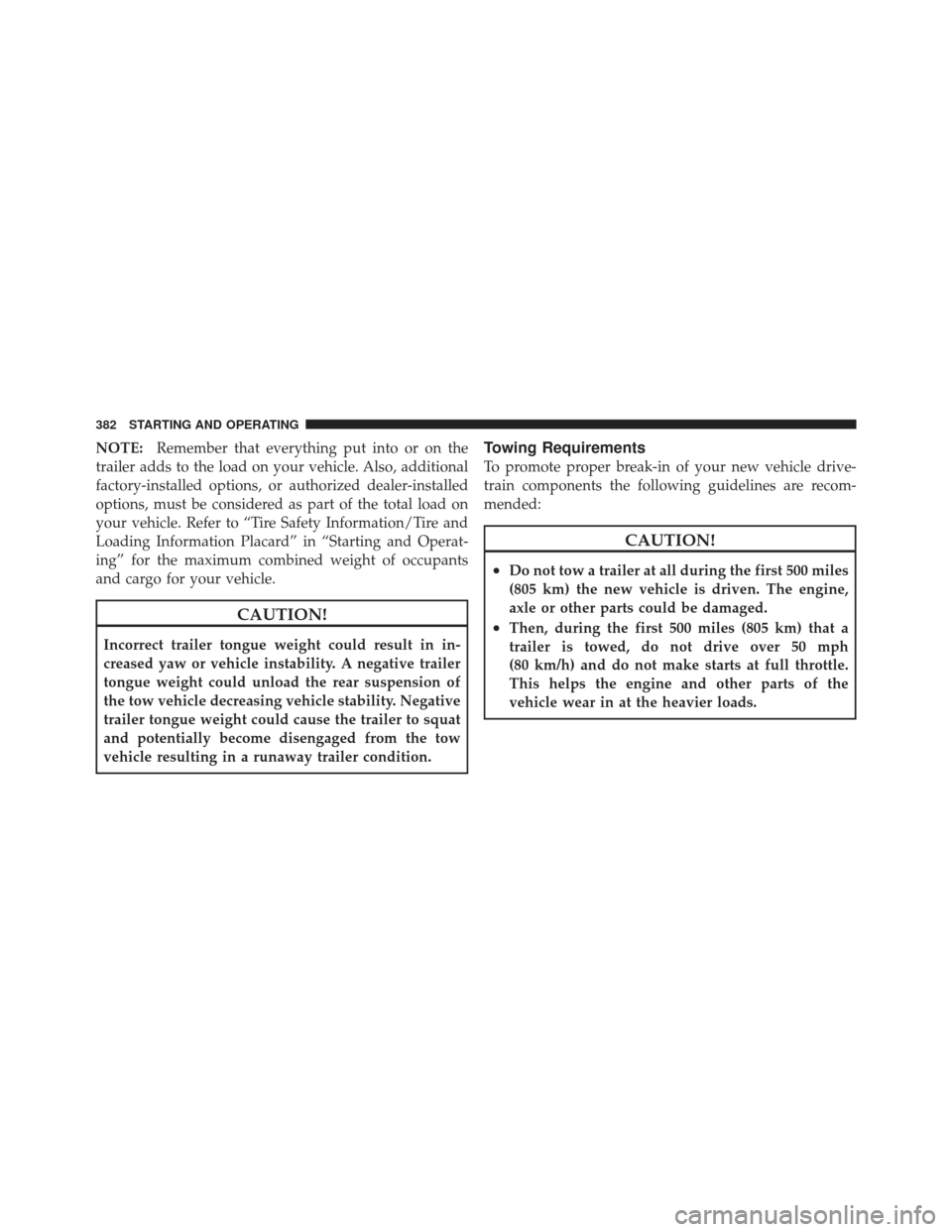
NOTE:Remember that everything put into or on the
trailer adds to the load on your vehicle. Also, additional
factory-installed options, or authorized dealer-installed
options, must be considered as part of the total load on
your vehicle. Refer to “Tire Safety Information/Tire and
Loading Information Placard” in “Starting and Operat-
ing” for the maximum combined weight of occupants
and cargo for your vehicle.
CAUTION!
Incorrect trailer tongue weight could result in in-
creased yaw or vehicle instability. A negative trailer
tongue weight could unload the rear suspension of
the tow vehicle decreasing vehicle stability. Negative
trailer tongue weight could cause the trailer to squat
and potentially become disengaged from the tow
vehicle resulting in a runaway trailer condition.
Towing Requirements
To promote proper break-in of your new vehicle drive-
train components the following guidelines are recom-
mended:
CAUTION!
•Do not tow a trailer at all during the first 500 miles
(805 km) the new vehicle is driven. The engine,
axle or other parts could be damaged.
•Then, during the first 500 miles (805 km) that a
trailer is towed, do not drive over 50 mph
(80 km/h) and do not make starts at full throttle.
This helps the engine and other parts of the
vehicle wear in at the heavier loads.
382 STARTING AND OPERATING
Page 385 of 517
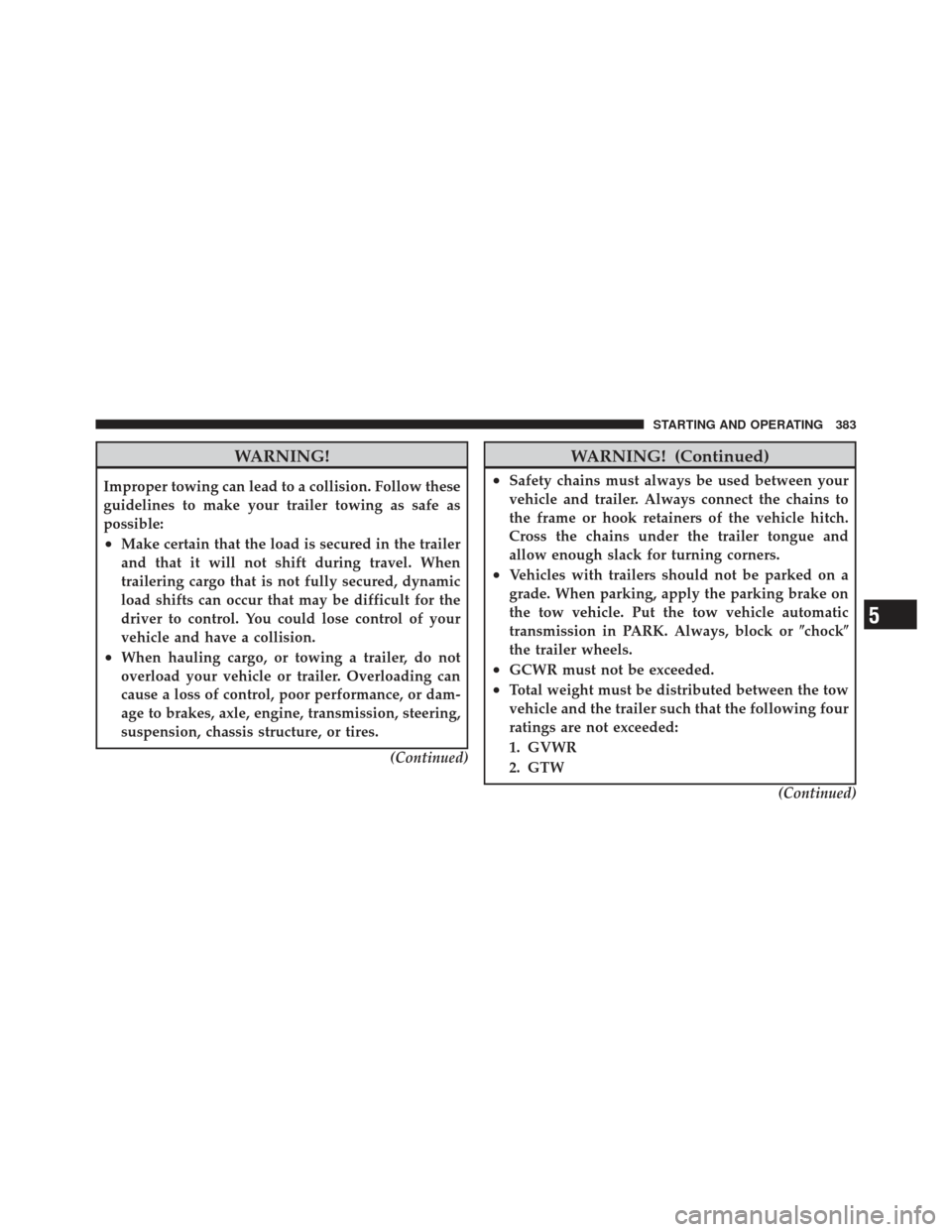
WARNING!
Improper towing can lead to a collision. Follow these
guidelines to make your trailer towing as safe as
possible:
•Make certain that the load is secured in the trailer
and that it will not shift during travel. When
trailering cargo that is not fully secured, dynamic
load shifts can occur that may be difficult for the
driver to control. You could lose control of your
vehicle and have a collision.
•When hauling cargo, or towing a trailer, do not
overload your vehicle or trailer. Overloading can
cause a loss of control, poor performance, or dam-
age to brakes, axle, engine, transmission, steering,
suspension, chassis structure, or tires.(Continued)
WARNING! (Continued)
•Safety chains must always be used between your
vehicle and trailer. Always connect the chains to
the frame or hook retainers of the vehicle hitch.
Cross the chains under the trailer tongue and
allow enough slack for turning corners.
•Vehicles with trailers should not be parked on a
grade. When parking, apply the parking brake on
the tow vehicle. Put the tow vehicle automatic
transmission in PARK. Always, block or �chock�
the trailer wheels.
•GCWR must not be exceeded.
•Total weight must be distributed between the tow
vehicle and the trailer such that the following four
ratings are not exceeded:
1. GVWR
2. GTW
(Continued)
5
STARTING AND OPERATING 383
Page 388 of 517

Towing Tips
Before setting out on a trip, practice turning, stopping,
and backing the trailer in an area located away from
heavy traffic.
Make sure all trailer and vehicle lights are working
properly — including hazard flashers.
Automatic Transmission
The DRIVE range can be selected when towing. How-
ever, if frequent shifting occurs, select a lower gear using
the AutoStick�shift control.
NOTE: Using a lower gear while operating the vehicle
under heavy operating conditions, will improve perfor-
mance and extend transmission life by reducing exces-
sive shifting and heat build-up. This action will also
provide better engine braking.
If you REGULARLY TOW a trailer for more than 45 min-
utes of continuous operation, then change the automatic transmission fluid and filter according to the interval
specified for “police, taxi, fleet, or frequent trailer tow-
ing.” Refer to the “Maintenance Schedule” for the proper
maintenance intervals.
NOTE:
The six-speed transmission does not require a
fluid level check before towing. If, however, you notice
fluid leakage or transmission malfunction, see your au-
thorized dealership service center for assistance.
Electronic Speed Control – If Equipped
•
Do not use in hilly terrain or with heavy loads.
•When using the speed control, if you experience speed
drops greater than 10 mph (16 km/h), disengage until
you can get back to cruising speed.
•Use speed control in flat terrain and with light loads to
maximize fuel efficiency.
386 STARTING AND OPERATING
Page 389 of 517
Cooling System
To reduce potential for engine and transmission over-
heating, take the following actions:
•City Driving
When stopped for short periods of time, shift the trans-
mission into NEUTRAL and increase engine idle speed.
•Highway Driving
Reduce speed.
•Air Conditioning
Turn off temporarily.
5
STARTING AND OPERATING 387
Page 393 of 517
WHAT TO DO IN EMERGENCIES
CONTENTS
�Hazard Warning Flashers ................ 392
� If Your Engine Overheats ................ 392
▫ Engine Oil Overheating — 2.4L Engine Only
(If Equipped) ....................... 393
� Jacking And Tire Changing ............... 394
▫ Jack Location ....................... 394
▫ Spare Tire Stowage ................... 394
▫ Preparations For Jacking ............... 395
▫ Jacking Instructions ................... 396 ▫
Road Tire Installation ................. 402
� Jump-Starting ........................ 404
▫ Preparations For Jump-Start ............. 405
▫ Jump-Starting Procedure ............... 407
� Freeing A Stuck Vehicle ................. 408
� Shift Lever Override ................... 410
� Towing A Disabled Vehicle ............... 411
▫ Automatic Transmission ............... 412
▫ Without The Ignition Key .............. 413
6


