2012 CHEVROLET SUBURBAN wheel
[x] Cancel search: wheelPage 330 of 514
Black plate (68,1)Chevrolet Tahoe/Suburban Owner Manual - 2012
9-68 Driving and Operating
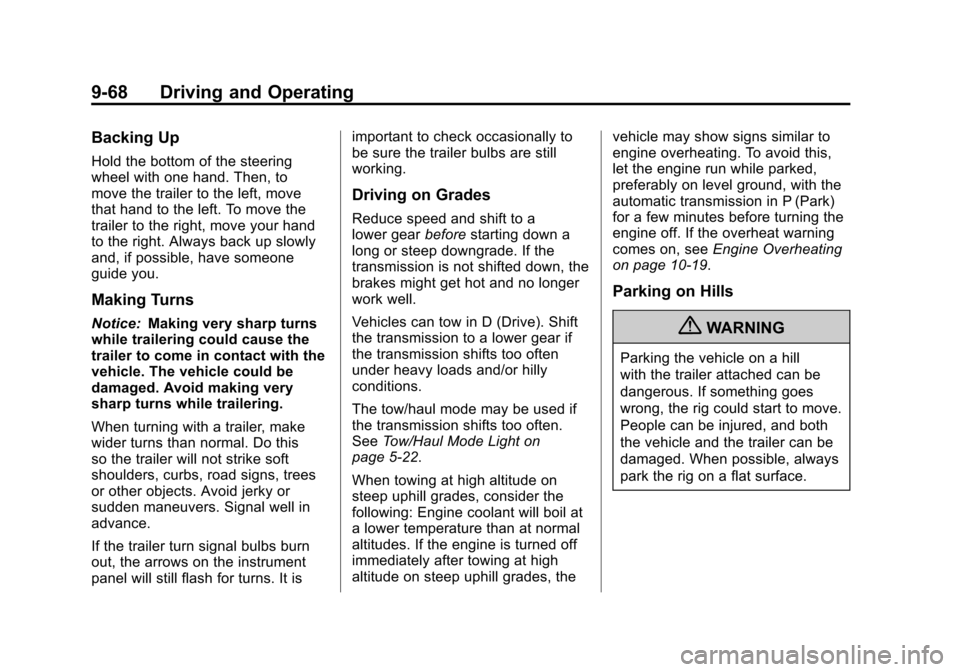
Backing Up
Hold the bottom of the steering
wheel with one hand. Then, to
move the trailer to the left, move
that hand to the left. To move the
trailer to the right, move your hand
to the right. Always back up slowly
and, if possible, have someone
guide you.
Making Turns
Notice:Making very sharp turns
while trailering could cause the
trailer to come in contact with the
vehicle. The vehicle could be
damaged. Avoid making very
sharp turns while trailering.
When turning with a trailer, make
wider turns than normal. Do this
so the trailer will not strike soft
shoulders, curbs, road signs, trees
or other objects. Avoid jerky or
sudden maneuvers. Signal well in
advance.
If the trailer turn signal bulbs burn
out, the arrows on the instrument
panel will still flash for turns. It is important to check occasionally to
be sure the trailer bulbs are still
working.
Driving on Grades
Reduce speed and shift to a
lower gear
beforestarting down a
long or steep downgrade. If the
transmission is not shifted down, the
brakes might get hot and no longer
work well.
Vehicles can tow in D (Drive). Shift
the transmission to a lower gear if
the transmission shifts too often
under heavy loads and/or hilly
conditions.
The tow/haul mode may be used if
the transmission shifts too often.
See Tow/Haul Mode Light on
page 5‑22.
When towing at high altitude on
steep uphill grades, consider the
following: Engine coolant will boil at
a lower temperature than at normal
altitudes. If the engine is turned off
immediately after towing at high
altitude on steep uphill grades, the vehicle may show signs similar to
engine overheating. To avoid this,
let the engine run while parked,
preferably on level ground, with the
automatic transmission in P (Park)
for a few minutes before turning the
engine off. If the overheat warning
comes on, see
Engine Overheating
on page 10‑19.
Parking on Hills
{WARNING
Parking the vehicle on a hill
with the trailer attached can be
dangerous. If something goes
wrong, the rig could start to move.
People can be injured, and both
the vehicle and the trailer can be
damaged. When possible, always
park the rig on a flat surface.
Page 331 of 514
Black plate (69,1)Chevrolet Tahoe/Suburban Owner Manual - 2012
Driving and Operating 9-69
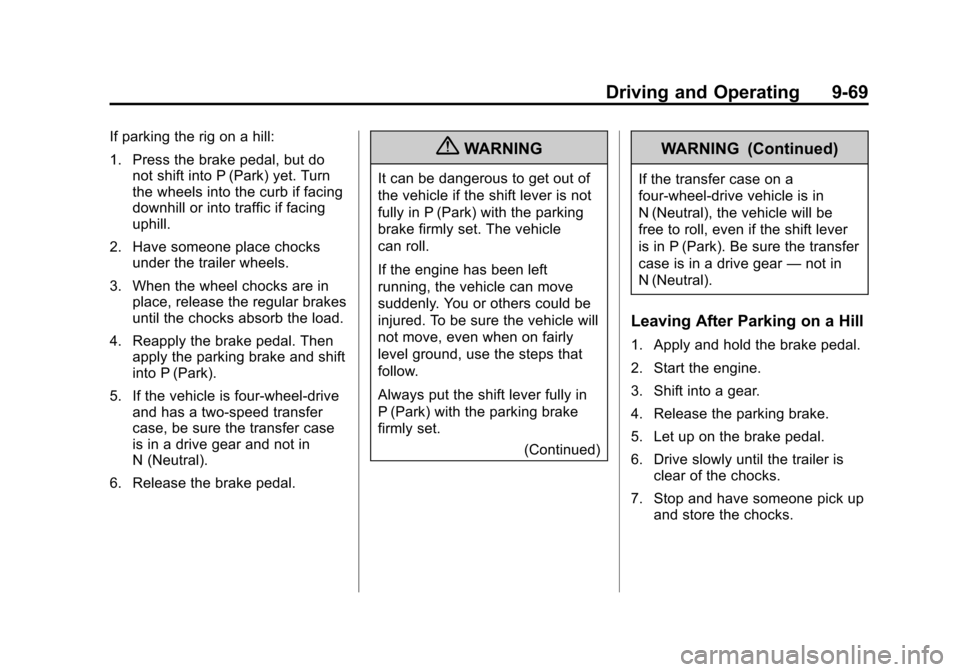
If parking the rig on a hill:
1. Press the brake pedal, but donot shift into P (Park) yet. Turn
the wheels into the curb if facing
downhill or into traffic if facing
uphill.
2. Have someone place chocks under the trailer wheels.
3. When the wheel chocks are in place, release the regular brakes
until the chocks absorb the load.
4. Reapply the brake pedal. Then apply the parking brake and shift
into P (Park).
5. If the vehicle is four-wheel-drive and has a two-speed transfer
case, be sure the transfer case
is in a drive gear and not in
N (Neutral).
6. Release the brake pedal.{WARNING
It can be dangerous to get out of
the vehicle if the shift lever is not
fully in P (Park) with the parking
brake firmly set. The vehicle
can roll.
If the engine has been left
running, the vehicle can move
suddenly. You or others could be
injured. To be sure the vehicle will
not move, even when on fairly
level ground, use the steps that
follow.
Always put the shift lever fully in
P (Park) with the parking brake
firmly set. (Continued)
WARNING (Continued)
If the transfer case on a
four-wheel-drive vehicle is in
N (Neutral), the vehicle will be
free to roll, even if the shift lever
is in P (Park). Be sure the transfer
case is in a drive gear —not in
N (Neutral).
Leaving After Parking on a Hill
1. Apply and hold the brake pedal.
2. Start the engine.
3. Shift into a gear.
4. Release the parking brake.
5. Let up on the brake pedal.
6. Drive slowly until the trailer is clear of the chocks.
7. Stop and have someone pick up and store the chocks.
Page 334 of 514
Black plate (72,1)Chevrolet Tahoe/Suburban Owner Manual - 2012
9-72 Driving and Operating
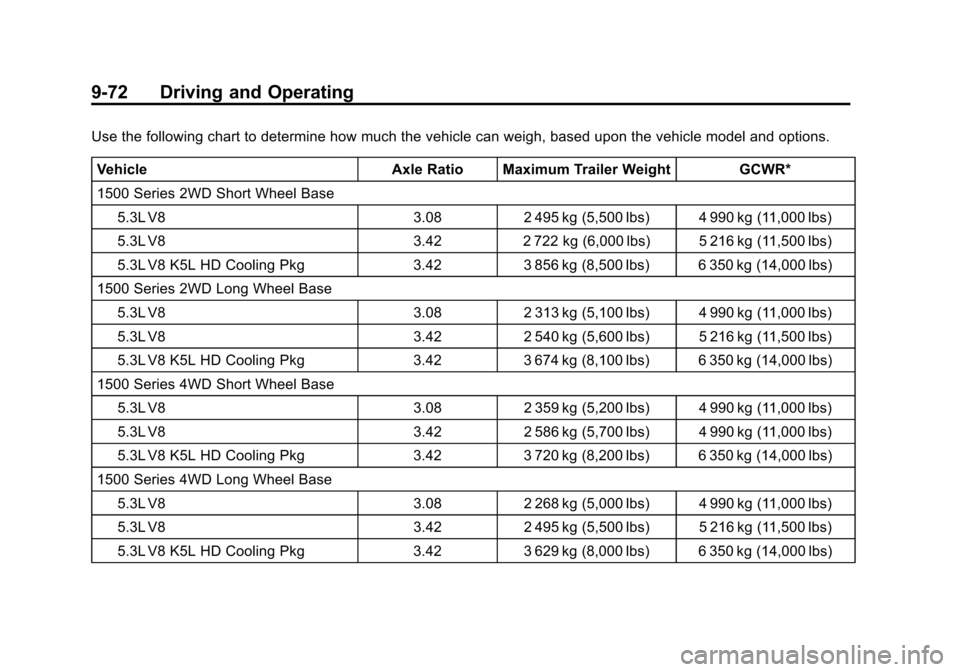
Use the following chart to determine how much the vehicle can weigh, based upon the vehicle model and options.Vehicle Axle Ratio Maximum Trailer Weight GCWR*
1500 Series 2WD Short Wheel Base
5.3L V8 3.082 495 kg (5,500 lbs) 4 990 kg (11,000 lbs)
5.3L V8 3.422 722 kg (6,000 lbs) 5 216 kg (11,500 lbs)
5.3L V8 K5L HD Cooling Pkg 3.423 856 kg (8,500 lbs) 6 350 kg (14,000 lbs)
1500 Series 2WD Long Wheel Base
5.3L V8 3.082 313 kg (5,100 lbs) 4 990 kg (11,000 lbs)
5.3L V8 3.422 540 kg (5,600 lbs) 5 216 kg (11,500 lbs)
5.3L V8 K5L HD Cooling Pkg 3.423 674 kg (8,100 lbs) 6 350 kg (14,000 lbs)
1500 Series 4WD Short Wheel Base 5.3L V8 3.082 359 kg (5,200 lbs) 4 990 kg (11,000 lbs)
5.3L V8 3.422 586 kg (5,700 lbs) 4 990 kg (11,000 lbs)
5.3L V8 K5L HD Cooling Pkg 3.423 720 kg (8,200 lbs) 6 350 kg (14,000 lbs)
1500 Series 4WD Long Wheel Base 5.3L V8 3.082 268 kg (5,000 lbs) 4 990 kg (11,000 lbs)
5.3L V8 3.422 495 kg (5,500 lbs) 5 216 kg (11,500 lbs)
5.3L V8 K5L HD Cooling Pkg 3.423 629 kg (8,000 lbs) 6 350 kg (14,000 lbs)
Page 335 of 514

Black plate (73,1)Chevrolet Tahoe/Suburban Owner Manual - 2012
Driving and Operating 9-73
VehicleAxle Ratio Maximum Trailer Weight GCWR*
2500 Series 2WD Long Wheel Base 6.0L V8 3.734 355 kg (9,600 lbs) 7 257 kg (16,000 lbs)
2500 Series 4WD Long Wheel Base 6.0L V8 3.734 264 kg (9,400 lbs) 7 257 kg (16,000 lbs)
*The Gross Combination Weight Rating (GCWR) is the total allowable weight of the completely loaded vehicle and
trailer including any passengers, cargo, equipment and conversions. The GCWR for the vehicle should not be
exceeded.
Ask your dealer for trailering
information or advice, or write us at
our Customer Assistance Offices,
See Customer Assistance Offices
(U.S. and Canada) on page 13‑4
or Customer Assistance Offices
(Mexico) on page 13‑5.
Weight of the Trailer Tongue
The tongue load (A) of any trailer is
very important because it is also
part of the vehicle weight. The
Gross Vehicle Weight (GVW)
includes the curb weight of the
vehicle, any cargo carried in it, and
the people who will be riding in the
vehicle as well as trailer tongue weight. Vehicle options, equipment,
passengers and cargo in the vehicle
reduce the amount of tongue weight
the vehicle can carry, which will also
reduce the trailer weight the vehicle
can tow. See
Vehicle Load Limits on
page 9‑16 for more information
about the vehicle's maximum load
capacity.
Page 341 of 514
Black plate (79,1)Chevrolet Tahoe/Suburban Owner Manual - 2012
Driving and Operating 9-79
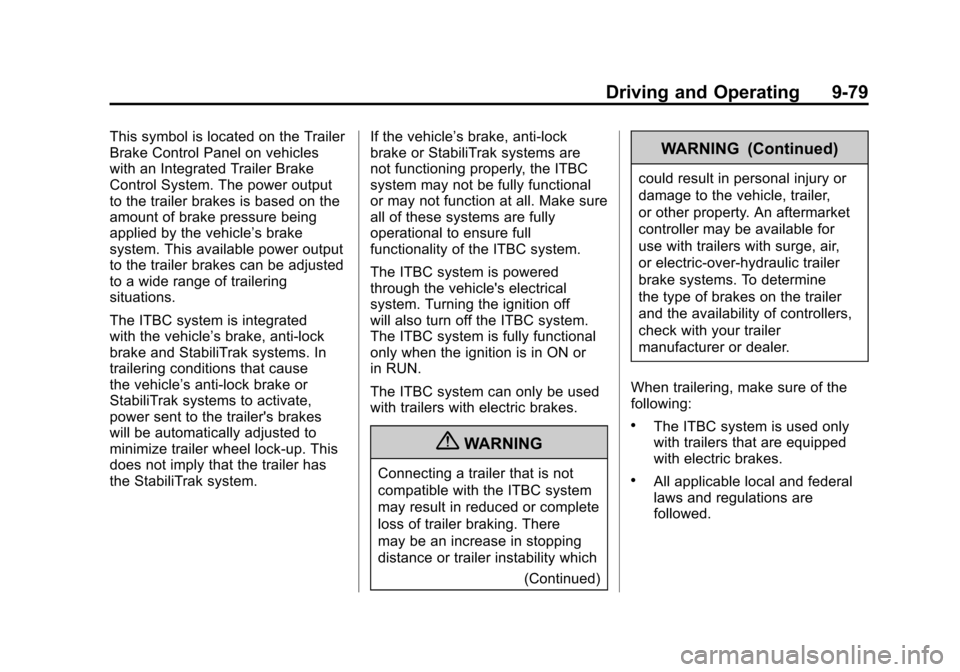
This symbol is located on the Trailer
Brake Control Panel on vehicles
with an Integrated Trailer Brake
Control System. The power output
to the trailer brakes is based on the
amount of brake pressure being
applied by the vehicle’s brake
system. This available power output
to the trailer brakes can be adjusted
to a wide range of trailering
situations.
The ITBC system is integrated
with the vehicle’s brake, anti‐lock
brake and StabiliTrak systems. In
trailering conditions that cause
the vehicle’s anti‐lock brake or
StabiliTrak systems to activate,
power sent to the trailer's brakes
will be automatically adjusted to
minimize trailer wheel lock-up. This
does not imply that the trailer has
the StabiliTrak system. If the vehicle’s brake, anti‐lock
brake or StabiliTrak systems are
not functioning properly, the ITBC
system may not be fully functional
or may not function at all. Make sure
all of these systems are fully
operational to ensure full
functionality of the ITBC system.
The ITBC system is powered
through the vehicle's electrical
system. Turning the ignition off
will also turn off the ITBC system.
The ITBC system is fully functional
only when the ignition is in ON or
in RUN.
The ITBC system can only be used
with trailers with electric brakes.
{WARNING
Connecting a trailer that is not
compatible with the ITBC system
may result in reduced or complete
loss of trailer braking. There
may be an increase in stopping
distance or trailer instability which
(Continued)
WARNING (Continued)
could result in personal injury or
damage to the vehicle, trailer,
or other property. An aftermarket
controller may be available for
use with trailers with surge, air,
or electric‐over‐hydraulic trailer
brake systems. To determine
the type of brakes on the trailer
and the availability of controllers,
check with your trailer
manufacturer or dealer.
When trailering, make sure of the
following:
.The ITBC system is used only
with trailers that are equipped
with electric brakes.
.All applicable local and federal
laws and regulations are
followed.
Page 345 of 514

Black plate (83,1)Chevrolet Tahoe/Suburban Owner Manual - 2012
Driving and Operating 9-83
5. Drive the vehicle with the trailerattached on a level road surface
representative of the towing
condition and free of traffic at
about 32 to 40 km/h (20 to
25 mph) and fully apply the
Manual Trailer Brake Apply
lever.
Adjusting trailer gain at speeds
lower than 32 to 40 km/h
(20 to 25 mph) may result in an
incorrect gain setting.
6. Adjust the Trailer Gain to just below the point of trailer wheel
lock-up, indicated by trailer
wheel squeal or tire smoke when
a trailer wheel locks.
Trailer wheel lock-up may not
occur if towing a heavily loaded
trailer. In this case, adjust the
Trailer Gain to the highest
allowable setting for the towing
condition. 7. Re-adjust Trailer Gain any time
vehicle loading, trailer loading or
road surface conditions change
or if trailer wheel lock-up is
noticed at any time while towing
Other ITBC Related DIC Messages
In addition to displaying TRAILER
GAIN and TRAILER OUTPUT
through the DIC, trailer connection
and ITBC system status is displayed
in the DIC.
TRAILER CONNECTED –This
message will be briefly displayed
when a trailer with electric brakes is
first connected to the vehicle. This
message will automatically turn off
in about ten seconds. The driver
can also acknowledge this message
before it automatically turns off.
CHECK TRAILER WIRING –This
message will be displayed if:
1. The ITBC system first
determines connection to a
trailer with electric brakes and
then the trailer harness becomes
disconnected from the vehicle. If the disconnect occurs while
the vehicle is stationary, this
message will automatically
turn off in about thirty seconds.
This message will also turn off if
the driver acknowledges this
message off or if the trailer
harness is re-connected.
If the disconnect occurs while
the vehicle is moving, this
message will continue until
the ignition is turned off. This
message will also turn off if
the driver acknowledges this
message off or if the trailer
harness is re-connected.
2. There is an electrical fault in the wiring to the electric trailer
brakes. This message will
continue as long as there is an
electrical fault in the trailer
wiring. This message will
also turn off if the driver
acknowledges this message off.
Page 349 of 514
Black plate (87,1)Chevrolet Tahoe/Suburban Owner Manual - 2012
Driving and Operating 9-87
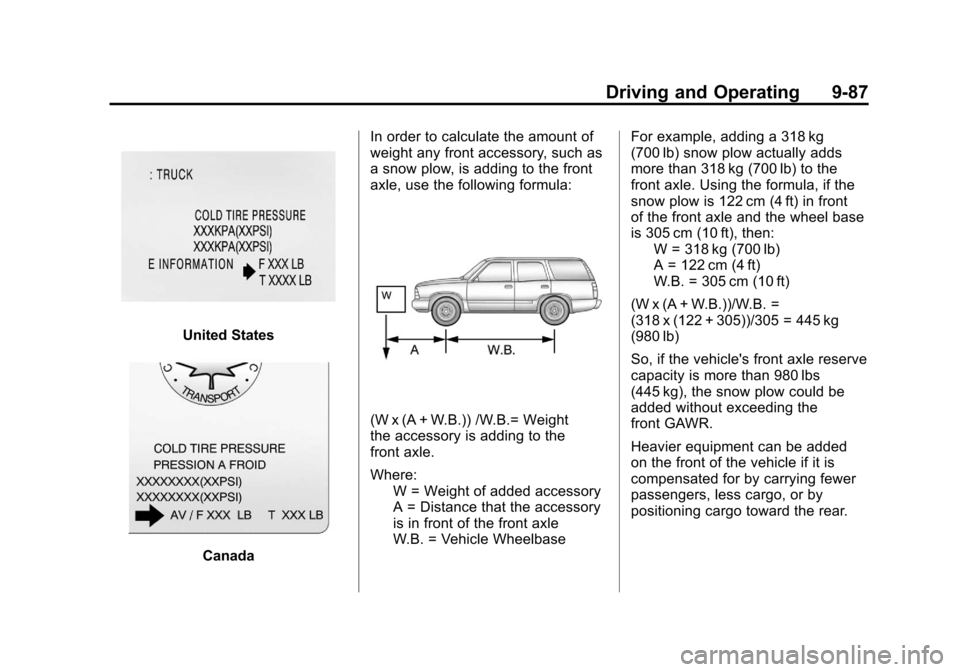
United States
CanadaIn order to calculate the amount of
weight any front accessory, such as
a snow plow, is adding to the front
axle, use the following formula:
(W x (A + W.B.)) /W.B.= Weight
the accessory is adding to the
front axle.
Where:
W = Weight of added accessory
A = Distance that the accessory
is in front of the front axle
W.B. = Vehicle Wheelbase For example, adding a 318 kg
(700 lb) snow plow actually adds
more than 318 kg (700 lb) to the
front axle. Using the formula, if the
snow plow is 122 cm (4 ft) in front
of the front axle and the wheel base
is 305 cm (10 ft), then:
W = 318 kg (700 lb)
A = 122 cm (4 ft)
W.B. = 305 cm (10 ft)
(W x (A + W.B.))/W.B. =
(318 x (122 + 305))/305 = 445 kg
(980 lb)
So, if the vehicle's front axle reserve
capacity is more than 980 lbs
(445 kg), the snow plow could be
added without exceeding the
front GAWR.
Heavier equipment can be added
on the front of the vehicle if it is
compensated for by carrying fewer
passengers, less cargo, or by
positioning cargo toward the rear.
Page 351 of 514
Black plate (1,1)Chevrolet Tahoe/Suburban Owner Manual - 2012
Vehicle Care 10-1
Vehicle Care
General Information
General Information . . . . . . . . . . 10-2
California Proposition65 Warning . . . . . . . . . . . . . . . . . 10-3
California Perchlorate Materials Requirements . . . . 10-3
Accessories and Modifications . . . . . . . . . . . . . . . 10-3
Vehicle Checks
Doing Your OwnService Work . . . . . . . . . . . . . . . 10-4
Hood . . . . . . . . . . . . . . . . . . . . . . . . 10-5
Engine Compartment Overview . . . . . . . . . . . . . . . . . . . 10-6
Engine Oil . . . . . . . . . . . . . . . . . . . 10-7
Engine Oil Life System . . . . . . 10-9
Automatic Transmission Fluid . . . . . . . . . . . . . . . . . . . . . . 10-11
Engine Air Cleaner/Filter . . . . 10-14
Cooling System . . . . . . . . . . . . 10-15
Engine Coolant . . . . . . . . . . . . . 10-16
Engine Overheating . . . . . . . . 10-19 Overheated Engine
Protection
Operating Mode . . . . . . . . . . . 10-21
Engine Fan . . . . . . . . . . . . . . . . . 10-21
Power Steering Fluid . . . . . . . 10-22
Washer Fluid . . . . . . . . . . . . . . . 10-23
Brakes . . . . . . . . . . . . . . . . . . . . . 10-24
Brake Fluid . . . . . . . . . . . . . . . . . 10-25
Battery . . . . . . . . . . . . . . . . . . . . . 10-26
Four-Wheel Drive . . . . . . . . . . . 10-27
Front Axle . . . . . . . . . . . . . . . . . . 10-27
Rear Axle . . . . . . . . . . . . . . . . . . 10-28
Starter Switch Check . . . . . . . 10-29
Automatic Transmission Shift Lock Control Function
Check . . . . . . . . . . . . . . . . . . . . . 10-30
Ignition Transmission Lock Check . . . . . . . . . . . . . . . . . . . . . 10-30
Park Brake and P (Park) Mechanism Check . . . . . . . . 10-30
Wiper Blade Replacement . . . . . . . . . . . . . . 10-31
Glass Replacement . . . . . . . . 10-32
Headlamp Aiming
Headlamp Aiming . . . . . . . . . . 10-32
Bulb Replacement
Bulb Replacement . . . . . . . . . . 10-34
Halogen Bulbs . . . . . . . . . . . . . . 10-34
Taillamps, Turn Signal, Stoplamps, and Back-Up
Lamps . . . . . . . . . . . . . . . . . . . . 10-34
License Plate Lamp . . . . . . . . 10-35
Replacement Bulbs . . . . . . . . . 10-36
Electrical System
Electrical System Overload . . . . . . . . . . . . . . . . . . 10-36
Fuses and Circuit Breakers . . . . . . . . . . . . . . . . . . 10-37
Engine Compartment Fuse Block . . . . . . . . . . . . . . . . . . . . . 10-37
Instrument Panel Fuse Block . . . . . . . . . . . . . . . . . . . . . 10-41
Wheels and Tires
Tires . . . . . . . . . . . . . . . . . . . . . . . . 10-44
Tire Sidewall Labeling . . . . . . 10-45
Tire Designations . . . . . . . . . . . 10-47
Tire Terminology and
Definitions . . . . . . . . . . . . . . . . 10-49
Tire Pressure . . . . . . . . . . . . . . . 10-52
Tire Pressure Monitor System . . . . . . . . . . . . . . . . . . . 10-53