2012 CHEVROLET SILVERADO wheel
[x] Cancel search: wheelPage 384 of 584
Black plate (98,1)Chevrolet Silverado Owner Manual - 2012
9-98 Driving and Operating
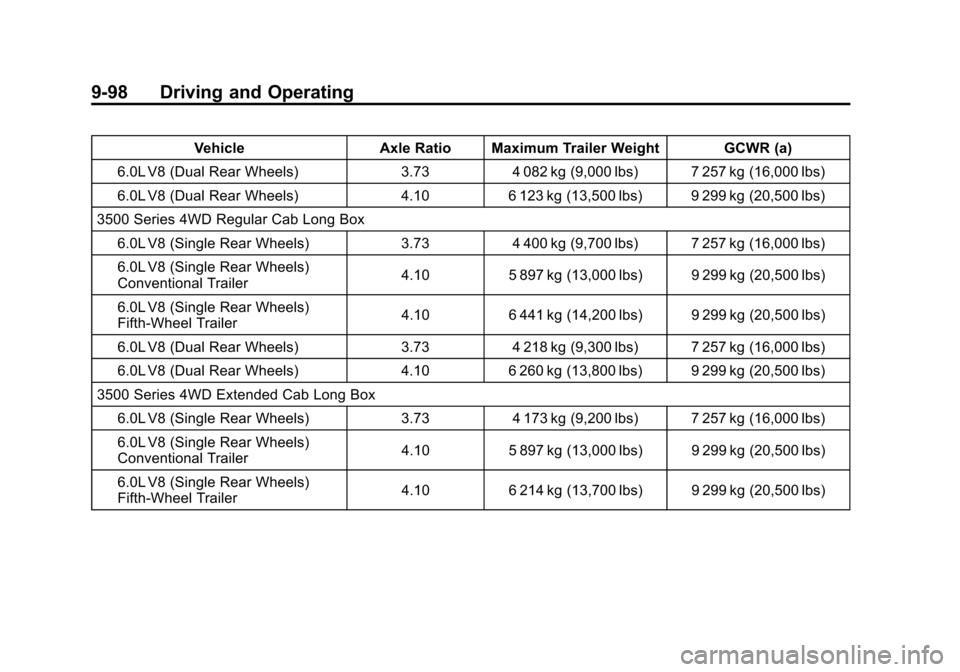
VehicleAxle Ratio Maximum Trailer Weight GCWR (a)
6.0L V8 (Dual Rear Wheels) 3.734 082 kg (9,000 lbs) 7 257 kg (16,000 lbs)
6.0L V8 (Dual Rear Wheels) 4.106 123 kg (13,500 lbs) 9 299 kg (20,500 lbs)
3500 Series 4WD Regular Cab Long Box 6.0L V8 (Single Rear Wheels) 3.734 400 kg (9,700 lbs) 7 257 kg (16,000 lbs)
6.0L V8 (Single Rear Wheels)
Conventional Trailer 4.10
5 897 kg (13,000 lbs) 9 299 kg (20,500 lbs)
6.0L V8 (Single Rear Wheels)
Fifth-Wheel Trailer 4.10
6 441 kg (14,200 lbs) 9 299 kg (20,500 lbs)
6.0L V8 (Dual Rear Wheels) 3.734 218 kg (9,300 lbs) 7 257 kg (16,000 lbs)
6.0L V8 (Dual Rear Wheels) 4.106 260 kg (13,800 lbs) 9 299 kg (20,500 lbs)
3500 Series 4WD Extended Cab Long Box 6.0L V8 (Single Rear Wheels) 3.734 173 kg (9,200 lbs) 7 257 kg (16,000 lbs)
6.0L V8 (Single Rear Wheels)
Conventional Trailer 4.10
5 897 kg (13,000 lbs) 9 299 kg (20,500 lbs)
6.0L V8 (Single Rear Wheels)
Fifth-Wheel Trailer 4.10
6 214 kg (13,700 lbs) 9 299 kg (20,500 lbs)
Page 385 of 584
Black plate (99,1)Chevrolet Silverado Owner Manual - 2012
Driving and Operating 9-99
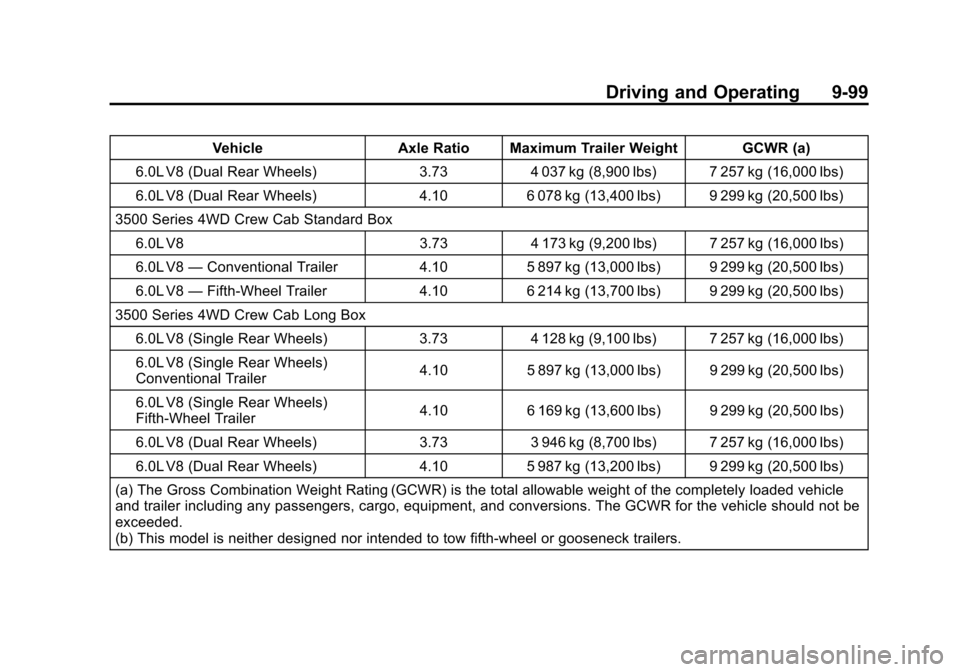
VehicleAxle Ratio Maximum Trailer Weight GCWR (a)
6.0L V8 (Dual Rear Wheels) 3.734 037 kg (8,900 lbs) 7 257 kg (16,000 lbs)
6.0L V8 (Dual Rear Wheels) 4.106 078 kg (13,400 lbs) 9 299 kg (20,500 lbs)
3500 Series 4WD Crew Cab Standard Box 6.0L V8 3.734 173 kg (9,200 lbs) 7 257 kg (16,000 lbs)
6.0L V8 —Conventional Trailer 4.105 897 kg (13,000 lbs) 9 299 kg (20,500 lbs)
6.0L V8 —Fifth-Wheel Trailer 4.106 214 kg (13,700 lbs) 9 299 kg (20,500 lbs)
3500 Series 4WD Crew Cab Long Box 6.0L V8 (Single Rear Wheels) 3.734 128 kg (9,100 lbs) 7 257 kg (16,000 lbs)
6.0L V8 (Single Rear Wheels)
Conventional Trailer 4.10
5 897 kg (13,000 lbs) 9 299 kg (20,500 lbs)
6.0L V8 (Single Rear Wheels)
Fifth-Wheel Trailer 4.10
6 169 kg (13,600 lbs) 9 299 kg (20,500 lbs)
6.0L V8 (Dual Rear Wheels) 3.733 946 kg (8,700 lbs) 7 257 kg (16,000 lbs)
6.0L V8 (Dual Rear Wheels) 4.105 987 kg (13,200 lbs) 9 299 kg (20,500 lbs)
(a) The Gross Combination Weight Rating (GCWR) is the total allowable weight of the completely loaded vehicle
and trailer including any passengers, cargo, equipment, and conversions. The GCWR for the vehicle should not be
exceeded.
(b) This model is neither designed nor intended to tow fifth-wheel or gooseneck trailers.
Page 386 of 584
Black plate (100,1)Chevrolet Silverado Owner Manual - 2012
9-100 Driving and Operating
Ask your dealer for trailering
information or advice, or write us at
our Customer Assistance Offices.
SeeCustomer Assistance Offices
(U.S. and Canada) on page 13‑4 or
Customer Assistance Offices
(Mexico) on page 13‑5 for more
information.Weight of the Trailer Tongue
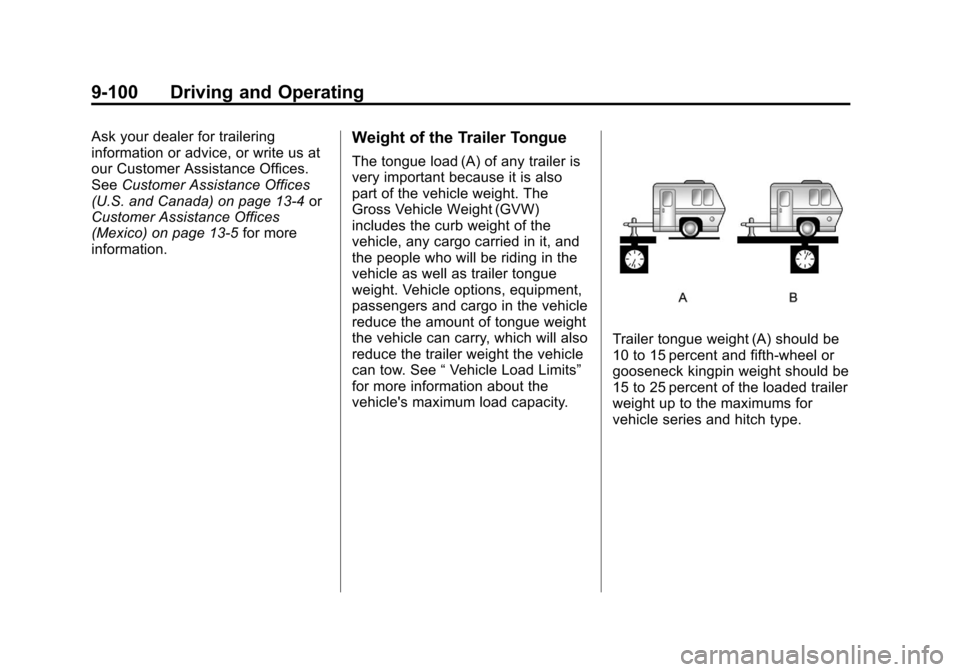
The tongue load (A) of any trailer is
very important because it is also
part of the vehicle weight. The
Gross Vehicle Weight (GVW)
includes the curb weight of the
vehicle, any cargo carried in it, and
the people who will be riding in the
vehicle as well as trailer tongue
weight. Vehicle options, equipment,
passengers and cargo in the vehicle
reduce the amount of tongue weight
the vehicle can carry, which will also
reduce the trailer weight the vehicle
can tow. See “Vehicle Load Limits”
for more information about the
vehicle's maximum load capacity.
Trailer tongue weight (A) should be
10 to 15 percent and fifth-wheel or
gooseneck kingpin weight should be
15 to 25 percent of the loaded trailer
weight up to the maximums for
vehicle series and hitch type.
Page 387 of 584

Black plate (101,1)Chevrolet Silverado Owner Manual - 2012
Driving and Operating 9-101
Vehicle Series Hitch TypeMaximum Tongue
Weight
1500 Weight Carrying 272 kg (600 lbs)
1500 Weight Distributing 499 kg (1,100 lbs)
1500 Fifth-Wheel Gooseneck 680 kg (1,500 lbs)
2500/3500
Standard Box Weight Carrying or
Weight Distributing 680 kg (1,500 lbs)
2500/3500
Long Box Weight Carrying or
Weight Distributing 907 (2,000 lbs)
2500 Fifth-Wheel Gooseneck 1 361 kg (3,000 lbs)
3500 Single Rear
Wheels Fifth-Wheel Gooseneck 1 814 kg (4,000 lbs)
3500 Dual Rear
Wheels Fifth-Wheel Gooseneck 2 495 kg (5,500 lbs)
*816 kg (41,800 lbs) for vehicles built before October, 2011. Check the
hitch rating label for correct maximum for the vehicle. Do not exceed the maximum
allowable tongue weight for the
vehicle. Choose the shortest hitch
extension that will position the hitch
ball closest to the vehicle. This will
help reduce the effect of trailer
tongue weight on the rear axle.
Trailering may be limited by the
vehicle's ability to carry tongue
weight. Tongue or kingpin weight
cannot cause the vehicle to exceed
the GVWR (Gross Vehicle Weight
Rating) or the RGAWR (Rear Gross
Axle Weight Rating). See
“Total
Weight on the Vehicle's Tires” later
in this section for more information.
After loading the trailer, weigh the
trailer and then the tongue,
separately, to see if the weights are
proper. If they are not, adjustments
might be made by moving some
items around in the trailer.
Page 388 of 584

Black plate (102,1)Chevrolet Silverado Owner Manual - 2012
9-102 Driving and Operating
Total Weight on the
Vehicle's Tires
Be sure the vehicle's tires are
inflated to the inflation pressures
found on the Certification Tire label
on the drivers door or seeVehicle
Load Limits on page 9‑17 for more
information. Make sure not to
exceed the GVWR limit for the
vehicle, or the RGAWR, with the
tow vehicle and trailer fully loaded
for the trip including the weight
of the trailer tongue. If using a
weight-distributing hitch, make sure
not to exceed the RGAWR before
applying the weight distribution
spring bars.
Weight of the Trailering
Combination
It is important that the combination
of the tow vehicle and trailer
does not exceed any of its weight
ratings —GCWR, GVWR, RGAWR, Trailer Weight Rating, or Tongue
Weight. The only way to be sure it is
not exceeding any of these ratings
is to weigh the tow vehicle and
trailer combination, fully loaded for
the trip, getting individual weights
for each of these items.
Towing Equipment
Hitches
The correct hitch equipment helps
maintain combination control.
Many trailers can be towed with a
weight-carrying hitch which simply
features a coupler latched to the
hitch ball, or a tow eye latched to a
pintle hook. Other trailers may
require a weight-distributing hitch
that uses spring bars to distribute
the trailer tongue weight among the
two vehicle and trailer axles.
Fifth-wheel and gooseneck hitches
may also be used. See
“Weight of
the Trailer Tongue” underTrailer
Towing on page 9‑86 for rating limits
with various hitch types.
If a step-bumper hitch will be used,
the bumper could be damaged in
sharp turns. Make sure there
is ample room when turning to avoid
contact between the trailer and the
bumper.
Consider using sway controls with
any trailer. Ask a trailering
professional about sway controls or
refer to the trailer manufacturer's
recommendations and instructions.
Page 389 of 584
Black plate (103,1)Chevrolet Silverado Owner Manual - 2012
Driving and Operating 9-103
Weight‐Distributing Hitch
Adjustment
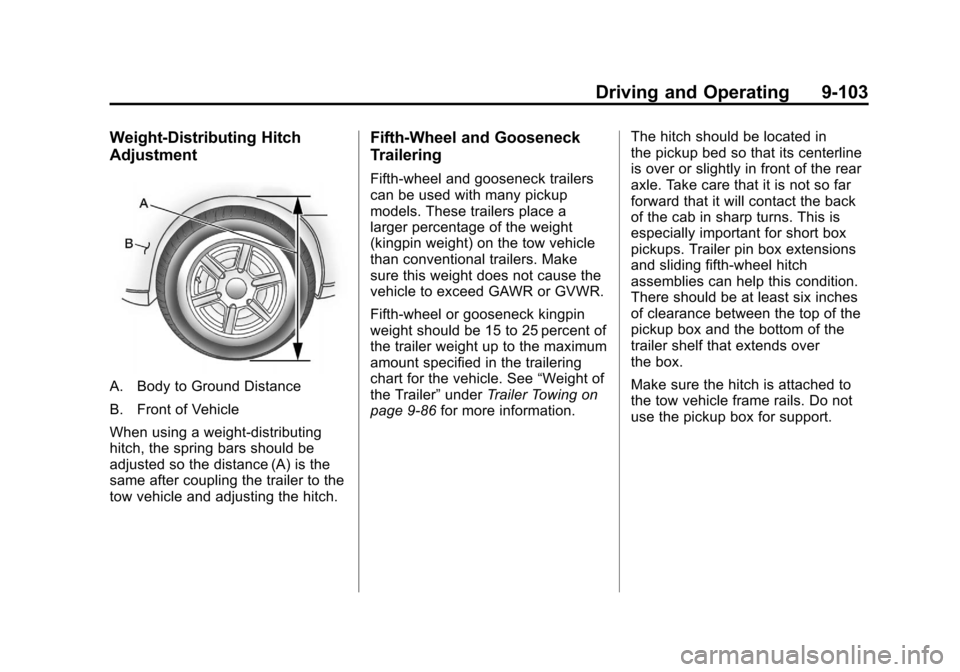
A. Body to Ground Distance
B. Front of Vehicle
When using a weight-distributing
hitch, the spring bars should be
adjusted so the distance (A) is the
same after coupling the trailer to the
tow vehicle and adjusting the hitch.
Fifth-Wheel and Gooseneck
Trailering
Fifth-wheel and gooseneck trailers
can be used with many pickup
models. These trailers place a
larger percentage of the weight
(kingpin weight) on the tow vehicle
than conventional trailers. Make
sure this weight does not cause the
vehicle to exceed GAWR or GVWR.
Fifth-wheel or gooseneck kingpin
weight should be 15 to 25 percent of
the trailer weight up to the maximum
amount specified in the trailering
chart for the vehicle. See“Weight of
the Trailer” underTrailer Towing on
page 9‑86 for more information. The hitch should be located in
the pickup bed so that its centerline
is over or slightly in front of the rear
axle. Take care that it is not so far
forward that it will contact the back
of the cab in sharp turns. This is
especially important for short box
pickups. Trailer pin box extensions
and sliding fifth-wheel hitch
assemblies can help this condition.
There should be at least six inches
of clearance between the top of the
pickup box and the bottom of the
trailer shelf that extends over
the box.
Make sure the hitch is attached to
the tow vehicle frame rails. Do not
use the pickup box for support.
Page 392 of 584
Black plate (106,1)Chevrolet Silverado Owner Manual - 2012
9-106 Driving and Operating
Camper/Fifth-Wheel Trailer
Wiring Package
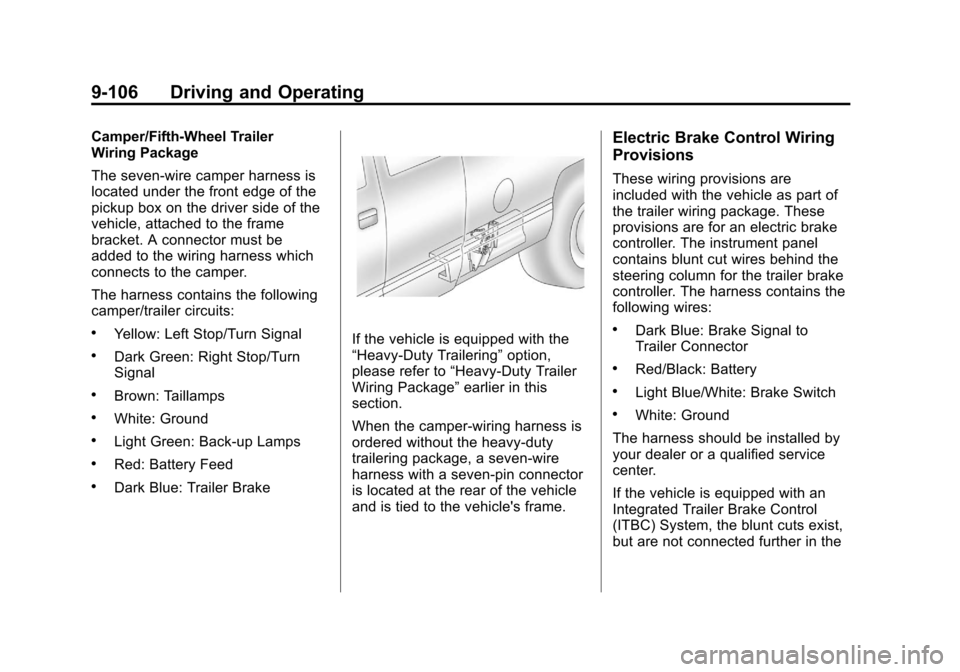
The seven-wire camper harness is
located under the front edge of the
pickup box on the driver side of the
vehicle, attached to the frame
bracket. A connector must be
added to the wiring harness which
connects to the camper.
The harness contains the following
camper/trailer circuits:
.Yellow: Left Stop/Turn Signal
.Dark Green: Right Stop/Turn
Signal
.Brown: Taillamps
.White: Ground
.Light Green: Back-up Lamps
.Red: Battery Feed
.Dark Blue: Trailer Brake
If the vehicle is equipped with the
“Heavy-Duty Trailering”option,
please refer to “Heavy-Duty Trailer
Wiring Package” earlier in this
section.
When the camper-wiring harness is
ordered without the heavy-duty
trailering package, a seven-wire
harness with a seven-pin connector
is located at the rear of the vehicle
and is tied to the vehicle's frame.
Electric Brake Control Wiring
Provisions
These wiring provisions are
included with the vehicle as part of
the trailer wiring package. These
provisions are for an electric brake
controller. The instrument panel
contains blunt cut wires behind the
steering column for the trailer brake
controller. The harness contains the
following wires:
.Dark Blue: Brake Signal to
Trailer Connector
.Red/Black: Battery
.Light Blue/White: Brake Switch
.White: Ground
The harness should be installed by
your dealer or a qualified service
center.
If the vehicle is equipped with an
Integrated Trailer Brake Control
(ITBC) System, the blunt cuts exist,
but are not connected further in the
Page 394 of 584
Black plate (108,1)Chevrolet Silverado Owner Manual - 2012
9-108 Driving and Operating
Integrated Trailer Brake
Control System
The vehicle may have an Integrated
Trailer Brake Control (ITBC) system
for electric trailer brakes.
This symbol is located on the Trailer
Brake Control Panel on vehicles
with an Integrated Trailer Brake
Control system. The power output to
the trailer brakes is based on the
amount of brake pressure being
applied by the vehicle’s brake
system. This available power output
to the trailer brakes can be adjusted
to a wide range of trailering
situations.The ITBC system is integrated
with the vehicle’s brake, antilock
brake, and StabiliTrak (if equipped)
systems. In trailering conditions that
cause the vehicle’s antilock brake or
StabiliTrak systems to activate,
power sent to the trailer's brakes
will be automatically adjusted to
minimize trailer wheel lock-up.
This does not imply that the trailer
has StabiliTrak.
Non-hybrid vehicles with StabiliTrak
have a Trailer Sway Control (TSC)
feature. See
Trailer Sway Control
(TSC) on page 9‑114.
Non-hybrid vehicles with StabiliTrak
have a Hill Start Assist (HSA)
feature. See Hill Start Assist (HSA)
on page 9‑62. If the vehicle’s brake, antilock brake,
or StabiliTrak systems are not
functioning properly, the ITBC
system may not be fully functional
or may not function at all. Make sure
all of these systems are fully
operational to ensure full
functionality of the ITBC system.
The ITBC system is powered
through the vehicle's electrical
system. Turning the ignition off will
also turn off the ITBC system.
The ITBC system is fully functional
only when the ignition is in ON or
in RUN.
The ITBC system can only be used
with trailers with electric brakes.