2012 CHEVROLET MALIBU clock
[x] Cancel search: clockPage 309 of 398
Black plate (69,1)Chevrolet Malibu Owner Manual - 2012
Vehicle Care 10-69
If a tire goes flat, avoid further tire
and wheel damage by driving slowly
to a level place. Turn on the hazard
warning flashers. SeeHazard
Warning Flashers on page 6‑4.
See If a Tire Goes Flat on
page 10‑65 for other important
safety warnings.
Do not remove any objects that
have penetrated the tire.
1. Remove the tire sealant and compressor kit from its storage
location. See Storing the Tire
Sealant and Compressor Kit on
page 10‑73.
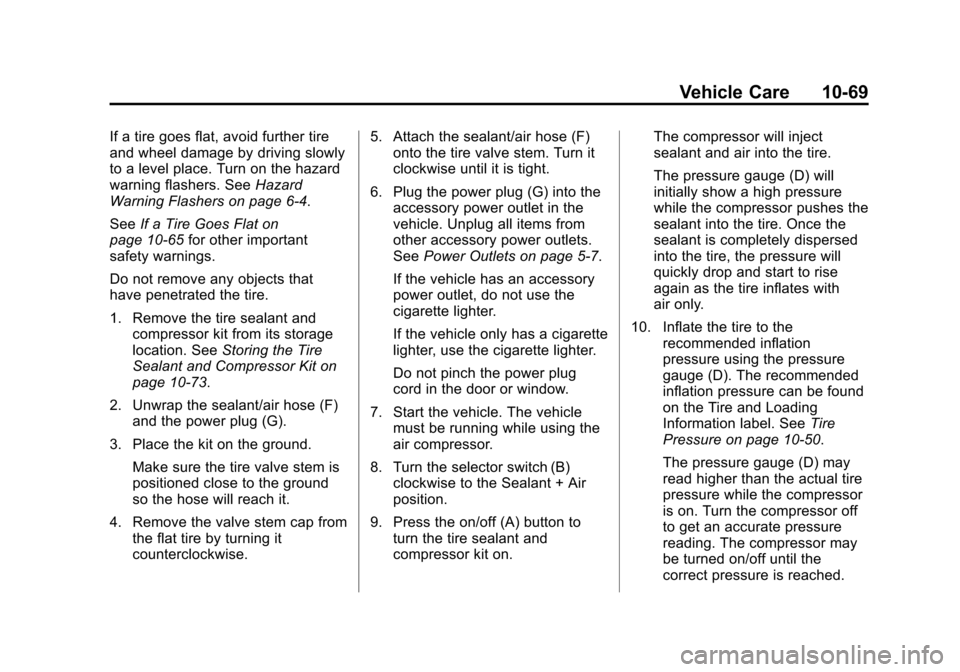
2. Unwrap the sealant/air hose (F) and the power plug (G).
3. Place the kit on the ground. Make sure the tire valve stem is
positioned close to the ground
so the hose will reach it.
4. Remove the valve stem cap from the flat tire by turning it
counterclockwise. 5. Attach the sealant/air hose (F)
onto the tire valve stem. Turn it
clockwise until it is tight.
6. Plug the power plug (G) into the accessory power outlet in the
vehicle. Unplug all items from
other accessory power outlets.
See Power Outlets on page 5‑7.
If the vehicle has an accessory
power outlet, do not use the
cigarette lighter.
If the vehicle only has a cigarette
lighter, use the cigarette lighter.
Do not pinch the power plug
cord in the door or window.
7. Start the vehicle. The vehicle must be running while using the
air compressor.
8. Turn the selector switch (B) clockwise to the Sealant + Air
position.
9. Press the on/off (A) button to turn the tire sealant and
compressor kit on. The compressor will inject
sealant and air into the tire.
The pressure gauge (D) will
initially show a high pressure
while the compressor pushes the
sealant into the tire. Once the
sealant is completely dispersed
into the tire, the pressure will
quickly drop and start to rise
again as the tire inflates with
air only.
10. Inflate the tire to the recommended inflation
pressure using the pressure
gauge (D). The recommended
inflation pressure can be found
on the Tire and Loading
Information label. See Tire
Pressure on page 10‑50.
The pressure gauge (D) may
read higher than the actual tire
pressure while the compressor
is on. Turn the compressor off
to get an accurate pressure
reading. The compressor may
be turned on/off until the
correct pressure is reached.
Page 310 of 398
Black plate (70,1)Chevrolet Malibu Owner Manual - 2012
10-70 Vehicle Care
Notice:If the recommended
pressure cannot be reached after
approximately 25 minutes, the
vehicle should not be driven
farther. The tire is too severely
damaged and the tire sealant and
compressor kit cannot inflate the
tire. Remove the power plug from
the accessory power outlet and
unscrew the inflating hose from
the tire valve. See Roadside
Assistance Program (U.S. and
Canada) on page 13‑7 or
Roadside Assistance Program
(Mexico) on page 13‑10.
11. Press the on/off button (A) to turn the tire sealant and
compressor kit off.
The tire is not sealed and will
continue to leak air until the
vehicle is driven and the
sealant is distributed in the tire;
therefore, Steps 12 through
18 must be done immediately
after Step 11. Be careful while
handling the tire sealant and
compressor kit as it could be
warm after usage. 12. Unplug the power plug (G) from
the accessory power outlet in
the vehicle.
13. Turn the sealant/air hose (F) counterclockwise to remove it
from the tire valve stem.
14. Replace the tire valve stem cap.
15. Return the sealant/air hose (F) and the power plug (G) back in
their original locations.
16. If the flat tire was able toinflate to the recommended
inflation pressure, remove the
maximum speed label from the
sealant canister and place it in
a highly visible location. Do not
exceed the speed on this label
until the damaged tire is
repaired or replaced. 17. Return the equipment to its
original storage location in the
vehicle.
18. Immediately drive the vehicle 8 km (5 mi) to distribute the
sealant in the tire.
19. Stop at a safe location and check the tire pressure.
Refer to Steps 1 through 11
under “Using the Tire Sealant
and Compressor Kit without
Sealant to Inflate a Tire
(Not Punctured).”
If the tire pressure has fallen
more than 68 kPa (10 psi)
below the recommended
inflation pressure, stop driving
the vehicle. The tire is too
severely damaged and the tire
sealant cannot seal the tire.
See Roadside Assistance
Program (U.S. and Canada) on
page 13‑7 orRoadside
Assistance Program (Mexico)
on page 13‑10.
Page 311 of 398
Black plate (71,1)Chevrolet Malibu Owner Manual - 2012
Vehicle Care 10-71
If the tire pressure has not
dropped more than 68 kPa
(10 psi) from the recommended
inflation pressure, use the
compressor kit to inflate the tire
to the recommended inflation
pressure.
20. Wipe off any sealant from the wheel, tire, and vehicle.
21. Dispose of the used sealant canister and sealant/air
hose (F) assembly at a local
dealer or in accordance with
local state codes and practices.
22. Replace it with a new canister available from your dealer.
23. After temporarily sealing a tire using the tire sealant and
compressor kit, take the
vehicle to an authorized dealer
within 161 km (100 mi) of
driving to have the tire repaired
or replaced.Using the Tire Sealant and
Compressor Kit without
Sealant to Inflate a Tire
(Not Punctured)
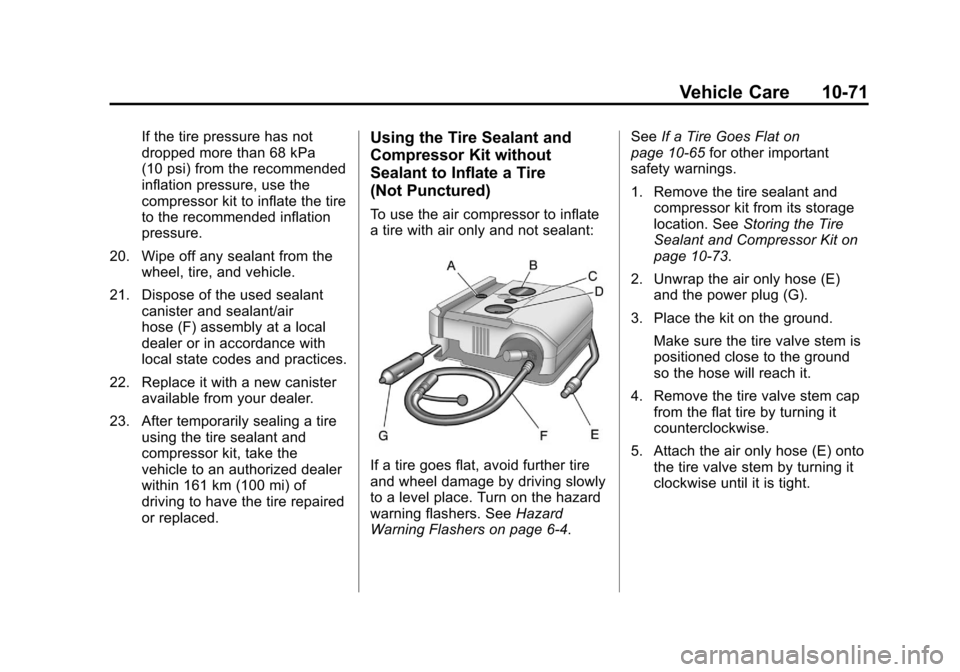
To use the air compressor to inflate
a tire with air only and not sealant:
If a tire goes flat, avoid further tire
and wheel damage by driving slowly
to a level place. Turn on the hazard
warning flashers. See Hazard
Warning Flashers on page 6‑4. See
If a Tire Goes Flat on
page 10‑65 for other important
safety warnings.
1. Remove the tire sealant and compressor kit from its storage
location. See Storing the Tire
Sealant and Compressor Kit on
page 10‑73.
2. Unwrap the air only hose (E) and the power plug (G).
3. Place the kit on the ground. Make sure the tire valve stem is
positioned close to the ground
so the hose will reach it.
4. Remove the tire valve stem cap from the flat tire by turning it
counterclockwise.
5. Attach the air only hose (E) onto the tire valve stem by turning it
clockwise until it is tight.
Page 312 of 398

Black plate (72,1)Chevrolet Malibu Owner Manual - 2012
10-72 Vehicle Care
6. Plug the power plug (G) into theaccessory power outlet in the
vehicle. Unplug all items from
other accessory power outlets.
See Power Outlets on page 5‑7.
If the vehicle has an accessory
power outlet, do not use the
cigarette lighter.
If the vehicle only has a cigarette
lighter, use the cigarette lighter.
Do not pinch the power plug
cord in the door or window.
7. Start the vehicle. The vehicle must be running while using the
air compressor.
8. Turn the selector switch (B) counterclockwise to the Air Only
position.
9. Press the on/off (A) button to turn the compressor on.
The compressor will inflate the
tire with air only. 10. Inflate the tire to the
recommended inflation
pressure using the pressure
gauge (D). The recommended
inflation pressure can be found
on the Tire and Loading
Information label. See Tire
Pressure on page 10‑50.
The pressure gauge (D) may
read higher than the actual tire
pressure while the compressor
is on. Turn the compressor off
to get an accurate reading.
The compressor may be turned
on/off until the correct pressure
is reached. If the tire is inflated
higher than the recommended
pressure, press the pressure
relief button (C), if equipped,
until the proper pressure
reading is reached. This option
is only functional when using
the air only hose (E). 11. Press the on/off button (A) to
turn the tire sealant and
compressor kit off.
Be careful while handling the
tire sealant and compressor kit
as it could be warm after
usage.
12. Unplug the power plug (G) from the accessory power outlet in
the vehicle.
13. Disconnect the air only hose (E) from the tire valve
stem, by turning it
counterclockwise, and replace
the tire valve stem cap.
14. Return the air only hose (E) and the power plug (G) back to
their original locations.
15. Return the equipment to its original storage location in the
vehicle.
Page 313 of 398
Black plate (73,1)Chevrolet Malibu Owner Manual - 2012
Vehicle Care 10-73
Removal and Installation of the
Sealant Canister
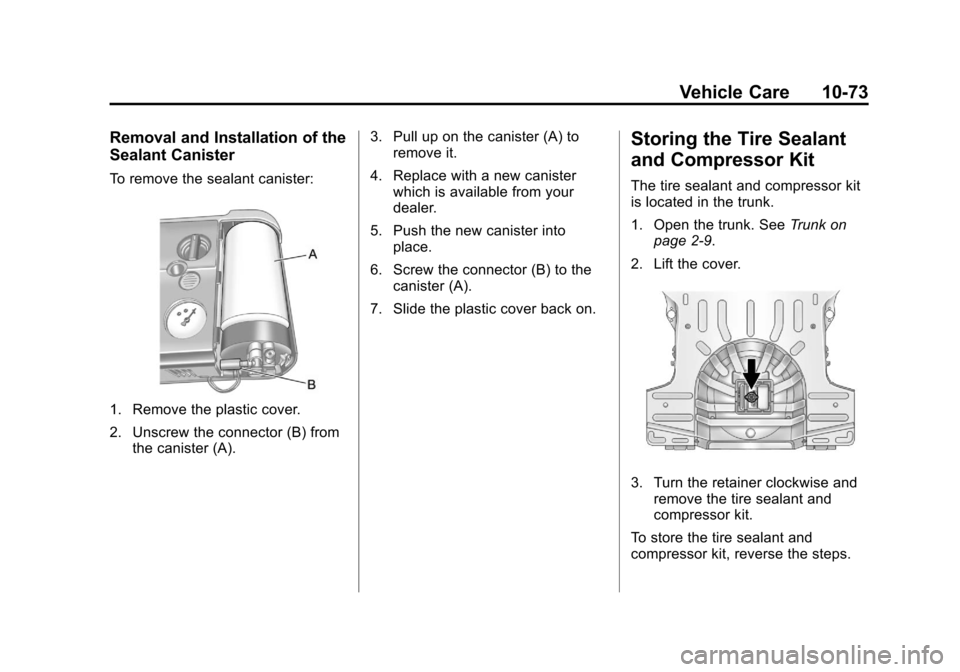
To remove the sealant canister:
1. Remove the plastic cover.
2. Unscrew the connector (B) fromthe canister (A). 3. Pull up on the canister (A) to
remove it.
4. Replace with a new canister which is available from your
dealer.
5. Push the new canister into place.
6. Screw the connector (B) to the canister (A).
7. Slide the plastic cover back on.
Storing the Tire Sealant
and Compressor Kit
The tire sealant and compressor kit
is located in the trunk.
1. Open the trunk. See Trunk on
page 2‑9.
2. Lift the cover.
3. Turn the retainer clockwise and remove the tire sealant and
compressor kit.
To store the tire sealant and
compressor kit, reverse the steps.
Page 314 of 398
Black plate (74,1)Chevrolet Malibu Owner Manual - 2012
10-74 Vehicle Care
Tire Changing
Removing the Spare Tire
and Tools
The equipment you will need is in
the trunk.
1. Open the trunk. SeeTrunk on
page 2‑9 for more information.
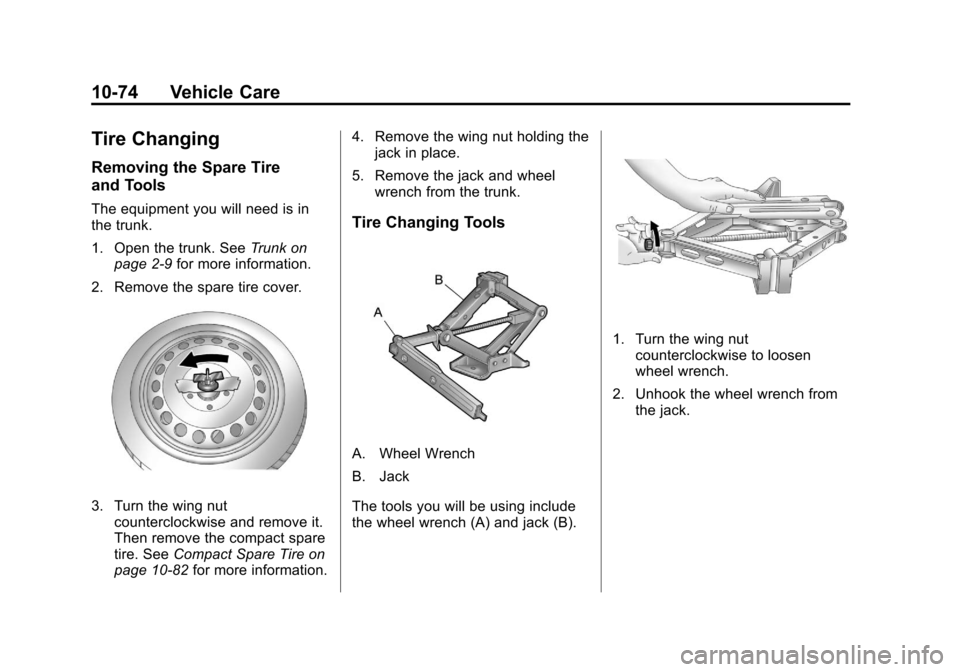
2. Remove the spare tire cover.
3. Turn the wing nut counterclockwise and remove it.
Then remove the compact spare
tire. See Compact Spare Tire on
page 10‑82 for more information. 4. Remove the wing nut holding the
jack in place.
5. Remove the jack and wheel wrench from the trunk.
Tire Changing Tools
A. Wheel Wrench
B. Jack
The tools you will be using include
the wheel wrench (A) and jack (B).
1. Turn the wing nutcounterclockwise to loosen
wheel wrench.
2. Unhook the wheel wrench from the jack.
Page 316 of 398
Black plate (76,1)Chevrolet Malibu Owner Manual - 2012
10-76 Vehicle Care
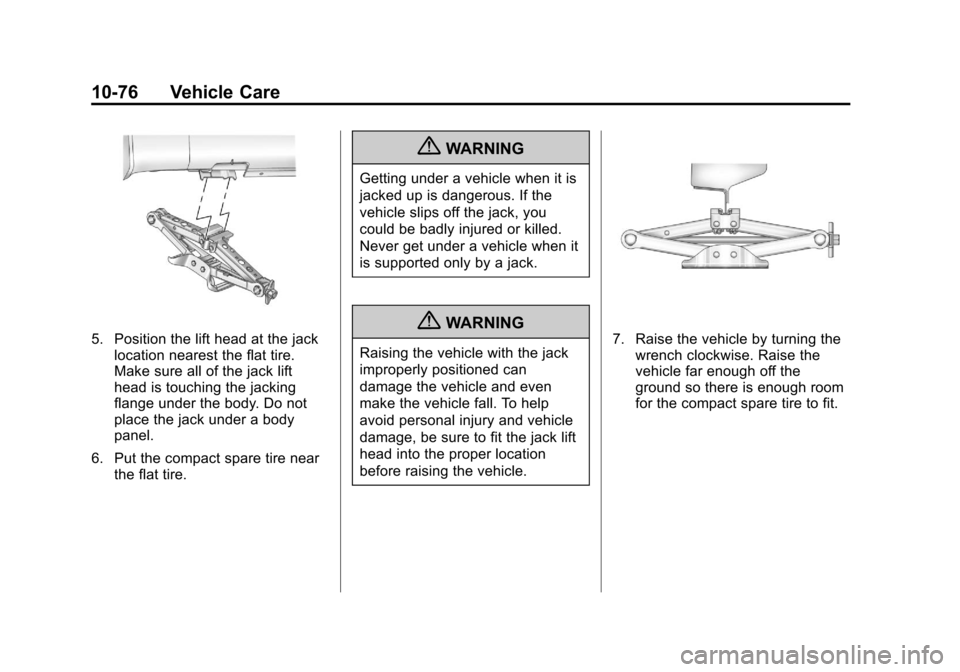
5. Position the lift head at the jacklocation nearest the flat tire.
Make sure all of the jack lift
head is touching the jacking
flange under the body. Do not
place the jack under a body
panel.
6. Put the compact spare tire near the flat tire.
{WARNING
Getting under a vehicle when it is
jacked up is dangerous. If the
vehicle slips off the jack, you
could be badly injured or killed.
Never get under a vehicle when it
is supported only by a jack.
{WARNING
Raising the vehicle with the jack
improperly positioned can
damage the vehicle and even
make the vehicle fall. To help
avoid personal injury and vehicle
damage, be sure to fit the jack lift
head into the proper location
before raising the vehicle.7. Raise the vehicle by turning thewrench clockwise. Raise the
vehicle far enough off the
ground so there is enough room
for the compact spare tire to fit.
Page 318 of 398
Black plate (78,1)Chevrolet Malibu Owner Manual - 2012
10-78 Vehicle Care
12. Put the wheel nuts back onwith the rounded end toward
the wheel. Tighten each nut by
hand or with the wrench until
the wheel is held against
the hub.
13. Lower the vehicle by turningthe wrench counterclockwise.
Lower the jack completely.
{WARNING
Wheel nuts that are improperly or
incorrectly tightened can cause
the wheels to become loose or
come off. The wheel nuts should
be tightened with a torque wrench
to the proper torque specification
after replacing. Follow the torque
specification supplied by the
aftermarket manufacturer when
using accessory locking wheel
nuts. See Capacities and
Specifications on page 12‑2 for
original equipment wheel nut
torque specifications.
Notice: Improperly tightened
wheel nuts can lead to brake
pulsation and rotor damage.
To avoid expensive brake repairs,
evenly tighten the wheel nuts in
the proper sequence and to the
proper torque specification.
See Capacities and Specifications
on page 12‑2 for the wheel nut
torque specification.
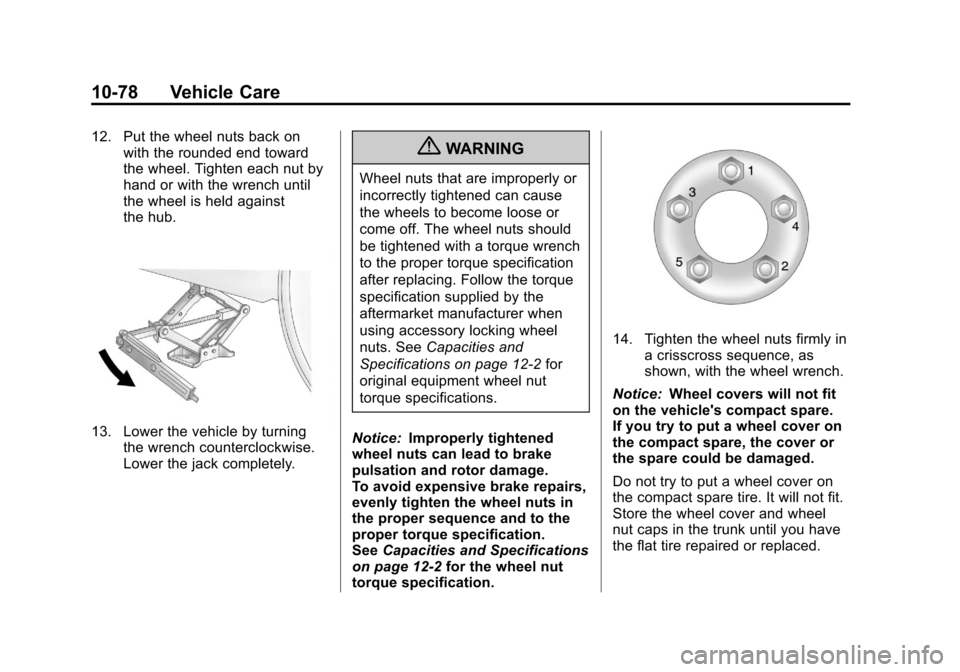
14. Tighten the wheel nuts firmly in a crisscross sequence, as
shown, with the wheel wrench.
Notice: Wheel covers will not fit
on the vehicle's compact spare.
If you try to put a wheel cover on
the compact spare, the cover or
the spare could be damaged.
Do not try to put a wheel cover on
the compact spare tire. It will not fit.
Store the wheel cover and wheel
nut caps in the trunk until you have
the flat tire repaired or replaced.