2012 CHEVROLET MALIBU air condition
[x] Cancel search: air conditionPage 185 of 398
Black plate (3,1)Chevrolet Malibu Owner Manual - 2012
Climate Controls 8-3
If the air-conditioning button is
pressed while in defrost mode, the
indicator light turns on. If the button
is pressed again, the light turns off.
Recirculation cannot be selected
while in the defrost mode.
To help clear the windshield quickly,
do the following:
1. Select
0.
2. Select the highest temperature.
3. Select the highest fan speed.
#(Air Conditioning): Press to
turn the air conditioning system on
or off. An indicator light comes on to
show it is on.
The air-conditioning system
removes moisture from the air, so a
small amount of water might drip
under the vehicle while it is idling or
after the engine is turned off is
normal.
Maximum Air Conditioning
On hot days, open the windows to
let hot inside air escape; then close
them. This helps reduce the time it
takes for the vehicle to cool down.
It also helps the air conditioning
system operate more efficiently.
For quick cool down on hot days,
do the following:
1. Select the
Cvent mode.
2. Select the highest fan speed.
3. Select
#air conditioning.
4. Select the
?
recirculation mode.
5. Select the coolest temperature.
Using these settings together for
long periods of time can cause the
air inside of the vehicle to become
too dry. To prevent this from
happening, after the air in the
vehicle has cooled, turn the
recirculation mode off.
:(Outside Air): Press to
turn the outside air mode on.
An indicator light comes on to
show that it is on. Air from outside
the vehicle will circulate throughout
the vehicle. The outside air mode
can be used with all modes,
but it cannot be used with the
recirculation mode. Press
:to
cancel the recirculation mode.
?(Recirculation): Press to
turn the recirculation mode on.
An indicator light comes on to show
that it is on. This mode recirculates
and helps to quickly cool the air
inside the vehicle. It can be used
to prevent outside air and odors
from entering the vehicle.
The recirculation indicator light
blinks three times if you try to use
recirculation in a mode in which it
cannot function.
Pressing this button cancels the
outside air mode. When switching
to the defog or defrost modes
the system automatically moves
from recirculation to outside air.
Page 187 of 398
Black plate (5,1)Chevrolet Malibu Owner Manual - 2012
Climate Controls 8-5
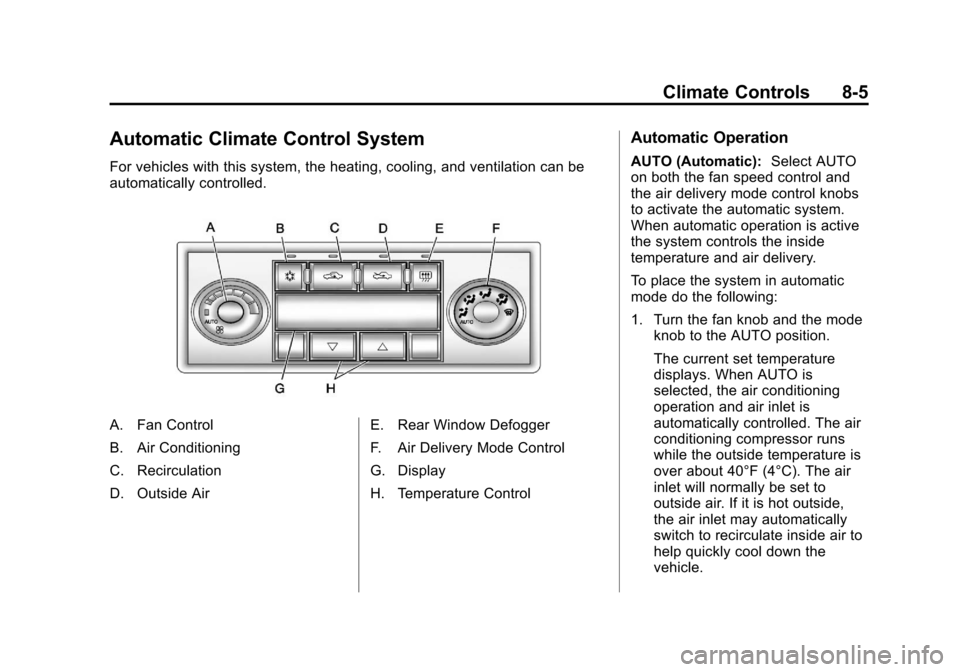
Automatic Climate Control System
For vehicles with this system, the heating, cooling, and ventilation can be
automatically controlled.
A. Fan Control
B. Air Conditioning
C. Recirculation
D. Outside AirE. Rear Window Defogger
F. Air Delivery Mode Control
G. Display
H. Temperature Control
Automatic Operation
AUTO (Automatic):
Select AUTO
on both the fan speed control and
the air delivery mode control knobs
to activate the automatic system.
When automatic operation is active
the system controls the inside
temperature and air delivery.
To place the system in automatic
mode do the following:
1. Turn the fan knob and the mode knob to the AUTO position.
The current set temperature
displays. When AUTO is
selected, the air conditioning
operation and air inlet is
automatically controlled. The air
conditioning compressor runs
while the outside temperature is
over about 40°F (4°C). The air
inlet will normally be set to
outside air. If it is hot outside,
the air inlet may automatically
switch to recirculate inside air to
help quickly cool down the
vehicle.
Page 189 of 398

Black plate (7,1)Chevrolet Malibu Owner Manual - 2012
Climate Controls 8-7
Select from the following:
H(Vent):Air is directed to the
instrument panel outlets.
)(Bi-Level): Air is divided
between the instrument panel
outlets and the floor outlets.
6(Floor): Air is directed to the
floor outlets with some air directed
to the side window outlets.
-(Defog): This mode clears the
windows of fog or moisture. Air is
directed to the floor and windshield
outlets.
0(Defrost): This mode clears the
windows of fog or frost more quickly.
The system automatically controls
the fan speed if defrost is selected
from the AUTO mode. If the outside
temperature is 4°C (40°F) or
warmer, the air conditioning
compressor automatically runs to
help dehumidify the air and dry the
windshield. The air conditioning
indicator light blinks three times if
the compressor is turned off while
in this mode.
#(Air Conditioning): Press turn
the air conditioning on and off.
An indicator light turns on to show
the air conditioning is on.
When air conditioning is selected or
is in AUTO mode, the system runs
the air conditioning automatically to
cool and dehumidify the air entering
the vehicle.
On hot days, open the windows long
enough to let hot inside air escape.
This reduces the time it takes for the
vehicle to cool down. Then keep
the windows closed for the air
conditioner to work its best.
On cool, but sunny days while using
manual operation of the automatic
system, use bi-level to deliver warm
air to the floor and cooler air to the
instrument panel outlets. To warm or
cool the air delivered, press the
temperature buttons to the desired
setting. In AUTO mode the system cools
and dehumidifies the air inside
the vehicle. Also while in AUTO
mode, the system maximizes its
performance by using recirculation
as necessary.
Heating:
On cold days when using
manual operation of the automatic
system, use floor mode to deliver air
to the floor outlets. To warm or cool
the air delivered, press
xorwto
the desired temperature setting.
To use the automatic mode, turn the
knob to AUTO and press
xorwto
adjust the temperature.
:(Outside Air): Press to
turn the outside air mode on.
An indicator light comes on to show
it is on. Air from outside the vehicle
will circulate throughout the vehicle.
The outside air mode can be used
with all modes, but it cannot be
used with the recirculation mode.
Pressing this button cancels the
recirculation mode.
Page 190 of 398
Black plate (8,1)Chevrolet Malibu Owner Manual - 2012
8-8 Climate Controls
h(Recirculation):Press to
turn the recirculation mode on.
An indicator light above the
button comes on to show it is on.
This mode recirculates and helps
to quickly cool the air inside the
vehicle. It can be used to help
prevent outside air and odors
from entering the vehicle.
The recirculation indicator light
blinks three times if you try to use
recirculation in a mode in which it
cannot function.
Pressing this button cancels the
auto recirculation feature. Each time
the vehicle is started, the system
reverts to the auto recirculation
function.
The recirculation mode cannot be
used with the floor, defrost, or defog
modes. If recirculation is selected in
these modes, the indicator flashes
three times and turns off to indicate
that this is not allowed. This is to
prevent window fogging. When the weather is cool or damp,
operating the system in recirculation
for extended periods of time can
cause fogging of the vehicle's
windows. To clear the fog, select
either defog or defrost. Make sure
the air conditioning is on. Allow the
air conditioning to run automatically
to help dehumidify the air.
To improve fuel efficiency and to
cool the vehicle faster, recirculation
may be automatically selected in
warm weather. The recirculation
light will not come on. To override
this feature, select outside air.
Rear Window Defogger
The rear window defogger uses a
warming grid to remove fog from the
rear window.
1(Rear):
Press to turn the
rear window defogger on or off.
An indicator light comes on to show
that the rear window defogger is on. If driving below 80 km/h (50 mph),
the rear window defogger turns off
about 15 minutes after the button is
pressed. If additional warming time
is needed, press the button again.
If the vehicle's speed is maintained
above 80 km/h (50 mph), the rear
window defogger remains on once
the button is pressed.
For vehicles with heated outside
mirrors, the surface of the outside
mirrors will also heat when the rear
window defogger is activated.
See
Heated Mirrors on page 2‑14.
Notice: Do not use a razor blade
or sharp object to clear the inside
rear window. Do not adhere
anything to the defogger grid
lines in the rear glass. These
actions may damage the rear
defogger. Repairs would not be
covered by your warranty.
Page 201 of 398
Black plate (9,1)Chevrolet Malibu Owner Manual - 2012
Driving and Operating 9-9
TheAntilock Brake System (ABS)
on page 9‑28 improves vehicle
stability during hard stops on
slippery roads, but apply the brakes
sooner than when on dry pavement.
Allow greater following distance on
any slippery road and watch for
slippery spots. Icy patches can
occur on otherwise clear roads in
shaded areas. The surface of a
curve or an overpass can remain icy
when the surrounding roads are
clear. Avoid sudden steering
maneuvers and braking while
on ice.
Turn off cruise control on slippery
surfaces.
Blizzard Conditions
Being stuck in snow can be a
serious situation. Stay with the
vehicle unless there is help nearby.
If possible, use the Roadside
Assistance Program (U.S. and
Canada) on page 13‑7 orRoadside Assistance Program (Mexico) on
page 13‑10. To get help and keep
everyone in the vehicle safe:
.Turn on the hazard warning
flashers.
.Tie a red cloth to an outside
mirror.
{WARNING
Snow can trap engine exhaust
under the vehicle. This may
cause exhaust gases to get
inside. Engine exhaust contains
carbon monoxide (CO) which
cannot be seen or smelled. It can
cause unconsciousness and even
death.
If the vehicle is stuck in the snow:
.Clear away snow from around
the base of your vehicle,
especially any that is blocking
the exhaust pipe.
(Continued)
WARNING (Continued)
.Check again from time to
time to be sure snow does
not collect there.
.Open a window about 5 cm
(2 in) on the side of the
vehicle that is away from the
wind to bring in fresh air.
.Fully open the air outlets
on or under the instrument
panel.
.Adjust the climate control
system to a setting that
circulates the air inside the
vehicle and set the fan
speed to the highest setting.
See“Climate Control System”
in the Index.
For more information about
carbon monoxide, see Engine
Exhaust on page 9‑23.
Page 212 of 398
Black plate (20,1)Chevrolet Malibu Owner Manual - 2012
9-20 Driving and Operating
Engine Heater
The engine coolant heater can
provide easier starting and better
fuel economy during engine
warm‐up in cold weather conditions
at or below−18°C (0°F). Vehicles
with an engine coolant heater
should be plugged in at least four
hours before starting the vehicle.
An internal thermostat in the
plug-end of the cord may exist
which will prevent engine coolant
heater operation at temperatures
above −18°C (0°F).
To Use the Engine Coolant
Heater
1. Turn off the engine.
2. Open the hood and unwrap the
electrical cord. With a 4 cylinder
engine, the engine coolant
heater cord is located near the
air cleaner box on the passenger
side of the engine compartment.
With a V6 engine, the engine
coolant heater cord is located
on the driver side around the
battery box. See Engine
Compartment Overview on
page 10‑6 for more information
on location.
{WARNING
Plugging the cord into an
ungrounded outlet could cause an
electrical shock. Also, the wrong
kind of extension cord could
overheat and cause a fire.
(Continued)
WARNING (Continued)
You could be seriously injured.
Plug the cord into a properly
grounded three-prong 110-volt AC
outlet. If the cord will not reach,
use a heavy-duty three-prong
extension cord rated for at least
15 amps.
3. Plug the cord into a normal, grounded 110-volt AC outlet.
4. Before starting the engine, be sure to unplug and store the
cord as it was before to keep it
away from moving engine parts
and prevent damage.
The length of time the heater should
remain plugged in depends on
several factors. Ask a dealer in the
area where you will be parking the
vehicle for the best advice on this.
Page 223 of 398
Black plate (31,1)Chevrolet Malibu Owner Manual - 2012
Driving and Operating 9-31
The traction off light comes on and
the DIC will display the appropriate
message as described previously
when the button is pressed.
Traction Control Operation
Traction control limits wheel spin by
reducing engine power to the
wheels (engine speed management)
and by applying brakes to each
individual wheel (brake-traction
control) as necessary.
The traction control system is
enabled automatically when the
vehicle is started, and it will activate
and flash the ESC/TCS light and
display the LOW TRACTION
message if it senses either of the
front wheels are spinning or
beginning to lose traction while
driving. For more information on theLOW TRACTION message, see
Ride Control System Messages on
page 5‑28.
Notice:
If the wheel(s) of one axle
are allowed to spin excessively
while the ESC/TCS, ABS and
Brake warning lights and the
SERVICE ESC and/or SERVICE
TRACTION messages are
displayed, the differential could
be damaged. The repairs would
not be covered by the vehicle
warranty. Reduce engine power
and do not spin the wheel(s)
excessively while these lights and
this message are displayed.
Notice: When traction control is
turned off, it is possible to lose
traction. If you attempt to shift
with the front wheels spinning
with a loss of traction, it is
possible to cause damage to the
transmission. Do not attempt to
shift when the front wheels do not
have traction. Damage caused by
misuse of the vehicle is not
covered. See your warranty book
for additional information. The traction control system may
activate on dry or rough roads or
under conditions such as heavy
acceleration while turning or
abrupt upshifts/downshifts of the
transmission. When this happens,
a reduction in acceleration may be
noticed, or a noise or vibration may
be heard. This is normal.
If the vehicle is in cruise control
when the system activates, the
ESC/TCS light will flash and the
cruise control will automatically
disengage. The cruise control
may be re-engaged when road
conditions allow. See
Cruise Control
on page 9‑33.
Adding non‐dealer accessories can
affect the vehicle's performance.
See Accessories and Modifications
on page 10‑3 for more information.
Page 229 of 398
Black plate (37,1)Chevrolet Malibu Owner Manual - 2012
Driving and Operating 9-37
If this occurs, use a gasoline rated
at 87 octane or higher as soon as
possible. If heavy knocking is heard
when using gasoline rated at
87 octane or higher, the engine
needs service.
Gasoline Specifications
(U.S. and Canada Only)
At a minimum, gasoline should
meet ASTM specification
D 4814 in the United States or
CAN/CGSB‐3.5 or 3.511 in Canada.
Some gasolines contain an
octane-enhancing additive called
methylcyclopentadienyl manganese
tricarbonyl (MMT). We recommend
against the use of gasolines
containing MMT. SeeFuel Additives
on page 9‑37 for additional
information.
California Fuel
Requirements
If the vehicle is certified to meet
California Emissions Standards, it is
designed to operate on fuels that
meet California specifications.
See the underhood emission control
label. If this fuel is not available in
states adopting California Emissions
Standards, the vehicle will operate
satisfactorily on fuels meeting
federal specifications, but emission
control system performance might
be affected. The malfunction
indicator lamp could turn on and the
vehicle might fail a smog‐check test.
See Malfunction Indicator Lamp on
page 5‑16. If this occurs, return to
your authorized dealer for diagnosis.
If it is determined that the condition
is caused by the type of fuel used,
repairs might not be covered by the
vehicle warranty.
Fuels in Foreign
Countries
Never use leaded gasoline or any
other fuel not recommended in the
previous text on fuel. Costly repairs
caused by use of improper fuel
would not be covered by the vehicle
warranty.
To check the fuel availability, ask an
auto club, or contact a major oil
company that does business in the
country where you will be driving.
Fuel Additives
To provide cleaner air, all gasolines
in the United States are now
required to contain additives that
help prevent engine and fuel system
deposits from forming, allowing the
emission control system to work
properly. In most cases, nothing
should have to be added to the fuel.