Page 328 of 430
Black plate (64,1)Chevrolet Express Owner Manual - 2012
10-64 Vehicle Care
Dual Tire Rotation
When the vehicle is new,
or whenever a wheel, wheel bolt,
or wheel nut is replaced, check
the wheel nut torque after
160, 1 600, and 10 000 km
(100, 1,000, and 6,000 mi) of driving.
For proper wheel nut tightening
information, see“Removing the Flat
Tire and Installing the Spare Tire”
later in this section, under If a Tire
Goes Flat on page 10‑72. Also see
“Wheel Nut Torque” under
Capacities and Specifications on
page 12‑2.
The outer tire on a dual wheel setup
generally wears faster than the
inner tire. Tires last longer and wear
more evenly if they are rotated. See
Tire Inspection on page 10‑62 and
Tire Rotation on page 10‑62. Also
see Maintenance Schedule on
page 11‑3.{WARNING
If the vehicle is operated with a
tire that is underinflated, the tire
can overheat. An overheated tire
can lose air suddenly or catch
fire. You or others could be
injured. Properly inflate all tires,
including the spare.
See Tires on page 10‑49 andTire
Pressure on page 10‑56 for more
information on proper tire inflation.
When It Is Time for
New Tires
Factors such as maintenance,
temperatures, driving speeds,
vehicle loading, and road conditions
affect the wear rate of the tires.
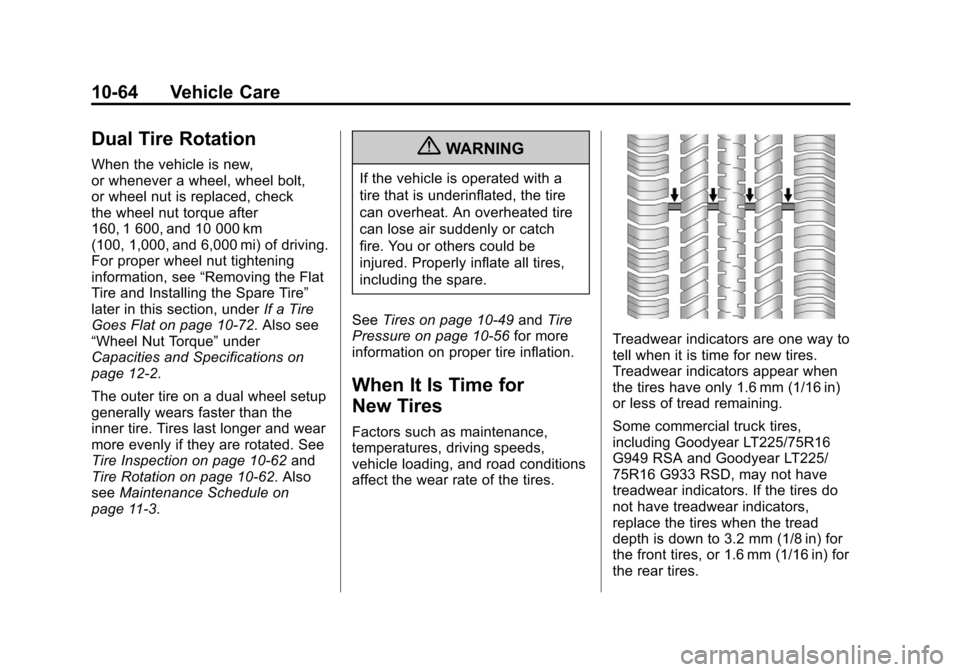
Treadwear indicators are one way to
tell when it is time for new tires.
Treadwear indicators appear when
the tires have only 1.6 mm (1/16 in)
or less of tread remaining.
Some commercial truck tires,
including Goodyear LT225/75R16
G949 RSA and Goodyear LT225/
75R16 G933 RSD, may not have
treadwear indicators. If the tires do
not have treadwear indicators,
replace the tires when the tread
depth is down to 3.2 mm (1/8 in) for
the front tires, or 1.6 mm (1/16 in) for
the rear tires.
Page 329 of 430
Black plate (65,1)Chevrolet Express Owner Manual - 2012
Vehicle Care 10-65
SeeTire Inspection on page 10‑62
and Tire Rotation on page 10‑62 for
additional information.
The rubber in tires ages over time.
This also applies to the spare tire,
if the vehicle has one, even if it is
never used. Multiple conditions
including temperatures, loading
conditions, and inflation pressure
maintenance affect how fast aging
takes place. Tires will typically need
to be replaced due to wear before
they may need to be replaced
due to age. Consult the tire
manufacturer for more information
on when tires should be replaced.
Vehicle Storage
Tires age when stored normally
mounted on a parked vehicle. Park
a vehicle that will be stored for at
least a month in a cool, dry, clean
area away from direct sunlight to
slow aging. This area should be
free of grease, gasoline or other
substances that can deteriorate
rubber. Parking for an extended period can
cause flat spots on the tires that
may result in vibrations while
driving. When storing a vehicle for
at least a month, remove the tires or
raise the vehicle to reduce the
weight from the tires.
Buying New Tires
GM has developed and matched
specific tires for the vehicle.
The original equipment tires
installed were designed to meet
General Motors Tire Performance
Criteria Specification (TPC Spec)
system rating. When replacement
tires are needed, GM strongly
recommends buying tires with the
same TPC Spec rating.
GM's exclusive TPC Spec system
considers over a dozen critical
specifications that impact the
overall performance of the
vehicle, including brake system
performance, ride and handling,
traction control, and tire pressure
monitoring performance.
GM's TPC Spec number is molded
onto the tire's sidewall near the tire
size. If the tires have an all‐season
tread design, the TPC Spec number
will be followed by MS for mud and
snow. See
Tire Sidewall Labeling on
page 10‑50 for additional
information.
Page 330 of 430

Black plate (66,1)Chevrolet Express Owner Manual - 2012
10-66 Vehicle Care
GM recommends replacing all the
tires at the same time. Uniform tread
depth on all tires will help to
maintain the performance of the
vehicle. Braking and handling
performance may be adversely
affected if all the tires are not
replaced at the same time. SeeTire
Inspection on page 10‑62 andTire
Rotation on page 10‑62 for
information on proper tire rotation.
{WARNING
Tires could explode during
improper service. Attempting
to mount or dismount a tire
could cause injury or death.
Only your dealer or authorized
tire service center should
mount or dismount the tires.
{WARNING
Mixing tires of different sizes,
brands, or types may cause loss
of control of the vehicle, resulting
in a crash or other vehicle
damage. Use the correct size,
brand, and type of tires on all
wheels.
This vehicle may have a different
size spare than the road tires
originally installed on the vehicle.
When new, the vehicle included a
spare tire and wheel assembly
with a similar overall diameter as
the road tires and wheels, so it is
all right to drive on it. The spare
tire was developed for use on this
vehicle and will not affect vehicle
handling.
{WARNING
Using bias-ply tires on the
vehicle may cause the wheel
rim flanges to develop cracks
after many miles of driving.
A tire and/or wheel could fail
suddenly and cause a crash.
Use only radial-ply tires with
the wheels on the vehicle.
If the vehicle tires must be replaced
with a tire that does not have a TPC
Spec number, make sure they are
the same size, load range, speed
rating, and construction (radial) as
the original tires.
Page 332 of 430

Black plate (68,1)Chevrolet Express Owner Manual - 2012
10-68 Vehicle Care
Uniform Tire Quality
Grading
Quality grades can be found
where applicable on the tire
sidewall between tread shoulder
and maximum section width.
For example:
Treadwear 200 Traction AA
Temperature A
The following information relates
to the system developed by the
United States National Highway
Traffic Safety Administration
(NHTSA), which grades tires
by treadwear, traction, and
temperature performance.
This applies only to vehicles
sold in the United States.
The grades are molded on the
sidewalls of most passenger
car tires.The Uniform Tire Quality
Grading (UTQG) system
does not apply to deep tread,
winter-type snow tires,
space-saver, or temporary use
spare tires, tires with nominal
rim diameters of 10 to 12 inches
(25 to 30 cm), or to some
limited-production tires.
While the tires available on
General Motors passenger cars
and light trucks may vary with
respect to these grades, they
must also conform to federal
safety requirements and
additional General Motors Tire
Performance Criteria (TPC)
standards.
All Passenger Car Tires Must
Conform to Federal Safety
Requirements In Addition To
These Grades.Treadwear
The treadwear grade is a
comparative rating based on the
wear rate of the tire when tested
under controlled conditions on a
specified government test
course. For example, a tire
graded 150 would wear one and
a half (1½) times as well on the
government course as a tire
graded 100. The relative
performance of tires depends
upon the actual conditions of
their use, however, and may
depart significantly from the
norm due to variations in driving
habits, service practices and
differences in road
characteristics and climate.
Page 338 of 430
Black plate (74,1)Chevrolet Express Owner Manual - 2012
10-74 Vehicle Care
Tire Changing
Removing the Spare Tire and
Tools
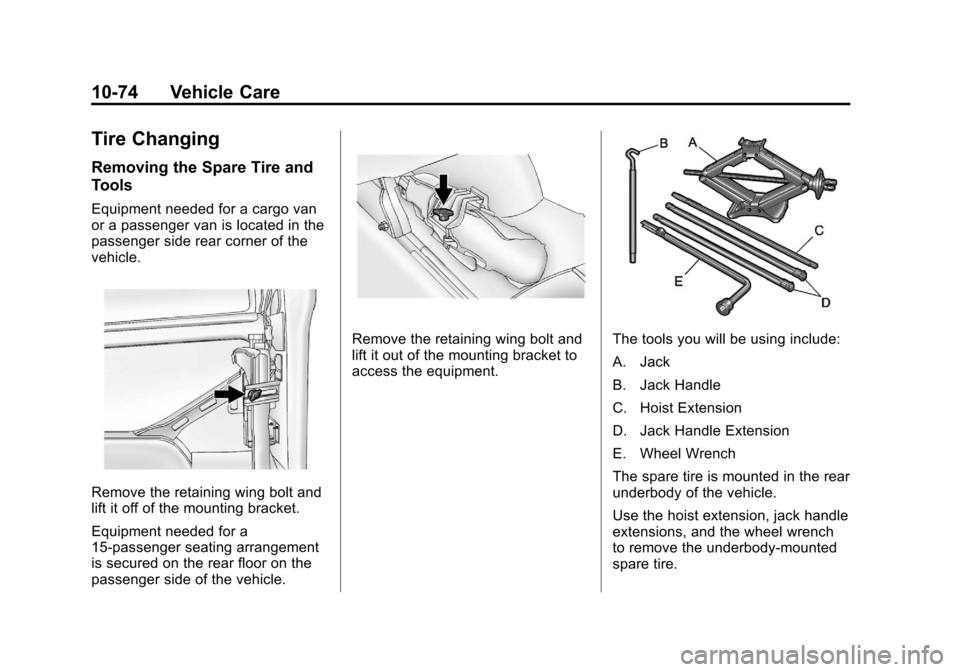
Equipment needed for a cargo van
or a passenger van is located in the
passenger side rear corner of the
vehicle.
Remove the retaining wing bolt and
lift it off of the mounting bracket.
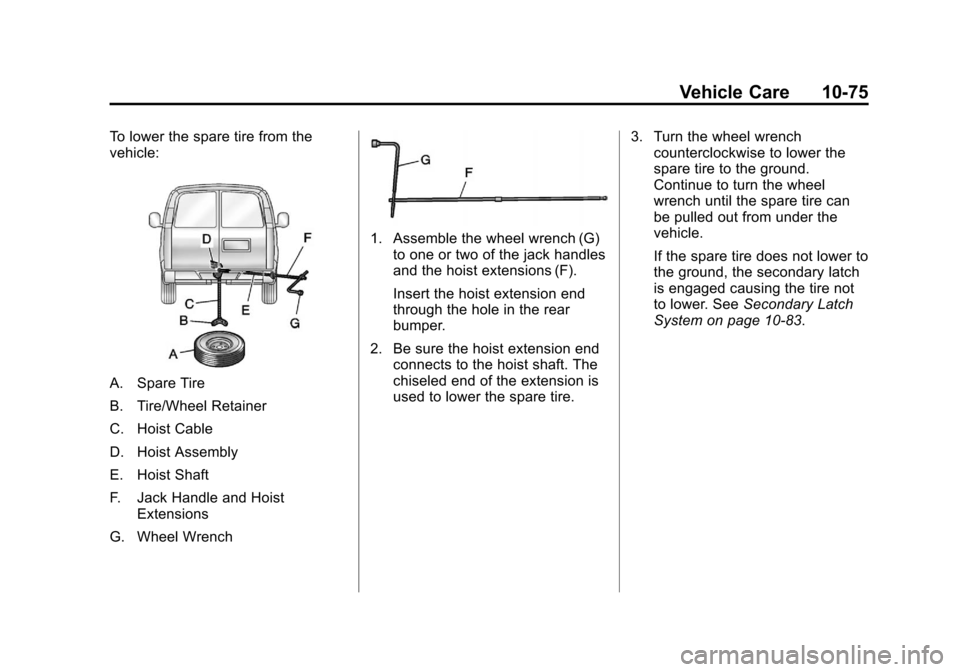
Equipment needed for a
15‐passenger seating arrangement
is secured on the rear floor on the
passenger side of the vehicle.
Remove the retaining wing bolt and
lift it out of the mounting bracket to
access the equipment.The tools you will be using include:
A. Jack
B. Jack Handle
C. Hoist Extension
D. Jack Handle Extension
E. Wheel Wrench
The spare tire is mounted in the rear
underbody of the vehicle.
Use the hoist extension, jack handle
extensions, and the wheel wrench
to remove the underbody‐mounted
spare tire.
Page 339 of 430
Black plate (75,1)Chevrolet Express Owner Manual - 2012
Vehicle Care 10-75
To lower the spare tire from the
vehicle:
A. Spare Tire
B. Tire/Wheel Retainer
C. Hoist Cable
D. Hoist Assembly
E. Hoist Shaft
F. Jack Handle and HoistExtensions
G. Wheel Wrench
1. Assemble the wheel wrench (G) to one or two of the jack handles
and the hoist extensions (F).
Insert the hoist extension end
through the hole in the rear
bumper.
2. Be sure the hoist extension end connects to the hoist shaft. The
chiseled end of the extension is
used to lower the spare tire. 3. Turn the wheel wrench
counterclockwise to lower the
spare tire to the ground.
Continue to turn the wheel
wrench until the spare tire can
be pulled out from under the
vehicle.
If the spare tire does not lower to
the ground, the secondary latch
is engaged causing the tire not
to lower. See Secondary Latch
System on page 10‑83.
Page 340 of 430

Black plate (76,1)Chevrolet Express Owner Manual - 2012
10-76 Vehicle Care
4. When the tire has been lowered,pull it closer to reach the tire
retainer and pull it up through
the wheel opening.
For a vehicle that was
completed from a cab and
chassis, refer to the information
from the body supplier/installer.
The spare tire is a full‐size tire,
like the other tires on the
vehicle.
5. Put the spare tire near the flat tire.
Removing the Flat Tire and
Installing the Spare Tire
If the vehicle has plastic wheel nut
caps, loosen them by turning the
wheel wrench counterclockwise.
The wheel nut caps are designed
to remain with the center cap.
Remove the center cap.
If the wheel has a smooth center
piece, place the chisel end of the
wheel wrench in the slot on the
wheel and gently pry it out.
1. Do a safety check beforeproceeding. See If a Tire Goes
Flat on page 10‑72 for more
information.
2. Loosen all the wheel nuts with the wheel wrench. Do not
remove them yet.
A. Jack
B. Jack Handle
C. Hoist Extension
D. Jack Handle Extension
E. Wheel Wrench
Page 342 of 430

Black plate (78,1)Chevrolet Express Owner Manual - 2012
10-78 Vehicle Care
4. Position the jack under thevehicle, as shown.
The front position jacking point is
on the frame. The rear position
jacking point is on the rear axle.
If the exhaust system interferes
in the jack location in the rear
axle, such as in Diesel vehicles,
place the jack (A) on the rear
axle between the axle housing
and the shock absorber
bracket in order to avoid any
interference with the exhaust
pipe (B).
{WARNING
Getting under a vehicle when it is
jacked up is dangerous. If the
vehicle slips off the jack you could
be badly injured or killed. Never
get under a vehicle when it is
supported only by a jack.
{WARNING
Raising the vehicle with the jack
improperly positioned can
damage the vehicle and even
make the vehicle fall. To help
avoid personal injury and vehicle
damage, be sure to fit the jack lift
head into the proper location
before raising the vehicle.
5. Turn the wheel wrench clockwise to raise the vehicle.
Raise the vehicle far enough off
the ground so there is enough
room for the spare tire to fit.
6. Remove all the wheel nuts.
7. Take flat tire off of the mountingsurface.
{WARNING
Rust or dirt on a wheel, or on the
parts to which it is fastened, can
make wheel nuts become loose
after time. The wheel could come
off and cause an accident. When
changing a wheel, remove any
rust or dirt from places where the
(Continued)