Page 273 of 400
Black plate (19,1)Chevrolet Cruze Owner Manual - 2012
Vehicle Care 10-19
WARNING (Continued)
and it will burn if the engine parts
are hot enough. Do not spill
coolant on a hot engine.
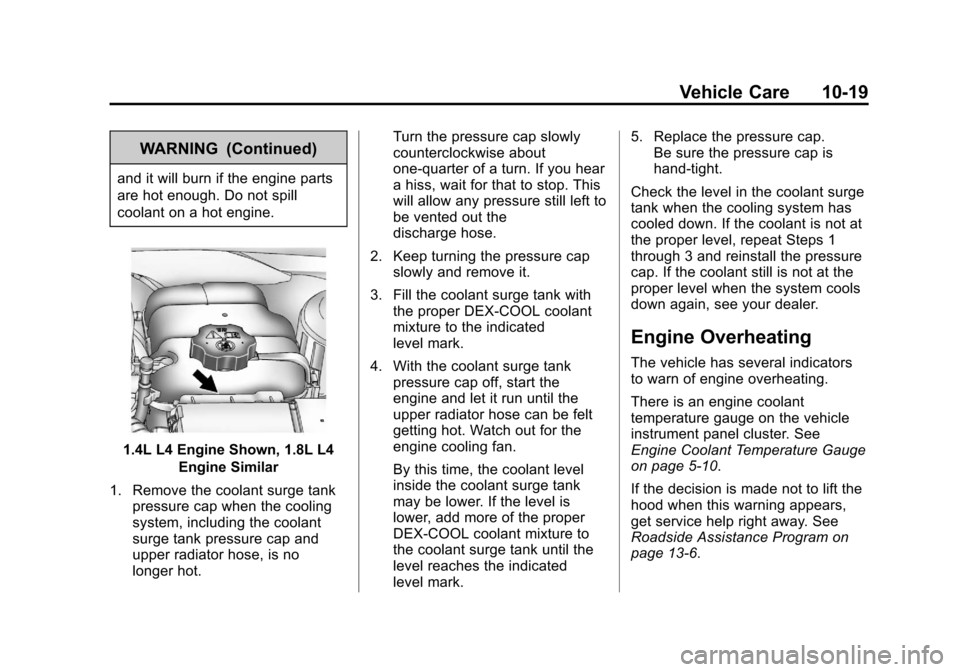
1.4L L4 Engine Shown, 1.8L L4Engine Similar
1. Remove the coolant surge tank pressure cap when the cooling
system, including the coolant
surge tank pressure cap and
upper radiator hose, is no
longer hot. Turn the pressure cap slowly
counterclockwise about
one-quarter of a turn. If you hear
a hiss, wait for that to stop. This
will allow any pressure still left to
be vented out the
discharge hose.
2. Keep turning the pressure cap slowly and remove it.
3. Fill the coolant surge tank with the proper DEX-COOL coolant
mixture to the indicated
level mark.
4. With the coolant surge tank pressure cap off, start the
engine and let it run until the
upper radiator hose can be felt
getting hot. Watch out for the
engine cooling fan.
By this time, the coolant level
inside the coolant surge tank
may be lower. If the level is
lower, add more of the proper
DEX-COOL coolant mixture to
the coolant surge tank until the
level reaches the indicated
level mark. 5. Replace the pressure cap.
Be sure the pressure cap is
hand-tight.
Check the level in the coolant surge
tank when the cooling system has
cooled down. If the coolant is not at
the proper level, repeat Steps 1
through 3 and reinstall the pressure
cap. If the coolant still is not at the
proper level when the system cools
down again, see your dealer.
Engine Overheating
The vehicle has several indicators
to warn of engine overheating.
There is an engine coolant
temperature gauge on the vehicle
instrument panel cluster. See
Engine Coolant Temperature Gauge
on page 5‑10.
If the decision is made not to lift the
hood when this warning appears,
get service help right away. See
Roadside Assistance Program on
page 13‑6.
Page 274 of 400
Black plate (20,1)Chevrolet Cruze Owner Manual - 2012
10-20 Vehicle Care
If the decision is made to lift the
hood, make sure the vehicle is
parked on a level surface.
Check to see if the engine cooling
fan is running. If the engine is
overheating, the fan should be
running. If it is not, do not continue
to run the engine and have the
vehicle serviced.
Notice:Engine damage from
running the engine without
coolant is not covered by the
warranty.If Steam Is Coming from the
Engine Compartment
{WARNING
Steam from an overheated engine
can burn you badly, even if you
just open the hood. Stay away
from the engine if you see or hear
steam coming from it. Just turn it
off and get everyone away from
the vehicle until it cools down.
Wait until there is no sign of
steam or coolant before you
open the hood.
If you keep driving when the
engine is overheated, the liquids
in it can catch fire. You or others
could be badly burned. Stop the
engine if it overheats, and get out
of the vehicle until the engine
is cool.
If No Steam Is Coming from
the Engine Compartment
If an engine overheat warning is
displayed but no steam can be seen
or heard, the problem may not be
too serious. Sometimes the engine
can get a little too hot when the
vehicle:
.Climbs a long hill on a hot day.
.Stops after high-speed driving.
.Idles for long periods in traffic.
.Tows a trailer.
If the overheat warning is displayed
with no sign of steam:
1. Turn the air off.
2. Turn the heater on to the highest temperature and to the highest
fan speed. Open the windows
as necessary.
Page 291 of 400
Black plate (37,1)Chevrolet Cruze Owner Manual - 2012
Vehicle Care 10-37
Mini Fuses Usage4 Canister Vent
Solenoid
5 Ignition
7 Not Used
8 Fuel Injection
9 Fuel Injection/
Ignition System
10 Engine Control
Module
11 Lambda Sensor
13 Canister Vent
Solenoid
14 Not Used
15 Rear Wiper
16 Ignition/Air Quality
Sensor/Aero‐Shutter
17 Ignition/Airbag Mini Fuses Usage
18 Fuel Control Module
19 Not Used
20 Fuel Pump
23 Not Used
29 Not Used
30 Antilock Brake
System
31 Body Control
Module
32 Body Control
Module
33 Front Seat Heating
34 Sunroof
(If Equipped)
35 Infotainment
System/Amplifier
36 Not Used Mini Fuses Usage
37 High Beam
Right Side
38 High Beam Left Side
39 Not Used
40 Not Used
46 Cooling Fan
47 Lambda Sensor
48 Fog Lights
49 Not Used
50 Not Used
51 Horn
52 Ignition
53 Automatic Dimming
Rearview Mirror
54 Light Switch/
Light Control
Page 292 of 400
Black plate (38,1)Chevrolet Cruze Owner Manual - 2012
10-38 Vehicle Care
Mini Fuses Usage55 Mirror Folding
56 Windshield Washer
57 Steering
Column Lock
58 Not Used
60 Heated Mirror
61 Heated Mirror
62 Air Conditioning
63 Rear Window
Sensor
64 Air Quality Sensor
65 Rear Fog Lamp
66 Rear Washer Mini Fuses Usage
67 Fuel System Control
Module
68 Not Used
69 Battery Voltage
Sensor
70 Not Used
71 Not Used
J‐Case Fuses Usage
6 Front Wipers
12 Starter Solenoid
21 Rear Power
Windows J‐Case
Fuses Usage
22 Not Used
24 Front Power
Windows
25 Electronic
Vacuum Pump
26 Antilock Brake
System Pump
27 Electronic Key
System/PEPS
28 Rear Window
Defogger
41 Not Used
42 Cooling Fan K2
Page 293 of 400
Black plate (39,1)Chevrolet Cruze Owner Manual - 2012
Vehicle Care 10-39
J‐CaseFuses Usage
43 Not Used
44 Not Used
45 Cooling Fan K1
59 Not Used
Micro
Relays Usage
1 A/C Clutch
2 Starter Solenoid
4 Front Wiper Speed Micro
Relays Usage
5 Front Wiper On
6 Not Used
10 Cooling Fan K3
12 Cooling Fan K3
14 Not Used
U‐Micro Relays Usage
3 Cooling Fan K7
8 Fuel Pump
11 Not Used HC Relays Usage
9 Cooling Fan K2
13 Cooling Fan K1
Mini Relays Usage 7 Ignition 87 Main
15 Ignition 15
16 Not Used
17 Not Used
Page 316 of 400

Black plate (62,1)Chevrolet Cruze Owner Manual - 2012
10-62 Vehicle Care
Replace wheels, wheel bolts, wheel
nuts, or Tire Pressure Monitor
System (TPMS) sensors with new
GM original equipment parts.
{WARNING
Using the wrong replacement
wheels, wheel bolts, or wheel
nuts can be dangerous. It could
affect the braking and handling of
the vehicle. Tires can lose air,
and cause loss of control, causing
a crash. Always use the correct
wheel, wheel bolts, and wheel
nuts for replacement.
Notice: The wrong wheel can
also cause problems with bearing
life, brake cooling, speedometer
or odometer calibration, headlamp aim, bumper height,
vehicle ground clearance, and tire
or tire chain clearance to the
body and chassis.
See
If a Tire Goes Flat on
page 10‑63 for more information.Used Replacement Wheels
{WARNING
Replacing a wheel with a used
one is dangerous. How it has
been used or how far it has been
driven may be unknown. It could
fail suddenly and cause a crash.
When replacing wheels, use a
new GM original equipment
wheel.
Tire Chains
{WARNING
Do not use tire chains. There is
not enough clearance. Tire chains
used on a vehicle without the
proper amount of clearance can
cause damage to the brakes,
suspension, or other vehicle
parts. The area damaged by the
tire chains could cause loss of
control and a crash. Use another
type of traction device only if its
manufacturer recommends it for
the vehicle's tire size combination
and road conditions. Follow that
manufacturer's instructions.
To avoid vehicle damage, drive
slowly and readjust or remove the
traction device if it contacts the
vehicle. Do not spin the wheels.
If traction devices are used, install
them on the rear tires.
Page 355 of 400
Black plate (7,1)Chevrolet Cruze Owner Manual - 2012
Service and Maintenance 11-7
Footnotes—Maintenance
Schedule Additional Required
Services —Normal
a) Check all fuel and vapor lines
and hoses for proper hook‐up,
routing, and condition. Check that
the purge valve, if the vehicle has
one, works properly. Replace as
needed.
b) Or every four years, whichever
comes first.
c) Or every 10 years, whichever
comes first. d)
Or every five years, whichever
comes first. See Cooling System on
page 10‑16.
e) Or every 10 years, whichever
comes first. Inspect for fraying,
excessive cracking, or damage;
replace, if needed.
Page 357 of 400
Black plate (9,1)Chevrolet Cruze Owner Manual - 2012
Service and Maintenance 11-9
Footnotes—Maintenance
Schedule Additional Required
Services —Severe
a) Check all fuel and vapor lines
and hoses for proper hook‐up,
routing, and condition. Check that
the purge valve, if the vehicle
has one, works properly.
Replace as needed.
b) Or every four years, whichever
comes first.
c) Or every 10 years, whichever
comes first. d)
Or every five years, whichever
comes first. See Cooling System on
page 10‑16.
e) Or every 10 years, whichever
comes first. Inspect for fraying,
excessive cracking, or damage;
replace, if needed.Special Application
Services
.Severe Commercial Use
Vehicles Only: Lubricate chassis
components every 5 000 km/
3,000 mi.
.Have underbody flushing service
performed once a year.