Page 279 of 434
Black plate (5,1)Chevrolet Corvette Owner Manual - 2012
Vehicle Care 10-5
{WARNING
Getting under a vehicle when it is
jacked up is dangerous. If the
vehicle slips off the jack, you
could be badly injured or killed.
Never get under a vehicle when it
is supported only by a jack.
{WARNING
Raising the vehicle with the jack
improperly positioned can
damage the vehicle or the vehicle
may fall and cause you or others
injury.
If you ever use a jack to lift your
vehicle, follow the instructions that
came with the jack, and be sure to
use the correct lifting points to avoid
damaging your vehicle. Notice:
Lifting your vehicle
improperly can damage your
vehicle and result in costly
repairs not covered by your
warranty. To lift your vehicle
properly, follow the advice in
this part.
To help prevent vehicle damage:
.Be sure to place a block or
pad between the jack and the
vehicle.
.Make sure the jack you are
using spans at least two
crossmember ribs.
.Lift only in the areas shown
in the following pictures.
For additional information,
see your dealer and the
Chevrolet Corvette service
manual.
Page 280 of 434
Black plate (6,1)Chevrolet Corvette Owner Manual - 2012
10-6 Vehicle Care
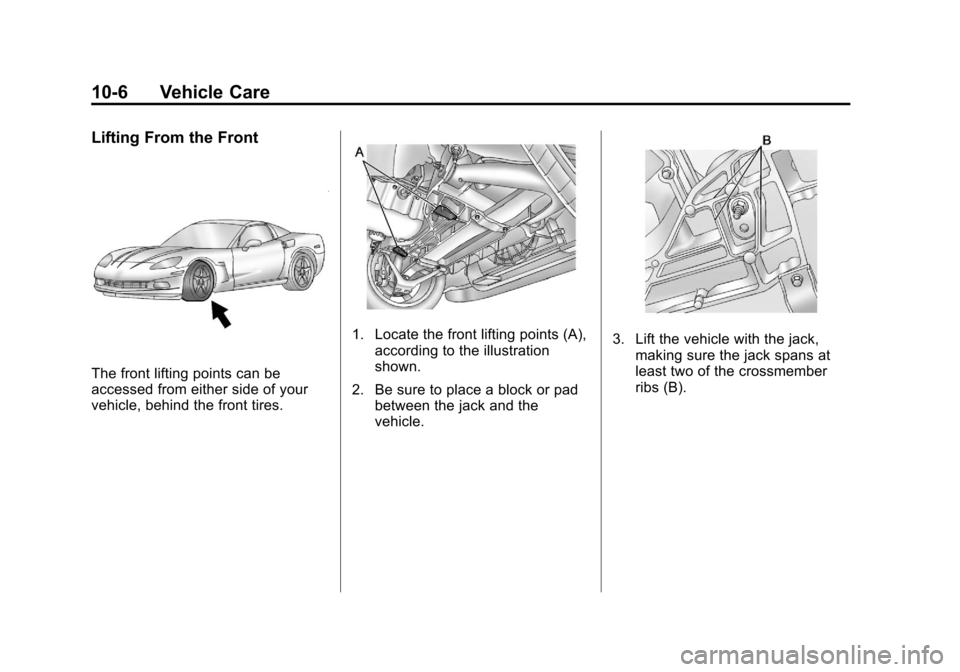
Lifting From the Front
The front lifting points can be
accessed from either side of your
vehicle, behind the front tires.
1. Locate the front lifting points (A),according to the illustration
shown.
2. Be sure to place a block or pad between the jack and the
vehicle.3. Lift the vehicle with the jack,making sure the jack spans at
least two of the crossmember
ribs (B).
Page 281 of 434
Black plate (7,1)Chevrolet Corvette Owner Manual - 2012
Vehicle Care 10-7
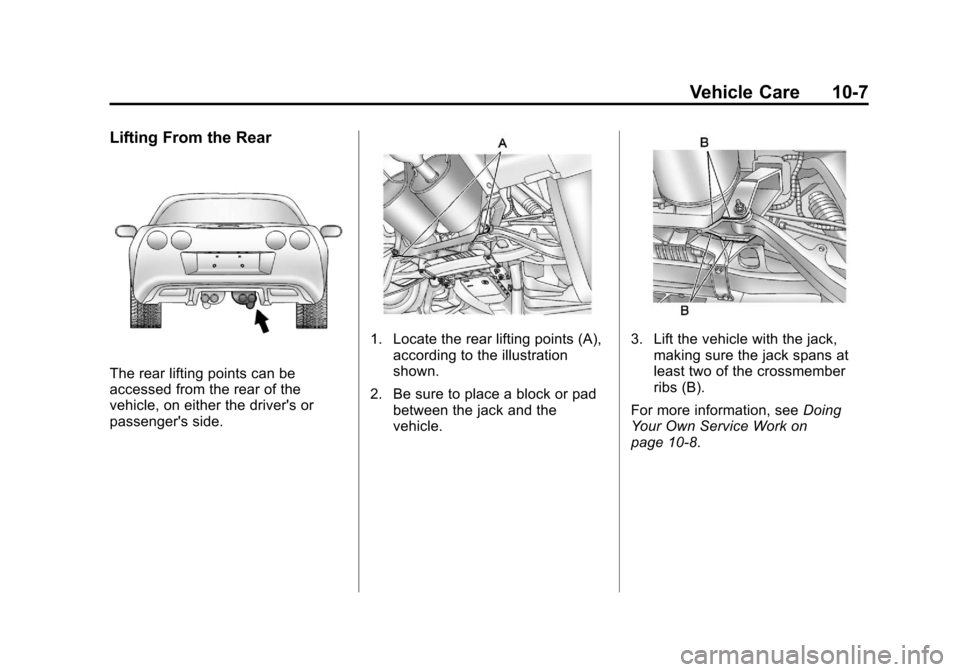
Lifting From the Rear
The rear lifting points can be
accessed from the rear of the
vehicle, on either the driver's or
passenger's side.
1. Locate the rear lifting points (A),according to the illustration
shown.
2. Be sure to place a block or pad between the jack and the
vehicle.3. Lift the vehicle with the jack,making sure the jack spans at
least two of the crossmember
ribs (B).
For more information, see Doing
Your Own Service Work on
page 10‑8.
Page 285 of 434

Black plate (11,1)Chevrolet Corvette Owner Manual - 2012
Vehicle Care 10-11
A. Clutch Master CylinderReservoir (If Equipped).
See Hydraulic Clutch on
page 10‑24.
B. Windshield Washer Fluid Reservoir. See “Adding Washer
Fluid” under Washer Fluid on
page 10‑38.
C. Brake Fluid Reservoir. See “Brake Fluid” under
Brakes on page 10‑38.
D. Coolant Surge Tank and Pressure Cap. See Engine
Coolant on page 10‑30. E.
Engine Air Cleaner/Filter on
page 10‑25.
F. Power Steering Fluid Reservoir. See Power Steering Fluid on
page 10‑36.
G. Engine Oil Fill Cap. See “When
to Add Engine Oil” underBrake
Fluid on page 10‑42.
H. Engine Oil Dipstick. See “Checking Engine Oil” under
Engine Oil on page 10‑16.
I. Engine Compartment Fuse
Block on page 10‑52. J. Passenger Compartment
Air Filter (Out of View).
See Passenger Compartment
Air Filter on page 8‑6.
K. Battery on page 10‑43.
If the vehicle has the 6.2 L LS3
V8 engine (without the dry sump
engine oil tank) and you are facing
the front of the vehicle.
Page 287 of 434

Black plate (13,1)Chevrolet Corvette Owner Manual - 2012
Vehicle Care 10-13
A. Intercooler. SeeCooling System
(Engine) on page 10‑28 or
Cooling System (Intercooler) on
page 10‑29.
B. Engine Air Cleaner/Filter on
page 10‑25.
C. Power Steering Fluid Reservoir and Cap. See Power Steering
Fluid on page 10‑36.
D. Coolant Surge Tank and Pressure Cap. See Engine
Coolant on page 10‑30.
E. Windshield Washer Fluid Reservoir. See “Adding Washer
Fluid” under Washer Fluid on
page 10‑38. F. Clutch Master Cylinder
Reservoir (If Equipped).
See Hydraulic Clutch on
page 10‑24.
G. Brake Fluid Reservoir. See “Brake Fluid” under
Brakes on page 10‑38.
H. Passenger Compartment Air Filter (Out of View).
See Passenger Compartment
Air Filter on page 8‑6.
I. Engine Oil Fill Cap. See “When
to Add Engine Oil” under
Engine Oil on page 10‑16.
J. Dry Sump Engine Oil Tank. See “Changing Engine Oil
and Filter” Brake Fluid on
page 10‑42. K. Engine Oil Dipstick. See
“Checking Engine Oil” under
Engine Oil on page 10‑16.
L. Remote Positive (+) Terminal (Out of View). See Jump
Starting on page 10‑82.
M. Engine Compartment Fuse
Block on page 10‑52.
If the vehicle has the 6.2 L LS9
Supercharged V8 engine and you
are facing the front of the vehicle.
Page 289 of 434

Black plate (15,1)Chevrolet Corvette Owner Manual - 2012
Vehicle Care 10-15
A.Engine Air Cleaner/Filter on
page 10‑25.
B. Power Steering Fluid Reservoir. See Power Steering Fluid on
page 10‑36.
C. Engine Compartment Fuse
Block on page 10‑52.
D. Remote Positive (+) Terminal (Out of View). See Jump
Starting on page 10‑82.
E. Engine Oil Dipstick. See “Checking Engine Oil” under
Engine Oil on page 10‑16. F. Dry Sump Engine Oil Tank.
See “Changing Engine Oil and
Filter” under Engine Oil on
page 10‑16.
G. Engine Oil Fill Cap. See “When
to Add Engine Oil” under
Engine Oil on page 10‑16.
H. Coolant Surge Tank and Pressure Cap. See Engine
Coolant on page 10‑30.
I. Windshield Washer Fluid Reservoir. See “Adding Washer
Fluid” under Washer Fluid on
page 10‑38. J. Brake Fluid Reservoir.
See “Brake Fluid” under
Brake Fluid on page 10‑42.
K. Clutch Master Cylinder Reservoir. See Hydraulic Clutch
on page 10‑24.
If the vehicle has the 6.2 L LS3
V8 engine with the manual
transmission (with the dry sump
engine oil tank) or the 7.0 L LS7
V8 engine and you are facing the
driver side of the vehicle.
Page 300 of 434
Black plate (26,1)Chevrolet Corvette Owner Manual - 2012
10-26 Vehicle Care
6.2 L V8 Engine LS3 Shown,6.2 L V8 Engine LS9 and
7.0 L V8 Engine LS7 Similar
A. Mass Air Flow Sensor Connector
B. Connector Lock
4. Remove the connector lock (B) located at the bottom of the
mass air flow sensor
connector (A).
5. Press on the top and bottom of the mass air flow sensor
connector (A) and remove.6.2 L V8 Engine LS36.2 L V8 Engine LS9 Shown,
7.0 L V8 Engine LS7 Similar
6. To access the air filter element, gently pull the air cleaner
assembly upward until the
fasteners are released from
the retainer pins in the upper
radiator support.
The LS3 engine has three
retainer pins and the LS7 and
LS9 engines have two.
Page 306 of 434
Black plate (32,1)Chevrolet Corvette Owner Manual - 2012
10-32 Vehicle Care
How to Add Coolant to the
Coolant Surge Tank
{WARNING
You can be burned if you spill
coolant on hot engine parts.
Coolant contains ethylene glycol
and it will burn if the engine parts
are hot enough. Do not spill
coolant on a hot engine.
{WARNING
Steam and scalding liquids from a
hot cooling system can blow out
and burn you badly. They are
under pressure, and if you turn
the coolant surge tank pressure(Continued)
WARNING (Continued)
cap—even a little —they can
come out at high speed. Never
turn the cap when the cooling
system, including the coolant
surge tank pressure cap, is hot.
Wait for the cooling system and
coolant surge tank pressure cap
to cool if you ever have to turn
the pressure cap.
If coolant is needed, add the proper
DEX-COOL coolant mixture directly
to the surge tank, but be sure the
cooling system is cool before this
is done.
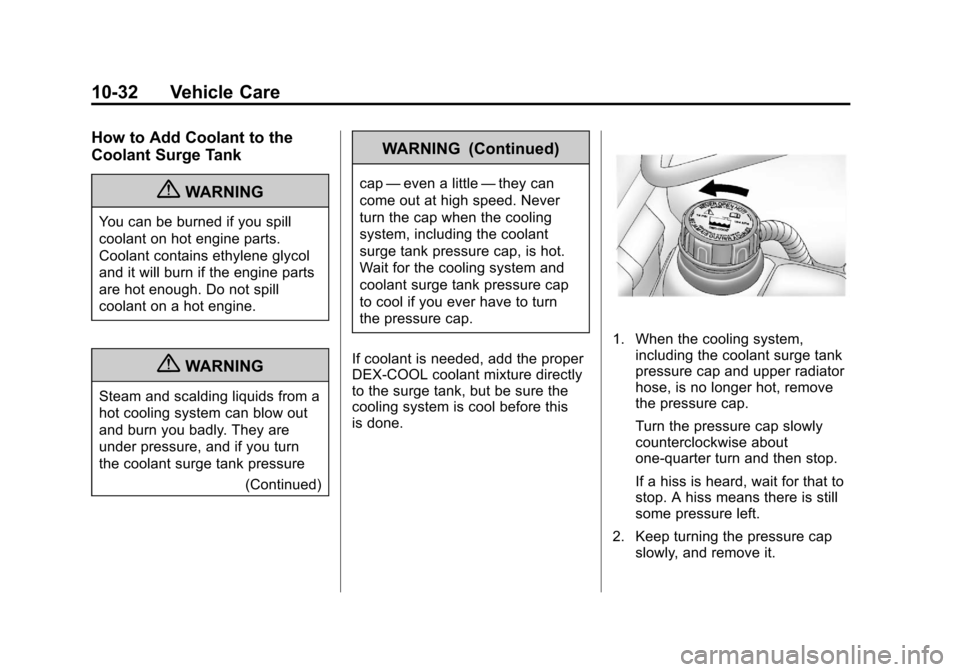
1. When the cooling system, including the coolant surge tank
pressure cap and upper radiator
hose, is no longer hot, remove
the pressure cap.
Turn the pressure cap slowly
counterclockwise about
one-quarter turn and then stop.
If a hiss is heard, wait for that to
stop. A hiss means there is still
some pressure left.
2. Keep turning the pressure cap slowly, and remove it.