2012 CHEVROLET COLORADO maintenance
[x] Cancel search: maintenancePage 231 of 394

Black plate (57,1)Chevrolet Colorado Owner Manual - 2012
Driving and Operating 9-57
Leaving After Parking on a Hill
1. Apply and hold the brake pedalwhile you:
.Start the engine
.Shift into a gear
.Release the parking brake
2. Let up on the brake pedal.
3. Drive slowly until the trailer is clear of the chocks.
4. Stop and have someone pick up and store the chocks.
Maintenance When Trailer
Towing
The vehicle needs service more
often when pulling a trailer.
See Maintenance Schedule on
page 11‑3 or the Index for more
information. Things that are
especially important in trailer
operation are automatic
transmission fluid, engine oil,
axle lubricant, belts, cooling system and brake system. It is a
good idea to inspect these before
and during the trip.
Check periodically to see that all
hitch nuts and bolts are tight.
Trailer Towing
{WARNING
The driver can lose control when
pulling a trailer if the correct
equipment is not used or the
vehicle is not driven properly.
For example, if the trailer is too
heavy, the brakes may not
work well
—or even at all. The
driver and passengers could be
seriously injured. The vehicle may
also be damaged; the resulting
repairs would not be covered by
the vehicle warranty. Pull a trailer
only if all the steps in this section
have been followed. Ask your
(Continued)
WARNING (Continued)
dealer for advice and information
about towing a trailer with the
vehicle.
Notice: Pulling a trailer
improperly can damage the
vehicle and result in costly
repairs not covered by the
vehicle warranty. To pull a trailer
correctly, follow the advice in this
section and see your dealer for
important information about
towing a trailer with the vehicle.
To identify the trailering capacity of
the vehicle, read the information in
“Weight of the Trailer” that appears
later in this section.
Page 242 of 394
Black plate (4,1)Chevrolet Colorado Owner Manual - 2012
10-4 Vehicle Care
Damage to vehicle components
resulting from modifications or
the installation or use of non‐GM
certified parts, including control
module or software modifications, is
not covered under the terms of the
vehicle warranty and may affect
remaining warranty coverage for
affected parts.
GM Accessories are designed to
complement and function with other
systems on the vehicle. See your
dealer to accessorize the vehicle
using genuine GM Accessories
installed by a dealer technician.
Also, seeAdding Equipment to
the Airbag-Equipped Vehicle on
page 3‑32.Vehicle Checks
Doing Your Own
Service Work
{WARNING
You can be injured and the
vehicle could be damaged if you
try to do service work on a vehicle
without knowing enough about it.
.Be sure you have sufficient
knowledge, experience,
the proper replacement
parts, and tools before
attempting any vehicle
maintenance task.
(Continued)
WARNING (Continued)
.Be sure to use the proper
nuts, bolts, and other
fasteners. Metric and
English fasteners can be
easily confused. If the wrong
fasteners are used, parts can
later break or fall off. You
could be hurt.
Page 243 of 394

Black plate (5,1)Chevrolet Colorado Owner Manual - 2012
Vehicle Care 10-5
If doing some of your own service
work, use the proper service
manual. It tells you much more
about how to service the vehicle
than this manual can. To order the
proper service manual, seeService
Publications Ordering Information
on page 13‑17.
This vehicle has an airbag system.
Before attempting to do your own
service work, see Servicing the
Airbag-Equipped Vehicle on
page 3‑31.
Keep a record with all parts receipts
and list the mileage and the date
of any service work performed.
See Maintenance Records on
page 11‑16.Hood
To open the hood, do the following:
1. Pull the handle with this symbol on it. It is located inside the
vehicle on the lower left side of
the instrument panel.
2. Release the secondary latch on the hood. It is located below the
front center of the hood. 3. Lift the hood.
4. Release the hood prop from its
retainer and put the hood prop
into the slot in the hood.
Before closing the hood, be sure all
the filler caps are on properly. Then
lift the hood to relieve pressure on
the hood prop. Remove the hood
prop from the slot in the hood and
return the prop to its retainer. Lower
the hood 25 to 30 cm (10 to 12 in)
above the vehicle and release it to
latch fully. Check to make sure the
hood is closed and repeat the
procedure if necessary.
Page 251 of 394

Black plate (13,1)Chevrolet Colorado Owner Manual - 2012
Vehicle Care 10-13
Automatic Transmission
Fluid
When to Check and Change
Automatic Transmission Fluid
A good time to check the automatic
transmission fluid level is when the
engine oil is changed.
Change the fluid and filter at the
intervals listed inMaintenance
Schedule on page 11‑3, and be
sure to use the transmission fluid
listed in Recommended Fluids and
Lubricants on page 11‑12.
How to Check Automatic
Transmission Fluid
Because this operation can be a
little difficult, it may be decided to
have this done at the dealer service
department.
If not taken to the dealer, be sure to
follow all the instructions here, or a
false reading on the dipstick could
result. Notice:
Too much or too
little fluid can damage the
transmission. Too much can
mean that some of the fluid could
come out and fall on hot engine
parts or exhaust system parts,
starting a fire. Too little fluid
could cause the transmission
to overheat. Be sure to get an
accurate reading if checking the
transmission fluid.
Wait at least 30 minutes before
checking the transmission fluid level
if the vehicle has been driven:
.When outside temperatures are
above 32°C (90°F).
.At high speed for quite a while.
.In heavy traffic —especially in
hot weather.
.While pulling a trailer.
To get the right reading, the fluid
should be at normal operating
temperature, which is 82°C to 93°C
(180°F to 200°F). Get the vehicle warmed up by
driving about 24 km (15 mi) when
outside temperatures are above
10°C (50°F). If it is colder than 10°C
(50°F), drive the vehicle in 3 (Third)
until the engine temperature gauge
moves and then remains steady for
10 minutes.
A cold fluid check can be made
after the vehicle has been sitting
for eight hours or more with the
engine off, but this is used only
as a reference. Let the engine run
at idle for five minutes if outside
temperatures are 10°C (50°F) or
more. If it is colder than 10°C
(50°F), the engine may have to
idle longer. Should the fluid level be
low during this cold check, check
the fluid hot before adding fluid.
Checking the fluid hot gives a more
accurate reading of the fluid level.
Page 252 of 394

Black plate (14,1)Chevrolet Colorado Owner Manual - 2012
10-14 Vehicle Care
Checking the Fluid Level
To prepare the vehicle:
1. Park the vehicle on a levelplace. Keep the engine running.
2. With the parking brake applied, place the shift lever in P (Park).
3. With foot on the brake pedal, move the shift lever through
each gear range, pausing for
about three seconds in each
range. Then, position the shift
lever in P (Park).
4. Let the engine run at idle for three minutes or more.
Then, without shutting off the
engine:
1. Flip the handle up and then pull out the dipstick and wipe it with
a clean rag or paper towel.
The automatic transmission
dipstick handle with this symbol
on it is located in the engine
compartment on the passenger
side of the vehicle.
See Engine Compartment
Overview on page 10‑6 for more
information on location.
2. Push it back in all the way, wait three seconds, and pull it back
out again.
3. Check both sides of the dipstick,
and read the lower level. The
fluid level must be in the COLD area, below the cross-hatched
area, for a cold check or in the
HOT or cross-hatched area for a
hot check. Be sure to keep the
dipstick pointed down to get an
accurate reading.
4. If the fluid level is in the acceptable range, push the
dipstick back in all the way; then
flip the handle down to lock the
dipstick in place.
How to Add Automatic
Transmission Fluid
Refer to the Maintenance
Schedule to determine what
kind of transmission fluid to use.
See Recommended Fluids and
Lubricants on page 11‑12.
Add fluid only after checking the
transmission fluid while it is hot.
A cold check is used only as a
reference. If the fluid level is low,
add only enough of the proper fluid
to bring the level up to the HOT area
for a hot check. It does not take
much fluid, generally less than 0.5 L
(1 pt). Do not overfill.
Page 254 of 394

Black plate (16,1)Chevrolet Colorado Owner Manual - 2012
10-16 Vehicle Care
3. If the fluid level is good, installthe plug and be sure it is fully
seated. If the fluid level is low,
add more fluid as described in
the next steps.
How to Add Fluid
Here is how to add fluid. Refer
to the Maintenance Schedule to
determine what kind of fluid to use.
See Recommended Fluids and
Lubricants on page 11‑12.
1. Remove the fill plug.
2. Add fluid at the fill plug hole.
Add only enough fluid to bring
the fluid level up to the bottom of
the fill plug hole.
3. Install the fill plug. Be sure the plug is fully seated.
Hydraulic Clutch
The hydraulic clutch linkage in the
vehicle is self-adjusting. The clutch
master cylinder reservoir is filled
with hydraulic clutch fluid.
The hydraulic clutch fluid reservoir
cap has this symbol on it. See
Engine Compartment Overview on
page 10‑6 for reservoir location.
It is not necessary to regularly
check clutch fluid unless a leak in
the system is suspected. Adding
fluid will not correct a leak.
A fluid loss in this system could
indicate a problem. Have the
system inspected and repaired.
When to Check and What
to Use
Refer to the Maintenance Schedule
to determine how often to check
the fluid level in the clutch master
cylinder reservoir and for the proper
fluid. See Recommended Fluids and
Lubricants on page 11‑12.
How to Check and Add Fluid
The proper fluid should be added if
the level does not reach the bottom
of the diaphragm when it is in place
in the reservoir. See the instructions
on the reservoir cap.
Page 255 of 394
Black plate (17,1)Chevrolet Colorado Owner Manual - 2012
Vehicle Care 10-17
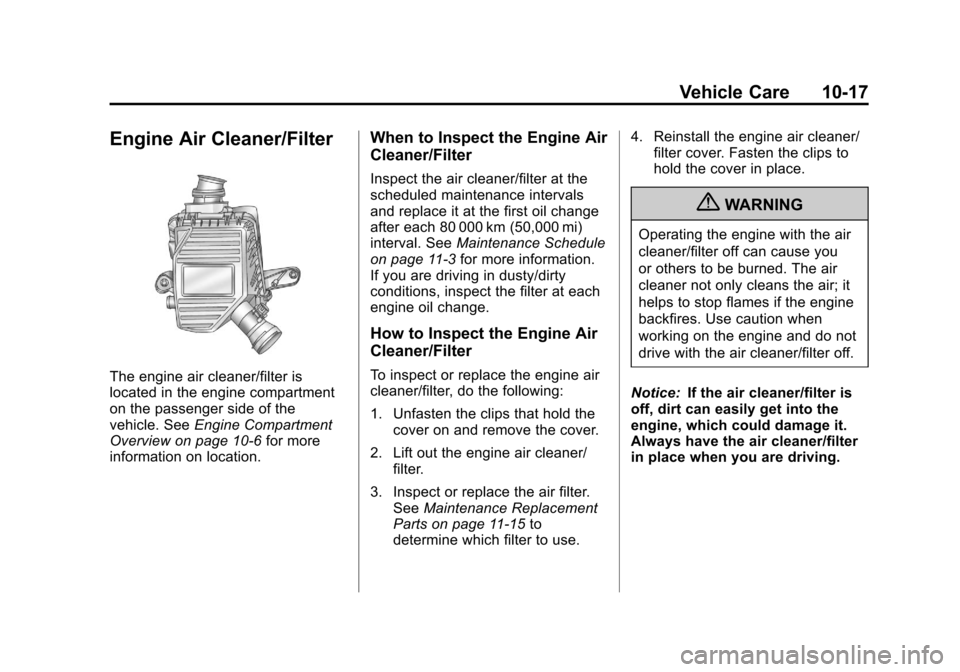
Engine Air Cleaner/Filter
The engine air cleaner/filter is
located in the engine compartment
on the passenger side of the
vehicle. SeeEngine Compartment
Overview on page 10‑6 for more
information on location.
When to Inspect the Engine Air
Cleaner/Filter
Inspect the air cleaner/filter at the
scheduled maintenance intervals
and replace it at the first oil change
after each 80 000 km (50,000 mi)
interval. See Maintenance Schedule
on page 11‑3 for more information.
If you are driving in dusty/dirty
conditions, inspect the filter at each
engine oil change.
How to Inspect the Engine Air
Cleaner/Filter
To inspect or replace the engine air
cleaner/filter, do the following:
1. Unfasten the clips that hold the cover on and remove the cover.
2. Lift out the engine air cleaner/ filter.
3. Inspect or replace the air filter. See Maintenance Replacement
Parts on page 11‑15 to
determine which filter to use. 4. Reinstall the engine air cleaner/
filter cover. Fasten the clips to
hold the cover in place.
{WARNING
Operating the engine with the air
cleaner/filter off can cause you
or others to be burned. The air
cleaner not only cleans the air; it
helps to stop flames if the engine
backfires. Use caution when
working on the engine and do not
drive with the air cleaner/filter off.
Notice: If the air cleaner/filter is
off, dirt can easily get into the
engine, which could damage it.
Always have the air cleaner/filter
in place when you are driving.
Page 264 of 394
Black plate (26,1)Chevrolet Colorado Owner Manual - 2012
10-26 Vehicle Care
Brakes
This vehicle has front disc brakes
and rear drum brakes.
Disc brake pads have built-in wear
indicators that make a high-pitched
warning sound when the brake pads
are worn and new pads are needed.
The sound can come and go or be
heard all the time the vehicle is
moving, except when applying the
brake pedal firmly.
{WARNING
The brake wear warning sound
means that soon the brakes will
not work well. That could lead to
a crash. When the brake wear
warning sound is heard, have the
vehicle serviced.
Notice: Continuing to drive with
worn-out brake pads could result
in costly brake repair. Some driving conditions or climates
can cause a brake squeal when the
brakes are first applied or lightly
applied. This does not mean
something is wrong with the brakes.
Properly torqued wheel nuts are
necessary to help prevent brake
pulsation. When tires are rotated,
inspect brake pads for wear and
evenly tighten wheel nuts in
the proper sequence to torque
specifications in
Capacities and
Specifications on page 12‑2.
Rear drum brakes do not have
wear indicators, but if a rear brake
rubbing noise is heard, have the
rear brake linings inspected
immediately. Rear brake drums
should be removed and inspected
each time the tires are removed for
rotation or changing. Drum brakes
have an inspection hole to inspect
lining wear during scheduled
maintenance. When the front brake
pads are replaced, have the rear
brakes inspected, too. Brake linings should always be
replaced as complete axle sets.
Brake Pedal Travel
See your dealer if the brake pedal
does not return to normal height,
or if there is a rapid increase in
pedal travel. This could be a
sign that brake service might be
required.
Brake Adjustment
Every time the brakes are applied,
with or without the vehicle moving,
the brakes adjust for wear.
Replacing Brake System Parts
The braking system on a vehicle is
complex. Its many parts have to be
of top quality and work well together
if the vehicle is to have really good
braking. The vehicle was designed
and tested with top-quality brake
parts. When parts of the braking
system are replaced, be sure to get
new, approved replacement parts.