Page 430 of 538

Black plate (62,1)Cadillac Escalade/Escalade ESV Owner Manual - 2012
10-62 Vehicle Care
Different Size Tires and
Wheels
If wheels or tires are installed that
are a different size than the original
equipment wheels and tires, vehicle
performance, including its braking,
ride and handling characteristics,
stability, and resistance to rollover
may be affected. If the vehicle has
electronic systems such as antilock
brakes, rollover airbags, traction
control, and electronic stability
control, the performance of these
systems can also be affected.
{WARNING
If different sized wheels are used,
there may not be an acceptable
level of performance and safety if
tires not recommended for those
wheels are selected. This
increases the chance of a crash
and serious injury. Only use GM
specific wheel and tire systems(Continued)
WARNING (Continued)
developed for the vehicle, and
have them properly installed by a
GM certified technician.
See Buying New Tires on
page 10‑60 andAccessories and
Modifications on page 10‑3 for
additional information.
Uniform Tire Quality
Grading
Quality grades can be found
where applicable on the tire
sidewall between tread shoulder
and maximum section width. For
example:
Treadwear 200 Traction AA
Temperature A
The following information relates
to the system developed by the
United States National Highway
Traffic Safety Administration (NHTSA), which grades tires
by treadwear, traction, and
temperature performance. This
applies only to vehicles sold in
the United States. The grades
are molded on the sidewalls of
most passenger car tires. The
Uniform Tire Quality Grading
(UTQG) system does not apply
to deep tread, winter-type snow
tires, space-saver, or temporary
use spare tires, tires with
nominal rim diameters of
10 to 12 inches (25 to 30 cm),
or to some limited-production
tires.
While the tires available on
General Motors passenger cars
and light trucks may vary with
respect to these grades, they
must also conform to federal
safety requirements and
additional General Motors Tire
Performance Criteria (TPC)
standards.
Page 434 of 538
Black plate (66,1)Cadillac Escalade/Escalade ESV Owner Manual - 2012
10-66 Vehicle Care
{WARNING
Lifting a vehicle and getting
under it to do maintenance or
repairs is dangerous without the
appropriate safety equipment and
training. If a jack is provided with
the vehicle, it is designed only for
changing a flat tire. If it is used for
anything else, you or others could
be badly injured or killed if the
vehicle slips off the jack. If a jack
is provided with the vehicle, only
use it for changing a flat tire.
If a tire goes flat, avoid further tire
and wheel damage by driving slowly
to a level place, well off the road,
if possible. Turn on the hazard
warning flashers. See Hazard
Warning Flashers on page 6‑7.
{WARNING
Changing a tire can be
dangerous. The vehicle can slip
off the jack and roll over or fall
causing injury or death. Find a
level place to change the tire. To
help prevent the vehicle from
moving:
1. Set the parking brake firmly.
2. Put an automatic transmission in P (Park)
or a manual transmission in
1 (First) or R (Reverse).
3. Turn off the engine and do not restart while the vehicle
is raised.
(Continued)
WARNING (Continued)
4. Do not allow passengers toremain in the vehicle.
5. Place wheel blocks on both sides of the tire at the
opposite corner of the tire
being changed.
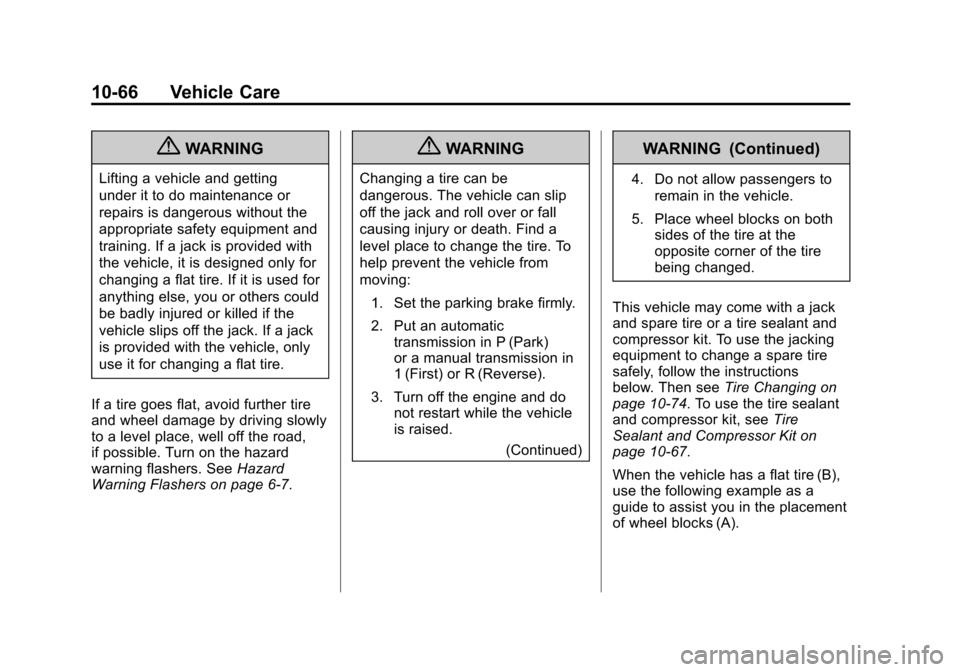
This vehicle may come with a jack
and spare tire or a tire sealant and
compressor kit. To use the jacking
equipment to change a spare tire
safely, follow the instructions
below. Then see Tire Changing on
page 10‑74. To use the tire sealant
and compressor kit, see Tire
Sealant and Compressor Kit on
page 10‑67.
When the vehicle has a flat tire (B),
use the following example as a
guide to assist you in the placement
of wheel blocks (A).
Page 435 of 538

Black plate (67,1)Cadillac Escalade/Escalade ESV Owner Manual - 2012
Vehicle Care 10-67
A. Wheel Block
B. Flat Tire
The following information explains
how to repair or change a tire.
Tire Sealant and
Compressor Kit
{WARNING
Idling a vehicle in an enclosed
area with poor ventilation is
dangerous. Engine exhaust may
enter the vehicle. Engine exhaust
contains carbon monoxide (CO)
which cannot be seen or smelled.(Continued)
WARNING (Continued)
It can cause unconsciousness
and even death. Never run the
engine in an enclosed area that
has no fresh air ventilation. For
more information, seeEngine
Exhaust on page 9‑28.
{WARNING
Overinflating a tire could cause
the tire to rupture and you or
others could be injured. Be sure
to read and follow the tire sealant
and compressor kit instructions
and inflate the tire to its
recommended pressure. Do not
exceed the recommended
pressure.
{WARNING
Storing the tire sealant and
compressor kit or other
equipment in the passenger
compartment of the vehicle could
cause injury. In a sudden stop or
collision, loose equipment could
strike someone. Store the tire
sealant and compressor kit in its
original location.
If this vehicle has a tire sealant and
compressor kit, there may not be a
spare tire, tire changing equipment,
and on some vehicles there may not
be a place to store a tire.
The tire sealant and compressor
can be used to temporarily seal
punctures up to 6 mm (¼ inch) in
the tread area of the tire. It can
also be used to inflate an under
inflated tire.
Page 442 of 538

Black plate (74,1)Cadillac Escalade/Escalade ESV Owner Manual - 2012
10-74 Vehicle Care
Storing the Tire Sealant
and Compressor Kit
The tire sealant and compressor kit
is located under the storage tray on
the driver side trim panel (over the
rear wheelhouse).
To access the tire sealant and
compressor kit:
1. Remove the tray by pulling upon the finger depression to
access the tire sealant and
compressor kit.
2. Locate the tire sealant andcompressor kit.
3. Remove the sealant and compressor kit by pulling the
velcro strip up and back.
4. Remove the sealant and compressor kit from its plastic
tray assembly.
To store the tire sealant and
compressor kit, reverse the steps.
Tire Changing
Removing the Spare Tire and
Tools
The equipment needed to change a
flat tire is stored under the storage
tray, located on the driver side trim
panel, over the rear wheelhouse.
Regular Wheelbase Shown,
Extended Wheelbase Similar.
1. Remove the tray to access the tools by pulling up on the finger
depression under the jack
symbol.
Page 444 of 538
Black plate (76,1)Cadillac Escalade/Escalade ESV Owner Manual - 2012
10-76 Vehicle Care
To access the spare tire:
A. Hoist Assembly
B. Hoist Shaft
C. Hoist Shaft Access Cover/Hole
D. Jack Handle Extensions
E. Wheel Wrench
F. Hoist Cable
G. Tire/Wheel Retainer
H. Spare Tire (Valve StemPointed Down) I. Hoist Shaft Access Hole
J. Hoist End of Extension Tool
K. Spare Tire Lock
1. To reach the hoist shaft access
cover (C), remove the hitch
cover by turning the two
fasteners located at the bottom
of the cover counterclockwise
and then pull the cover down
and rotate it towards you.
2. Open the hoist shaft accesscover on the bumper to access
the spare tire lock. 3. To remove the spare tire lock
insert the ignition key, turn it
clockwise and then pull the
lock out.
4. Assemble the two jack handle
extensions (D) and wheel
wrench (E), as shown.
Page 445 of 538

Black plate (77,1)Cadillac Escalade/Escalade ESV Owner Manual - 2012
Vehicle Care 10-77
5. Insert the open end of theextension (J) through the hole in
the rear bumper (I) (hoist shaft
access hole).
Be sure the hoist end (J) of the
extension connects to the hoist
shaft. The ribbed square end of
the extension is used to lower
the spare tire.
6. Turn the wheel wrench counterclockwise to lower
the spare tire to the ground.
Continue to turn the wheel
wrench until the spare tire can
be pulled out from under the
vehicle. If the spare tire does not lower to
the ground, the secondary latch
is engaged causing the tire not
to lower. See
Secondary Latch
System on page 10‑85 for more
information.
7. Use the wheel wrench hook to pull the hoist cable closer to
assist in reaching the spare tire.
8. Tilt the tire toward the vehicle
with some slack in the cable to
access the tire/wheel retainer.
Separate the retainer from the
guide pin by sliding the retainer
up the pin while pressing down
on the latch.
Page 446 of 538
Black plate (78,1)Cadillac Escalade/Escalade ESV Owner Manual - 2012
10-78 Vehicle Care
Once the retainer is separated
from the pin, tilt the retainer and
pull it through the center of the
wheel along with the cable and
latch.
9. Put the spare tire near the flat tire.
Removing the Flat Tire and
Installing the Spare Tire
1. Do a safety check beforeproceeding. See If a Tire Goes
Flat on page 10‑65 for more
information.
2. To remove the center cap, place the chiseled end of the wheel
wrench in the slot on the wheel
and gently pry the cap out.
3. Use the wheel wrench to loosenall the wheel nuts. Turn the
wheel wrench counterclockwise
to loosen the wheel nuts. Do not
remove the wheel nuts yet.Jacking Locations (Overall View)
A. Front Position
B. Rear Position
{WARNING
Getting under a vehicle when it is
jacked up is dangerous. If the
vehicle slips off the jack, you
could be badly injured or killed.
Never get under a vehicle when it
is supported only by a jack.
Page 447 of 538

Black plate (79,1)Cadillac Escalade/Escalade ESV Owner Manual - 2012
Vehicle Care 10-79
{WARNING
Raising the vehicle with the jack
improperly positioned can
damage the vehicle and even
make the vehicle fall. To help
avoid personal injury and vehicle
damage, be sure to fit the jack lift
head into the proper location
before raising the vehicle.
4. Position the jack under the vehicle as shown.
Front Position
Front Tire Flat: If the flat tire is
on a front tire of the vehicle, use
the jack handle and only one
jack handle extension. Attach
the wheel wrench to the jack
handle extension. Attach the
jack handle to the jack (A).
Position the jack on the frame
behind the flat tire where the
frame sections overlap. Turn the
wheel wrench clockwise to raise
the vehicle. Raise the vehicle far
enough off the ground so there
is enough room for the spare tire
to clear the ground.Rear Position
Rear Tire Flat: If the flat tire is
on a rear tire of the vehicle, use
the jack handle (B) and both jack
handle extensions (C). Attach
the wheel wrench (D) to the
jack handle extensions (C).
Attach the jack handle (B) to the
jack (A). Use the jacking pad (E)
provided on the rear axle. Turn
the wheel wrench (D) clockwise
to raise the vehicle. Raise
the vehicle far enough off the
ground so there is enough room
for the spare tire to clear the
ground.

