2012 AUDI R8 SPYDER tires
[x] Cancel search: tiresPage 202 of 236

200 Tires and wheels
conditions. Ask your authorized Audi dea ler
for more details.
The low aspect ratio of these tires is indicated
by a numeral of 55 or less in the tire's size
designation. The numera l represents the ratio
of the tire's sidewall height in relation to its
tread width expressed in percentage. Conven
tional tires have a height/width ratio of 60 or
more.
The performance of low-aspect -ratio tires is
particularly sensitive to improper inflation
pressure. It is therefore important that low
aspect ratio tires are inflated to the specified
pressure and that the inflation pressure is reg
ularly checked and maintai ned. Tire pressures
should be checked at least once a month and
a lways befo re a long t rip
~ page 189, Check
ing tire pressure.
What you can do to avoid tire and rim
damage
L ow aspect ratio tires can be damaged more
eas ily by impact with potholes, curbs, gullies
o r ridge5 on the road, particu larly if the tire i5
underinflated.
I n order to minimize the occurrence of impact
damage to the tires of your vehicle, we recom
mend that you observe the following precau
tions:
- Always maintain recommended inflation
pressures. Check your tire pressure every
2.000 miles (3.000 km) and add air if neces
sary .
- Drive carefully on roads with potholes, deep
gullies or ridges. The impact from driving
through or over such obstacles can damage
your tires. Impact with a curb may also cause damage to your tires.
- After any impact, immediately inspect your
tires or have them inspected by the nearest
authori zed Aud i dealer. Rep lace a damaged
t ir e as soon as possible.
- Inspect your tires every 2.000 miles (3.000 km) for damage and wear . Damage is not al
ways easy to see. Damage can lead to loss of
air and underinflation, wh ich could eventu
ally cause t ire failure . If you believe that a tire
may have been damaged, rep lace the
tire as soon as possible.
- These tires may wear more quickly than oth
ers.
- Please also remember that, while these tires
delive r responsive handling, they may ride
less comfortably and make more noise than
other choices .
Reduced performance in winter/cold
season conditions
All tires are designed for certain purposes.
The low aspect ratio, ultra high performance
t ir es or iginally installed on your vehicle are in
tended for maximum dry and wet road per
formance and handling . T hey are not suitable
for cold, snowy or icy weather conditions . If
you drive under those c ircumstances, you
should equ ip your vehicle with winter tires,
which offer better traction under those condi
tions . We suggest yo u use the recommended
snow tires specified for your vehicle, or their
equivalent.
Refer to~
poge 197 for more detailed infor
mation regarding winter tires.
Ti re pressure
monitoring system
General notes
Eac h tire, including the spare (if provided),
shou ld be checked mon thly when cold and in
flated to the inflat ion pressure recommended
by the ve hicle manufacturer on the vehicle
placard or tire inflation pressure labe l (If your
vehicle has tires of a different si ze than the
s ize indicated on the vehicle placard or tire in
flat ion pressure label, you should determine
the proper t ire in flation pressure for those
t ir es .) .
As an added safety feature, your vehicle has been equipped with a tire pressure monitoring
system (TPMS) that illum inates a low tire
pressure telltale when one or more of your
tires is significantly under-inflated. Acco rding
ly, when the low tire pressure telltale illumi
nates, you shou ld stop and check you r tires as
Ill>-
Page 203 of 236

soon as possible, and inflate them to the
proper pressure . Driving on a significant ly un
der-inflated tire causes the tire to overheat
and can lead to tire failure. Under-inflation a l
so reduces fuel efficiency and tire tread l ife,
and may affect the veh icle 's handling and
stopping ab ility.
Please note that the TPMS is not a substitute
for proper t ire maintenance, and it is the dr iv
er's responsib ility to ma inta in correct t ire
p ress ure , even if under- inflation has not
reached the leve l to t rigger illumination of the
TPMS low tire pressure telltale .
Your veh icle has also been equ ipped with a
TPMS malfunction indicato r to indicate when
the system is not ope rating properly. The
TPMS malfunc tion indica to r i s combined wi th
the low t ire pr essu re tellta le. When the sys
tem detec ts a ma lf u nct ion, the te lltale will
flash for approximately one minute and then remain continuo usly ill uminated . This se
q uence will continue upon subsequent vehicle
start-ups as long as the malfunction ex ists.
When the malfunction indicator is ill uminat
ed, the system may not be able to detect or
signa l low t ire pressure as intended . TPMS
malfunct ions may occ ur for a variety of rea
sons, including the ins talla tio n of replace
ment or a lternate tires o r whee ls on the veh i
cle that prevent the TPMS from funct io ni ng
p roperly . Always check the TPMS malfunct ion
t ellta le afte r replacing one o r more t ires or
wheels o n your veh icle to ensure tha t the re
p lacemen t or a lternate tires and wheels allow
the TPMS to continue to function properly .
Introduction
The tire pressure monitoring system monitors
air pressure in all four road wheels while the
vehicle is moving .
As soon as the tire pressu re mo nitor ing sys
tem senses a s ignificant loss of a ir pressure in
one or severa l ti res, text messages and yellow
symbo ls appear in the instr ument cluster dis
p lay to alert the driver. The
[ti warning light
Tire s an d wheel s 201
in the instrument cluster comes on when the
ti re is significant ly underinflated .
T he wa rni ng lig ht
[ti also illu minates i n the
case of a system mal funct io n.
Be aware that t ire pressure is a lso dependent
o n the tempe ratu re of the t ire. For eve ry 18 ° F
(10 °C) incre ase in tir e te mper ature, tire pres
s u re inc reases by about 1.5 psi (0 .1 bar). The
ti re warms up while the ve hicle is moving and
tire p ress ure rises . So you sho uld ad just tire
pressure only when they a re
cold, when the
temperature of the tires is ro ughly the same
as the ambient a ir temperature.
In order to keep the tire press ure monito ring
system p roperly ca librated, t ire press ure on
all four tires sho uld be checked at regu lar in
terva ls.
The tire pressure is shown on the label located
on the dr iver's side B-pillar (v is ib le when the
door is open) .
A WARNING
When the tire pressure mo nitoring system
war ning light is lit , one o r m ore of your
tires is s ignificantly under-infla ted . You
shou ld stop and check your tires as soon as
pos sib le, and in flate t hem to the proper
p ress ure a s in dic ate d on the ve hicle's ti re
p ress ure lab el
¢page 187. Driving on a
significantly under -inflated ti re causes t he
tire to over heat and can lead to tire failure .
Under-inflat ion also is like ly to impair the
vehicle's handling and stopping ab ility.
@ For the sake of the environment
D riving wit h un der -inflated tires red uces
fuel efficiency an d tire t read life.
(D Tips
- E ach tire should be chec ked monthly
w hen the tem perature of the tires is
about the same as amb ient a ir tempera
t u re and set to the recommended infla
tion press ure as specified on the tire
pressure label¢
page 187.
•
•
Page 204 of 236

202 Tire s and whee ls
- The tire pressure monitoring system
helps the driver to keep an eye on tire
pressures. But the driver st ill has the re
spons ibility for maintaining the correct
tire pressure.
- Tire pressure must only be adjusted
when the temperature of the tires is
about the same as ambient air tempera
ture.
- When t ires are replaced, the sensors and
valves should not be exchanged . The
valve core, nut, valve sealing and seal
washer (rep lacement kit) needs to be re
placed. If necessary, the valve and the
whee l electronics have to be rep laced.
- The tire pressure monitoring system on
your Audi was calibrated us ing tires w ith
"RO" identification. We recommend us
ing these tires.
- If you should put different whee ls and
ti res on yo ur vehicle (e.g. w inter wheels
and tires), yo u m ust be certain that the
whee ls and tires are compatible with the
tire pressure monitoring system . Other
wise the system w ill reg ister a ma lfunc
tion and a fault message will be d is
played . For more information, contact
your authorized Audi dealer .
- For Declaration of Compliance to United
States FCC and Industry Canada regula
tions
~ page 222 .
Programming a new set of tires
App lies to vehicles: with tire pressure monitoring system
When driving with a new set of ti res, you can
program them to the t ire pressure monitoring
system using the menu disp lay.
"' Turn the ign ition on.
"' Se lect the menu :
Set> Tir e pr essu re >
Wh eel cha ng e.
"' Co nfirm that you wou ld like to begin the
programming process. The message
Wh eel
s en sors a re being in it ia lised. Thi s ma y ta ke
a fe w minute s .. .
appears in the instrument
cluster disp lay. You can switch between programmed tire sets
at any time without reinitializing the system .
(D Tips
If the programming process was not com
pleted successfully, the message
Wheel
s en sors could not be initi alis ed
appears in
the disp lay and the
IIQIS, indicator light
turns on. If this happens, repeat the pro
cedure.
Page 206 of 236

204 What do I do now?
Using TM S, tire damage caused by foreign
bodies up to about
0.16 inch (4 mm ) in diam
eter can be sealed reliably.
The foreign object must s tay in the t ire.
The tir e sea lant mu st not be us ed :
- for cuts or punctures in the tire which are
larger than 0.16 inch (4 mm)¢ fig. 153
(D
- for damage to the rim@
- if you have been driving with very low tire
pressures or tires with no air @
Using the
TM S is described in the section
¢ page 204, Preliminary steps.
TMS can be used at temperatures down to
-4 °F (- 20 °C).
A WARNING
Take the following preca utions after re
pairing the tire:
-
- Do not drive faster than 50 mph (80 km/
h)!
- Avoid full-throttle acce leration, heavy
braking an d fast cornering.
- The vehicle's road behavior can be affect
ed.
- Tires sealed w ith
TMS are intended only
for
temporar y, short-term use . Dam
aged tires must be replaced . Drive care
fully to the next professional repair fa
cility.
- After using the t ire sea lant the tire pres
sure monitoring system may no longer
work properly. Drive carefully to the next professional repair fac ility.
- TMS must NOT be used,
- for cuts or pu nctures in the ti re whi ch
are larger than 0.16 inch (4 mm)
- for damage to the r im
- if you have been dr iv ing with very low
tire pressures or t ires with no air
- Seek profess ional assistance if it is not
poss ible to repair the tire with the tire
sealant.
- The tire sealant must not come into con
tact with sk in, eyes or clothing. -
If you get any ti re sea lant in yo ur eyes or
come into contact w ith it, rinse the af
fected area thoroughly with clean water. Find a phys ician immediately!
- Change any clothing contaminated with
tire sealant immediately.
- Do not inha le the vapor!
- If you have swallowed tire sealant, rinse
your mouth thoroughly right away and
drink plenty of water.
- Do not induce vomit ing! Find a physi
c ian immediately!
- I f you have allergic react ions, find a
phys ic ian immediately.
- Keep the tire sealant away from children.
(D Note
Do not use commercially avai lab le tire
sealants. The e lectr ica l components of the
tire pressure monitoring system will no longe r work properly.
@) For the sake of the environment
Used sealant bottles ca n be dropped off at
a recycling facility.
(D Tips
- If sea lant has run out, allow it to dry.
Then you can peel it off.
- Have the t ire sea lant rep laced every 4
years at a dealership.
Preliminary steps
Some preliminary steps are necessary for tire
repair.
... If you have a flat tire, park the vehicle as far
as possible from moving traffic .
... App ly the
parking brake firmly.
... Engage a gear.
... Check whether a repair using the Tire Mobi
lity System is poss ible ¢ page 203 .
... Have all passengers
lea ve the veh icle and
stay away from the danger zone¢.&_ .
... Take the
sea lant bottle and the ele ctri c air
pum p from the luggage compartment un-
de r the floor ¢ page 203, fig. 152. ....
Page 208 of 236

206 What do I do now?
• Switch the electric air pump off -switch in
position
0. If the required tire pressure of at
l east 1.8 bar has not been reached, it is not
poss ible to make a repa ir with the tire seal
ant. Seek professional ass istance.
Disassembling Tire Mobility System
• Remove the hose from the valve and pull
the p lug out of the socket .
• Screw the dust cap onto the valve.
• Place the empty sealant bottle back in the
original packaging and clip it in place under
the floor so that no tire sealant can run out into the vehicle .
• Start driving r ight away so that the sealant
is distributed in the tire.
.&_ WARNING
- Follow the manufactur er's safety instruc
tions on the decal for the air pump and
the sea lant bott le .
- If a tire pressure of 1.8 bar cannot be
achieved after pumping for 5 minutes,
the tire is too severely damaged. Do not continue to drive.
- Seek professional assistance if it is not
possible to repair the tire with the tire
sealant.
(D Tips
- Do not operate the electric air pump for
more than 8 min utes without stopping,
otherwise it can overheat. When the air
pump has cooled down, you can continue
to use it.
- If sealant has escaped, allow it to dry,
then you can peel it off.
Final check
After driving for a short distance, t ire pressure
must be checked .
• After driving for about 10 minutes, stop
and check the t ire pressure .
• If tire pressure is still at least 1.3 bar, in
flate the tire to specified p ressure (see driv
er's side B-pillar), drive to the next repair shop and have the tire and the sealant
bot
tle replaced.
• If tire pressure is less than 1.3 bar, the t ire
is too severely damaged. Do not continue to
drive. Seek professional assistance.
.&_ WARNING
If tire pressure is less than 1.3 bar after
driving for 10 minutes, the tire is too se
ve rely damaged. Do not continue to drive.
Seek professional assistance.
(D Tips
After a tire repair, have the sealant bottle
replaced at a dealership. This restores full
functionality to the Tire Mobility System .
What should I be
aware of when
changing a tire?
Tires with unidirectional tread design
-
Tires with unidirectional tread design must be
mounted with their tread pattern pointed the
right direction.
A unidirectional tire can be identified by ar
rows on the sidewall, which point in the direc
tion of the rotation. You must follow the
specified direction of rotation. This is necessa
ry in order for these tires to develop their op
timum characteristics regarding grip, road
noise, wear, and hydroplaning .
· Anti-theft wheel bolts
A special adopter is needed to turn the anti
theft wheel bolts.
Fig . 156 A nti-theft wheel bolts wit h adapte r
Page 211 of 236

Tightening wheel bolts
~ Fit the wheel bolt wren ch over the wheel
bolt and push it down as far as it will go
1l.
~ Close your gr ip around the end of the
wrenc h handle fo r maximum torque and
turn each whee l bolt
clockwi se u nti l it sits
t ight.
H ave the
tightening torque of the whee l bolts
checked as soon as possible with a torque
wrench. It shou ld be 120 Nm.
Chec k the
tir e pre ssure as soon as possible .
Return the vehicle tool kit to its proper place .
A WARNING
Loosening the wheel bo lts is prohib ited;
da nger of an accident!
@ Tips
- Never try and use the hexagona l socke t
i n the handle of the screwdr iver to loos
en or tighten the w heel bolts.
- If yo u have dete rm ined t hat wheel bolts
a re cor roded and difficult to t urn, the
bo lts must be rep laced befo re checking
the to rque.
- Unti l the tig hte ning torque is checked,
d rive at redu ced speeds as a precaution .
Notes on wheel change
Please read the information ¢ page 193, New
tires and replacing tires and wheels ,
if you are
going to use a spare t ire which is different
from the tires on you r veh icle.
Afte r you change a tire :
- Check the tire pressure on the spare imme
diately after mounting.
- Have the wheel bolt t ightening torque
chec ked w ith a torq ue wrench as soon as
poss ib le by your author ized A udi dealer or a
qualified service sta tion .
1) You need t he appro pria te adapte r to t ig hte n th e an ti
t h eft whee l bolt s
c:> page 206 .
What do I do now? 209
- With stee l and alloy wheel rims, the whee l
bolts are correctly tightened at a torque of
90 ft lb (120 Nm) .
- If you notice while changing a tire that the
wheel bo lts are corroded and difficu lt to
turn, then they shou ld be rep laced before
you check the tightening torque.
- Replace the flat tire with a new one and
have it installed on your vehicle as soon as
possible . Remount the wheel cover.
Until then , d riv e with e xtra care and at re
duced speeds.
A WARNING
- If you are going to equ ip your vehicle
with tires or rims which differ from those
which were facto ry installed, then be
sure to read the information ¢
page 193,
New tires and replacing tir es and
wheels.
- Always sto re the tools secu rely in lug
gage compartment. Othe rwise, in a n ac
cident o r su dden maneuver they cou ld fly
forwdrd, CciU5ing injury to pd55enger5 in
the vehicle.
(D Note
Do not use comme rcially avai lab le tire
sea lants . Otherwise, the e le ctr ic al compo
nen ts of t he tire p ressu re monitoring sys
tem * wi ll no longe r work proper ly and the
sensor fo r the tire pressure mon itor ing
system will have to be rep laced by a quali
fied workshop.
Jump-starting
General
If necessary, the engine can be started by
connecting it to the battery of another vehi
cle.
If the engi ne should fail to start because of a
discharged or weak battery, the battery can be
II>
•
•
Page 222 of 236

220 Consumer Inf ormation
steadi ly reduced the scope of maintenance
and repairs which can be carried out by vehicle
owners.
Als o, sa fe ty a nd en vir onm ent al con
cerns place very strict limits on the nature of
repairs and adjustments to engine and trans
miss ion parts which an owner can perform .
Maintenance, adjustments and repa irs usua lly
require special tools, testing devices and oth
er equipment available to specially trained
workshop personnel in order to assure proper pe rformance, reliab ility and safety of the vehi
cle and its many systems.
Improper maintenance, adjustments and re
pa irs can impair the operation and reliab ility
of your vehicle and even void your vehicle war
ranty. Therefore, proof of servic ing in accord
ance w ith the ma intenance schedule may be a
condition for upholding a poss ible warranty
claim made within the warranty period.
Above all, operational safety can be adversely
affected, c reating unnecessary risks for you
and your passengers.
If in doubt about any se rv icing, have it done
by your author ized Audi dealer or any other
p roperly equipped and qualified workshop.
We strong ly urge you to give yo ur autho rized
Audi dealer the opportunity to perfo rm all
schedu led maintenance and necessary repairs.
Your dea ler has the facilities, original parts
and trained specialists to keep your vehicle
running properly.
Performing limit ed m aint enance yours elf
The following pages describe a limited num
ber of proced ures which can be performed on
your vehicle with ordinary too ls, shou ld the
need arise and trained personnel be unavaila
ble. Before performing any of these proce
dures, always thoroughly read all of the app li
cable text and carefully follow the instruc
tions given . Always rigorously obse rve the
WARNINGS p rovided.
Before you ch eck anything in th e eng ine
co mpartm ent , alway s re ad and h eed all
WA RNINGS
c::> .&. and c::> ..&. in Working in the
engine compartment on page 169.
A WARNING
- Serious personal injury may occur as a re
sult of improperly performed mainte
nance, adjustments or repa irs.
- Always be extremely careful when work
ing on the vehicle. Always follow com
monly accepted safety pract ices and gen
eral common sense. Never r is k personal
injury.
- Do not attempt any of the maintenance,
checks or repairs descr ibed on the fol
lowing pages if you are not fu lly fam iliar
with these or other procedures with re
spect to the vehicle, or are uncertain how
to proceed .
- Do not do any work without the proper
too ls and equipment. Have the necessa ry
work done by your author ized A udi deal
er or another proper ly equipped and
qualified workshop.
- Always remove the ignition key before
anyone gets under the vehicle.
- Always support your veh icle with safety
stands if it is necessary to work under
neath the vehicle. The jack* is not ade
quate for this purpose and cou ld collapse
causing ser ious personal inju ry.
- If you must work underneath the vehicle
with the wheels on the ground, a lways
make sure the vehicle is on level ground,
that the wheels a re a lways secure ly
b locked and that t he engine cannot be
s tarted.
- Always make sure the transmission se
lec to r l ever is in
"N" (Neut ral) (R t ron ic)
or Neutral (manual transmission) and
the hand bra ke is f irmly app lied.
@ For the sake of the environment
- Changing the engine sett ings will ad
verse ly affect emission leve ls. Th is is det
r imental to the environment and increas
es fuel consumpt ion .
- Always observe environmenta l regu la
tions when disposing of old eng ine oil,
used brake flu id, dirty engine coo lant,
spent batteries or worn out tires.
Page 225 of 236
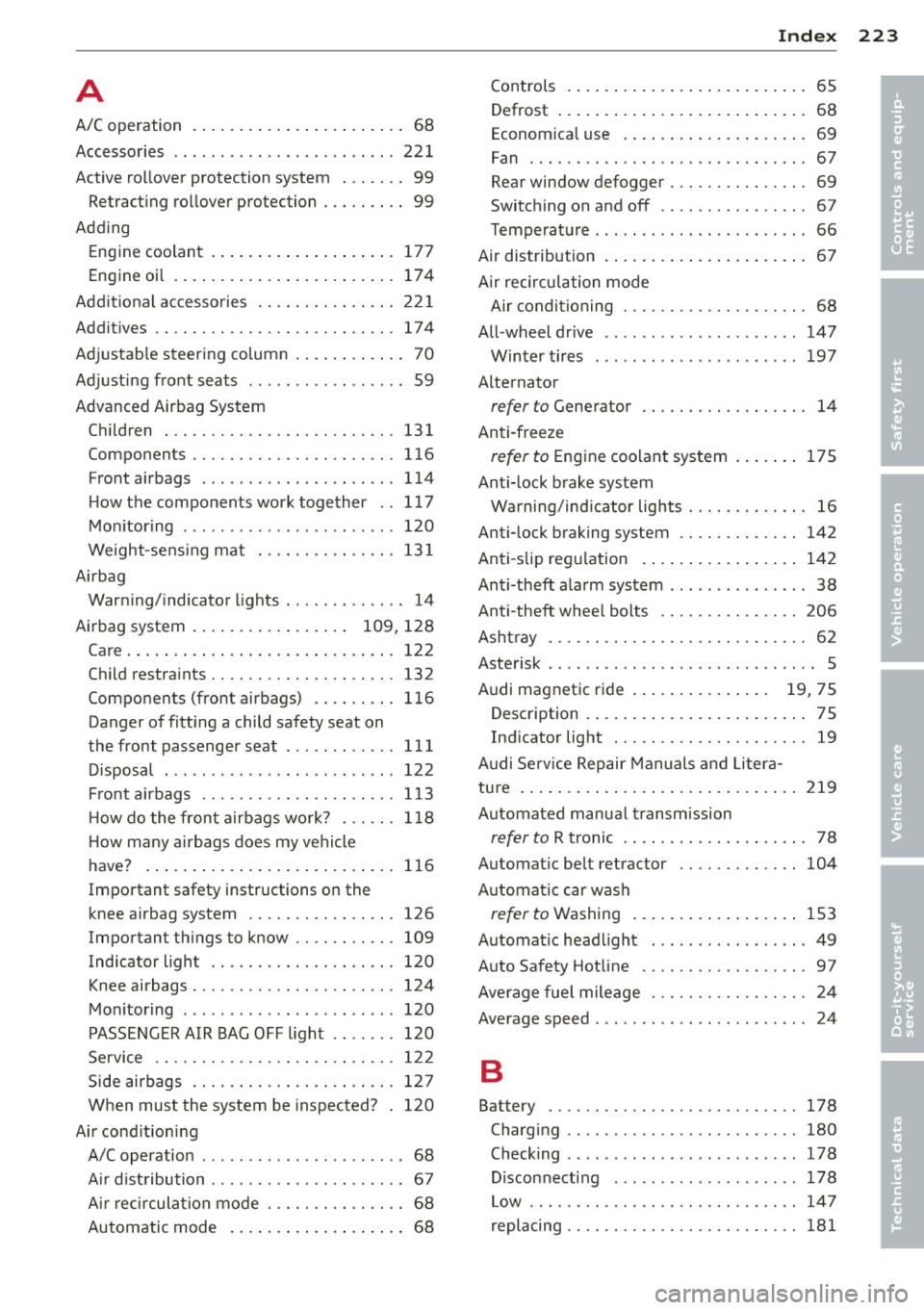
A
A/C operation . . . . . . . . . . . . . . . . . . . . . . . 68
Accessories .. ... .. .. ...... .. .. .. .. . 221
Active ro llover protection system . . . . . . . 99
Retract ing ro llover protection . .. .. .. .. 99
Add ing
Engine coolant . ....... ... .. .. .. ... 177
Engine oi l .. .. ... ..... ... .. .. .. ... 174
Addit io nal accesso ries ...... .. .. .. .. . 22 1
Addit ives . . . . . . . . . . . . . . . . . . . . . . . . . . 17 4
Ad justab le steer ing column . ... .. .. .... 70
Adj usti ng front seats ....... .. .. .. .. .. 59
Advanced Airbag System Ch ildren . .. ............. .... .. .. . 131
Components .. ........... .. .. .. ... 116
Front airbags . . . . . . . . . . . . . . . . . . . . . 114
H ow the components work together . . 117
M oni toring . ................ ... ... 120
Weight-se nsing mat ...... .. .. .. .. . 13 1
Airbag War ning/ indicator lights . .. .. .. .. .. .. 14
Airbag system . . . . . . . . . . . . . . . . . 109, 128
Care ... .. .. .. .... .. .... ... .. .. ... 122
Child restra ints ........... .... .. ... 132
Components (front airbags) .. .. .. .. . 116
Danger of fitting a child safety seat on
the front passenger seat . . . . . . . . . . . . 11 1
Disposal . ................ ... ... .. 122
Fr ont airbags ............ .... .. ... 1 13
H ow do the front a irbags work? . .. .. . 118
H ow many airbags does my vehicle
have? ... .. .. .... .. .... ... .. .. ... 116
Important safety instructions on the
knee airbag system ....... .. .. .. .. . 126
Important things to know . . . . . . . . . . . 109
Indicator light ........... .. .. .. ... 120
Knee airbags . . . . . . . . . . . . . . . . . . . . . . 124
Mo nitor ing . ................ ... ... 120
P ASSENGER AIR BAG OFF l ight .. ... .. 120
Service . . . . . . . . . . . . . . . . . . . . . . . . . . 12 2
Side airbags .. ........... .. .. .. ... 12 7
When mus t the system be inspected? . 120
Ai r cond itioni ng
A/C operation . . . . . . . . . . . . . . . . . . . . . . 68
A ir dist ribution ........... .. .. .. .... 67
A ir r eci rcula tion mode ..... .. .. .. .. .. 68
Automatic mode . . . . . . . . . . . . . . . . . . . 68
Inde x 223
Controls . . . . . . . . . . . . . . . . . . . . . . . . . . 65
Defrost ... .. .. .... . ... ...... ... .. . 68
Econom ica l use . ... . .. ..... ... .. .. . 69
Fan ........ .. .. .................. 67
Rear window defogger . ............. . 69
Switching on and off ................ 67
T emperature ... .. .. . .. .... .... .. .. . 66
Air distribution . . . . . . . . . . . . . . . . . . . . . . 67
A ir recircu lation mode
Air condi tioning . . . . . . . . . . . . . . . . . . . . 68
All -wheel drive .. .. .. ..... .......... 147
Winter tires . . . . . . . . . . . . . . . . . . . . . . 197
A lternator
refer to Generator . . . . . . . . . . . . . . . . . . 14
Anti-freeze
refer to Engine coolan t sys tem ... .. .. 175
Anti- lock b rake system
Warning/ind icator lights .......... .. . 16
Anti- lock braking system ......... .... 142
Anti -slip reg ulation . .. ... .... ... .. .. 142
Anti-theft ala rm system ......... .... .. 38
Anti-theft whee l bolts ........... .... 206
Ashtray .. .. .. .. .. .... ........... .. . 62
Asterisk ...... .. .... .. ........ ...... . 5
Audi magnet ic r ide . . . . . . . . . . . . . . . 19, 75
Description . ... .... . ... ...... ... .. . 75
Ind icator light . .. ................. . 19
Audi Se rv ice Repair Manuals and Lit era-
ture .. ... .. .. .... ... .. .. ..... ... .. 219
Automated manual t ransmission
refer to R tronic . . . . . . . . . . . . . . . . . . . . 78
Automat ic be lt retractor ......... .. .. 104
A utomat ic car wash
refer to Washing . . . . . . . . . . . . . . . . . . 153
Automat ic head light . .............. .. 49
Auto Safety Hot line .................. 97
Ave rage fuel mileage . . . . . . . . . . . . . . . . . 24
Average speed . . . . . . . . . . . . . . . . . . . . . . . 24
B
Battery .... .. .. .. .. .. ........... .. 178
Charg ing .. .... .. ................. 180
Checking . . . . . . . . . . . . . . . . . . . . . . . . . 178
Disconnecting ... .. . .. .... .... .. .. 178
Low .... .. .. .. .. .. ............... 14 7
replacing .. .. .. .. .... ............. 181
•
•