2012 AUDI R8 SPYDER battery
[x] Cancel search: batteryPage 184 of 236

182 Checking and filling
(D Note
- Your vehicle is equipped with a specia l
battery. Installing a different type of
battery can cause prob lems in the vehi
cle electrical system. When replacing the
vehicle battery, always install one with
the same spec ificat ions as the original
battery .
- Make sure that the gas venting hose is
always connected to the o riginal open ing
on the battery side. Otherw ise gasses or
ba tte ry acid could leak out .
- Battery holder and term inals a lways
have to be secured cor rectly.
- Read and follow the warnings under
9 page 179, Working on the battery be
fore performing any work on the batte ry.
@) For the sake of the environment
Because of the problem of proper disposal
of a battery, we recommend your author
ized Audi dealer change the battery for
you . Batteries contain sulfur ic ac id and
lead and must always be disposed of prop
erly in compliance with a ll environmenta l
reg ulations. D isposing of vehicle batteries
improperly is very dangerous to the envi
ronment. Make sure that the removed bat
tery ca nnot overbalance, otherwise sulfu
r ic acid might escape!
Windshield washer
container
Fig. 147 Luggage compa rtment : W inds hield washer
fl uid reservo ir
The windshield washer container O is located
in the luggage compartment. You can find the
reservo ir capacity in the table in
¢page 218.
Clean water should be used when filling up. If
possible, use soft water to prevent scaling on
the washer jets . Always add a glass cleaner
solution (with frost protection in the winter) .
(D Note
- Do not mix engine coolant antifreeze or
any other additives to fill up the wind
shield washer reservoir.
- Do not use glass cleaners containing
pai nt so lvent; you risk damaging the
paint.
Page 187 of 236

Maximum loaded vehicle weight
means the sum of:
(a) Curb weight
(b) Accessory weight
(c) Vehicle capacity weight, and
(d) Production options weight
Maximum (permissible) inflation pressure
means the maximum cold inflation pressure
to which a tire may be inflated. Also called
"maximum inflation pressu re."
Normal occupant weight
means 150 lbs. (68 k ilograms) times the
number of occupants seated in the vehicle up
to the total seating capacity of your vehicle.
Occupant distribution
means distribution of occupants in a vehicle .
Outer diameter means the overall diameter of an inflated new
tire.
Overall width
means the linear distance between the exteri
ors of the sidewalls of an inflated tire, includ
ing e levations due to labeling, decorations, or
protective bands or ribs.
Ply
means a layer of rubber-coated para llel cords.
Production options weight
means the comb ined weight of those installed
regular production options weighing over 5
lbs . (2 .3 kg) in excess of those standard items
which they replace, not previously considered
in curb weight or accessory weight, including
heavy duty brakes, r ide leve lers, roof rack,
heavy duty battery, and specia l trim .
Radial ply tire
means a pneumatic t ire in which the p ly cords
that extend to the beads are laid at substan
tially 90 degrees to the centerline of the
tread.
Tires and wheels 185
Recommended inflation pressure
see~
page 184, Cold tire inflation pressure.
Reinforced tire
means a t ire designed to operate at higher
loads and at higher inflat ion pressures than
the corresponding standard tire. Reinforced
ti res my be ident ified as "XL" , "xl", " EXTRA
LOAD", or "RF" on the sidewall.
Rim
means a metal support for a tire or a t ire and
tube assembly upon which the tire beads are
seated.
Rim diameter
means nom inal d iameter of the bead seat. If
you change your wheel s ize, you w ill have to
purchase new tires to match the new r im di
ameter.
Rim size designation
means r im diameter and width.
Rim width
means nom inal distance between rim fla nges.
Sidewall
means that portion of a tire between the
tread and bead.
Speed rating (letter code)
means the speed at which a tire is designed to
be driven for extended periods of time. The
ratings range from 93 mph (150 km/h) to
186 mph (298 km/h)
~pag e 194 . You may
not find this information on all tires because
it is not requ ired by law.
T he speed rating letter code, where applica
ble, is molded on the tire sidewall and indi
cates the maximum pe rmissib le road speeds
~ .&. in Winter tires on page 198.
Tire pressure monitoring system
means a system that detects when one or
more of a veh icle's tires are underinflated and
illuminates a low tire pressure warning tell
tale.
•
•
Page 197 of 236

T up to 118 mph (190 km/h)
U up to 124 mph (200 km/ h)
H up to 130 mph (210 km/ h)
V up to 149 mph (240 km/h)
1 )
Z over 149 mph (240 km/h)1l
W up to 168 mph (270 km/h)
1
)
Y up to 186 mph (298 km/h)1
)
Your veh icle is no rma lly factory equipped with
tires , which possess excellent driving charac
teristics and give yo ur Audi opt imum driving
comfort ¢&. .
U.S. DO T Tire Identification Numbe r (TIN )
and ti re manufacture date
This is the ti re's "serial number". It begins
with the letters "DOT" and indicates that the
ti re meets all federal standards. The next two
numbers or letters indicate the plant where it
was manufac tured, and the last four numbers
represent the week and year of manufacture .
For example, the numbers 2210 mean that
the t ire was produced in the 22nd week of
20 11. The othe r numbe rs a re mar keting co
des tha t may or may not be used by the t ire
manufacturer . This information is used to con
tact consumers if a tire defect requires a re
call.
Audi original tire
Tires wi th the ident ificat io n "AO" or "RO" have
been spec ia lly matched with your Aud i. We
r ecommend using only these tires because
they meet the highest standards regarding
safety and driving character istics when used
correctly . Your authori zed Audi dealer will
g lad ly provide you with more information .
Tire ply composit ion and materials u sed
The number of p lies ind icates the n umbe r of
l ayers of rubber-coated fabric in the t ire. In
general, the greater the number of p lies, the
more weig ht a tire can support. Tire manufac
turers also must indicate the materials in the
ll Fo r tires wit h a m ax im um s pee d ca pabil ity over 149
mph (2 4 0 km/ h), ti re ma nufa ctur ers some times use
t h e l ett ers " ZR."
Tire s an d wheel s 195
tire, which incl ude stee l, nylon, po lyester, and
others .
Maximum Load Rating
This number ind icates the max imum load in
kil ograms and po unds that can be ca rr ied by
the tire.
Tire quality grading for treadwear ,
traction, and temperature resistance
T read wear, t raction and tempe ra tur e grades
¢page 197 .
Maximum Permissible Inflation Pressure
This number is the greatest amount of a ir
pressure that should ever be put in the tire
u nder norma l dr iv ing cond itions .
Replacing tires or rims on veh icles
equipped with tire p ressure monitoring
system
T he w heels on yo ur vehicle are equippe d with
a sensor which constantly monito rs the ai r
pressure inside the tire, a nd then transmits
th is information to the tire p ress ure monitor ·
ing system. If yo u are going to replace the
whee l rims on your veh icle, make sure the new
rims also have these sensors . The sensors
must be compatib le with the t ire pressure
monito rin g sys tem on your vehicle .
If you install rims, wh ic h do not have the sen
sors, or have senso rs which are not compati
ble , then the t ire p ressure monitoring system
will not wor k prope rly. In t his case, the tire
pressure monitor ing system wou ld no t be
able to moni tor the tire pressure or warn yo u
i f i t is necessary .
- The battery inside of t he tire pressure sen
sor has a limited se rvice life .
- Always dr ive with the va lve stem caps se
curely mounted . We recommend using fac
t o ry installed valve stem caps. As k yo ur au
t hori zed A udi dealer to rep lace lost valve
stem caps .
•
•
Page 211 of 236

Tightening wheel bolts
~ Fit the wheel bolt wren ch over the wheel
bolt and push it down as far as it will go
1l.
~ Close your gr ip around the end of the
wrenc h handle fo r maximum torque and
turn each whee l bolt
clockwi se u nti l it sits
t ight.
H ave the
tightening torque of the whee l bolts
checked as soon as possible with a torque
wrench. It shou ld be 120 Nm.
Chec k the
tir e pre ssure as soon as possible .
Return the vehicle tool kit to its proper place .
A WARNING
Loosening the wheel bo lts is prohib ited;
da nger of an accident!
@ Tips
- Never try and use the hexagona l socke t
i n the handle of the screwdr iver to loos
en or tighten the w heel bolts.
- If yo u have dete rm ined t hat wheel bolts
a re cor roded and difficult to t urn, the
bo lts must be rep laced befo re checking
the to rque.
- Unti l the tig hte ning torque is checked,
d rive at redu ced speeds as a precaution .
Notes on wheel change
Please read the information ¢ page 193, New
tires and replacing tires and wheels ,
if you are
going to use a spare t ire which is different
from the tires on you r veh icle.
Afte r you change a tire :
- Check the tire pressure on the spare imme
diately after mounting.
- Have the wheel bolt t ightening torque
chec ked w ith a torq ue wrench as soon as
poss ib le by your author ized A udi dealer or a
qualified service sta tion .
1) You need t he appro pria te adapte r to t ig hte n th e an ti
t h eft whee l bolt s
c:> page 206 .
What do I do now? 209
- With stee l and alloy wheel rims, the whee l
bolts are correctly tightened at a torque of
90 ft lb (120 Nm) .
- If you notice while changing a tire that the
wheel bo lts are corroded and difficu lt to
turn, then they shou ld be rep laced before
you check the tightening torque.
- Replace the flat tire with a new one and
have it installed on your vehicle as soon as
possible . Remount the wheel cover.
Until then , d riv e with e xtra care and at re
duced speeds.
A WARNING
- If you are going to equ ip your vehicle
with tires or rims which differ from those
which were facto ry installed, then be
sure to read the information ¢
page 193,
New tires and replacing tir es and
wheels.
- Always sto re the tools secu rely in lug
gage compartment. Othe rwise, in a n ac
cident o r su dden maneuver they cou ld fly
forwdrd, CciU5ing injury to pd55enger5 in
the vehicle.
(D Note
Do not use comme rcially avai lab le tire
sea lants . Otherwise, the e le ctr ic al compo
nen ts of t he tire p ressu re monitoring sys
tem * wi ll no longe r work proper ly and the
sensor fo r the tire pressure mon itor ing
system will have to be rep laced by a quali
fied workshop.
Jump-starting
General
If necessary, the engine can be started by
connecting it to the battery of another vehi
cle.
If the engi ne should fail to start because of a
discharged or weak battery, the battery can be
II>
•
•
Page 212 of 236

210 What do I do now?
connected to the battery of another veh icle,
using a pair of jump er cable s to start the en
g ine.
Both batter ies must be rated at 12 vo lts. The
ca pacity (Ah) of the booster battery must not
be substantially less than the capacity of the
d ischarged battery .
J umper cables
Use
only jumper cables of sufficiently large
cr oss sec tion to safely carry the starter cur
rent . Re fer to the manu facturer's specifica
tions .
Use only jumper cables which have
insulated
termina l clamps and are properly marked for
distinction :
plu s(+) ca ble: in most cases co lored red
minu s(-) ca ble: in most cases colored black
A WARNING
Batteries contain electricity, ac id, and gas .
Any of these can cause ve ry serious or fatal
injury. Follow the instructions below fo r
safe handl ing of your veh icle's battery.
- Always shield you r eyes and avoid lean
ing over the batte ry whenever possible.
- A discharged battery can already freeze
a t temperatures just be low 32 ° F (0 °C).
Before connecting a jumper cable, the
frozen battery must be thawed com
pletely, otherwise it could exp lode .
- Do not a llow battery ac id to contact eyes
or s kin. Fl ush any contacted area w ith
water immediately .
- Improper use o f a booster battery to
start a ve hicle may cause an explosion.
- Vehicle batteries gene rate explos ive gas
es . Keep sparks, flame and lighted ciga
rettes away from batteries .
- Do not try to jump s tar t any veh icle with
a low acid level in the battery.
- Th e volt age of the booster battery must
also have a 12-Volt rating . The capacity
(Ah) of the booster battery shou ld not be
lower than that of the discharged bat
tery. Use of batter ies of different voltage or substantially d
iffe rent "Ah" rating
may cause an exp losion and persona l in
jury.
- Never charge a frozen battery. Gas trap
ped in the ice may cause an explosion.
- Never charge or use a battery that has
been frozen . The battery case may have
be weakened .
- Use of batter ies of different voltage or
substantially d ifferent capacity (Ah) rat
ing may cause an exp losion and injury.
The capac ity (Ah) of the booster battery
should not be lower than that of the dis
charged battery.
- Before you check anything in the engine compa rtment, always read and heed a ll
WARNINGS
,=;, page 169, Working in the
engine comportment.
(!) Note
- App lying a higher voltage booster bat
tery will cause expens ive damage to sen
sitive e lectronic components, such as
cont ro l uni ts, relays, rad io, etc.
- There must be no electrical contact be
tween the vehicles as otherwise cur rent
c o ul d already start to f low as soon as the
positive( +) terminals are connected.
(D Tips
- T he d ischa rged ba ttery m ust be properly
c onnected to the veh icle's e lectr ica l sys
t em.
- Switch off any car phone, o r follow the
car phone instructions for th is si tuat ion.
Page 213 of 236

Use of jumper cables
Make sure to connect the jumper cable
clamps in exactly the order described below'
Fig . 160 Luggage co m pa rtme nt: connec tor s for a
ch arge r and jump start cab les
F ig . 161 Ju m p sta rt usin g t he batte ry in a not her ve hi
cl e:
A -Fem ale so cket , B · Di scharge
The batte ry is located in the luggage compart
ment
¢ page 179. The front lid can be opened
in an emergency
~page 37.
Do not connect the negat ive cable directly to
the negative termina l on the battery. Connect
it to a
j u mp start pin instead ¢ fig. 160.
Connect the posi tive cable (red) to the
positive t ermin al
1. Connect one end of the red jumper cable
¢ fig. 161 (D to the positive te rm inal of
d isc harged battery @.
2. Connect the other end of the red jumper
cable to the positive termina l@ of the
booster battery @.
Conn ect the negat ive cable (black ) to the
negati ve t erminal
3. Connect one end of the black jumper ca
b le @ to the negative terminal of the
booster battery @.
What do I d o now ? 211
4. Secu re the other end to the jump start pin
@ for the discharged battery @.
Starting the engine
~ Sta rt the engine of the veh icle providing as
sistance and al low it to run at idle.
~ Now sta rt the eng ine of the vehicle with the
discharged battery .
~ If the engine does not start: Stop trying af
ter 10 seconds and then try again after
about 30 seconds.
~ Disconnect the cable while the engine is
running in exactly
reverse order to that de
scribed .
The ba ttery is vented to the ou tside to prevent
gases from entering the veh icle inter ior . Make
sure that the jumper clamps are well connect
ed with their
metal parts in full contact with
the battery term inals .
.&, WARNING
To avoid serious person al injury and dam
age to the veh icle, heed all warnings and
instructions o f the jumper cable manufac
turer . If in doubt , call for road service.
- Ju mper cables m ust be long enough so
that the vehicles do not touch.
- When connecting jumper cables, make
sure that they canno t get caught in any
mov ing parts in the engine compart
ment.
- Before you check anything in the engine
compartment, always read and heed a ll
WARNINGS
¢ page 169, Working in the
engine compartment.
(D Note
Improper hook-up of jumper cables can ru
in the generator .
- Always co nnect POSITIVE(+) to POSI
TIVE(+), and NEGATIVE( -) to NEGATIVE
( - ) ground post of the battery manager
control unit.
- Check that all screw p lugs on the battery
cells are screwed in firm ly. If not, tighten
plugs prior to connecting clamp on nega-
-
tive battery term inal. .,..
Page 214 of 236

212 What do I do now ?
-Please note that the procedure for con
necting a jumper cable as described
above applies spec ifically to the case of
your vehicle be ing jump started. When
you are giving a jump start to another ve
hicle, do
not connect the negative( -) ca
ble to the negat ive( -) terminal on the
discharged bat tery ©-Instead, securely
con nect the negative( -) cable to either a
solid meta l comp onent that i s firmly
bo lted to the engine b lock or to the en
gine block itself . If the battery that is be
ing charged does not vent to the outside,
escaping battery gas cou ld ign ite and ex
plode!
Emergency towing
with commercial tow
truck
General hints
Your Audi requires special handling for tow
ing.
The following information is to be used by
commercia l tow truck operators who know
how to operate their equipment safe ly.
- Never tow your A udi, towing will cause dam
age to the engine and transmission .
- Never wrap the safety chains or winch cables
around the brake lines.
- To preven t unnecessary damage, your Audi
must be transported with a ca r carr ie r (flat
bed truck).
- To load the vehicle on to the flat bed, use
the towing loop fo und in the veh icle tools
and attach to the front anchorage
~ page 212.
A WARNING
A vehicle being towed is not safe for pas
senge rs. Never allow anyone to r ide in a
veh icle being towed, for any reason.
(D Note
The vehicle has very low gro und clea rance.
Make sure that no damage is caused to the
-
u nderside of the vehicle when it is being
l oaded onto a f lat bed t ruck .
Front towing loop
Do not install the front towing loop until it is
needed.
Fi g. 162 Righ t front bumper witho ut g rille : Tow ing
l oop
fully screwed in
On t he right fron t in the bumper, there is a
th readed hole behind the air in take grill into
which the towing loop is screwed.
"' Remove the tow ing loop from the vehicle
t oo l kit
~page 203.
"' Pull the lower part of the gr ill forward and
out .
"' Sc rew the towing loop tightly into the
threaded ho le as far as it wi ll go ¢
fig. 162.
When it is no longer needed, unscrew the
towing loop and put it back into the on -board
toolkit . Make su re to have the towing loop
stored in the vehicle at all times.
When installing t he grill for the air d uct, be
s u re that the tabs on the grill are f irst inse rt
ed into their guides on the vehicle . Then push
the grill into pos ition.
A WARNING
= If the tow ing loop is not screwed in as far
as it will go, the thread can pull out when
the veh icle is towed -potent ial r is k of an
a ccident.
@ Tips
Check caref ully to make sure the hook-up
i s secure.
Page 225 of 236
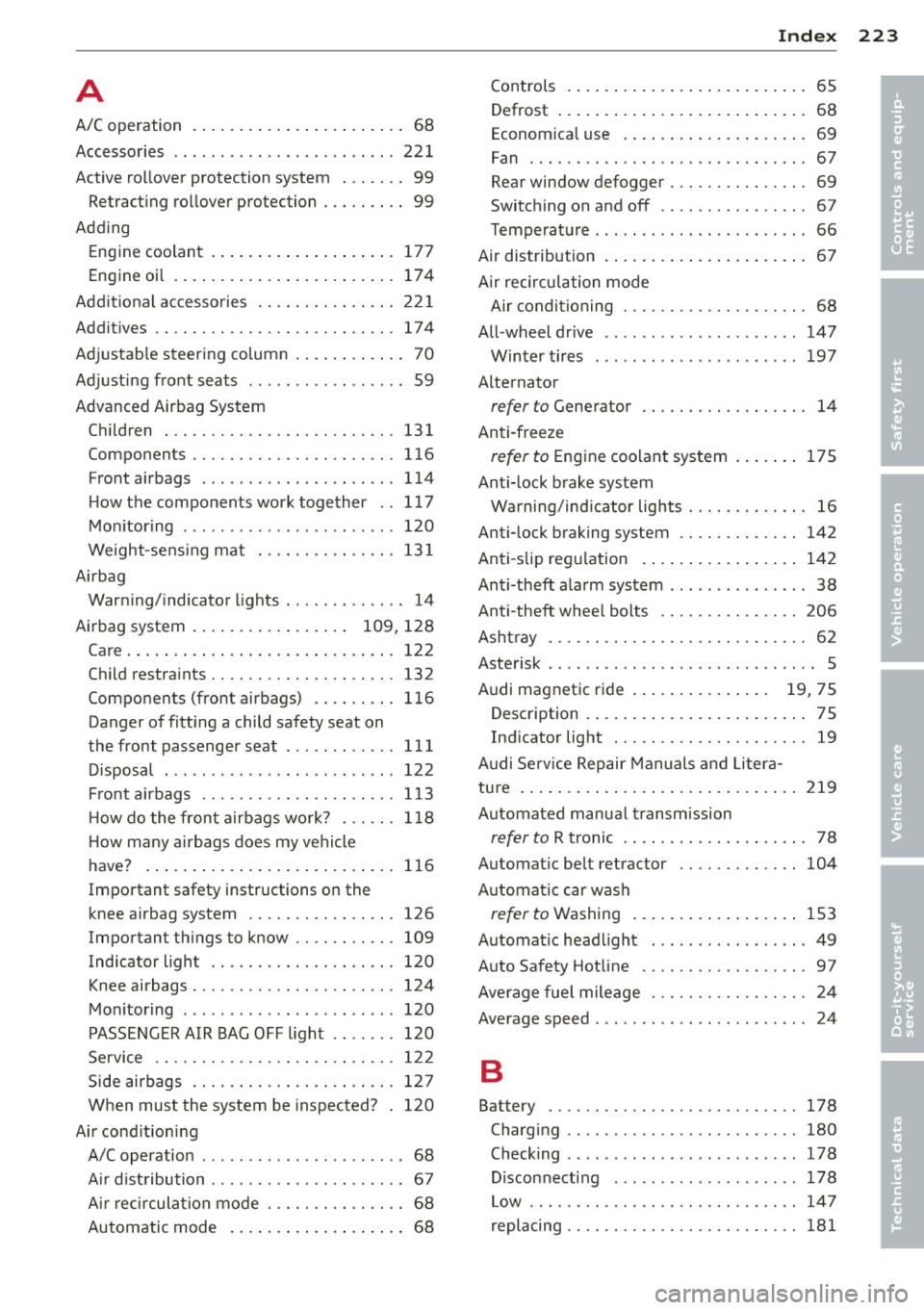
A
A/C operation . . . . . . . . . . . . . . . . . . . . . . . 68
Accessories .. ... .. .. ...... .. .. .. .. . 221
Active ro llover protection system . . . . . . . 99
Retract ing ro llover protection . .. .. .. .. 99
Add ing
Engine coolant . ....... ... .. .. .. ... 177
Engine oi l .. .. ... ..... ... .. .. .. ... 174
Addit io nal accesso ries ...... .. .. .. .. . 22 1
Addit ives . . . . . . . . . . . . . . . . . . . . . . . . . . 17 4
Ad justab le steer ing column . ... .. .. .... 70
Adj usti ng front seats ....... .. .. .. .. .. 59
Advanced Airbag System Ch ildren . .. ............. .... .. .. . 131
Components .. ........... .. .. .. ... 116
Front airbags . . . . . . . . . . . . . . . . . . . . . 114
H ow the components work together . . 117
M oni toring . ................ ... ... 120
Weight-se nsing mat ...... .. .. .. .. . 13 1
Airbag War ning/ indicator lights . .. .. .. .. .. .. 14
Airbag system . . . . . . . . . . . . . . . . . 109, 128
Care ... .. .. .. .... .. .... ... .. .. ... 122
Child restra ints ........... .... .. ... 132
Components (front airbags) .. .. .. .. . 116
Danger of fitting a child safety seat on
the front passenger seat . . . . . . . . . . . . 11 1
Disposal . ................ ... ... .. 122
Fr ont airbags ............ .... .. ... 1 13
H ow do the front a irbags work? . .. .. . 118
H ow many airbags does my vehicle
have? ... .. .. .... .. .... ... .. .. ... 116
Important safety instructions on the
knee airbag system ....... .. .. .. .. . 126
Important things to know . . . . . . . . . . . 109
Indicator light ........... .. .. .. ... 120
Knee airbags . . . . . . . . . . . . . . . . . . . . . . 124
Mo nitor ing . ................ ... ... 120
P ASSENGER AIR BAG OFF l ight .. ... .. 120
Service . . . . . . . . . . . . . . . . . . . . . . . . . . 12 2
Side airbags .. ........... .. .. .. ... 12 7
When mus t the system be inspected? . 120
Ai r cond itioni ng
A/C operation . . . . . . . . . . . . . . . . . . . . . . 68
A ir dist ribution ........... .. .. .. .... 67
A ir r eci rcula tion mode ..... .. .. .. .. .. 68
Automatic mode . . . . . . . . . . . . . . . . . . . 68
Inde x 223
Controls . . . . . . . . . . . . . . . . . . . . . . . . . . 65
Defrost ... .. .. .... . ... ...... ... .. . 68
Econom ica l use . ... . .. ..... ... .. .. . 69
Fan ........ .. .. .................. 67
Rear window defogger . ............. . 69
Switching on and off ................ 67
T emperature ... .. .. . .. .... .... .. .. . 66
Air distribution . . . . . . . . . . . . . . . . . . . . . . 67
A ir recircu lation mode
Air condi tioning . . . . . . . . . . . . . . . . . . . . 68
All -wheel drive .. .. .. ..... .......... 147
Winter tires . . . . . . . . . . . . . . . . . . . . . . 197
A lternator
refer to Generator . . . . . . . . . . . . . . . . . . 14
Anti-freeze
refer to Engine coolan t sys tem ... .. .. 175
Anti- lock b rake system
Warning/ind icator lights .......... .. . 16
Anti- lock braking system ......... .... 142
Anti -slip reg ulation . .. ... .... ... .. .. 142
Anti-theft ala rm system ......... .... .. 38
Anti-theft whee l bolts ........... .... 206
Ashtray .. .. .. .. .. .... ........... .. . 62
Asterisk ...... .. .... .. ........ ...... . 5
Audi magnet ic r ide . . . . . . . . . . . . . . . 19, 75
Description . ... .... . ... ...... ... .. . 75
Ind icator light . .. ................. . 19
Audi Se rv ice Repair Manuals and Lit era-
ture .. ... .. .. .... ... .. .. ..... ... .. 219
Automated manual t ransmission
refer to R tronic . . . . . . . . . . . . . . . . . . . . 78
Automat ic be lt retractor ......... .. .. 104
A utomat ic car wash
refer to Washing . . . . . . . . . . . . . . . . . . 153
Automat ic head light . .............. .. 49
Auto Safety Hot line .................. 97
Ave rage fuel mileage . . . . . . . . . . . . . . . . . 24
Average speed . . . . . . . . . . . . . . . . . . . . . . . 24
B
Battery .... .. .. .. .. .. ........... .. 178
Charg ing .. .... .. ................. 180
Checking . . . . . . . . . . . . . . . . . . . . . . . . . 178
Disconnecting ... .. . .. .... .... .. .. 178
Low .... .. .. .. .. .. ............... 14 7
replacing .. .. .. .. .... ............. 181
•
•