2012 AUDI A3 towing
[x] Cancel search: towingPage 166 of 280

164 Intelligent technolog y
Faults in the bra ke sys tem
If you should notice a sudden increase in
b rake peda l travel, then one of the two brake
circuits may have failed¢.& .
Low brake flu id le vel
Malfunct ions can occur in the brake system if
the brake fluid level is too low . T he brake fluid
l eve l is moni to red electronica lly .
Bra ke lining w ear st atu s
Brake l ining wear may be checked by visual in
spection of the condition of the brake pads
through the openings in the whee l. If neces
sa ry, the wheel may be removed for this in
spection
¢page 236, Wheel change.
A WARNING
-You should perform braking maneuvers
for the purpose of cleaning the brake
system on ly if road conditions permit.
Other road users must not be put at risk -
you may cause an acc ident!
- Before descending a steep grade, reduce
speed and shift transmiss ion into a lower
gear or lower driving range . Do not ride
the brakes or hold the pedal down too long or too often. This cou ld cause the
brakes to get hot and dimin ish braking
efficiency.
- Do not "r ide the brakes" by resting your
foot on the pedal when yo u do not intend
to bra ke . This may cause the brakes to
overheat, premature wear and increased
stopping distance .
- Under certain climat ic and operating
condit ions such as passing through wa
ter, driving in heavy rain or after washing
the vehicle, the effectiveness of the brakes can be reduced. In winter, ice can
accumulate on the brake pads, linings,
discs and drums . Carefully apply brakes
for a test . Brakes will dry and ice coat
ings will be cleaned off after a few care
ful brake applications.
- Driv ing for an extended period of time on
salt-covered roads w ithout us ing your
brakes can also affect braking efficiency . Clean off accumulated salt coating from
brake discs and pads with a few careful
brake applications.
- If you damage the front spoiler, or if you
install a different spoiler, be sure the a ir
flow to the front brakes is not obstruct ed. Otherwise the brake system could
overheat reducing the effectiveness of
the entire brake system.
- Failure of one brake circuit will impa ir
the braking capab ility result ing in an in
creased stopping distance. Avoid driving
the vehicle and have it towed to the near
est a utho rized Audi dea le r or q ualified
wo rkshop.
Brake booster '
The brake booster adds extra broking power.
The brake booster works with vacuum pres
sure which is created only when the eng ine is
run ning ¢.&_ .
_&. WARNING
-Never let the vehicle roll to a stop with
the engine shut off.
- I f the b rake booster is not working, for
examp le when towing yo ur vehicle, or
because the brake booster has somehow
been damaged, the brake pedal must be
pressed conside rably harder to make up
for the lack of booster assistance.
Functioning of Anti-Lock Brake System
(ABS)
ABS prevents the wheels from locking up un der broking.
.
The ABS contributes effectively to vehicle con
trol since it prevents the whee ls from
locking
when the brakes are applied. This means that
the vehicle remains steerable and is less likely
to sk id .
With ABS you do not need to pump th e
brake. Ju st hold the b ra ke pedal down.
Page 176 of 280

174 Trailer towing
Trailer towing Driving with a trailer
General information
Your Audi was designed primarily for passen
ger transportation .
If you plan to tow a tra iler, p lease remember
that the addit ional load will affect durability,
economy and performance.
T railer towing not on ly places more stress on
the vehicle, it also calls for more concentra
tion from the driver.
F or this reasons, always follow the operating
and drivi ng in str uctions provided and use
common sense.
Technical requirements
Traile r hitch
Use a weight-carrying hitch conforming to the
gross trailer weight. The hitch must be suita
b le for your veh icle and trailer and must be
mounted securely on the ve hicle's chassis at a
technically sound location. Use only a trailer
h itch with removable ba ll mount. Always
check with the tr ailer hitch manufac turer to
make sure tha t you are using t he cor rect
hitch.
Do not us e a bumper hitch .
The hitch must be installed in such a way that
it does not interfere with the impact-absorb
ing bumper syst em. No modifications should
be made to the vehi cle exhaust and brake sys
tems. From time to time, check th at a ll hitch
mo unt ing bo lts remain securely fastened.
When you are not towing a trailer, remove the
tra iler hitch ball mount. This prevents the
h itch from causing damage sho uld your ve hi
cle be str uck from behind
¢ A .
Tire pressure
When tow ing a traile r, inflate the t ires of your
ve hicle to the co ld tire pressure listed under
"Full load"on the stick er on the rig ht doo r- jamb. Inflate trailer tires to trailer and tire
manufacturers' specifications.
Lights
T he headlight set tings sho uld be checked with
t h e trai le r attached before d riving o ff. Have
the headlights adjusted as necessary so tha t
yo u can see t he road ahead b ut not blind on
coming traffic.
Check to make sure bo th ve hicle and tr ailer
lights are wo rk ing properly .
Engine cooling system
T owing a t railer makes the engine work hard
er.
It i s impo rtant that the cooling system's
performance stands up to the additional
stra in. Make sure tha t the cooling sys tem has
enough fluid.
Trailer brakes
If your trailer is equipped with a brak ing sys
tem, c heck to be sure t hat it conforms to all
regula tions.
The trailer hyd raulic brake system must not be
directly connected to the vehicle's hydraulic
brake system.
Safety ch ains
Be sure trailer safety chains are properly con
nected from the trailer to the hitch on the ve
hicle. Leave enough slack in the cha ins to per
mit turning co rne rs. When yo u in stall safety
c h ains, ma ke sure they will not drag on the
r oad when you a re driving.
The chains should cross under the t railer
tong ue to prevent it from dropping in case of
separation from the h itch.
Trailer lights
Trai ler lights must meet all regulations. Be
sure to check w ith your authorized Audi dealer
for correct w ir in g, sw itches and re lays .
Mir rors
If you are unable to see the traffic behind you
us ing the regular outside mirrors, then you
Page 177 of 280

must install extended mirrors. I t is important
that you
always have clear vision to the rear.
A WARNING -
After removing the tra ile r hitch, do not
store it in your vehicle. In case of s udden
braking , the hitch could fly forward and in
jure you or your passengers .
Operating instructions
Maximum trailer weight
A trailer for your ve hicle is limited to a typica l
class 1 o r class 2 trailer.
Trailer l oad di stribut ion
Be s ure the load in the trai ler is he ld sec urely
in place to guard aga inst shift ing, be it for
ward, backward or sideways.
Never allow a passenger to ride in a trailer
~ &. in Driving instructions on page 176 .
Tire pressure
When tow ing a tra ile r, i nflate the ti res of yo ur
ve hicl e to the co ld tire pressure listed u nder
"Full load" on the sticker on the r igh t door
jamb . Inflate trai ler ti res to trai ler and tire
manufacturers' specifications.
Lights
The he adlig ht setti ngs should be che cked w ith
the trailer a ttached be fore dr iv ing off . Adjus t
as necessary so that you can see the road
a h ead but not blind o ncoming traff ic .
C hec k prope r wo rking of vehicle a nd t ra ile r
lights.
Safety chains
B e s ure tra ile r safe ty cha ins are p roperly con
nected from the t railer to the hitch on the ve
hicl e. Leave e no ugh s lack in the chains to pe r
mi t turning corners . Whe n you ins tall safe ty
ch ains, m ake s ure they w ill not drag on the
road when yo u are driving .
The c ha ins shou ld cross un der th e tra ile r
t ongue to prevent it from droppi ng in case of
separat ion from the h itch.
Trailer towin g 175
Driving instructions
Driving with a trailer always requires extra
care and consideration .
To obtain the best possible handli ng of vehicle
and trailer, please note the fo llow ing:
... Do not tow a loaded t railer w hen you r ca r it
self is not loaded .
... Be especially caref ul when pass ing other ve
hicles .
... Obse rve speed lim its .
... Do not dr ive at the maximum permissib le
speed.
... Always app ly brakes e arly .
... Mon itor the tempe rature g auge.
Weight distribution
Towing a loaded t railer w ith an em pty car re
su lts in a highly unstab le distrib ution of
weig ht. If th is cannot be avoided d rive at very
l ow speed s on ly t o a void t he ri sk of losi ng
stee ring cont rol.
A "ba lanced " rig is easier to operate and con
tr ol. Th is means t hat the tow vehicle should
b e lo ade d to t he e xten t possible and per miss i
ble while keep ing t he tr ailer a s light as possi
ble under the c ircu mstances . Wheneve r poss i
ble, transfe r some ca rgo to the lugga ge com
partment of the tow vehicle w hile obse rv in g
tong ue load requ irements and vehicle load ing
consideratio ns.
Speed
The higher the speed, the mo re di fficu lt it be
comes for the driver to contro l the rig . Do not
drive at the maximum permissib le speed. Re
duce your speed even more under unfavo rable
load, weather or wind conditions - partic ularly
whe n going downhill .
Red uce veh icle speed
immediately if the trail
er shows t he slig htest s ign of sway ing.
Do not
try to stop the swaying by accelerating .
Observe speed limits . In some a reas speeds
f or vehicles tow ing tra ile rs a re lower than for
r egular veh icles .
•
•
Page 178 of 280

176 Trailer towing
Always app ly bra kes early . When driving
downhill, shift into lower gear to use the en
g ine braking effect to slow down the vehicle.
Use of the brakes alone can cause them to
overheat and fail.
Coolant temperature
The coolant temperature gauge ¢ page 11
must be observed carefully. If the needle
moves close to the upper end of the scale, re
duce speed immed iate ly and/or switch
off the
a ir cond itioner.
If the coolant temperature warning light in
the instrument cluster starts flashing
J_, pull
off the road, stop and let the engine idle for
about two minutes to prevent heat build-up.
A WARNING
Anyone not properly restrained in a mov
ing veh icle is at a much greater risk in an
accident . Never let anyone r ide in your car
who is not prope rly wear ing the restra ints
provided by Aud i.
Trailer towing tips
Important to know
Your veh icle handles different ly when towing
-
a trailer because of the addit io nal weight and
weight distribution . Safety, performance and
economy w ill greatly depend on how carefu lly
you load your trai ler and ope rate your rig .
Before you actually tow your trailer, practice
turn ing, stopp ing and back ing up in an area
away from traffic. Keep practicing until you have comp letely become fam iliar w ith the way
your ve hicle-trai ler comb ination behaves and
responds .
Backing up is d iff icu lt and requires practice .
Backing up with a tra ile r genera lly requ ires
steer ing act ion opposite of tha t when backing
up your veh icle without a trailer .
Ma intain a g reater distance between your ve
h icle and the one in fro nt of you. You will need
mo re room to stop. To compensate for the trailer, yo
u will need a
larger than normal turning radius.
When passing, remember that you cannot ac
ce le rate as fas t as you no rma lly would be
cause of the added load. Make sure yo u have
enough room to pass . After passing, a llow
plenty of room for your trailer before chang
ing lanes again.
Avoid jerky starts , sharp turns or rapid lane
changes.
(D Tips
- Do not tow a trailer during the break -in
period of your vehicle.
- If you tow a trailer, yo ur Audi may re
quire more frequent maintenance due to
the extra load ¢
page 2 59.
Parking on a slope
Do not park with a trailer on a slope . If it can
not be avoided, do so only after doing the fol
lowing:
When parking:
.,. App ly the foot brake.
.. Have someone p lace cho cks under both the
veh icle and the trailer wheels.
.. With chocks in place, slowly release the
brakes unti l wheel b locks absorb th e load.
.. Turn the whee ls towards the cu rb.
.. App ly the parking brake.
.. Place an automat ic transm ission in
P, re
spectively a manual transmission in first or
reverse gear .
When restarting after p ark ing:
.. Start the engine.
.. Shift transm ission into gear .
.. Release the parking brake and slowly pull
out and away from the wheel blocks.
.,. Stop and have someone retr ieve the wheel
b locks .
Ill-
Page 224 of 280
222 Tires and wheels
and luggag e loa d cap acit y
c alcul ated in St ep 4.
6 . If your v ehi cle will b e towing
a trail er, load fro m your trail
er will b e tr ansferr ed to your
vehi cle. Con sult thi s manual
to determin e how thi s re
d uces the available cargo
and luggage lo ad capacity of
y our vehicle.
..., Check the tire sidewall
(q page 223, fi g . 171) to de
termine the d esignated lo ad
rating f or a specific tire.
Tire service life
The service life of tires depends on a lot of
different things including proper installation
and balan cing, correct tire pressure and driv
ing style.
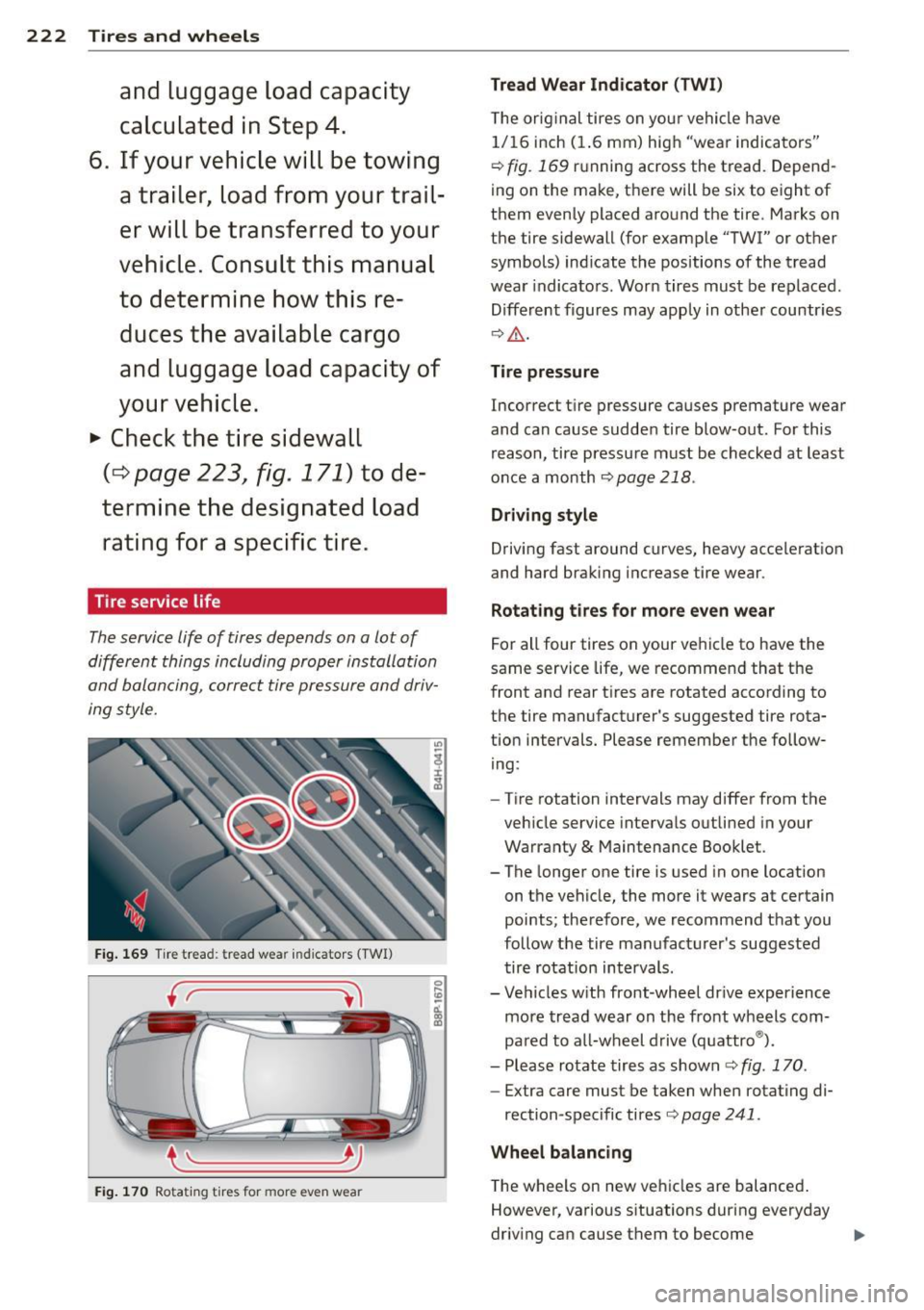
Fig. 16 9 Tire tread: trea d wea r in di cators (TWI)
fr
Fig. 1 70 Rotat ing t ires for more even wear
Tread Wear Indicator (TWI)
The or ig inal tires on you r vehicle have
1/ 16 inch ( 1.6 mm) hig h "wear indica tors"
c::> fig. 169 ru nning across the tread . Depend
ing on the ma ke, there will be six to eight of
them even ly placed aro und the tire. Marks on
the tire sidewall (for example "TWI" or other
symbols) ind icate the positions of the tread
wear indica to rs. Wor n tires must be replaced .
Different figures may apply in other countr ies
c::> .&_ .
Tire pressure
Incor rect t ire pressure causes premature wea r
and can cause sudde n tire blow-out . For this
reason, tire pressu re must be checked at least
o nce a month
c::> page 218 .
Driving style
Driving fast around c urves , heavy accelerat ion
and hard braking increase tire wear .
Rotating tires for more even wear
F or all four tires on your ve hicle to have the
same service life, we recomme nd that the
front and rear tires are rotated accord ing to
the tire manufact urer's suggested tire rota
tion intervals. Please remembe r th e follow
i ng:
- T ire rotation intervals may differ from the
veh icle service intervals o utli ned in your
Warranty
& M ain tena nce Booklet .
- The longer one tire is used in one location
on t he vehicle, the more it wears at certain
points; the refore , we recommend that you
follow the tire man ufac turer's suggested
tir e rotat ion intervals.
- Vehi cles with front -wheel dr ive experience
more trea d wear on the fro nt wheels com
pa red to all-wheel d rive (q uattro ®).
- Please rotate tires as shown
c::> fig . 170 .
-Extra care must be taken when rotating di-
rection -spec ific tires
c::> page 241 .
Wheel balancing
The wheels on new ve hicles are balanced .
However, various s ituations during everyday
driv ing ca n cause them to become
...
Page 238 of 280

236 What do I do now?
-After installing the compact spare wheel,
the tire inflation pressure should be
checked and, if necessary, increased to
60 psi (4.2 bar).
- The load carrying capacity is marked on
the tire sidewalls and must not be ex
ceeded.
- After installing the compact spare wheel,
make sure that you remount the flat tire
in its storage area properly.
- The compact spare tire should be proper
ly remounted in its storage area as soon
as the standard road tire can be re placed .
- Because the compact spare tire was spe
cifically designed for your vehicle, it must not be used on any other vehicle .
Likewise, compact spare wheels from
other vehicles must not be used on your
vehicle.
- The compact spare tire must not be
mounted on any other wheels, nor must
standard tires, snow tires, wheel covers
or trim rings be used with the compact
spare wheel. If such use is attempted,
damage to these items or other vehicle
components may occur .
(D Tips
Check the inflation pressure of the com
pact spare tire (60 psi/4.2 bar) periodically
to keep the tire ready for use.
Wheel change
Before changing a wheel
Observe the following precautions for your
own and your passenger's safety when chang
ing a wheel .
.. After you experience a tire failure, pull the
car well away from moving traffic and try to
reach
level ground before you stop c:> ,&. .
.. All passengers should leave the car and
move to a safe location (for instance, behind
the guardrail)
c:> _&. .
.. Apply the parking brake firmly c:> _&. .
.. Move selector lever to position Pon an au
tomatic transmission ; put manual transmis
sion in
first gear c:> _&..
.. If you are towing a trailer : unhitch the trail
e r from your vehicle.
.. Take the
tool and the spare tire c:> page 234
out of the luggage compartment .
.&, WARNING
You or your passengers could be injured
while changing a wheel if you do not fol
low these safety precautions:
- If you have a flat tire, move a safe dis
tance off the road. Turn off the engine,
turn the emergency flasher on and use
other warning devices to alert other mo
torists.
- Make sure that passengers wait in a safe place away from the vehicle and well
away from the roadway and traffic .
- To help prevent the vehicle from moving suddenly and possibly slipping off the
jack, always fully set the parking brake
and block the wheel diagonally opposite
the wheel being changed. When one
front wheel is lifted off the ground, plac
ing the automatic transmission in "P"
(Park) , or engaging a gear in a manual
transmission will
not prevent the vehicle
from moving.
- Before you change a wheel, be sure the
ground is level and firm. If necessary,
use a sturdy board under the jack.
- After installing the spare wheel, make
sure that you remount the flat tire/wheel
in its storage area properly and tighten
the knurled retaining screw securely.
Changing a wheel
-
When you change a wheel, follow these
quence described below step-by-step and ex
actly in that order .
1. Remove the decorative wheel cover*. For
more details see also
c:> page 23 7, Deco
rative wheel covers
or c:> page 238,
Wheels with cap-covered wheel bolts.
Page 250 of 280

248 Emergency situations
Emergency situations
General
This chapter is intended for trained emer
gency crews and working per sonnel who
have the necessary tools and equ ipment to
perform these ope rations.
Starting by pushing or
towing
Q;) Note
Vehicle s with an automati c transmission
cannot be started by pushing or towing .
Starting with jumper
cables
Jumper cable: Note the manufacturer's infor
mation.
If th e battery is d ischa rged, another vehicle
can provide starting assistance. For this you
req uire a j umper cab le . Both batteries m ust
have the same voltage (V) and a s imilar ca
pac ity (Ah).
Jumper cables
Use only jumper cab les of sufficiently
large cross section to safely carry the sta rter
cur rent. Refer to the manufacturer 's specifica
ti ons.
Use on ly jumper cables with
isola ted termina l
clamps an d properly marke d for distinction :
plus(+) cable in most cases colo red red
minu s(-) cable
in most cases colo red black .
The wire cross section must be at least
0.038 in
2 (25 mm2 ) for gasoline eng ines and
at least 0.054 in
2 (35 mm2
) for diese l en
gines .
A WARNING
Batte ries co ntain e lec tricity, ac id, a nd gas .
Any of these can cause ve ry ser io us or fatal i
njury . Follow the instructions below for
safe handling o f your vehicle's battery.
- Always shie ld your eyes and avo id lean-
ing over the battery wheneve r poss ib le.
- A discharged battery can a lready freeze
at temperatures just be low 32 °F (0 °() .
N ever attempt to provide start ing ass is
tance on a frozen or thawed out batte ry -
Da nger of explosion and chemical burns!
Replace a battery if it has bee n froze n.
- Do not allow battery acid to contact eyes
or skin . Fl ush a ny con tacted a rea with
wa te r immediat ely .
- Imp rope r use of a booster battery to
start a vehicle may cause an ex plosion .
- Vehicle batter ies ge nerate explosive gas
e s . K eep spar ks, flame and lighted c iga
r e ttes away from ba tteries.
- Do not try to ju mp start a ny ve hicle w it h
a low ac id leve l in the battery .
- The vo ltage of the bo oste r batte ry m ust
a lso have a 12-Vo lt rat ing. T he capacity
(A h) of the booste r battery sho uld not b e
lowe r than that of the discharged bat
tery . U se o f batte rie s of d iffe ren t voltage
or subs tan tia lly diffe ren t "Ah" rat ing
may c ause an exp losion and person al in
jury .
- N ever ch arge a fr oze n b atte ry. Gas t rap
ped in the i ce may c ause an ex plosion .
- N ever ch arge or use a batt ery th at h as
been frozen . T he battery case may have
be weake ned.
- Us e of batt erie s of diff ere nt vol tage or
subs tanti ally diff eren t ca pac ity (Ah) rat
in g may cause an exp losion and injury.
The ca pac ity ( Ah) of the booster battery
should not be lower than that of the dis
charged batte ry.
- Before you check anythin g in the engine
compa rtment, always read and heed a ll
WAR NIN GS¢
page 187, Engine com
partment.
Page 253 of 280

securely connect the minus(- ) cable to
either a massive metal component that
i s firm ly bolted to the eng ine b lock or to
the engine block itself. If the battery
that is being charged does not ve nt to
the outside, escaping battery gas cou ld
i gnite and explode!
Emergency towing
with commercial tow
truck
General hints
Your Audi requires special handling for tow
ing .
The fol low ing information is to be used by
commercial tow truck operators who know how to ope rate their equipment safe ly.
- Never to w your Audi, towing will cause
damage to the engine and t ransmission.
- Never wrap the safety chain s or winch ca
bles around the br ake lines.
- To pre vent unnecessary damage , you r Audi
must be transported with a car carrie r (flat
bed truck ).
- To load the vehicle on to the flat bed, use
the towing loop found in the veh icle tools
and attach to the front or rear anchorag e
¢page 251 and ¢page 252.
..&, WARNING
A vehicle being towed is not saf e for pas
senge rs. Never a llow anyone to r ide in a
vehicle being towed, for any re ason.
Emergenc y situ ation s 251
Front towing loop
Do not install the front towing loop until it is
needed .
Fig . 194 Fro nt bu mper: re m ov ing t he cover ca p
Fig. 195 Fro nt bump er: s crew ing in t he tow ing loo p
The towing loop fits into the threaded hole lo
cated on the right s ide of the front b umper
and covered by a sma ll cover when not in use .
Note that the towing loop has
a left-h and
thread !
.,. Remove the tow ing loop from the vehicle
too lki t¢
pag e 234 .
.. Press on the bottom edge of the cover cap
to disengage and take it out of the bumper.
T he cap rema ins connected to the bumper
¢fig . 194 .
.,. Inser t the tow ing loop into the threaded
hole
<=> fig . 195 and tur n it all the way in un
til it is seated securely, then tighten it with
t h e wheel bolt w rench .
When it is no longer needed, unscrew the
towing loop and put it back into the o n-boa rd
toolk it . Make su re to have the towing loop
stored in the vehicle at all times .