Page 521 of 621

Symbol Maintenance Main Items
A
●Replace engine oil
1
B
●Replace engine oil
1and oil filter
●Inspect front and rear brakes●Check parking brake adjustment●Inspect these items:●Tie rod ends, steering gear box, and boots●Suspension components●Driveshaft boots●Brake hoses and lines (including ABS/VSA)●All fluid levels and condition of fluids●Exhaust system
#
●Fuel lines and connections
#
1: If the message‘‘SERVICE DUE NOW’’does not appear more than
12 months after the display is reset, change the engine oil every
year.
#: See information on maintenance and emissions warranty in the
first column on page 512.
NOTE:
●Independent of the Maintenance Midner information, replace
the brake fluid every 3 years.●Inspect idle speed every 160,000 miles (256,000 km).●Adjust the valves during services A, B, 1, 2, or 3 if they are
noisy.Symbol Maintenance Sub Items
1
●Rotate tires
2●Replace air cleaner element
If you drive in dusty conditions, replace every 15,000
miles (24,000 km).●Replace dust and pollen filter
If you drive primarily in urban areas that have high
concentrations of soot in the air from industry and from
diesel-powered vehicles, replace every 15,000 miles
(24,000 km).●Inspect drive belt
3●Replace transmission and transfer fluid
4●Replace spark plugs●Replace timing belt and inspect water pump
If you drive regularly in very high temperatures (over
110°F, 43°C), in very low temperatures (under-20°F,-
29°C), or towing a trailer, replace every 60,000 miles (U.
S.)/100,000 km (Canada).●Inspect valve clearance
5●Replace engine coolant
6●Replace rear differential fluid
Driving in mountainous areas at very low vehicle
speeds or trailer towing results in higher level of
mechanical (shear) stress to fluid. This requires
differential fluid changes more frequently than
recommended by the Maintenance Minder. If you
regularly drive your vehicle under these conditions,
have the differential fluid changed at 7,500 miles (12,000
km), then every 15,000 miles (24,000 km).
Maintenance Minder
TM
Maintenance Minder
514
Page 522 of 621
POWER STEERING FLUID
(Red cap)
ENGINE COOLANT
RESERVOIR
WASHER FLUID
(Black cap)
ENGINE OIL DIPSTICK
(Orange loop)
RADIATOR CAPAUTOMATIC
TRANSMISSION
FLUID DIPSTICK
(Yellow loop) ENGINE OIL
FILL CAP BRAKE FLUID
(Black cap)
Fluid Locations
515
Maintenance
Page 532 of 621
Independent of the Maintenance
Midner information, replace the
brake fluid every 3 years.
Check the fluid level in the brake
fluid reservoir monthly.Always use Honda Heavy Duty
Brake Fluid DOT 3. If it is not
available, you should use only DOT 3
or DOT 4 fluid, from a sealed
container, as a temporary
replacement.
Using any non-Honda brake fluid can
cause corrosion and decrease the life
of the system. Have the brake
system flushed and refilled with
Honda Heavy Duty Brake Fluid DOT
3 as soon as possible.
Brake fluid marked DOT 5 is not
compatible with your vehicle's
braking system and can cause
extensive damage.
The fluid level should be between
the MIN and MAX marks on the side
of the reservoir. If the level is at or
below the MIN mark, your brake
system needs attention. Have the
brake system inspected for leaks or
worn brake pads.
MIN MAX
Brake Fluid
525
Maintenance
Page 540 of 621
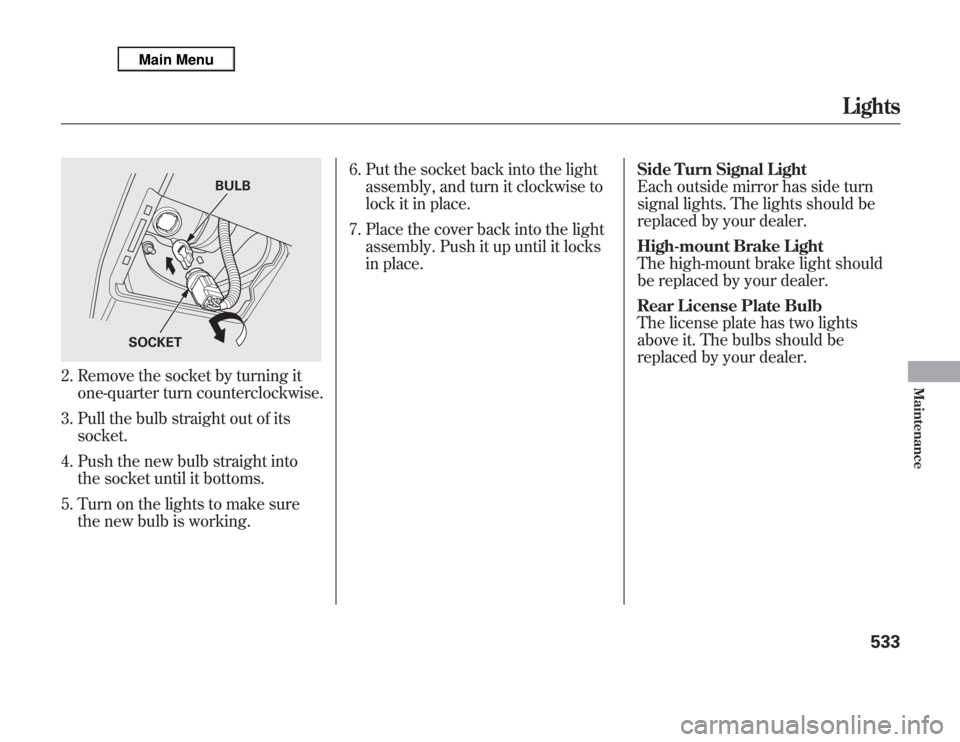
2. Remove the socket by turning it
one-quarter turn counterclockwise.
3. Pull the bulb straight out of its
socket.
4. Push the new bulb straight into
the socket until it bottoms.
5. Turn on the lights to make sure
the new bulb is working.6. Put the socket back into the light
assembly, and turn it clockwise to
lock it in place.
7. Place the cover back into the light
assembly. Push it up until it locks
in place.Side Turn Signal Light
Each outside mirror has side turn
signal lights. The lights should be
replaced by your dealer.
High-mount Brake Light
The high-mount brake light should
be replaced by your dealer.
Rear License Plate Bulb
The license plate has two lights
above it. The bulbs should be
replaced by your dealer.
BULB
SOCKET
Lights
533
Maintenance
Page 553 of 621

Snow Tires
If you mount snow tires on your
vehicle, make sure they are radial
tires of the same size and load range
as the original tires. Mount snow
tires on all four wheels. The traction
provided by snow tires on dry roads
may be lower than your original tires.
Check with the tire dealer for
maximum speed recommendations.
Tire Chains
Mount tire chains on your tires when
required by driving conditions or
local laws. Install them only on the
front tires.
Because your vehicle has limited tire
clearance, Acura strongly
recommends using the chains listed
below.
SCC Super Z-6#SC 435When installing chains, follow the
manufacturer's instructions and
mount them as tightly as you can.
Drive slowly with chains installed. If
you hear them contacting the body
or chassis, stop and investigate.
Make sure the chains are installed
tightly, and that they are not
contacting the brake lines or
suspension. Remove the chains as
soon as you start driving on cleared
roads.
Using the wrong chains, or not
properly installing chains, can
damage the brake lines and
cause a crash in which you can
be seriously injured or killed.
Follow all instructions in this
owner's manual regarding the
selection and use of tire chains.
Traction devices that are the wrong size
or improperly installed can damage
your vehicle's brake lines, suspension,
body, and wheels. Stop driving if they
are hitting any part of the vehicle.
Wheels
Clean the wheels as you would the
rest of the exterior. Wash them with
the same solution, and rinse them
thoroughly.
Aluminum alloy wheels have a
protective clear-coat that keeps the
aluminum from corroding and
tarnishing. Cleaning the wheels with
harsh chemicals (including some
commercial wheel cleaners) or a stiff
brush can damage the clear-coat. To
clean the wheels, use a mild
detergent and a soft brush or sponge.
Tires546
Page 555 of 621

If you need to park your vehicle for
an extended period (more than 1
month), there are several things you
should do to prepare it for storage.
Proper preparation helps prevent
deterioration and makes it easier to
get your vehicle back on the road. If
possible, store your vehicle indoors.●
Fill the fuel tank.
●
Wash and dry the exterior
completely.
●
Clean the interior. Make sure the
carpeting, floor mats, etc., are
completely dry.
●
Leave the parking brake off. Put
the transmission in Park.
●
Block the rear wheels.
●
If the vehicle is to be stored for a
longer period, it should be
supported on jackstands so the
tires are off the ground.
●
Leave one window open slightly (if
the vehicle is being stored
indoors).
●
Disconnect the battery.
●
Support the front and rear wiper
blade arms with a folded towel or
rag so they do not touch the
windshield.
●
To minimize sticking, apply a
silicone spray lubricant to all door
and tailgate seals. Also, apply a
vehicle body wax to the painted
surfaces that mate with the door
and tailgate seals.
●
Cover the vehicle with a
‘‘breathable’’cover, one made from
a porous material such as cotton.
Non-porous materials, such as
plastic sheeting, trap moisture,
which can damage the paint.
●
If possible, periodically run the
engine until it reaches full
operating temperature (the cooling
fans cycle on and off twice).
Preferably, do this once a month.
Vehicle Storage548
Page 556 of 621

This section covers the more
common problems that motorists
experience with their vehicles. It
gives you information about how to
safely evaluate the problem and what
to do to correct it. If the problem has
stranded you on the side of the road,
you may be able to get going again. If
not, you will also find instructions on
getting your vehicle towed.Compact Spare Tire
....................
550
Changing a Flat Tire
...................
551
If the Engine Won't Start
.............
557
Jump Starting
..............................
558
If the Engine Overheats
..............
560
Low Oil Pressure Indicator
.........
562
Charging System Indicator
.........
562
Malfunction Indicator Lamp
........
563
Brake System Indicator
...............
564
Fuses
..........................................
565
Fuse Locations
............................
569
Opening the Fuel Fill Door
Manually
.................................
572
Emergency Towing
.....................
572
If Your Vehicle Gets Stuck
..........
573
Taking Care of the Unexpected
549
Taking Care of the Unexpected
Page 558 of 621
If you have a flat tire while driving,
stop in a safe place to change it.
Drive slowly along the shoulder until
you get to an exit or an area to stop
that is far away from the traffic lanes.
The vehicle can easily roll off
the jack, seriously injuring
anyone underneath.
Follow the directions for
changing a tire exactly, and
never get under the vehicle
when it is supported only by the
jack.
1. Park the vehicle on firm, level, and
non-slippery ground. Put the
transmission in Park. Apply the
parking brake.
2. Turn on the hazard warning lights,
and turn the ignition switch to the
LOCK (0) position. Have all
passengers get out of the vehicle
while you change the tire.
3. Open the tailgate.4. Push the rear edge of the handle
to raise the handle loop and pull up
the loop to raise the cargo area
floor.
CARGO AREA
FLOOR
TOOLS
SPARE TIREJACK
CONTINUED
Changing a Flat Tire
551
Taking Care of the Unexpected