2011 YAMAHA YZ125LC lock
[x] Cancel search: lockPage 70 of 166
4-10
CARBURETOR AND REED VALVE
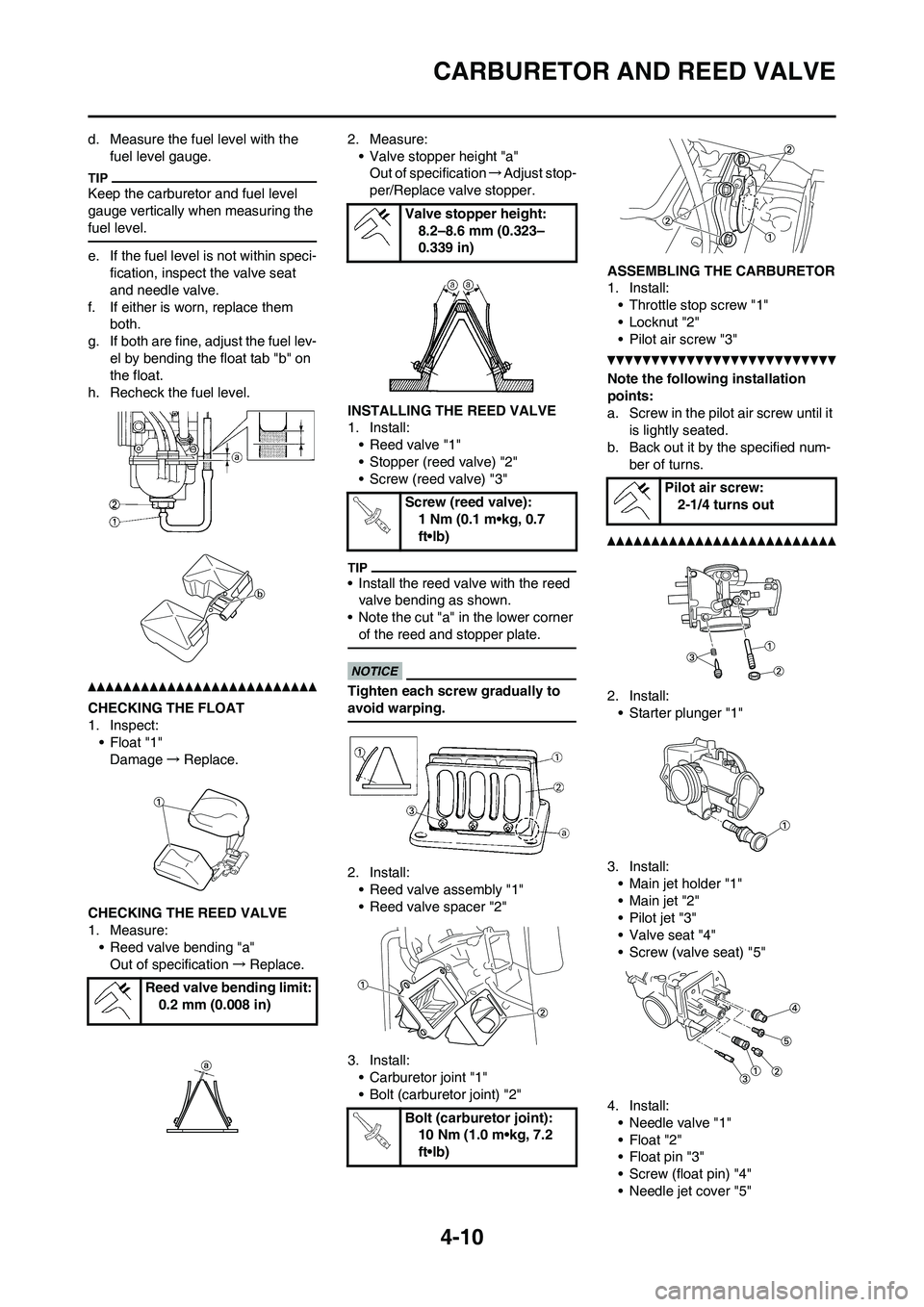
d. Measure the fuel level with the
fuel level gauge.
Keep the carburetor and fuel level
gauge vertically when measuring the
fuel level.
e. If the fuel level is not within speci-
fication, inspect the valve seat
and needle valve.
f. If either is worn, replace them
both.
g. If both are fine, adjust the fuel lev-
el by bending the float tab "b" on
the float.
h. Recheck the fuel level.
CHECKING THE FLOAT
1. Inspect:
• Float "1"
Damage→Replace.
CHECKING THE REED VALVE
1. Measure:
• Reed valve bending "a"
Out of specification→Replace.2. Measure:
• Valve stopper height "a"
Out of specification→Adjust stop-
per/Replace valve stopper.
INSTALLING THE REED VALVE
1. Install:
• Reed valve "1"
• Stopper (reed valve) "2"
• Screw (reed valve) "3"
• Install the reed valve with the reed
valve bending as shown.
• Note the cut "a" in the lower corner
of the reed and stopper plate.
Tighten each screw gradually to
avoid warping.
2. Install:
• Reed valve assembly "1"
• Reed valve spacer "2"
3. Install:
• Carburetor joint "1"
• Bolt (carburetor joint) "2"ASSEMBLING THE CARBURETOR
1. Install:
• Throttle stop screw "1"
• Locknut "2"
• Pilot air screw "3"
Note the following installation
points:
a. Screw in the pilot air screw until it
is lightly seated.
b. Back out it by the specified num-
ber of turns.
2. Install:
• Starter plunger "1"
3. Install:
• Main jet holder "1"
•Main jet "2"
• Pilot jet "3"
• Valve seat "4"
• Screw (valve seat) "5"
4. Install:
• Needle valve "1"
• Float "2"
• Float pin "3"
• Screw (float pin) "4"
• Needle jet cover "5" Reed valve bending limit:
0.2 mm (0.008 in)
Valve stopper height:
8.2–8.6 mm (0.323–
0.339 in)
Screw (reed valve):
1 Nm (0.1 m•kg, 0.7
ft•lb)
Bolt (carburetor joint):
10 Nm (1.0 m•kg, 7.2
ft•lb)
Pilot air screw:
2-1/4 turns out
Page 71 of 166
4-11
CARBURETOR AND REED VALVE
• After installing the needle valve to
the float, install them to the carbure-
tor.
• Check the float for smooth move-
ment.
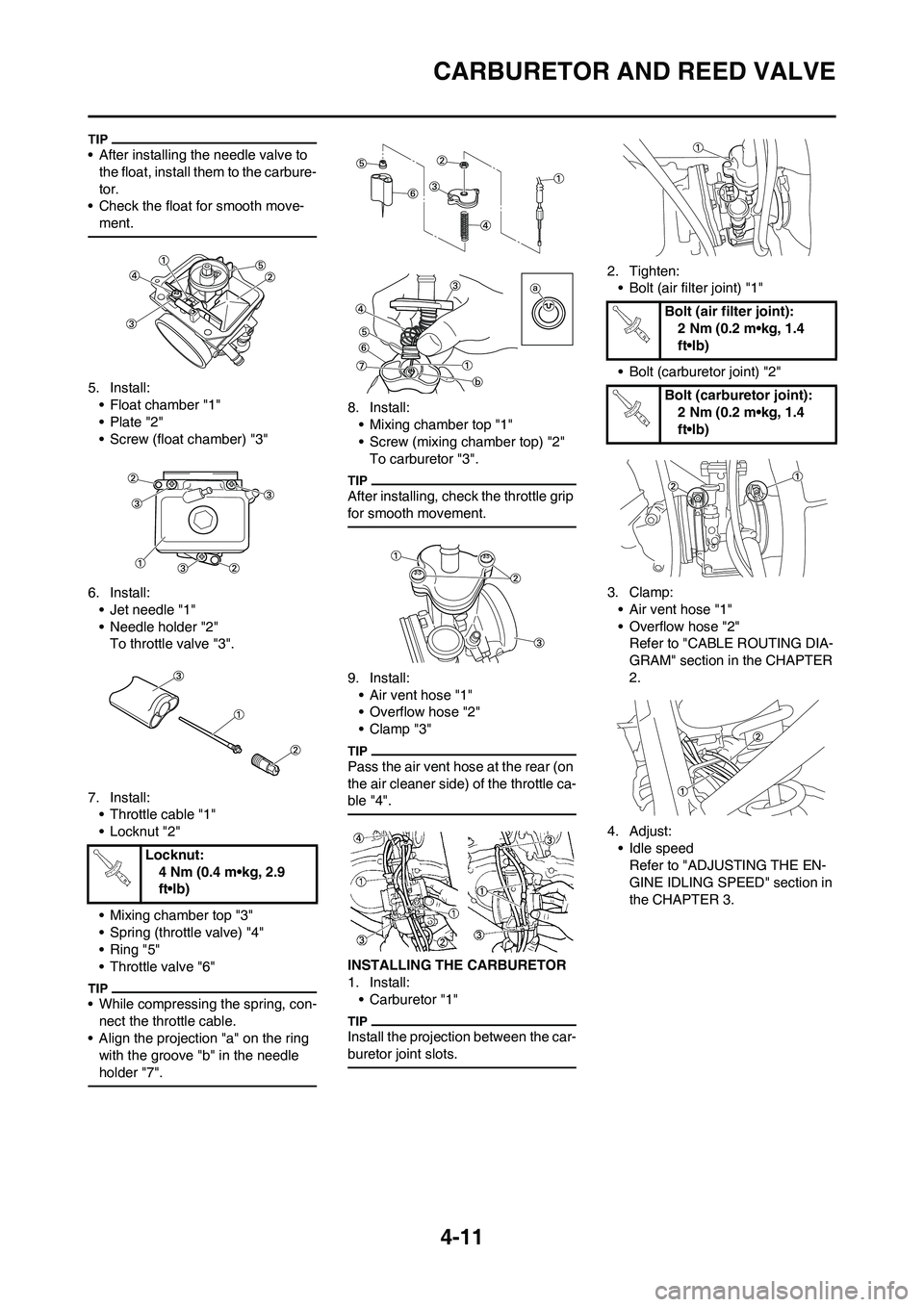
5. Install:
• Float chamber "1"
• Plate "2"
• Screw (float chamber) "3"
6. Install:
• Jet needle "1"
• Needle holder "2"
To throttle valve "3".
7. Install:
• Throttle cable "1"
• Locknut "2"
• Mixing chamber top "3"
• Spring (throttle valve) "4"
• Ring "5"
• Throttle valve "6"
• While compressing the spring, con-
nect the throttle cable.
• Align the projection "a" on the ring
with the groove "b" in the needle
holder "7".
8. Install:
• Mixing chamber top "1"
• Screw (mixing chamber top) "2"
To carburetor "3".
After installing, check the throttle grip
for smooth movement.
9. Install:
• Air vent hose "1"
• Overflow hose "2"
•Clamp "3"
Pass the air vent hose at the rear (on
the air cleaner side) of the throttle ca-
ble "4".
INSTALLING THE CARBURETOR
1. Install:
• Carburetor "1"
Install the projection between the car-
buretor joint slots.
2. Tighten:
• Bolt (air filter joint) "1"
• Bolt (carburetor joint) "2"
3. Clamp:
• Air vent hose "1"
• Overflow hose "2"
Refer to "CABLE ROUTING DIA-
GRAM" section in the CHAPTER
2.
4. Adjust:
• Idle speed
Refer to "ADJUSTING THE EN-
GINE IDLING SPEED" section in
the CHAPTER 3. Locknut:
4 Nm (0.4 m•kg, 2.9
ft•lb)
Bolt (air filter joint):
2 Nm (0.2 m•kg, 1.4
ft•lb)
Bolt (carburetor joint):
2 Nm (0.2 m•kg, 1.4
ft•lb)
Page 80 of 166
4-20
CLUTCH
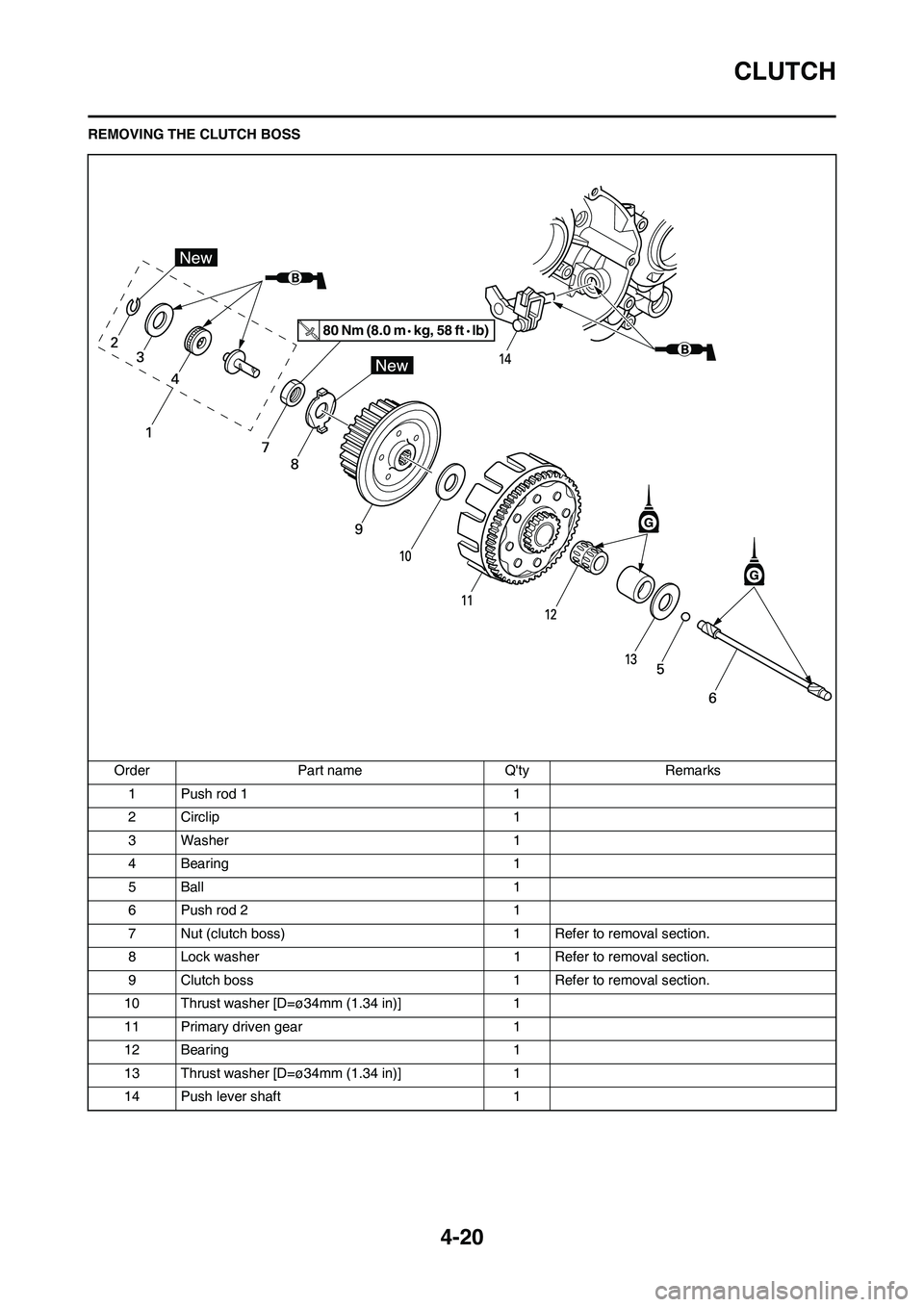
REMOVING THE CLUTCH BOSS
Order Part name Q'ty Remarks
1 Push rod 1 1
2 Circlip 1
3 Washer 1
4 Bearing 1
5Ball 1
6 Push rod 2 1
7 Nut (clutch boss) 1 Refer to removal section.
8 Lock washer 1 Refer to removal section.
9 Clutch boss 1 Refer to removal section.
10 Thrust washer [D=ø34mm (1.34 in)] 1
11 Primary driven gear 1
12 Bearing 1
13 Thrust washer [D=ø34mm (1.34 in)] 1
14 Push lever shaft 1
80 Nm (8.0 m kg, 58 ft lb)
Page 81 of 166
4-21
CLUTCH
REMOVING THE CLUTCH BOSS
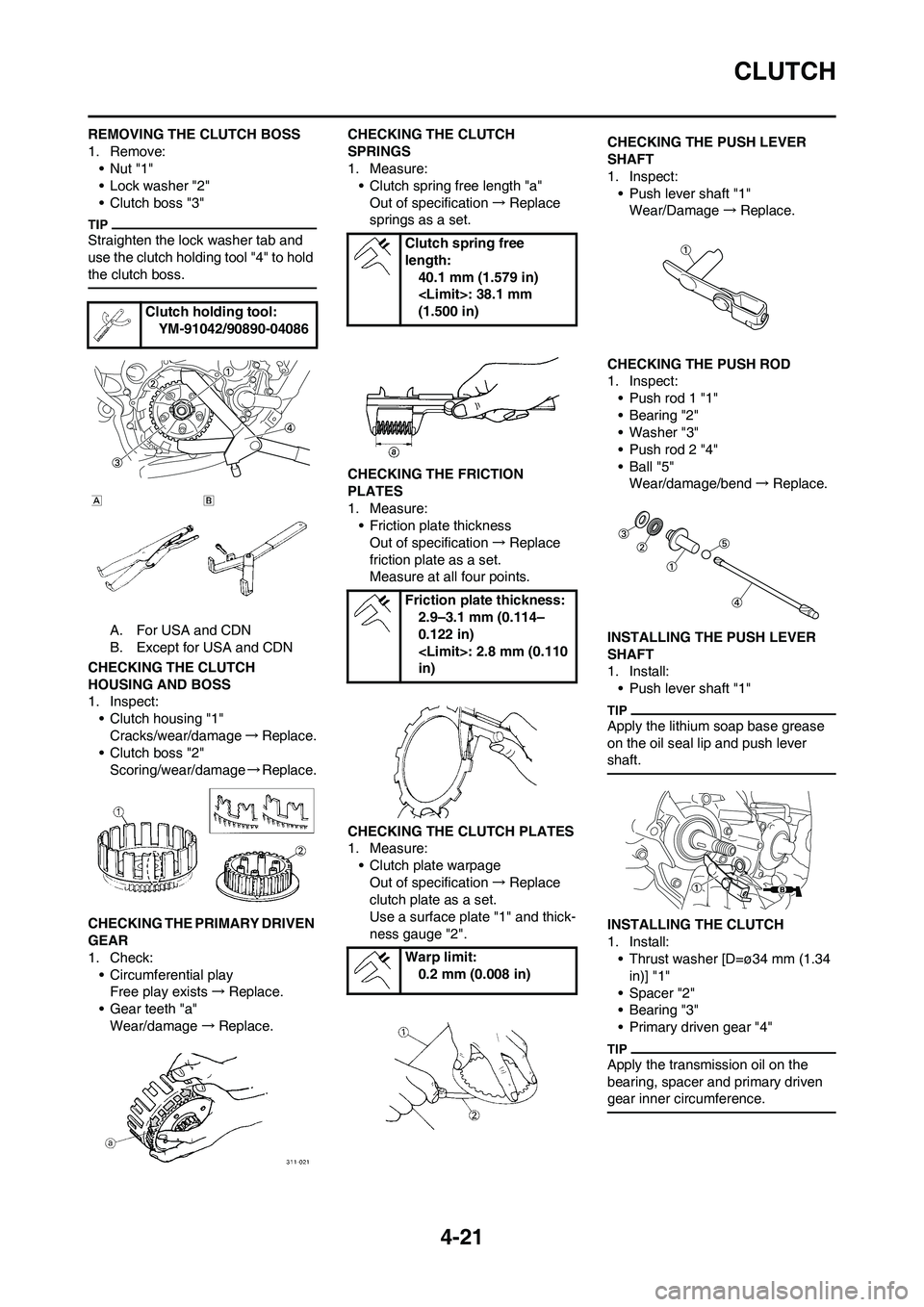
1. Remove:
•Nut "1"
• Lock washer "2"
• Clutch boss "3"
Straighten the lock washer tab and
use the clutch holding tool "4" to hold
the clutch boss.
A. For USA and CDN
B. Except for USA and CDN
CHECKING THE CLUTCH
HOUSING AND BOSS
1. Inspect:
• Clutch housing "1"
Cracks/wear/damage→Replace.
• Clutch boss "2"
Scoring/wear/damage→Replace.
CHECKING THE PRIMARY DRIVEN
GEAR
1. Check:
• Circumferential play
Free play exists→Replace.
• Gear teeth "a"
Wear/damage→Replace.CHECKING THE CLUTCH
SPRINGS
1. Measure:
• Clutch spring free length "a"
Out of specification→Replace
springs as a set.
CHECKING THE FRICTION
PLATES
1. Measure:
• Friction plate thickness
Out of specification→Replace
friction plate as a set.
Measure at all four points.
CHECKING THE CLUTCH PLATES
1. Measure:
• Clutch plate warpage
Out of specification→Replace
clutch plate as a set.
Use a surface plate "1" and thick-
ness gauge "2".CHECKING THE PUSH LEVER
SHAFT
1. Inspect:
• Push lever shaft "1"
Wear/Damage→Replace.
CHECKING THE PUSH ROD
1. Inspect:
• Push rod 1 "1"
• Bearing "2"
• Washer "3"
• Push rod 2 "4"
•Ball "5"
Wear/damage/bend→Replace.
INSTALLING THE PUSH LEVER
SHAFT
1. Install:
• Push lever shaft "1"
Apply the lithium soap base grease
on the oil seal lip and push lever
shaft.
INSTALLING THE CLUTCH
1. Install:
• Thrust washer [D=ø34 mm (1.34
in)] "1"
• Spacer "2"
• Bearing "3"
• Primary driven gear "4"
Apply the transmission oil on the
bearing, spacer and primary driven
gear inner circumference.
Clutch holding tool:
YM-91042/90890-04086
Clutch spring free
length:
40.1 mm (1.579 in)
(1.500 in)
Friction plate thickness:
2.9–3.1 mm (0.114–
0.122 in)
in)
Warp limit:
0.2 mm (0.008 in)
Page 82 of 166
![YAMAHA YZ125LC 2011 Owners Manual 4-22
CLUTCH
2. Install:
• Thrust washer [D=ø34 mm (1.34
in)] "1"
• Clutch boss "2"
3. Install:
• Lock washer "1"
• Nut (clutch boss) "2"
Use the clutch holding tool "3" to hold
the clutc](/manual-img/51/53908/w960_53908-81.png "YAMAHA YZ125LC 2011 Owners Manual 4-22
CLUTCH
2. Install:
• Thrust washer [D=ø34 mm (1.34
in)] \"1\"
• Clutch boss \"2\"
3. Install:
• Lock washer \"1\"
• Nut (clutch boss) \"2\"
Use the clutch holding tool \"3\" to hold
the clutc")
4-22
CLUTCH
2. Install:
• Thrust washer [D=ø34 mm (1.34
in)] "1"
• Clutch boss "2"
3. Install:
• Lock washer "1"
• Nut (clutch boss) "2"
Use the clutch holding tool "3" to hold
the clutch boss.
A. For USA and CDN
B. Except for USA and CDN
4. Bend the lock washer "1" tab.5. Install:
• Friction plate "1"
• Clutch plate "2"
• Install the clutch plates and friction
plates alternately on the clutch
boss, starting with a friction plate
and ending with a friction plate.
• Apply the transmission oil on the
friction plates and clutch plates.
6. Install:
•Bearing "1"
• Washer "2"
• Circlip "3"
To push rod 1 "4".
Apply the lithium soap base grease
on the bearing and washer.
7. Install:
• Push rod 2 "1"
• Ball "2"
• Push rod 1 "3"
Apply the transmission oil on the
push rod 1, 2 and ball.
8. Install:
• Pressure plate "1"9. Install:
• Clutch spring "1"
• Bolt (clutch spring) "2"
Tighten the bolts in stage, using a
crisscross pattern.
10. Install:
• Dowel pin "1"
• Gasket (clutch cover) "2"
11. Install:
• Clutch cover "1"
• Bolt (clutch cover)
Tighten the bolts in stage, using a
crisscross pattern.
12. Install:
• O-ring "1"
• Clutch cable "2"
Apply the lithium soap base grease
on the O-ring.
Nut (clutch boss):
80 Nm (8.0 m•kg, 58
ft•lb)
Clutch holding tool:
YM-91042/90890-04086
Bolt (clutch spring):
10 Nm (1.0 m•kg, 7.2
ft•lb)
Bolt (clutch cover):
10 Nm (1.0 m•kg, 7.2
ft•lb)
Page 86 of 166
4-26
KICK SHAFT AND SHIFT SHAFT
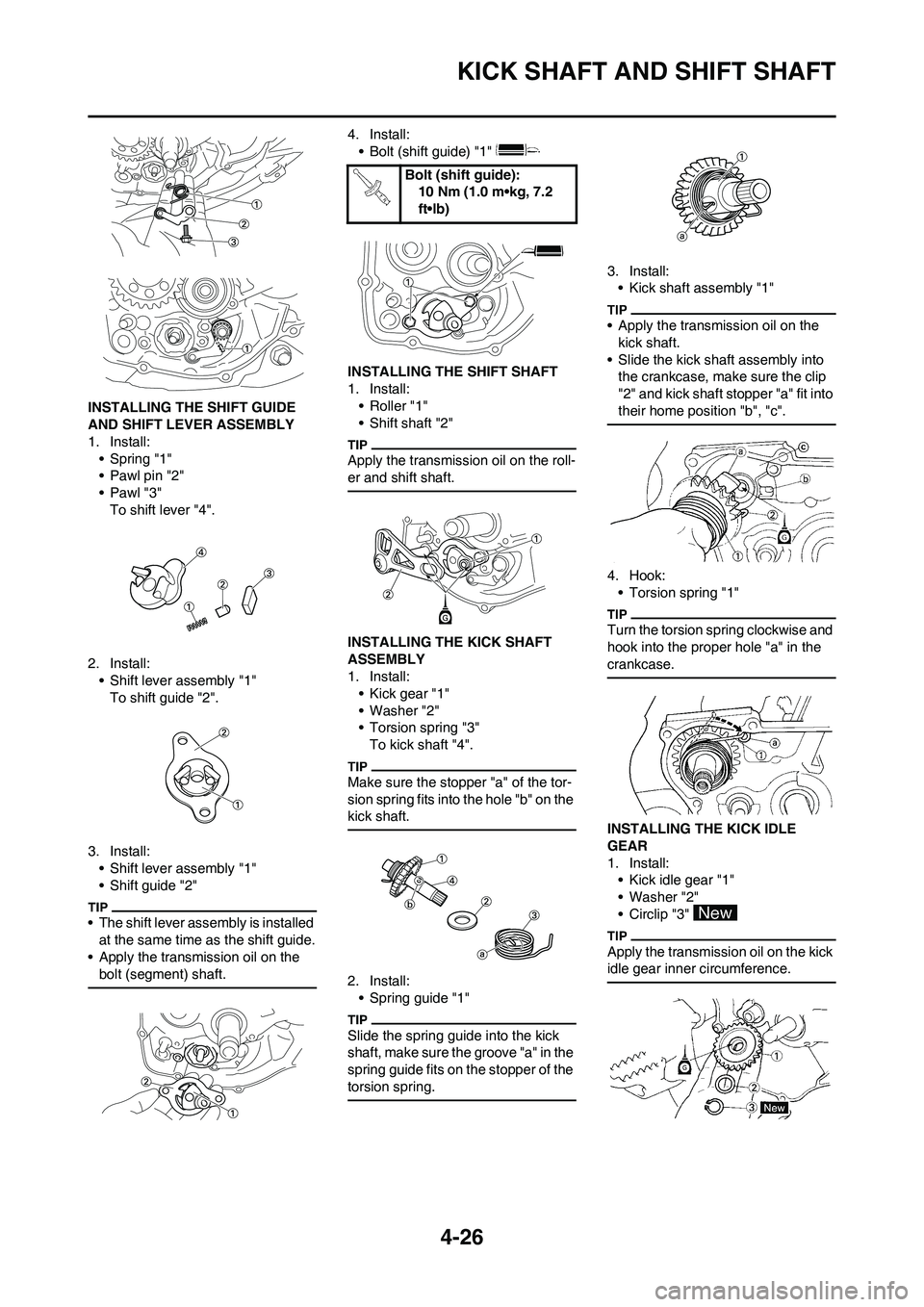
INSTALLING THE SHIFT GUIDE
AND SHIFT LEVER ASSEMBLY
1. Install:
• Spring "1"
• Pawl pin "2"
•Pawl "3"
To shift lever "4".
2. Install:
• Shift lever assembly "1"
To shift guide "2".
3. Install:
• Shift lever assembly "1"
• Shift guide "2"
• The shift lever assembly is installed
at the same time as the shift guide.
• Apply the transmission oil on the
bolt (segment) shaft.
4. Install:
• Bolt (shift guide) "1"
INSTALLING THE SHIFT SHAFT
1. Install:
• Roller "1"
• Shift shaft "2"
Apply the transmission oil on the roll-
er and shift shaft.
INSTALLING THE KICK SHAFT
ASSEMBLY
1. Install:
• Kick gear "1"
• Washer "2"
• Torsion spring "3"
To kick shaft "4".
Make sure the stopper "a" of the tor-
sion spring fits into the hole "b" on the
kick shaft.
2. Install:
• Spring guide "1"
Slide the spring guide into the kick
shaft, make sure the groove "a" in the
spring guide fits on the stopper of the
torsion spring.
3. Install:
• Kick shaft assembly "1"
• Apply the transmission oil on the
kick shaft.
• Slide the kick shaft assembly into
the crankcase, make sure the clip
"2" and kick shaft stopper "a" fit into
their home position "b", "c".
4. Hook:
• Torsion spring "1"
Turn the torsion spring clockwise and
hook into the proper hole "a" in the
crankcase.
INSTALLING THE KICK IDLE
GEAR
1. Install:
• Kick idle gear "1"
• Washer "2"
• Circlip "3"
Apply the transmission oil on the kick
idle gear inner circumference.
Bolt (shift guide):
10 Nm (1.0 m•kg, 7.2
ft•lb)
Page 87 of 166
4-27
KICK SHAFT AND SHIFT SHAFT
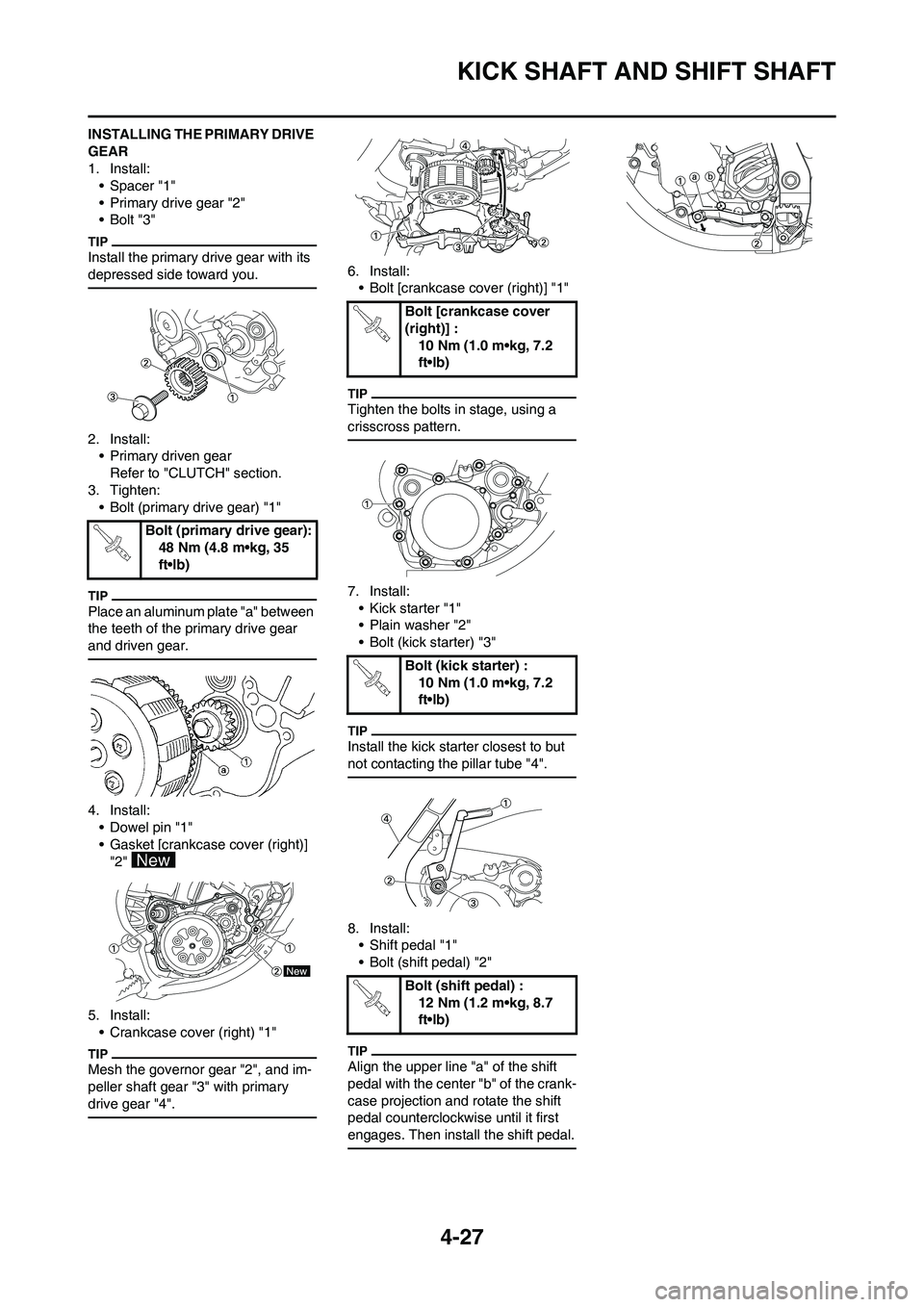
INSTALLING THE PRIMARY DRIVE
GEAR
1. Install:
• Spacer "1"
• Primary drive gear "2"
•Bolt "3"
Install the primary drive gear with its
depressed side toward you.
2. Install:
• Primary driven gear
Refer to "CLUTCH" section.
3. Tighten:
• Bolt (primary drive gear) "1"
Place an aluminum plate "a" between
the teeth of the primary drive gear
and driven gear.
4. Install:
• Dowel pin "1"
• Gasket [crankcase cover (right)]
"2"
5. Install:
• Crankcase cover (right) "1"
Mesh the governor gear "2", and im-
peller shaft gear "3" with primary
drive gear "4".
6. Install:
• Bolt [crankcase cover (right)] "1"
Tighten the bolts in stage, using a
crisscross pattern.
7. Install:
• Kick starter "1"
• Plain washer "2"
• Bolt (kick starter) "3"
Install the kick starter closest to but
not contacting the pillar tube "4".
8. Install:
• Shift pedal "1"
• Bolt (shift pedal) "2"
Align the upper line "a" of the shift
pedal with the center "b" of the crank-
case projection and rotate the shift
pedal counterclockwise until it first
engages. Then install the shift pedal.
Bolt (primary drive gear):
48 Nm (4.8 m•kg, 35
ft•lb)
Bolt [crankcase cover
(right)] :
10 Nm (1.0 m•kg, 7.2
ft•lb)
Bolt (kick starter) :
10 Nm (1.0 m•kg, 7.2
ft•lb)
Bolt (shift pedal) :
12 Nm (1.2 m•kg, 8.7
ft•lb)
Page 94 of 166
4-34
CDI MAGNETO
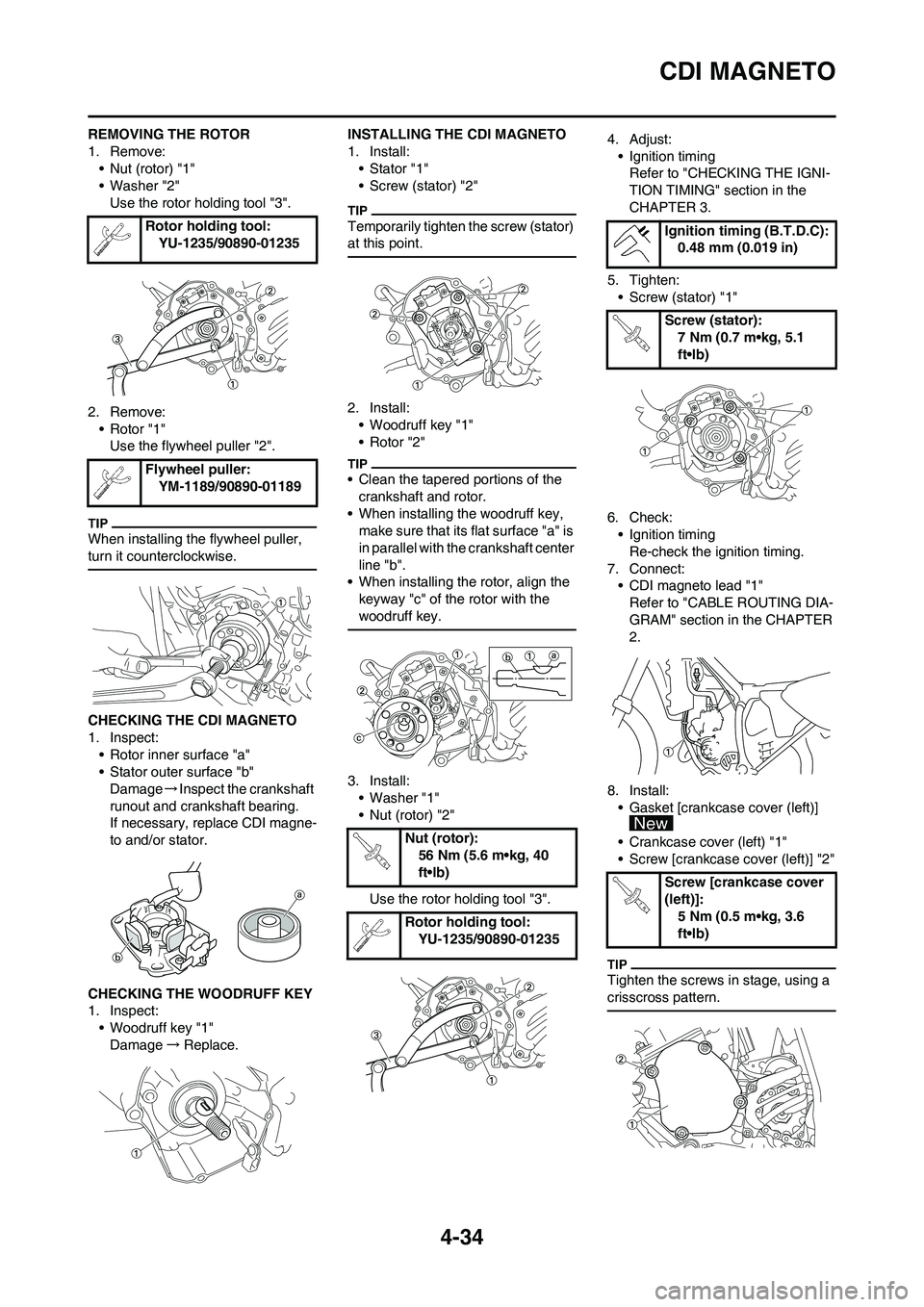
REMOVING THE ROTOR
1. Remove:
• Nut (rotor) "1"
• Washer "2"
Use the rotor holding tool "3".
2. Remove:
• Rotor "1"
Use the flywheel puller "2".
When installing the flywheel puller,
turn it counterclockwise.
CHECKING THE CDI MAGNETO
1. Inspect:
• Rotor inner surface "a"
• Stator outer surface "b"
Damage→Inspect the crankshaft
runout and crankshaft bearing.
If necessary, replace CDI magne-
to and/or stator.
CHECKING THE WOODRUFF KEY
1. Inspect:
• Woodruff key "1"
Damage→Replace.INSTALLING THE CDI MAGNETO
1. Install:
• Stator "1"
• Screw (stator) "2"
Temporarily tighten the screw (stator)
at this point.
2. Install:
• Woodruff key "1"
• Rotor "2"
• Clean the tapered portions of the
crankshaft and rotor.
• When installing the woodruff key,
make sure that its flat surface "a" is
in parallel with the crankshaft center
line "b".
• When installing the rotor, align the
keyway "c" of the rotor with the
woodruff key.
3. Install:
• Washer "1"
• Nut (rotor) "2"
Use the rotor holding tool "3".4. Adjust:
• Ignition timing
Refer to "CHECKING THE IGNI-
TION TIMING" section in the
CHAPTER 3.
5. Tighten:
• Screw (stator) "1"
6. Check:
• Ignition timing
Re-check the ignition timing.
7. Connect:
• CDI magneto lead "1"
Refer to "CABLE ROUTING DIA-
GRAM" section in the CHAPTER
2.
8. Install:
• Gasket [crankcase cover (left)]
• Crankcase cover (left) "1"
• Screw [crankcase cover (left)] "2"
Tighten the screws in stage, using a
crisscross pattern.
Rotor holding tool:
YU-1235/90890-01235
Flywheel puller:
YM-1189/90890-01189
Nut (rotor):
56 Nm (5.6 m•kg, 40
ft•lb)
Rotor holding tool:
YU-1235/90890-01235
Ignition timing (B.T.D.C):
0.48 mm (0.019 in)
Screw (stator):
7 Nm (0.7 m•kg, 5.1
ft•lb)
Screw [crankcase cover
(left)]:
5 Nm (0.5 m•kg, 3.6
ft•lb)