Page 53 of 140
6-7
6
NOTICEECB00220If any engine trouble should occur during the
engine break-in period, immediately have a
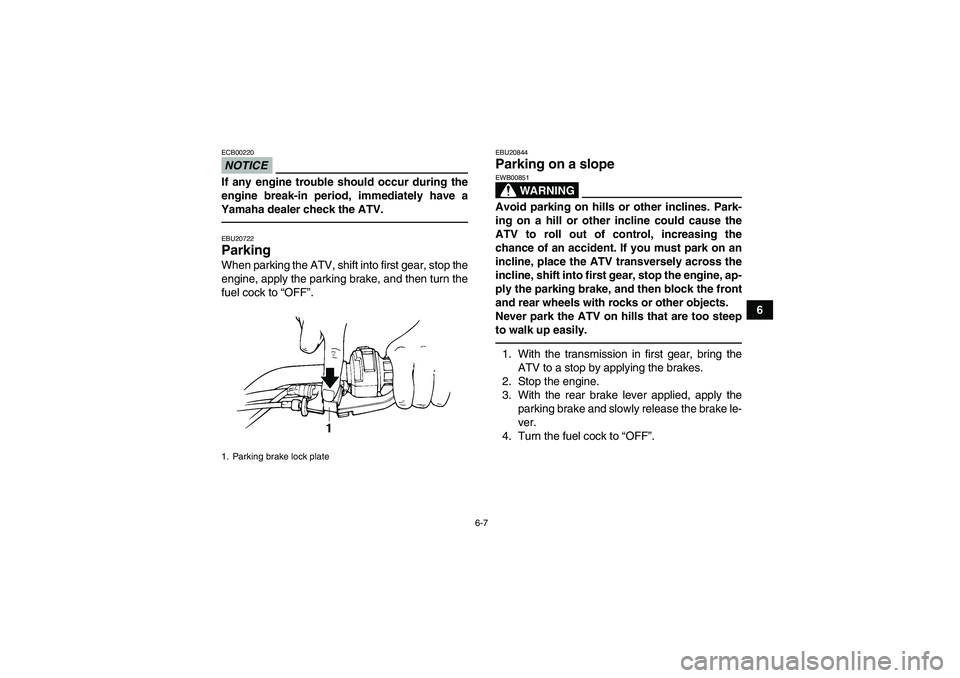
Yamaha dealer check the ATV.EBU20722Parking When parking the ATV, shift into first gear, stop the
engine, apply the parking brake, and then turn the
fuel cock to “OFF”.
EBU20844Parking on a slope
WARNING
EWB00851Avoid parking on hills or other inclines. Park-
ing on a hill or other incline could cause the
ATV to roll out of control, increasing the
chance of an accident. If you must park on an
incline, place the ATV transversely across the
incline, shift into first gear, stop the engine, ap-
ply the parking brake, and then block the front
and rear wheels with rocks or other objects.
Never park the ATV on hills that are too steep
to walk up easily.1. With the transmission in first gear, bring the
ATV to a stop by applying the brakes.
2. Stop the engine.
3. With the rear brake lever applied, apply the
parking brake and slowly release the brake le-
ver.
4. Turn the fuel cock to “OFF”.
1. Parking brake lock plateU1P066E0.book Page 7 Thursday, August 5, 2010 4:15 PM
Page 72 of 140
7-16
7If you are climbing a hill and you find that you have
not properly judged your ability to make it to the
top, you should turn the ATV around while you still
have forward motion (provided you have the room
to do so) and go down the hill.
If your ATV has stalled or stopped and you believe
you can continue up the hill, restart carefully to
make sure you do not lift the front wheels which
could cause you to lose control. If you are unable
to continue up the hill, dismount the ATV on the up-
hill side. Physically turn the ATV around and then
descend the hill.
If you start to roll backwards, DO NOT apply the
rear brake, and apply the front brake gradually.
The ATV could easily tip over backwards. When
fully stopped, apply the rear brake as well, and
then lock the parking brake. Dismount the ATV im-
mediately on the uphill side or to a side if pointed
straight uphill. Turn the ATV around and remount,
following the procedure described in the Owner’s
Manual. WARNING! Stalling, rolling backwards
or improperly dismounting while climbing a hill
could result in ATV overturning. If you cannot
control the ATV, dismount immediately on the
uphill side.
[EWB01802]
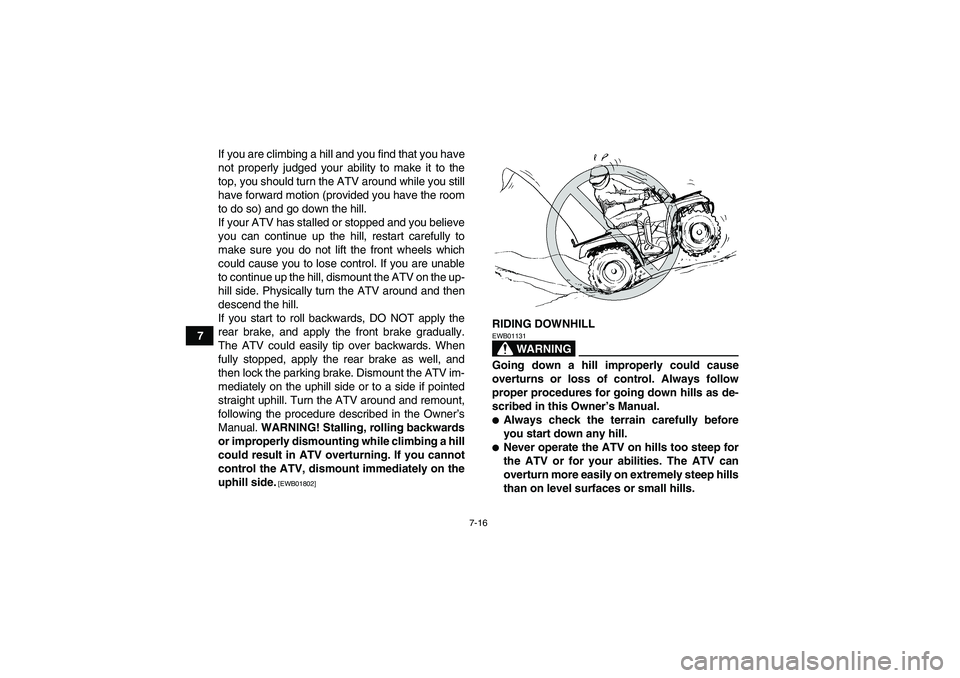
RIDING DOWNHILL
WARNING
EWB01131Going down a hill improperly could cause
overturns or loss of control. Always follow
proper procedures for going down hills as de-
scribed in this Owner’s Manual.�Always check the terrain carefully before
you start down any hill.�Never operate the ATV on hills too steep for
the ATV or for your abilities. The ATV can
overturn more easily on extremely steep hills
than on level surfaces or small hills.
U1P066E0.book Page 16 Thursday, August 5, 2010 4:15 PM
Page 106 of 140
8-27
8
TIPIf the specified idling speed cannot be obtained as
described above, have a Yamaha dealer make the
adjustment.EBU24047Adjusting the throttle lever free play The throttle lever free play should be checked and,
if necessary, adjusted at the intervals specified in
the periodic maintenance and lubrication chart.
The throttle lever free play should measure 3.0–
5.0 mm (0.12–0.20 in) as shown. Periodically
check the throttle lever free play and, if necessary,
adjust it as follows.TIPThe engine idling speed must be checked, and ad-
justed if necessary, before adjusting the throttle le-
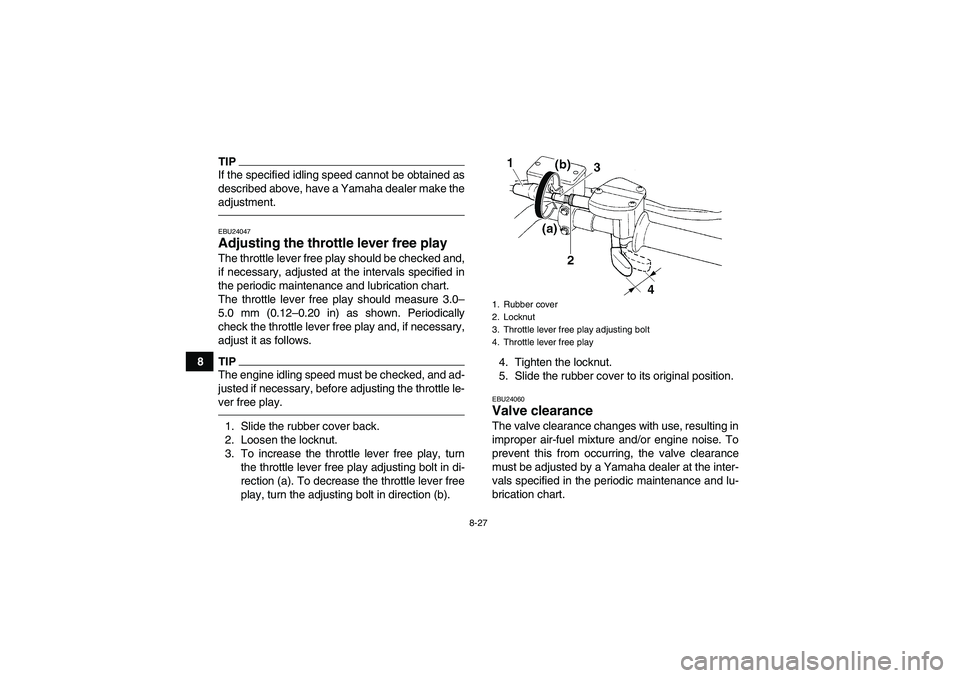
ver free play.1. Slide the rubber cover back.
2. Loosen the locknut.
3. To increase the throttle lever free play, turn
the throttle lever free play adjusting bolt in di-
rection (a). To decrease the throttle lever free
play, turn the adjusting bolt in direction (b).4. Tighten the locknut.
5. Slide the rubber cover to its original position.
EBU24060Valve clearance The valve clearance changes with use, resulting in
improper air-fuel mixture and/or engine noise. To
prevent this from occurring, the valve clearance
must be adjusted by a Yamaha dealer at the inter-
vals specified in the periodic maintenance and lu-
brication chart.1. Rubber cover
2. Locknut
3. Throttle lever free play adjusting bolt
4. Throttle lever free play
U1P066E0.book Page 27 Thursday, August 5, 2010 4:15 PM
Page 109 of 140
8-30
8
�Use only the recommended quality brake fluid,
otherwise the rubber seals may deteriorate,
causing leakage and poor braking performance.�Refill with the same type of brake fluid. Mixing
fluids may result in a harmful chemical reaction
and lead to poor braking performance.�Be careful that water does not enter the brake
fluid reservoir when refilling. Water will signifi-
cantly lower the boiling point of the fluid and may
result in vapor lock.�Brake fluid may deteriorate painted surfaces or
plastic parts. Always clean up spilled fluid imme-
diately.�As the brake pads wear, it is normal for the brake
fluid level to gradually go down. However, if the
brake fluid level goes down suddenly, have a
Yamaha dealer check the cause.EBU24281Changing the brake fluid Have a Yamaha dealer change the brake fluid at
the intervals specified in the TIP after the periodic
maintenance and lubrication chart. In addition,have the oil seals of the brake master cylinder and
calipers as well as the brake hoses replaced at the
intervals listed below or whenever they are dam-
aged or leaking.
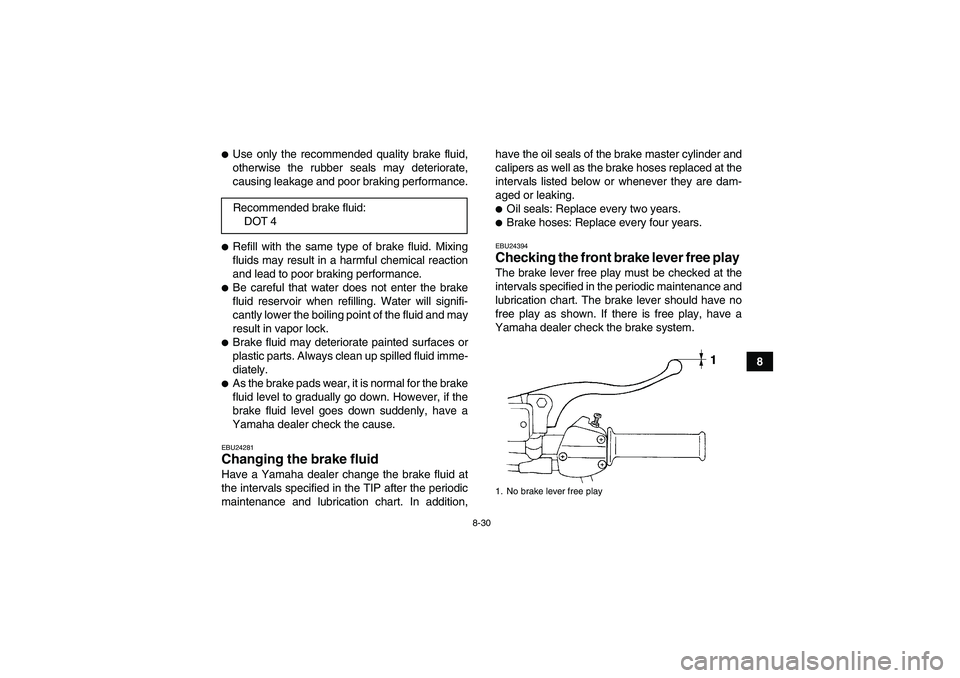
�Oil seals: Replace every two years.�Brake hoses: Replace every four years.EBU24394Checking the front brake lever free play The brake lever free play must be checked at the
intervals specified in the periodic maintenance and
lubrication chart. The brake lever should have no
free play as shown. If there is free play, have a
Yamaha dealer check the brake system. Recommended brake fluid:
DOT 41. No brake lever free play
U1P066E0.book Page 30 Thursday, August 5, 2010 4:15 PM
Page 110 of 140
8-31
8
EBU24575Adjusting the brake pedal height and
free play, and the rear brake lever free
play The brake pedal height and free play, and the
brake lever free play must be checked and, if nec-
essary, adjusted at the intervals specified in the
periodic maintenance and lubrication chart.TIP�Always perform this maintenance completely in
the following order whenever adjusting the rear
brake.�Before adjusting the brake pedal height and free
play, and the brake lever free play, check the
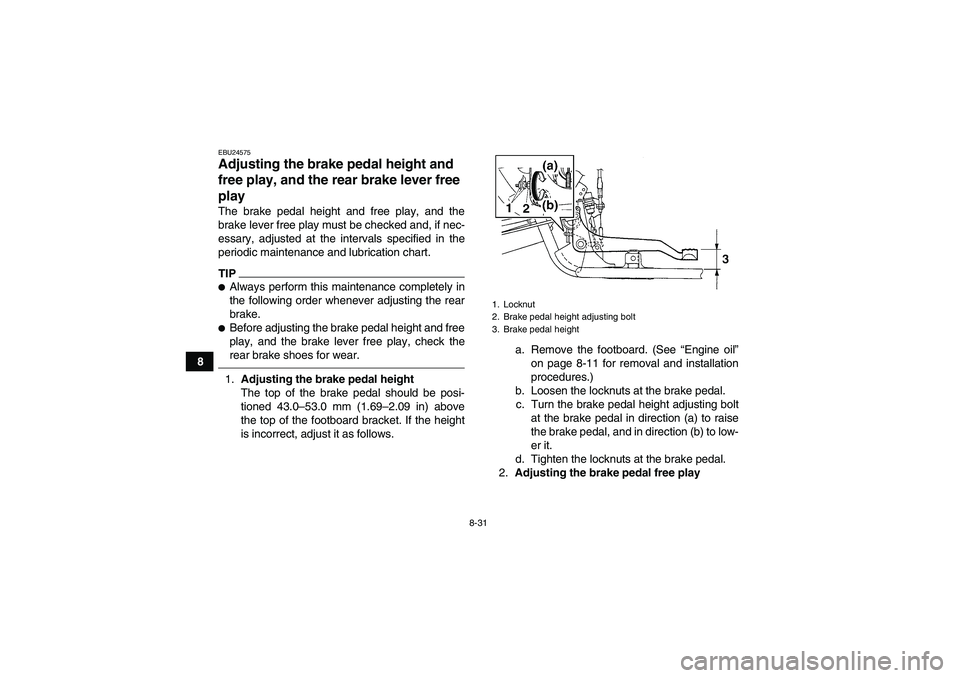
rear brake shoes for wear.1.Adjusting the brake pedal height
The top of the brake pedal should be posi-
tioned 43.0–53.0 mm (1.69–2.09 in) above
the top of the footboard bracket. If the height
is incorrect, adjust it as follows.a. Remove the footboard. (See “Engine oil”
on page 8-11 for removal and installation
procedures.)
b. Loosen the locknuts at the brake pedal.
c. Turn the brake pedal height adjusting bolt
at the brake pedal in direction (a) to raise
the brake pedal, and in direction (b) to low-
er it.
d. Tighten the locknuts at the brake pedal.
2.Adjusting the brake pedal free play
1. Locknut
2. Brake pedal height adjusting bolt
3. Brake pedal height
U1P066E0.book Page 31 Thursday, August 5, 2010 4:15 PM
Page 112 of 140
8-33
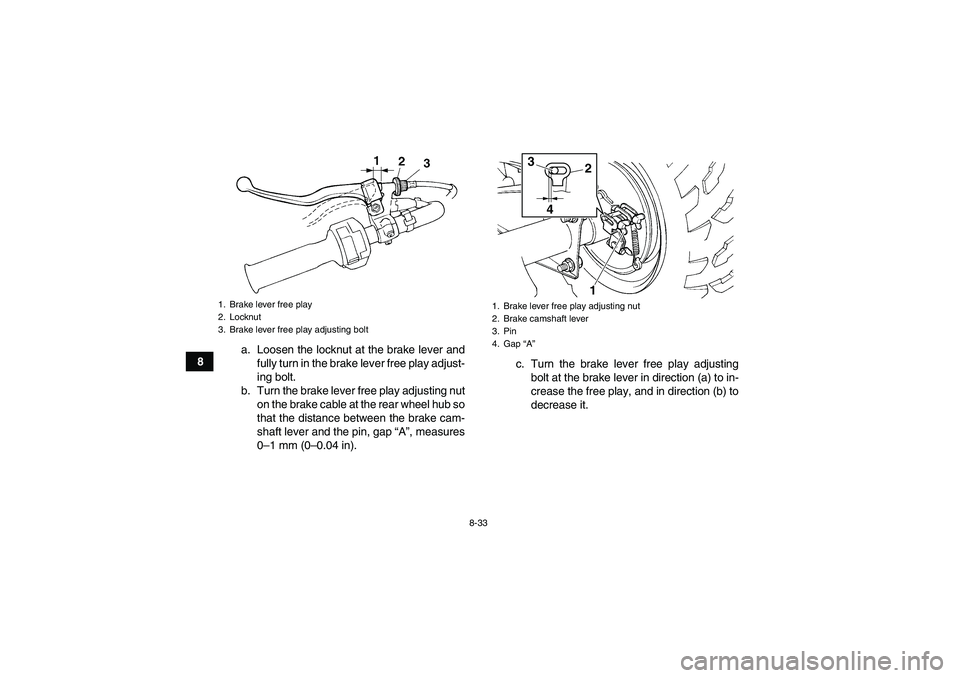
8a. Loosen the locknut at the brake lever and
fully turn in the brake lever free play adjust-
ing bolt.
b. Turn the brake lever free play adjusting nut
on the brake cable at the rear wheel hub so
that the distance between the brake cam-
shaft lever and the pin, gap “A”, measures
0–1 mm (0–0.04 in).c. Turn the brake lever free play adjusting
bolt at the brake lever in direction (a) to in-
crease the free play, and in direction (b) to
decrease it.
1. Brake lever free play
2. Locknut
3. Brake lever free play adjusting bolt
1. Brake lever free play adjusting nut
2. Brake camshaft lever
3. Pin
4. Gap “A”
2 31 4
U1P066E0.book Page 33 Thursday, August 5, 2010 4:15 PM
Page 113 of 140
8-34
8 d. Tighten the locknut at the brake lever.
e. Install the footboard.
TIPWhen adjusting the rear brake lever free play:�Be sure not to step on the brake pedal.�Make sure the brake pedal does not move.EBU24762Brake light switches The brake light, which is activated by the brake
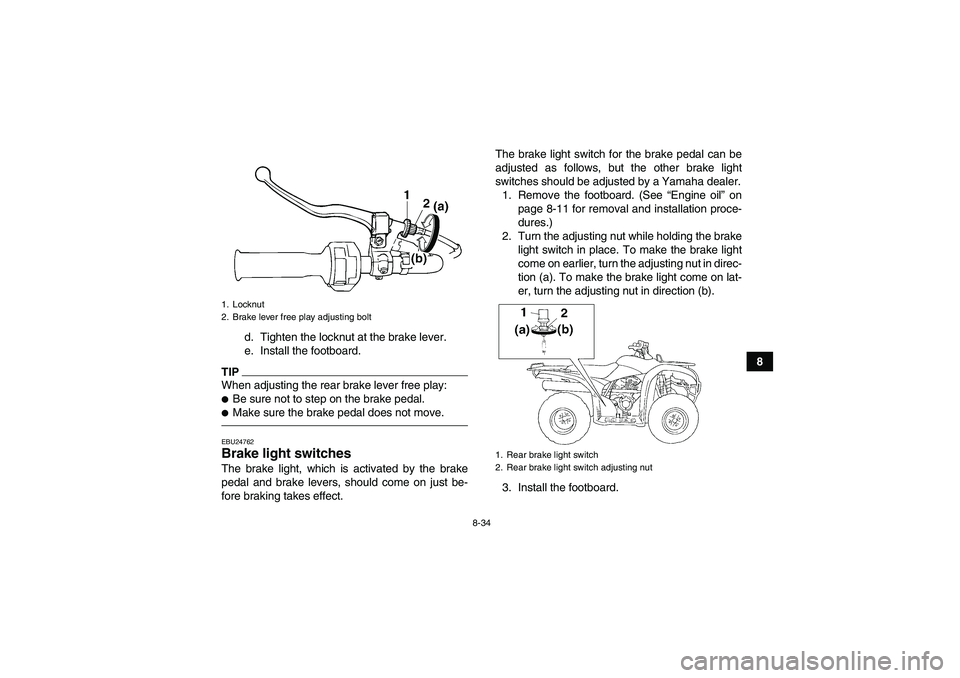
pedal and brake levers, should come on just be-
fore braking takes effect.The brake light switch for the brake pedal can be
adjusted as follows, but the other brake light
switches should be adjusted by a Yamaha dealer.
1. Remove the footboard. (See “Engine oil” on
page 8-11 for removal and installation proce-
dures.)
2. Turn the adjusting nut while holding the brake
light switch in place. To make the brake light
come on earlier, turn the adjusting nut in direc-
tion (a). To make the brake light come on lat-
er, turn the adjusting nut in direction (b).
3. Install the footboard.1. Locknut
2. Brake lever free play adjusting bolt
1. Rear brake light switch
2. Rear brake light switch adjusting nut
U1P066E0.book Page 34 Thursday, August 5, 2010 4:15 PM
Page 114 of 140
8-35
8
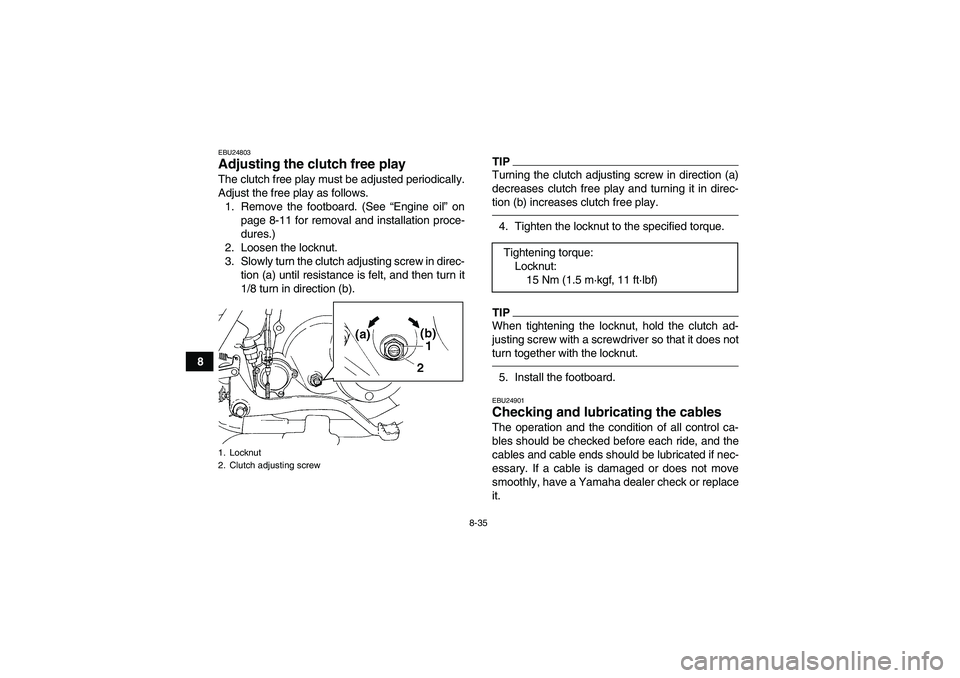
EBU24803Adjusting the clutch free play The clutch free play must be adjusted periodically.
Adjust the free play as follows.
1. Remove the footboard. (See “Engine oil” on
page 8-11 for removal and installation proce-
dures.)
2. Loosen the locknut.
3. Slowly turn the clutch adjusting screw in direc-
tion (a) until resistance is felt, and then turn it
1/8 turn in direction (b).
TIPTurning the clutch adjusting screw in direction (a)
decreases clutch free play and turning it in direc-
tion (b) increases clutch free play.4. Tighten the locknut to the specified torque.TIPWhen tightening the locknut, hold the clutch ad-
justing screw with a screwdriver so that it does not
turn together with the locknut.5. Install the footboard.EBU24901Checking and lubricating the cables The operation and the condition of all control ca-
bles should be checked before each ride, and the
cables and cable ends should be lubricated if nec-
essary. If a cable is damaged or does not move
smoothly, have a Yamaha dealer check or replace
it.
1. Locknut
2. Clutch adjusting screw
Tightening torque:
Locknut:
15 Nm (1.5 m·kgf, 11 ft·lbf)
U1P066E0.book Page 35 Thursday, August 5, 2010 4:15 PM