Page 77 of 148
7-20
1
2
3
4
5
67
8
9
10
11
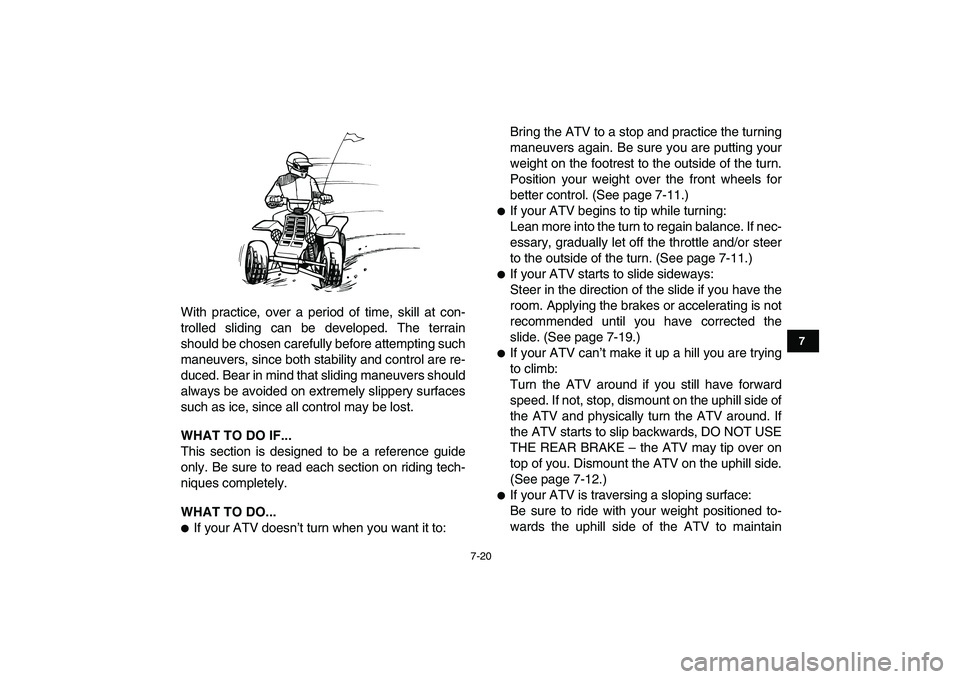
With practice, over a period of time, skill at con-
trolled sliding can be developed. The terrain
should be chosen carefully before attempting such
maneuvers, since both stability and control are re-
duced. Bear in mind that sliding maneuvers should
always be avoided on extremely slippery surfaces
such as ice, since all control may be lost.
WHAT TO DO IF...
This section is designed to be a reference guide
only. Be sure to read each section on riding tech-
niques completely.
WHAT TO DO...
�
If your ATV doesn’t turn when you want it to:Bring the ATV to a stop and practice the turning
maneuvers again. Be sure you are putting your
weight on the footrest to the outside of the turn.
Position your weight over the front wheels for
better control. (See page 7-11.)
�
If your ATV begins to tip while turning:
Lean more into the turn to regain balance. If nec-
essary, gradually let off the throttle and/or steer
to the outside of the turn. (See page 7-11.)
�
If your ATV starts to slide sideways:
Steer in the direction of the slide if you have the
room. Applying the brakes or accelerating is not
recommended until you have corrected the
slide. (See page 7-19.)
�
If your ATV can’t make it up a hill you are trying
to climb:
Turn the ATV around if you still have forward
speed. If not, stop, dismount on the uphill side of
the ATV and physically turn the ATV around. If
the ATV starts to slip backwards, DO NOT USE
THE REAR BRAKE – the ATV may tip over on
top of you. Dismount the ATV on the uphill side.
(See page 7-12.)
�
If your ATV is traversing a sloping surface:
Be sure to ride with your weight positioned to-
wards the uphill side of the ATV to maintain
Page 78 of 148
7-21
1
2
3
4
5
67
8
9
10
11
proper balance. If the ATV starts to tip, steer
down the hill (if there are no obstacles in your
way) to regain balance. If you discover that the
ATV is going to tip over, dismount on the uphill
side. (See page 7-16.)
�
If your ATV encounters shallow water:
Ride slowly and carefully through slow moving
water, watching for obstacles. Be sure to let wa-
ter drain from the ATV and CHECK YOUR
BRAKES FOR PROPER OPERATION when
you come out of the water. Do not continue to
ride your ATV until you have regained adequate
braking ability. (See page 7-17.)
Page 79 of 148
8-1
1
2
3
4
5
6
78
9
10
11
EBU28783
PERIODIC MAINTENANCE AND ADJUSTMENT
EBU21673
Periodic inspection, adjustment, and lubrication
will keep your vehicle in the safest and most effi-
cient condition possible. Safety is an obligation of
the vehicle owner/operator. The most important
points of vehicle inspection, adjustment, and lubri-
cation are explained on the following pages.
WARNING
EWB01841
Failure to properly maintain the vehicle or per-
forming maintenance activities incorrectly may
increase your risk of injury or death during ser-
vice or while using the vehicle. If you are not fa-
miliar with vehicle service, have a Yamaha
dealer perform the service.
WARNING
EWB02561
Turn off the engine when performing mainte-
nance unless otherwise specified.
�
A running engine has moving parts that can
catch on body parts or clothing and electri-
cal parts that can cause shocks or fires.
�
Running the engine while servicing can lead
to eye injury, burns, fire, or carbon monoxide
poisoning - possibly leading to death. See
page 2-1 for more information about carbon
monoxide.
WARNING
EWB02690
Brake discs, calipers, drums, and linings can
become very hot during use. To avoid possible
burns, let brake components cool before
touching them.
The intervals given in the periodic maintenance
charts should be considered as a general guide
under normal riding conditions. However, DE-
PENDING ON THE WEATHER, TERRAIN, GEO-
GRAPHICAL LOCATION, AND INDIVIDUAL
USE, THE MAINTENANCE INTERVALS MAY
NEED TO BE SHORTENED.
EBU21691
Owner’s manual and tool kit
Be sure to put this owner’s manual and the low-
pressure tire gauge in the plastic bag and always
Page 83 of 148

8-5
1
2
3
4
5
6
78
9
10
11
EBU21865
General maintenance and lubrication chart
TIP
�
For ATVs not equipped with an odometer or an hour meter, follow the month maintenance intervals.
�
For ATVs equipped with an odometer or an hour meter, follow the km (mi) or hours maintenance inter-
vals. However, keep in mind that if the ATV isn’t used for a long period of time, the month maintenance
intervals should be followed.
�
Items marked with an asterisk should be performed by a Yamaha dealer as they require special tools,
data and technical skills.
NO. ITEMCHECK OR MAINTENANCE
JOBINITIAL EVERY
Whichev-
er comes
firstmonth136612
km
(mi)320
(200)1300
(800)2500
(1600)2500
(1600)5000
(3200)
hours 20 80 160 160 3201 Air filter element
�
Clean and replace if necessary.Every 20–40 hours (more often in wet or
dusty areas)
2 * Clutch
�
Check operation and adjust if necessary.
√ √√√
3 * Front brake
�
Check operation and correct if necessary.
�
Check fluid level and ATV for fluid leakage, and
correct if necessary.
√√√√√
�
Replace brake pads. Whenever worn to the limit
4 * Rear brake
�
Check operation and correct if necessary.
�
Check brake pedal free play and adjust if neces-
sary.
�
Check fluid level and ATV for fluid leakage, and
correct if necessary.
√√√√√
�
Replace brake pads. Whenever worn to the limit
Page 84 of 148
8-6
1
2
3
4
5
6
78
9
10
11
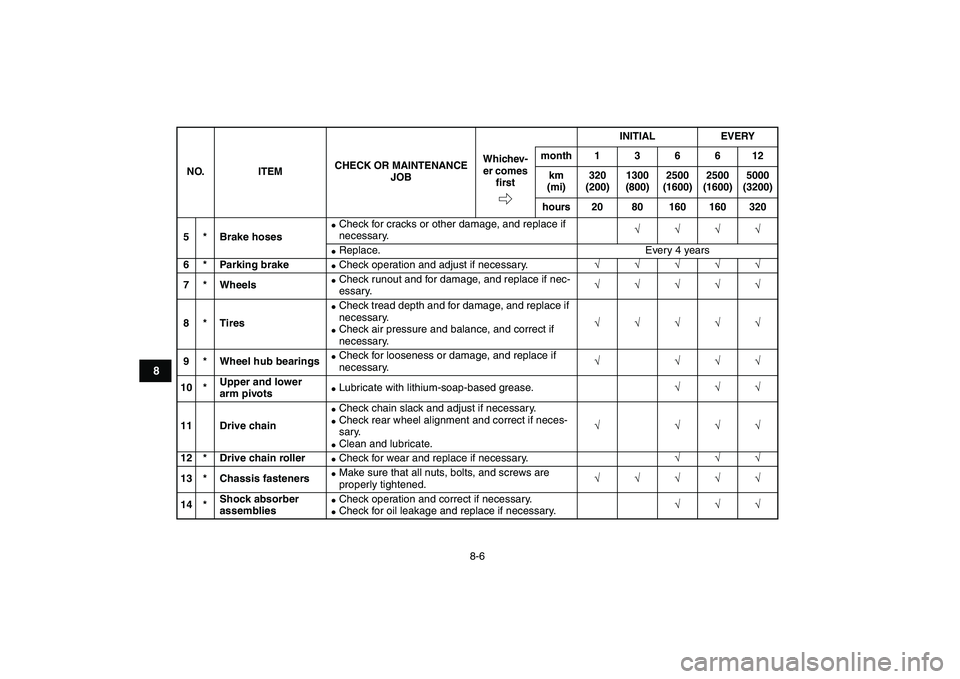
5 * Brake hoses
�
Check for cracks or other damage, and replace if
necessary.
√√√√
�
Replace. Every 4 years
6 * Parking brake
�
Check operation and adjust if necessary.
√√√√√
7 * Wheels
�
Check runout and for damage, and replace if nec-
essary.
√√√√√
8 * Tires
�
Check tread depth and for damage, and replace if
necessary.
�
Check air pressure and balance, and correct if
necessary.
√√√√√
9 * Wheel hub bearings
�
Check for looseness or damage, and replace if
necessary.
√ √√√
10 *Upper and lower
arm pivots
�
Lubricate with lithium-soap-based grease.
√√√
11 Drive chain
�
Check chain slack and adjust if necessary.
�
Check rear wheel alignment and correct if neces-
sary.
�
Clean and lubricate.
√ √√√
12 * Drive chain roller
�
Check for wear and replace if necessary.
√√√
13 * Chassis fasteners
�
Make sure that all nuts, bolts, and screws are
properly tightened.
√√√√√
14 *Shock absorber
assemblies
�
Check operation and correct if necessary.
�
Check for oil leakage and replace if necessary.
√√√
NO. ITEMCHECK OR MAINTENANCE
JOBINITIAL EVERY
Whichev-
er comes
firstmonth 1 3 6 6 12
km
(mi)320
(200)1300
(800)2500
(1600)2500
(1600)5000
(3200)
hours 20 80 160 160 320
Page 85 of 148
8-7
1
2
3
4
5
6
78
9
10
11
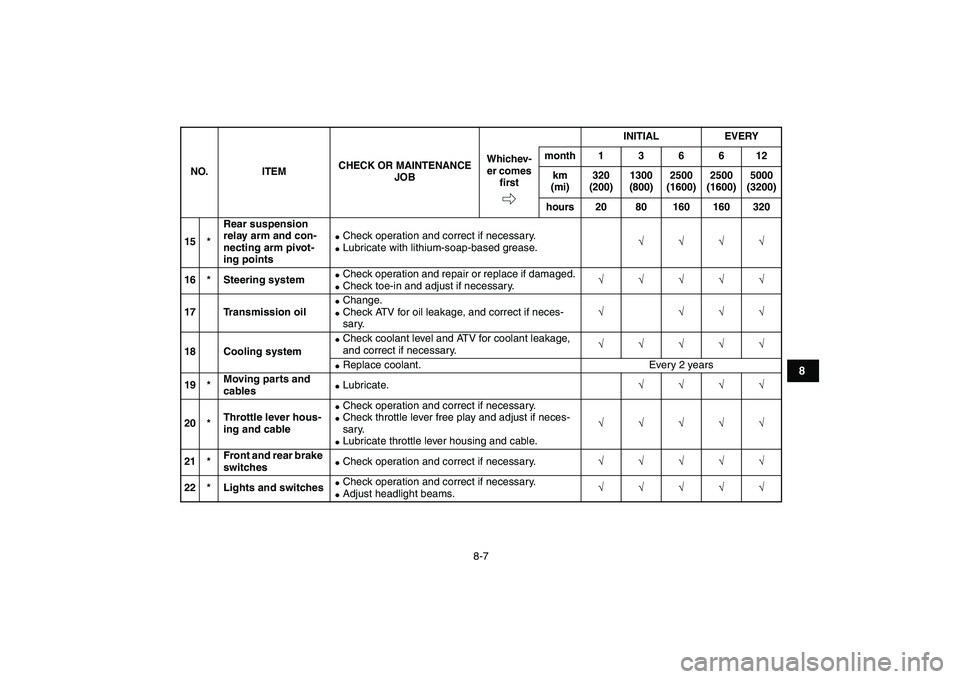
15 *Rear suspension
relay arm and con-
necting arm pivot-
ing points
�
Check operation and correct if necessary.
�
Lubricate with lithium-soap-based grease.
√√√√
16 * Steering system
�
Check operation and repair or replace if damaged.
�
Check toe-in and adjust if necessary.
√√√√√
17 Transmission oil
�
Change.
�
Check ATV for oil leakage, and correct if neces-
sary.
√ √√√
18 Cooling system
�
Check coolant level and ATV for coolant leakage,
and correct if necessary.
√√√√√
�
Replace coolant. Every 2 years
19 *Moving parts and
cables
�
Lubricate.
√√√√
20 *Throttle lever hous-
ing and cable
�
Check operation and correct if necessary.
�
Check throttle lever free play and adjust if neces-
sary.
�
Lubricate throttle lever housing and cable.
√√√√√
21 *Front and rear brake
switches
�
Check operation and correct if necessary.
√√√√√
22 * Lights and switches
�
Check operation and correct if necessary.
�
Adjust headlight beams.
√√√√√
NO. ITEMCHECK OR MAINTENANCE
JOBINITIAL EVERY
Whichev-
er comes
firstmonth136612
km
(mi)320
(200)1300
(800)2500
(1600)2500
(1600)5000
(3200)
hours 20 80 160 160 320
Page 86 of 148
8-8
1
2
3
4
5
6
78
9
10
11
EBU23071
TIP
�
Some maintenance items need more frequent service if you are riding in unusually wet, dusty, sandy or
muddy areas, or at full-throttle.
�
Hydraulic brake service
�
Regularly check and, if necessary, correct the brake fluid level.
�
Every two years replace the internal components of the brake master cylinders and calipers, and
change the brake fluid.
�
Replace the brake hoses every four years and if cracked or damaged.
Page 112 of 148
8-34
1
2
3
4
5
6
78
9
10
11
optimum engine performance.
TIP
If the specified idling speed cannot be obtained as
described above, have a Yamaha dealer make the
adjustment.
7. Install the seat.
EBU24047
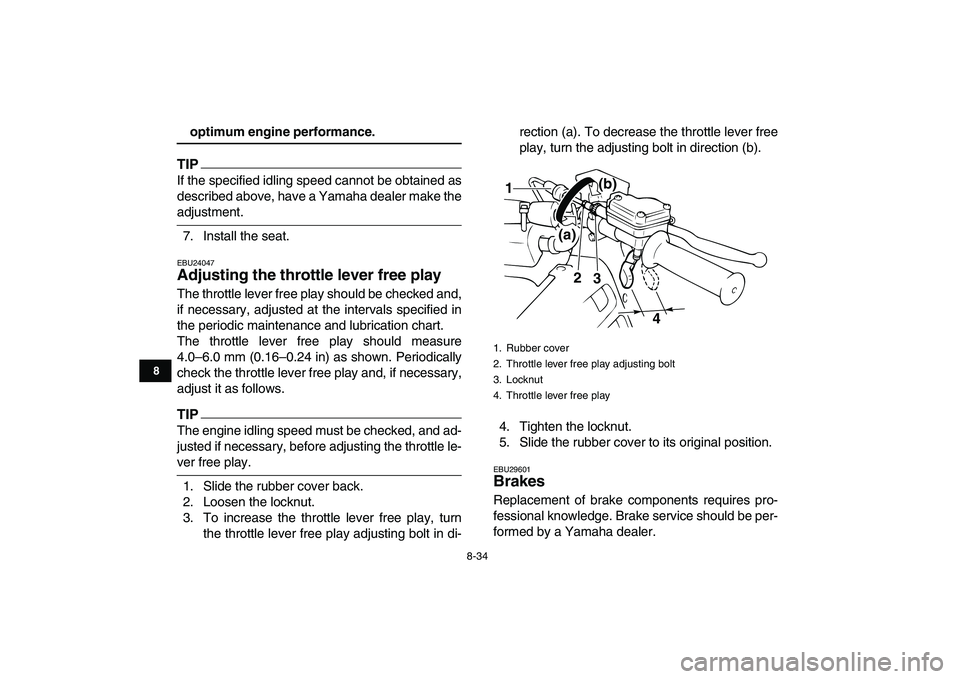
Adjusting the throttle lever free play
The throttle lever free play should be checked and,
if necessary, adjusted at the intervals specified in
the periodic maintenance and lubrication chart.
The throttle lever free play should measure
4.0–6.0 mm (0.16–0.24 in) as shown. Periodically
check the throttle lever free play and, if necessary,
adjust it as follows.
TIP
The engine idling speed must be checked, and ad-
justed if necessary, before adjusting the throttle le-
ver free play.
1. Slide the rubber cover back.
2. Loosen the locknut.
3. To increase the throttle lever free play, turn
the throttle lever free play adjusting bolt in di-rection (a). To decrease the throttle lever free
play, turn the adjusting bolt in direction (b).
4. Tighten the locknut.
5. Slide the rubber cover to its original position.
EBU29601
Brakes
Replacement of brake components requires pro-
fessional knowledge. Brake service should be per-
formed by a Yamaha dealer.
1. Rubber cover
2. Throttle lever free play adjusting bolt
3. Locknut
4. Throttle lever free play
2
3
4
(a)(b)
1