Page 36 of 148
4-11
1
2
34
5
6
7
8
9
10
11
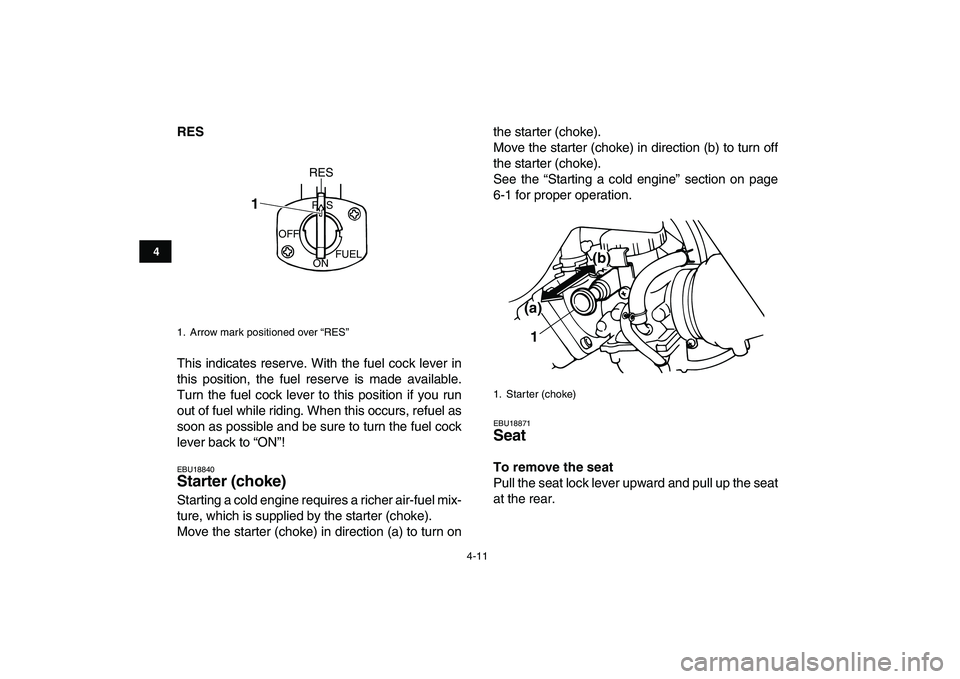
RES
This indicates reserve. With the fuel cock lever in
this position, the fuel reserve is made available.
Turn the fuel cock lever to this position if you run
out of fuel while riding. When this occurs, refuel as
soon as possible and be sure to turn the fuel cock
lever back to “ON”!
EBU18840
Starter (choke)
Starting a cold engine requires a richer air-fuel mix-
ture, which is supplied by the starter (choke).
Move the starter (choke) in direction (a) to turn onthe starter (choke).
Move the starter (choke) in direction (b) to turn off
the starter (choke).
See the “Starting a cold engine” section on page
6-1 for proper operation.
EBU18871
Seat
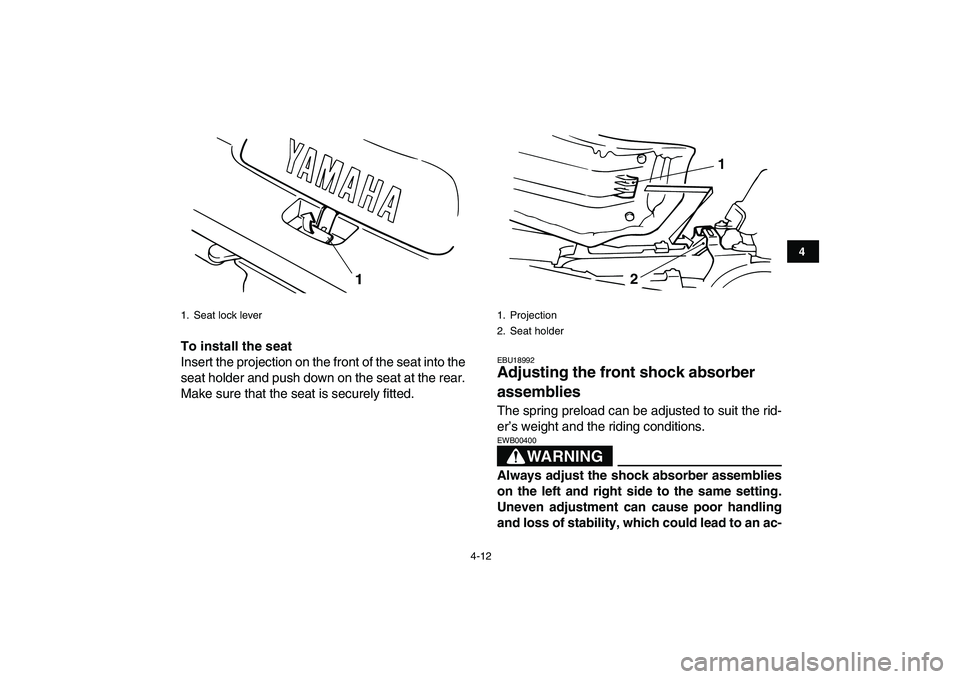
To remove the seat
Pull the seat lock lever upward and pull up the seat
at the rear.
1. Arrow mark positioned over “RES”
OFF
ONFUEL RES
RES
1
1. Starter (choke)1 (a)(b)
Page 37 of 148
4-12
1
2
34
5
6
7
8
9
10
11
To install the seat
Insert the projection on the front of the seat into the
seat holder and push down on the seat at the rear.
Make sure that the seat is securely fitted.
EBU18992
Adjusting the front shock absorber
assemblies
The spring preload can be adjusted to suit the rid-
er’s weight and the riding conditions.
WARNING
EWB00400
Always adjust the shock absorber assemblies
on the left and right side to the same setting.
Uneven adjustment can cause poor handling
and loss of stability, which could lead to an ac-
1. Seat lock lever
1
1. Projection
2. Seat holder
1
2
Page 39 of 148
4-14
1
2
34
5
6
7
8
9
10
11
NOTICE
ECB00090
Never turn an adjusting mechanism beyond
the minimum and maximum settings.
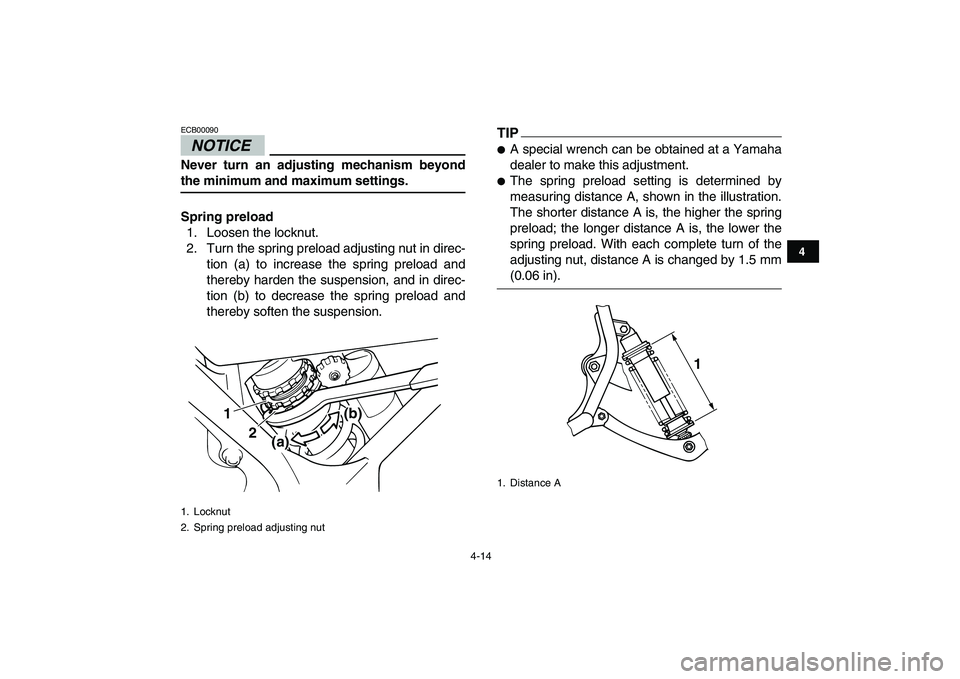
Spring preload
1. Loosen the locknut.
2. Turn the spring preload adjusting nut in direc-
tion (a) to increase the spring preload and
thereby harden the suspension, and in direc-
tion (b) to decrease the spring preload and
thereby soften the suspension.TIP
�
A special wrench can be obtained at a Yamaha
dealer to make this adjustment.
�
The spring preload setting is determined by
measuring distance A, shown in the illustration.
The shorter distance A is, the higher the spring
preload; the longer distance A is, the lower the
spring preload. With each complete turn of the
adjusting nut, distance A is changed by 1.5 mm
(0.06 in).
1. Locknut
2. Spring preload adjusting nut
1
2
(a)(b)
1. Distance A
1
Page 40 of 148
4-15
1
2
34
5
6
7
8
9
10
11
3. Tighten the locknut to the specified torque.
NOTICE:
Always tighten the locknut
against the adjusting nut, and then tighten
it to the specified torque.
[ECB00081]
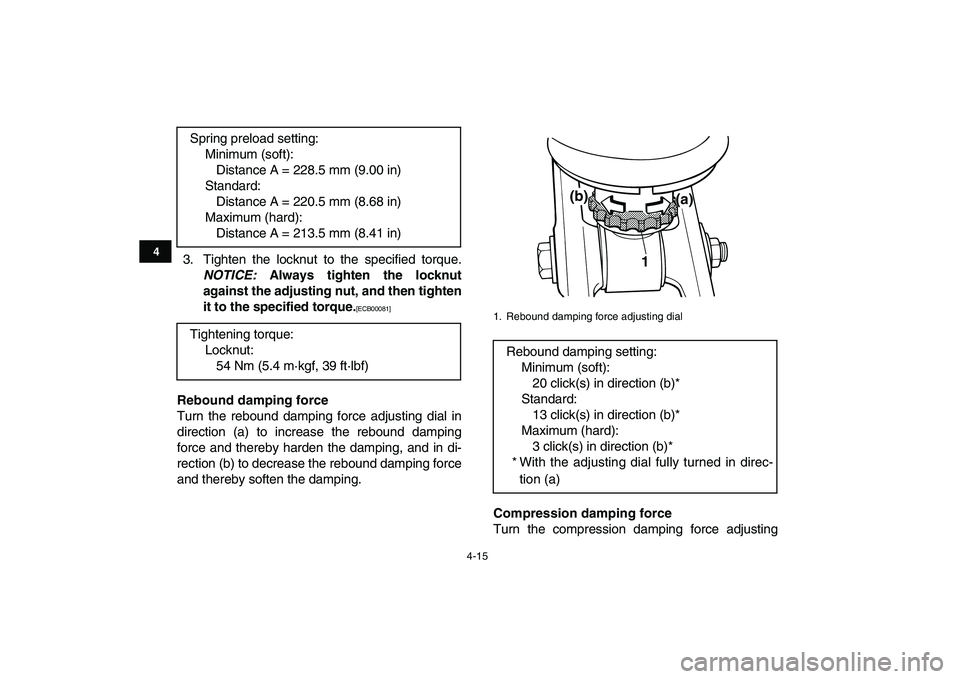
Rebound damping force
Turn the rebound damping force adjusting dial in
direction (a) to increase the rebound damping
force and thereby harden the damping, and in di-
rection (b) to decrease the rebound damping force
and thereby soften the damping.
Compression damping force
Turn the compression damping force adjusting Spring preload setting:
Minimum (soft):
Distance A = 228.5 mm (9.00 in)
Standard:
Distance A = 220.5 mm (8.68 in)
Maximum (hard):
Distance A = 213.5 mm (8.41 in)
Tightening torque:
Locknut:
54 Nm (5.4 m·kgf, 39 ft·lbf)
1. Rebound damping force adjusting dial
Rebound damping setting:
Minimum (soft):
20 click(s) in direction (b)*
Standard:
13 click(s) in direction (b)*
Maximum (hard):
3 click(s) in direction (b)*
* With the adjusting dial fully turned in direc-
tion (a)
1(a) (b)
Page 54 of 148
6-5
1
2
3
4
56
7
8
9
10
11
ances. During this period, prolonged full-throttle
operation or any condition that might result in en-
gine overheating must be avoided.
0–160 km (0–100 mi) or 0–10 hours
Avoid prolonged operation above 1/2 throttle. Vary
the speed of the ATV regularly. Do not operate it at
one set throttle position.
160–320 km (100–200 mi) or 10–20 hours
Avoid prolonged operation above 3/4 throttle. Rev
the engine through the gears freely, but do not use
full throttle at any time.
320 km (200 mi) or 20 hours and beyond
The ATV can now be operated normally.
NOTICE
ECB00220
If any engine trouble should occur during the
engine break-in period, immediately have a
Yamaha dealer check the ATV.
EBU20722
Parking
When parking the ATV, shift into first gear, stop the
engine, apply the parking brake, and then turn the
fuel cock to “OFF”.
1. Button
2. Parking brake lock plate
1
2
Page 55 of 148
6-6
1
2
3
4
56
7
8
9
10
11
EBU20865
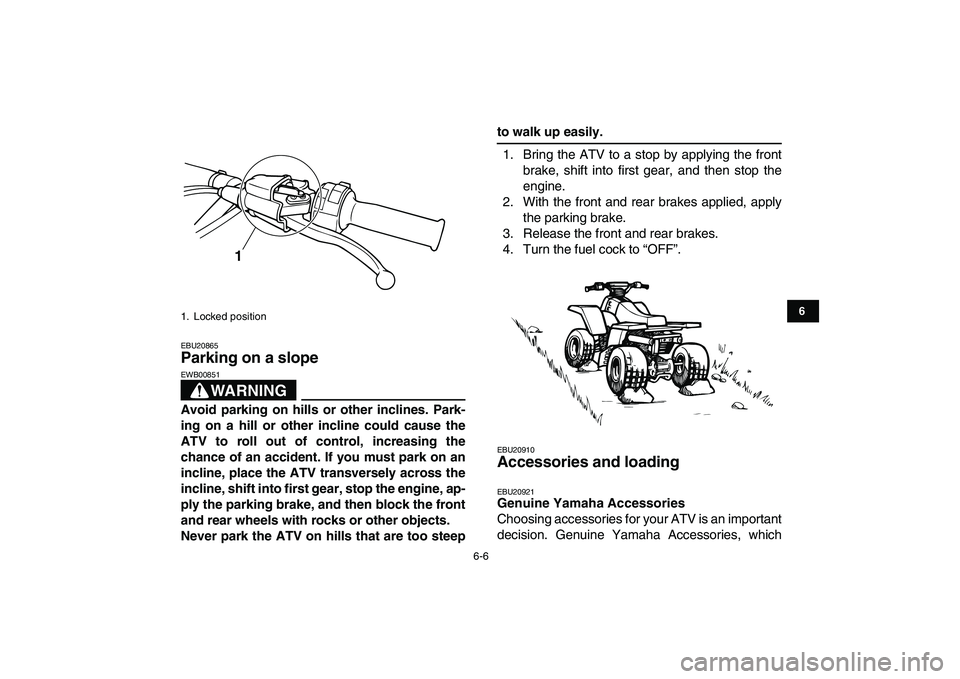
Parking on a slope
WARNING
EWB00851
Avoid parking on hills or other inclines. Park-
ing on a hill or other incline could cause the
ATV to roll out of control, increasing the
chance of an accident. If you must park on an
incline, place the ATV transversely across the
incline, shift into first gear, stop the engine, ap-
ply the parking brake, and then block the front
and rear wheels with rocks or other objects.
Never park the ATV on hills that are too steep
to walk up easily.
1. Bring the ATV to a stop by applying the front
brake, shift into first gear, and then stop the
engine.
2. With the front and rear brakes applied, apply
the parking brake.
3. Release the front and rear brakes.
4. Turn the fuel cock to “OFF”.
EBU20910
Accessories and loading
EBU20921
Genuine Yamaha Accessories
Choosing accessories for your ATV is an important
decision. Genuine Yamaha Accessories, which
1. Locked position
1
Page 71 of 148
7-14
1
2
3
4
5
67
8
9
10
11
hill. In all cases avoid inclines with slippery or loose
surfaces, or obstacles that might cause you to lose
control.
To climb a hill, you need traction, momentum, and
steady throttle. Travel fast enough to maintain mo-
mentum, but not so fast that you cannot react to
changes in the terrain as you climb.
It is important when climbing a hill to make sure
that your weight is transferred forward on the ATV.
This can be accomplished by leaning forward and,
on steeper inclines, standing on the footrests and
leaning forward over the handlebars. Whenever
possible, ride straight up hills.
Slow down when you reach the crest of the hill if
you cannot see clearly what is on the other side –
there could be another person, an obstacle, or a
sharp drop-off. Use common sense and remember
that some hills are too steep for you to climb or de-
scend.
If you are climbing a hill and you find that you have
not properly judged your ability to make it to the
top, you should turn the ATV around while you still
have forward motion (provided you have the room
to do so) and go down the hill.
If your ATV has stalled or stopped and you believe
you can continue up the hill, restart carefully tomake sure you do not lift the front wheels which
could cause you to lose control. If you are unable
to continue up the hill, dismount the ATV on the up-
hill side. Physically turn the ATV around and then
descend the hill.
If you start to roll backwards, DO NOT apply the
rear brake, and apply the front brake gradually.
The ATV could easily tip over backwards. When
fully stopped, apply the rear brake as well, and
then lock the parking brake. Dismount the ATV im-
mediately on the uphill side or to a side if pointed
straight uphill. Turn the ATV around and remount,
following the procedure described in the Owner’s
Manual.
WARNING! Stalling, rolling backwards
or improperly dismounting while climbing a hill
could result in ATV overturning. If you cannot
control the ATV, dismount immediately on the
uphill side.
[EWB01802]
Page 97 of 148
8-19
1
2
3
4
5
6
78
9
10
11
1. Place the ATV on a level surface.
2. Remove the seat. (See page 4-11.)
3. Remove the air filter case cover by unhooking
the holders.4. Pull the air filter element out of the air filter
case.
5. Remove the lock plate by turning it, and then
remove the sponge material from the air filter
element frame.
1. Air filter case check hose
1
1. Air filter case cover
2. Air filter case cover holder
1 2 2