Page 97 of 406
83
1
1-7. Safety information
Before driving
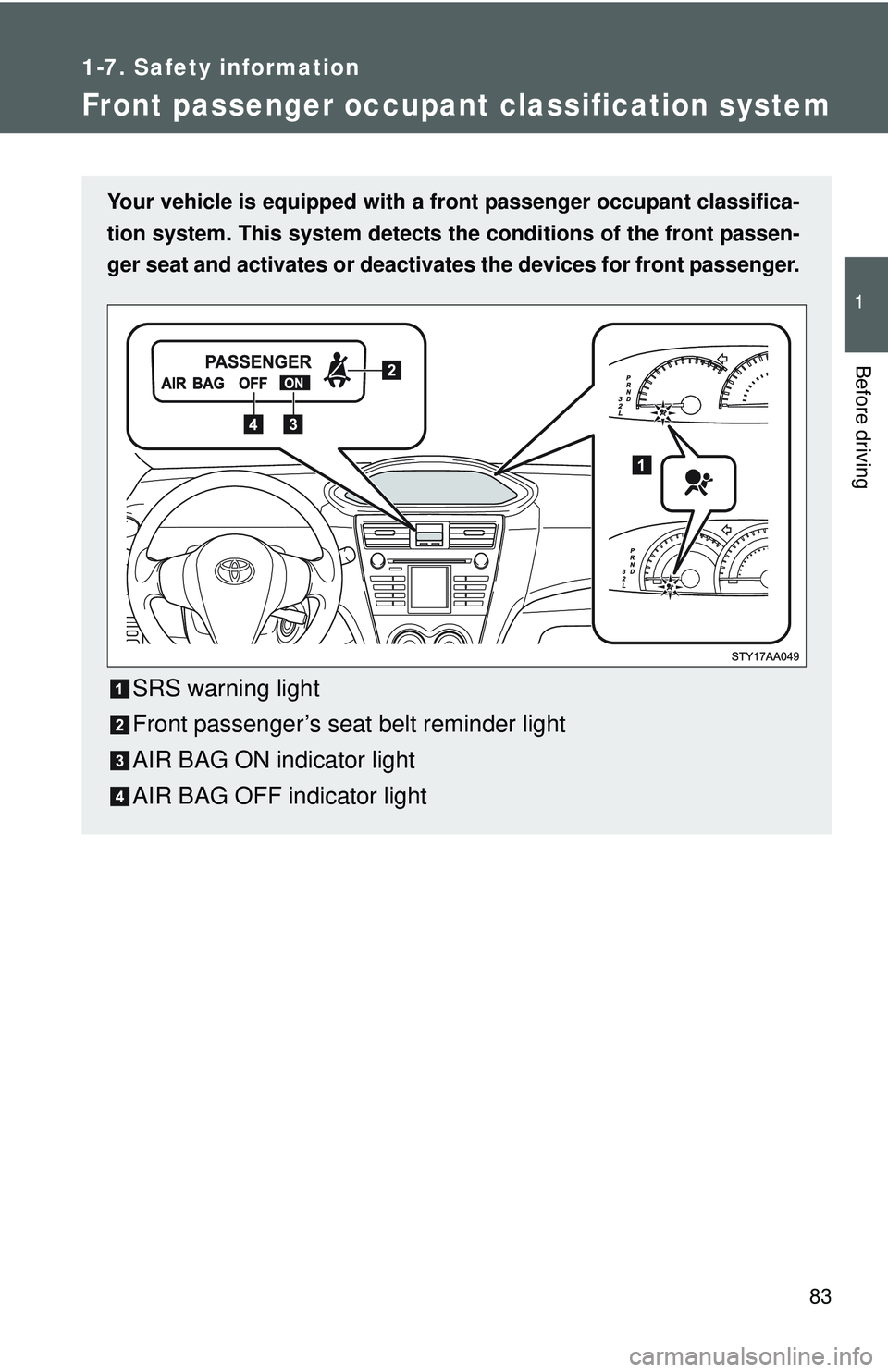
Front passenger occupant classification system
Your vehicle is equipped with a front passenger occupant classifica-
tion system. This system detects the conditions of the front passen-
ger seat and activates or deactivates the devices for front passenger.
SRS warning light
Front passenger’s seat belt reminder light
AIR BAG ON indicator light
AIR BAG OFF indicator light
Page 98 of 406
84 1-7. Safety information
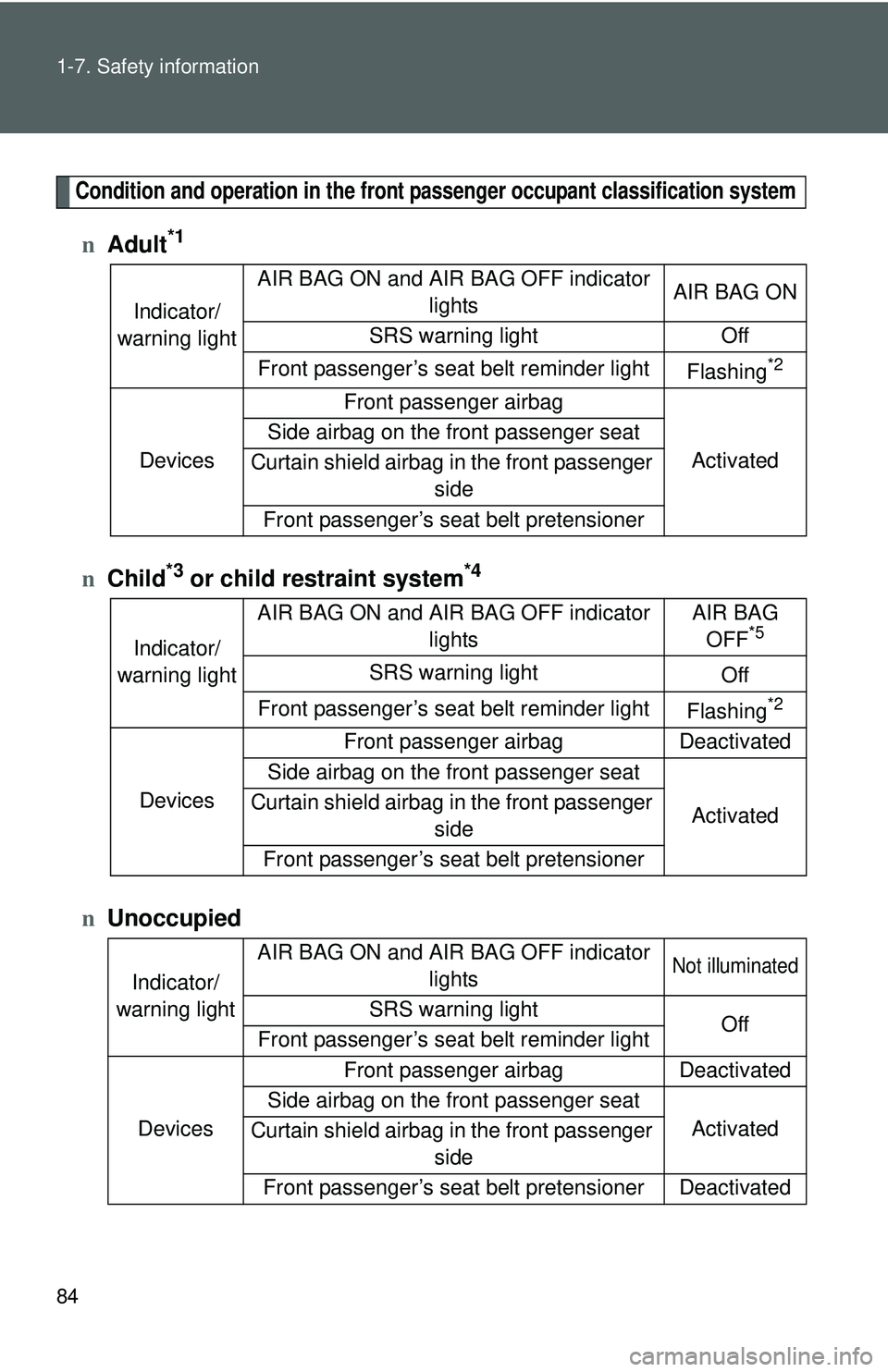
Condition and operation in the front passenger occupant classification system
nAdult*1
nChild*3 or child restraint system*4
nUnoccupied
Indicator/
warning light AIR BAG ON and AIR BAG OFF indicator
lights AIR BAG ON
SRS warning light Off
Front passenger’s seat belt reminder light Flashing
*2
DevicesFront passenger airbag
Activated
Side airbag on the front passenger seat
Curtain shield airbag in the front passenger side
Front passenger’s seat belt pretensioner
Indicator/
warning light AIR BAG ON and AIR BAG OFF indicator
lights AIR BAG
OFF
*5
SRS warning light Off
Front passenger’s seat belt reminder light Flashing
*2
DevicesFront passenger airbag
Deactivated
Side airbag on the front passenger seat
Activated
Curtain shield airbag in the front passenger
side
Front passenger’s seat belt pretensioner
Indicator/
warning light AIR BAG ON and AIR BAG OFF indicator
lights
Not illuminated
SRS warning light Off
Front passenger’s seat belt reminder light
Devices Front passenger airbag Deactivated
Side airbag on the front passenger seat Activated
Curtain shield airbag in the front passenger
side
Front passenger’s seat belt pretensioner Deactivated
Page 163 of 406
150
2-5. Driving information
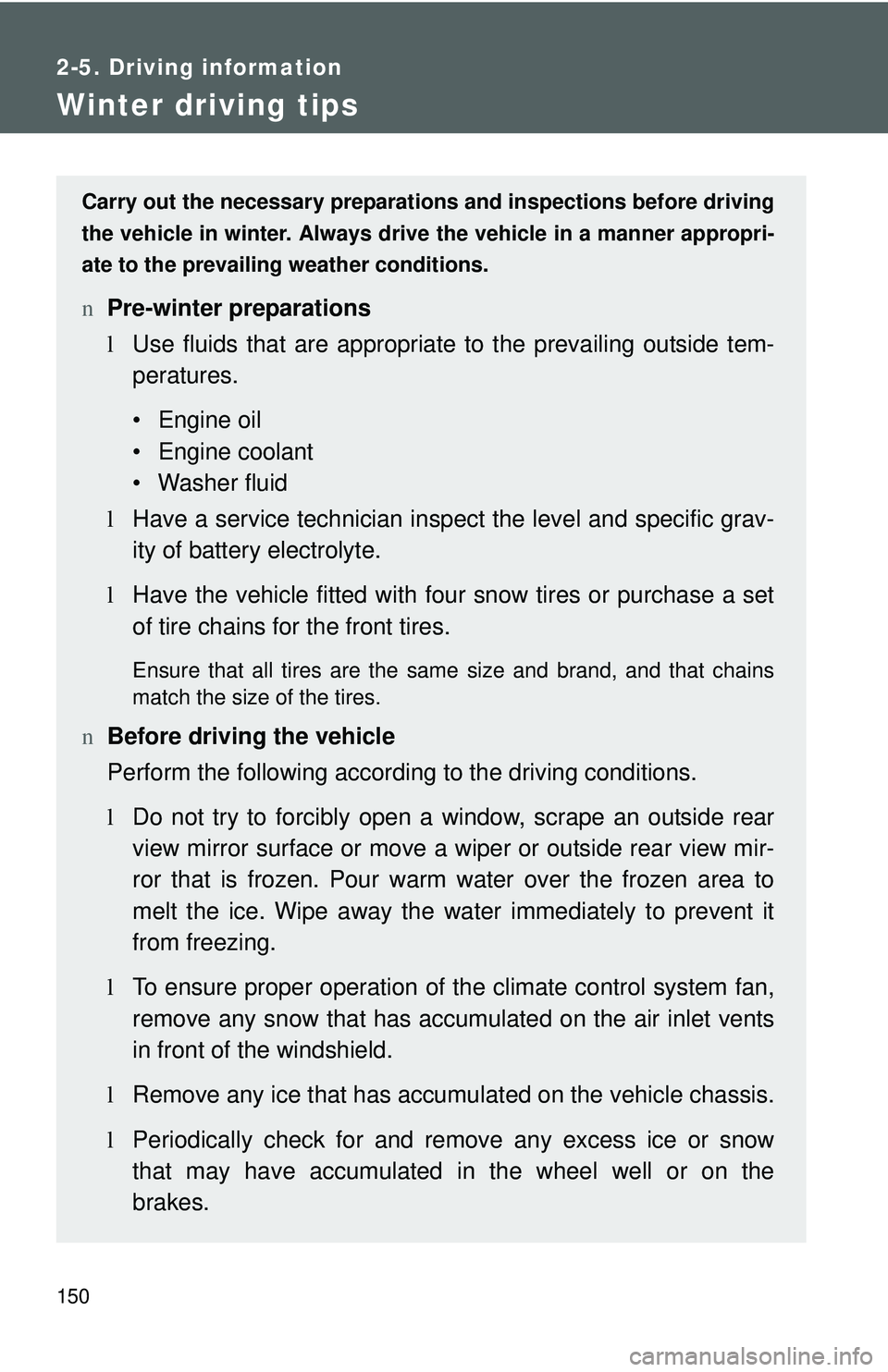
Winter driving tips
Carry out the necessary preparations and inspections before driving
the vehicle in winter. Always drive the vehicle in a manner appropri-
ate to the prevailing weather conditions.
n Pre-winter preparations
lUse fluids that are appropriate to the prevailing outside tem-
peratures.
• Engine oil
• Engine coolant
• Washer fluid
l Have a service technician inspect the level and specific grav-
ity of battery electrolyte.
l Have the vehicle fitted with four snow tires or purchase a set
of tire chains for the front tires.
Ensure that all tires are the same size and brand, and that chains
match the size of the tires.
nBefore driving the vehicle
Perform the following according to the driving conditions.
lDo not try to forcibly open a window, scrape an outside rear
view mirror surface or move a wiper or outside rear view mir-
ror that is frozen. Pour warm water over the frozen area to
melt the ice. Wipe away the water immediately to prevent it
from freezing.
l To ensure proper operation of th e climate control system fan,
remove any snow that has accumulated on the air inlet vents
in front of the windshield.
l Remove any ice that has accumu lated on the vehicle chassis.
l Periodically check for and remove any excess ice or snow
that may have accumulated in the wheel well or on the
brakes.
Page 173 of 406
160 2-5. Driving information
lTake care when passing other v ehicles. Passing requires consider-
able distance. After passing a vehi cle, do not forget the length of
your trailer, and be sure you hav e plenty of room before changing
lanes.
l In order to maintain engine braking efficiency, do not use the trans-
mission in D (automatic transmission) or 5 (manual transmission).
l Due to the added load of the trailer, your vehicle’s engine may
overheat on hot days (at temper atures over 85°F [30°C]) when
driving up a long or steep grade. If the engine coolant temperature
gauge indicates overheating, immediately turn off the air condition-
ing (if in use), pull your vehicle off the road and stop in a safe spot.
( → P. 329)
l Always place wheel blocks under both the vehicle and the trailer
wheels when parking. Apply the parking brake firmly, and put the
transmission in P (automatic transmission) or in 1 or R (manual
transmission). Avoid parking on a slope, but if unavoidable, do so
only after performing the following:
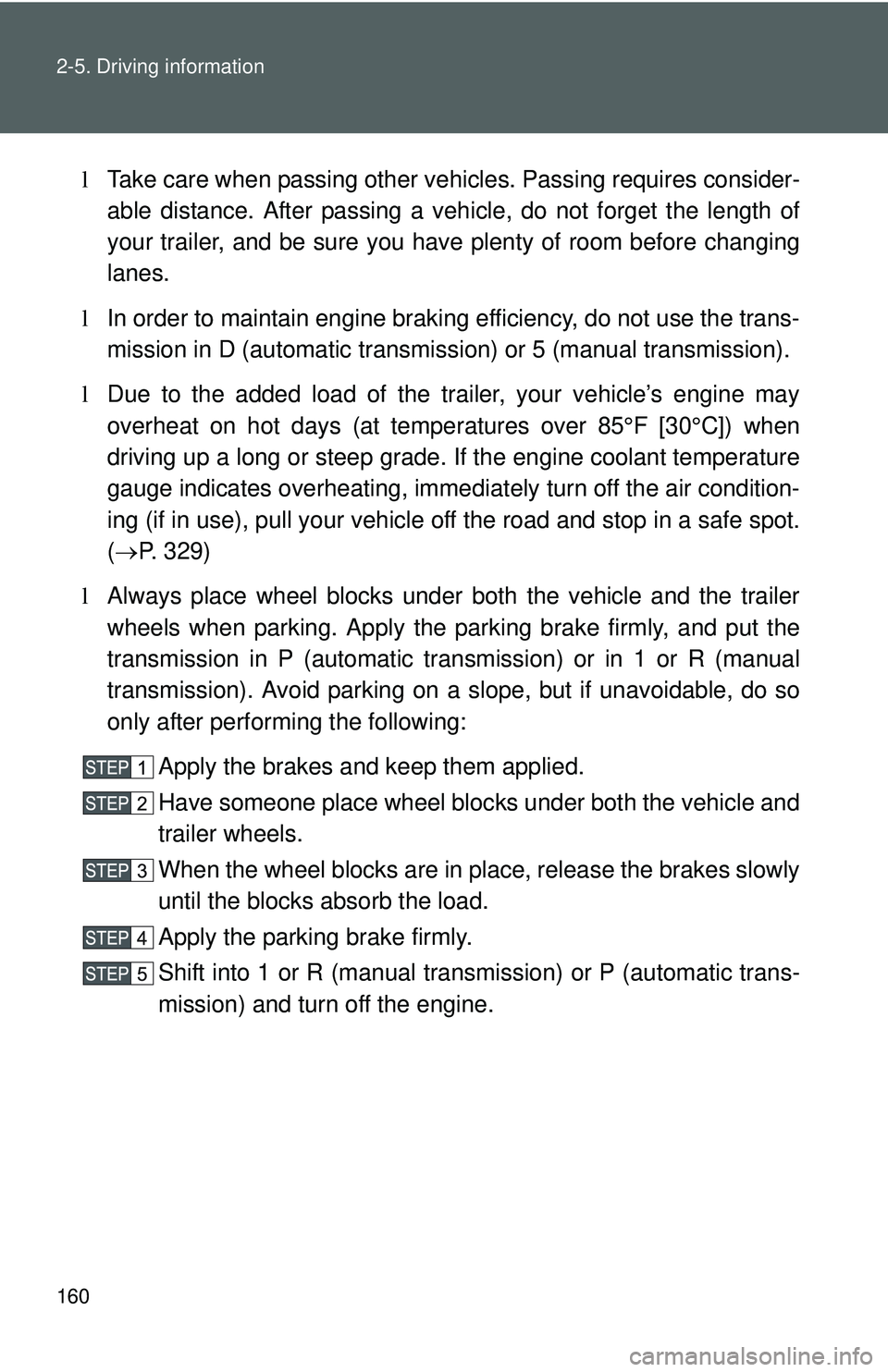
Apply the brakes and keep them applied.
Have someone place wheel bloc ks under both the vehicle and
trailer wheels.
When the wheel blocks are in place, release the brakes slowly
until the blocks absorb the load.
Apply the parking brake firmly.
Shift into 1 or R (manual transmission) or P (automatic trans-
mission) and turn off the engine.
Page 178 of 406
166
3-1. Using the air conditioning system and defogger
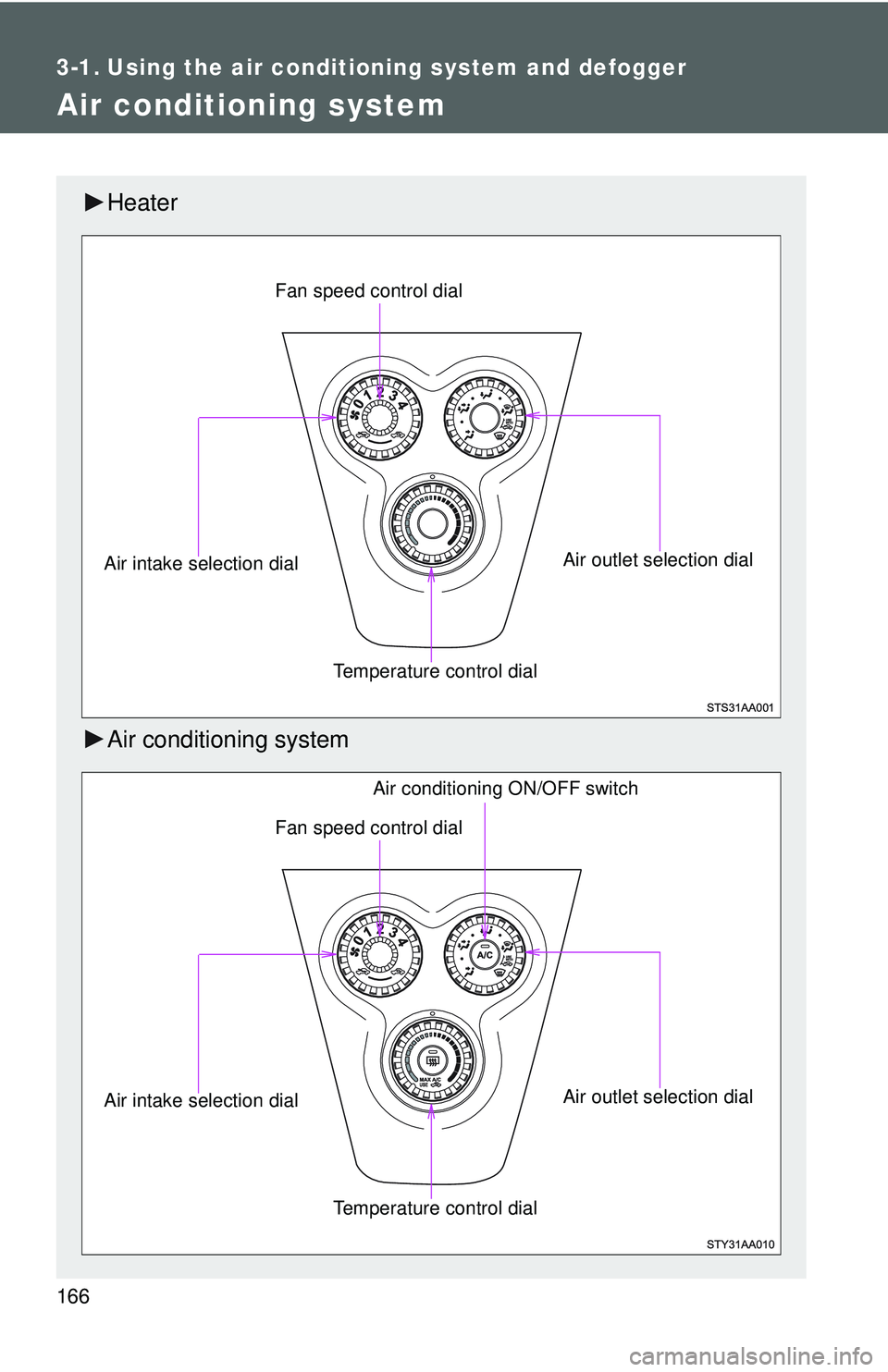
Air conditioning system
Heater
Air conditioning system
Fan speed control dialAir outlet selection dial
Temperature control dial
Air intake selection dial
Fan speed control dial
Air outlet selection dial
Air conditioning ON/OFF switch
Temperature control dial
Air intake selection dial
Page 179 of 406
167
3-1. Using the air conditioning system
and defogger
3
Interior features
Adjusting the settings
n Adjusting the temperature setting (heater)
Turn the temperature control dial clockwise to increase the temper-
ature.
n Adjusting the temperature setting (air conditioning system)
Turn the temperature control dial clockwise (warm) or counter-
clockwise (cool).
If is not pressed, the system will blow ambient temperature air or
heated air.
For quick cooling, turn the temperature control dial to the “
MAX A/C”
position and set the air intake selection dial to (recirculated air)
mode.
n Adjusting the fan speed
Turn the fan speed control dial clockwise (increase) or counter-
clockwise (decrease).
Set the dial to “0” to turn the fan off.
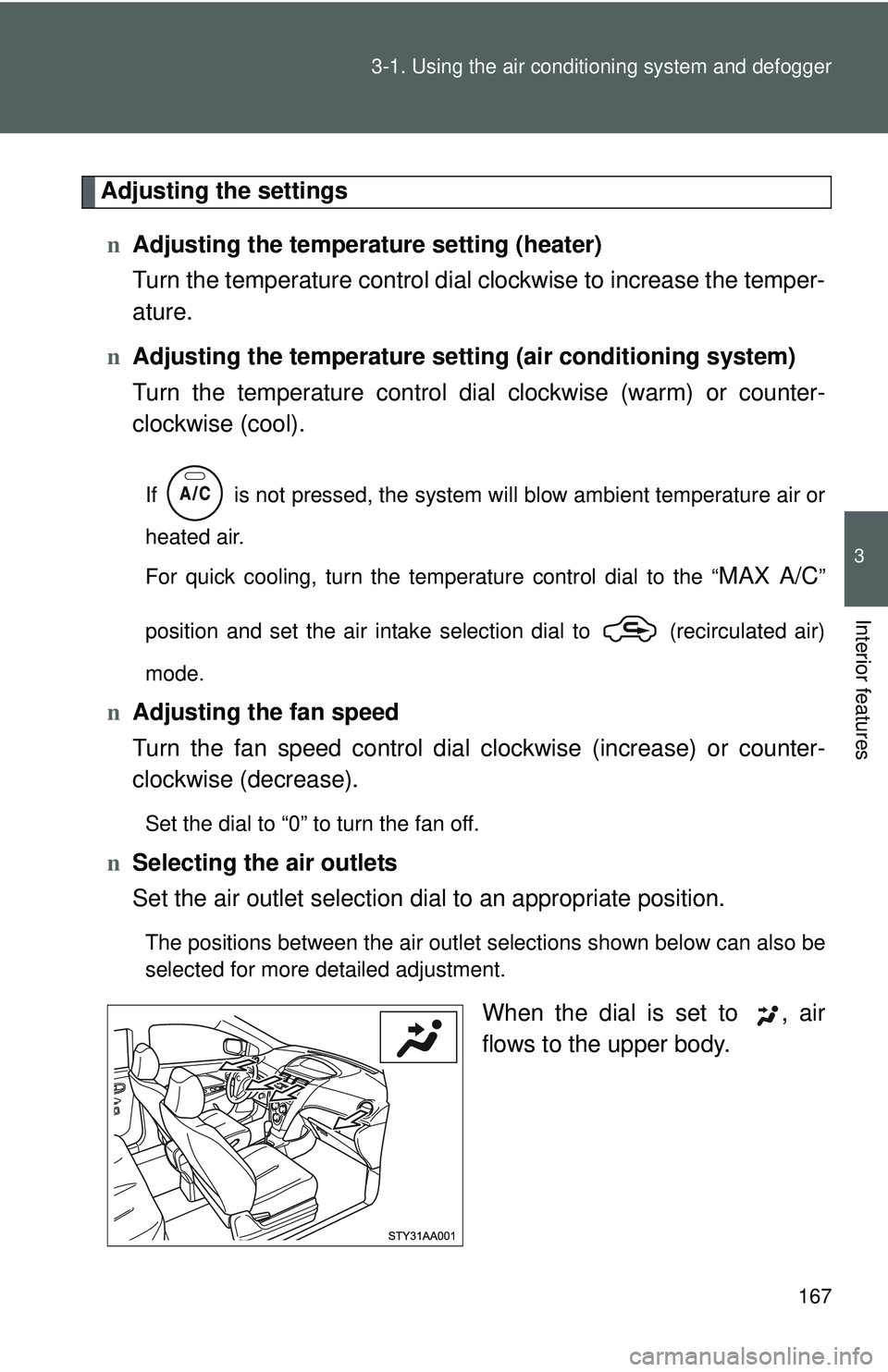
n Selecting the air outlets
Set the air outlet selection di al to an appropriate position.
The positions between the air outlet selections shown below can also be
selected for more detailed adjustment.
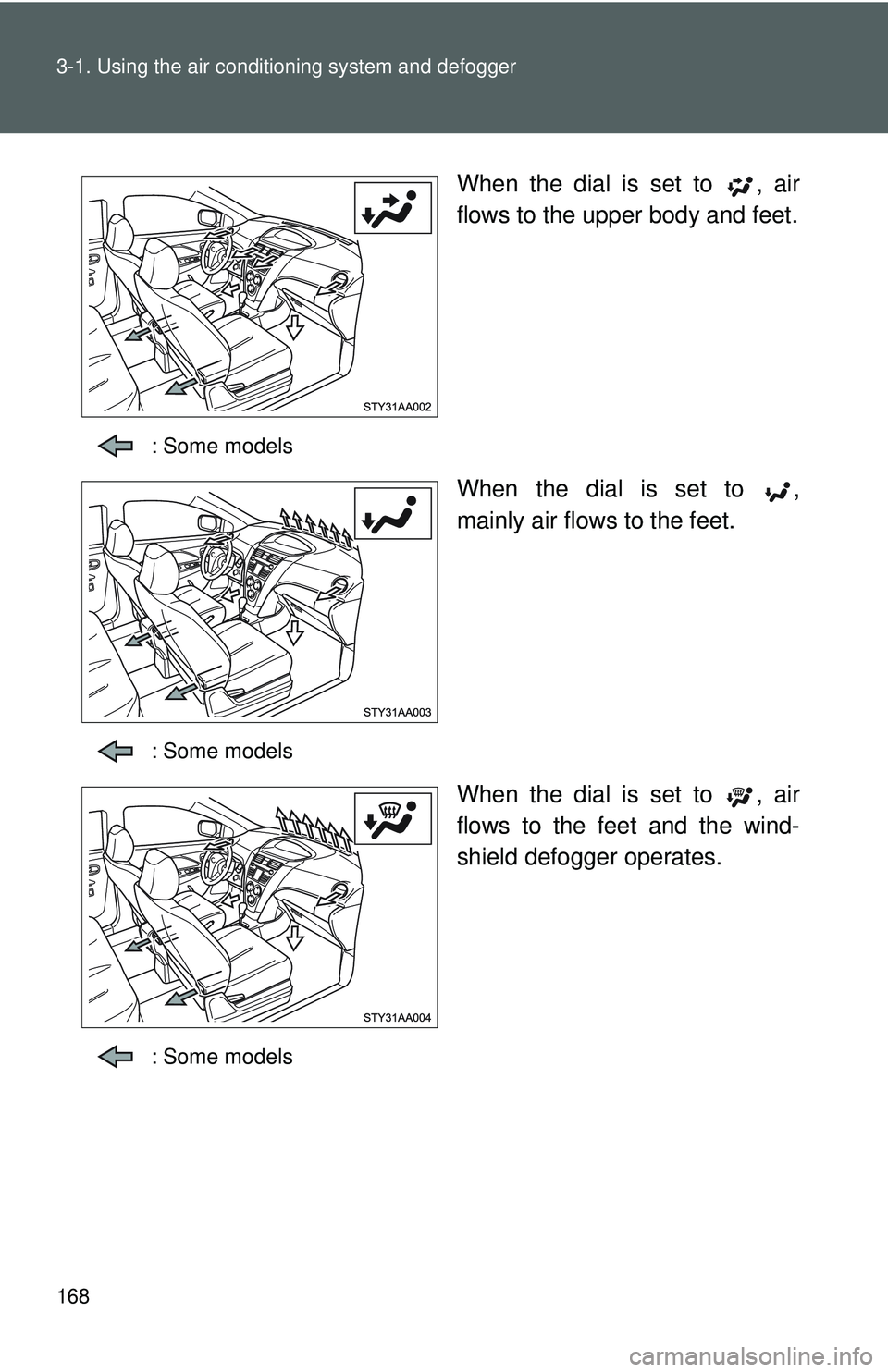
When the dial is set to , air
flows to the upper body.
Page 180 of 406
168 3-1. Using the air conditioning system and defogger
When the dial is set to , air
flows to the upper body and feet.
: Some models
When the dial is set to ,
mainly air flows to the feet.
: Some models
When the dial is set to , air
flows to the feet and the wind-
shield defogger operates.
: Some models
Page 181 of 406
169
3-1. Using the air conditioning system
and defogger
3
Interior features
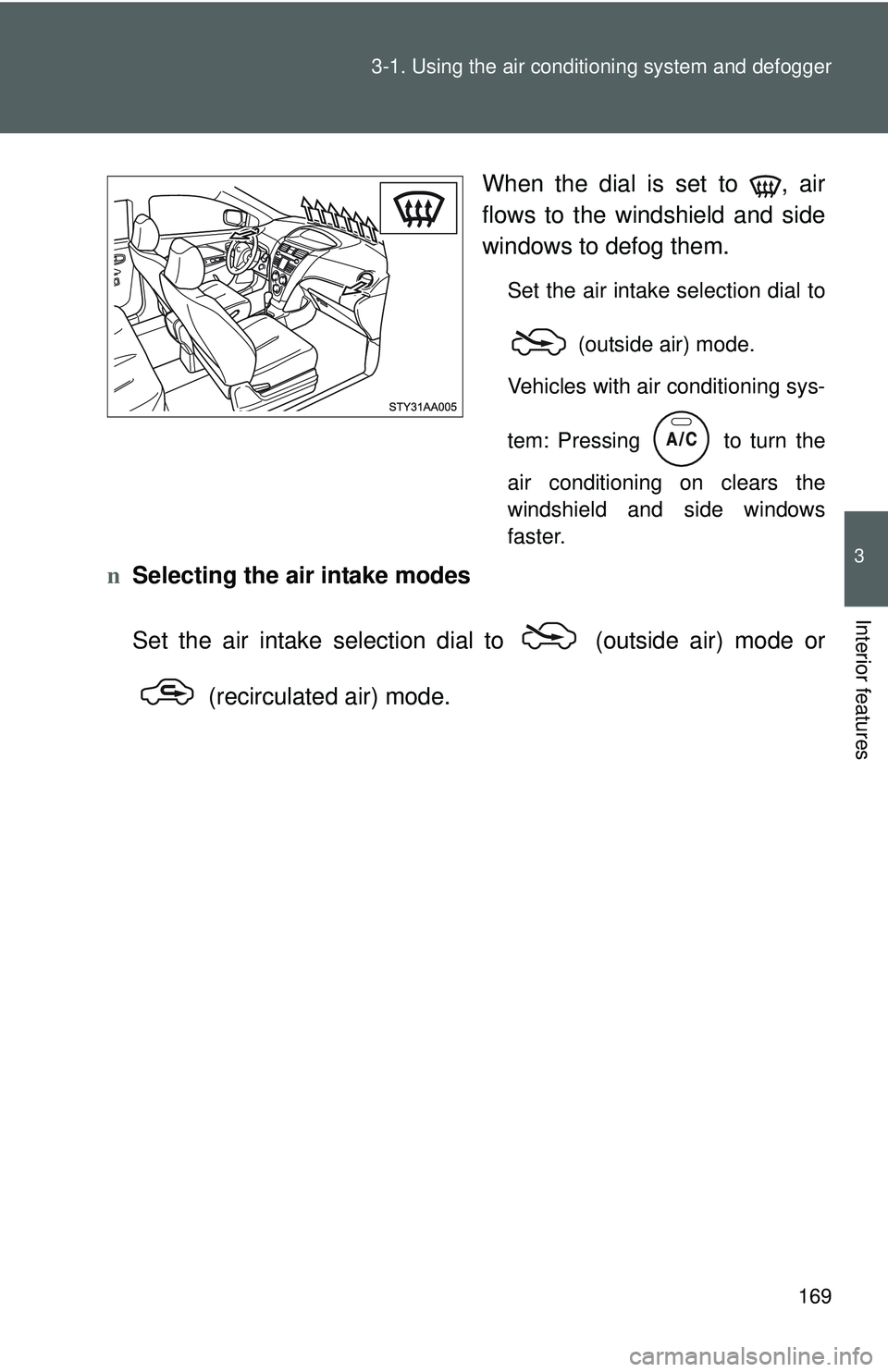
When the dial is set to , air
flows to the windshield and side
windows to defog them.
Set the air intake selection dial to
(outside air) mode.
Vehicles with air conditioning sys-
tem: Pressing
to turn the
air conditioning on clears the
windshield and side windows
faster.
n Selecting the air intake modes
Set the air intake selection dial to (outside air) mode or
(recirculated air) mode.