2011 TOYOTA YARIS power steering
[x] Cancel search: power steeringPage 2 of 416

TABLE OF CONTENTSIndex
2
1-1. Key informationKeys ..................................... 26
1-2. Opening, closing and locking
the doors
Wireless remote control ....... 28
Side doors ............................ 31
Back door ............................. 35
1-3. Adjustable components
(seats, mirrors, steering
wheel)
Front seats ........................... 39
Rear seats ............................ 42
Head restraints ..................... 49
Seat belts ............................. 55
Steering wheel ..................... 65
Anti-glare inside rear view mirror .................................. 66
Outside rear view mirrors ..... 68
1-4. Opening a nd closing the
windo ws
Power windows .................... 71
1-5. Refueling Opening the fuel tank cap .... 74
1-6. Theft deterrent system Engine immobilizer system ................................ 78
Alarm (Puerto Rico).............. 80
Theft prevention labels (except Canada) ................ 83 1-7. Safety information
Correct driving posture ......... 84
SRS airbags ......................... 86
Front passenger occupant classification system ........... 98
Child restraint systems ....... 103
Installing child restraints ..... 107
2-1. Driving procedures Driving the vehicle .............. 120
Engine (ignition) switch....... 130
Automatic
Transmission...... 133
Manual Transmission ......... 135
Turn signal lever ................. 136
Parking brake ..................... 137
Horn .................................... 139
2-2. Instrument cluster Gauges and meters ............ 140
Indicators and warning lights ................................. 146
2-3. Operating the lights and wipers
Headlight switch ................. 150
Fog light switch ................... 152
Windshield wipers and washer .............................. 153
Rear window wiper and washer .............................. 155
2-4. Using other driving systems Cruise control ..................... 156
Driving assist systems ........ 160
1Before driving
2When driving
Page 25 of 416

Before driving1
25
1-1. Key informationKeys ................................... 26
1-2. Opening, closing and locking the doors
Wireless remote control ..... 28
Side doors .......................... 31
Back door ........................... 35
1-3. Adjustable components (seats, mirrors, steering
wheel)
Front seats ......................... 39
Rear seats.......................... 42
Head restraints................... 49
Seat belts ........................... 55
Steering wheel ................... 65
Anti-glare inside rear view mirror ............................... 66
Outside rear view mirrors ... 68
1-4. Opening and closing the windows
Power windows .................. 71
1-5. Refueling Opening the fuel tank cap ................................... 74 1-6. Theft deterrent system
Engine immobilizer system ............................. 78
Alarm (Puerto Rico) ........... 80
Theft prevention labels (except Canada) .............. 83
1-7. Safety information Correct driving posture....... 84
SRS airbags ....................... 86
Front passenger occupant classification system ........ 98
Child restraint systems..... 103
Installing child restraints ........................ 107
Page 68 of 416
68
1-3. Adjustable components (seats, mirrors, steering wheel)
Outside rear view mirrors
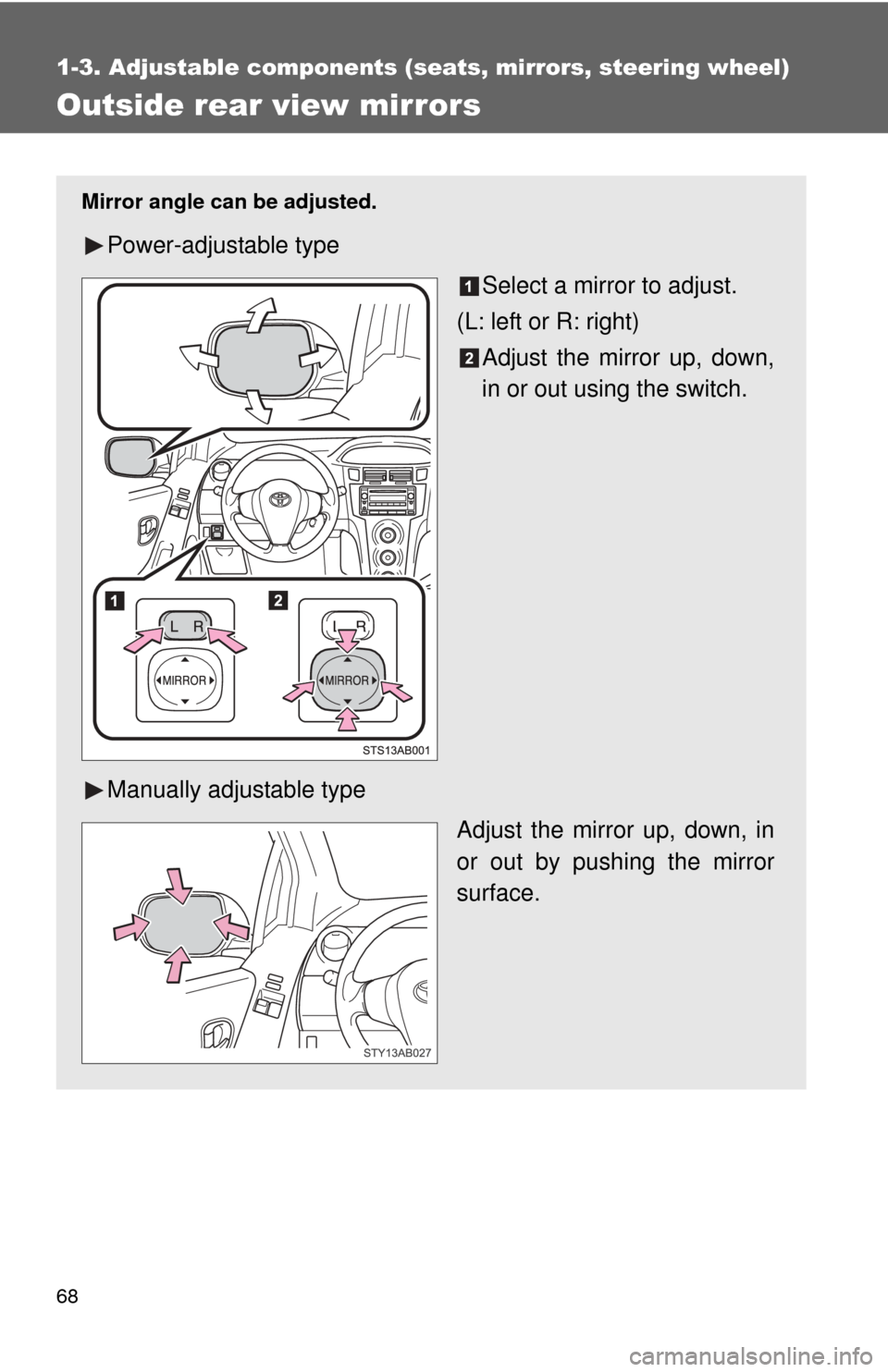
Mirror angle can be adjusted.
Power-adjustable type
Select a mirror to adjust.
(L: left or R: right) Adjust the mirror up, down,
in or out using the switch.
Manually adjustable type Adjust the mirror up, down, in
or out by pushing the mirror
surface.
Page 69 of 416
69
1-3. Adjustable components (s
eats, mirrors, steering wheel)
1
Before driving
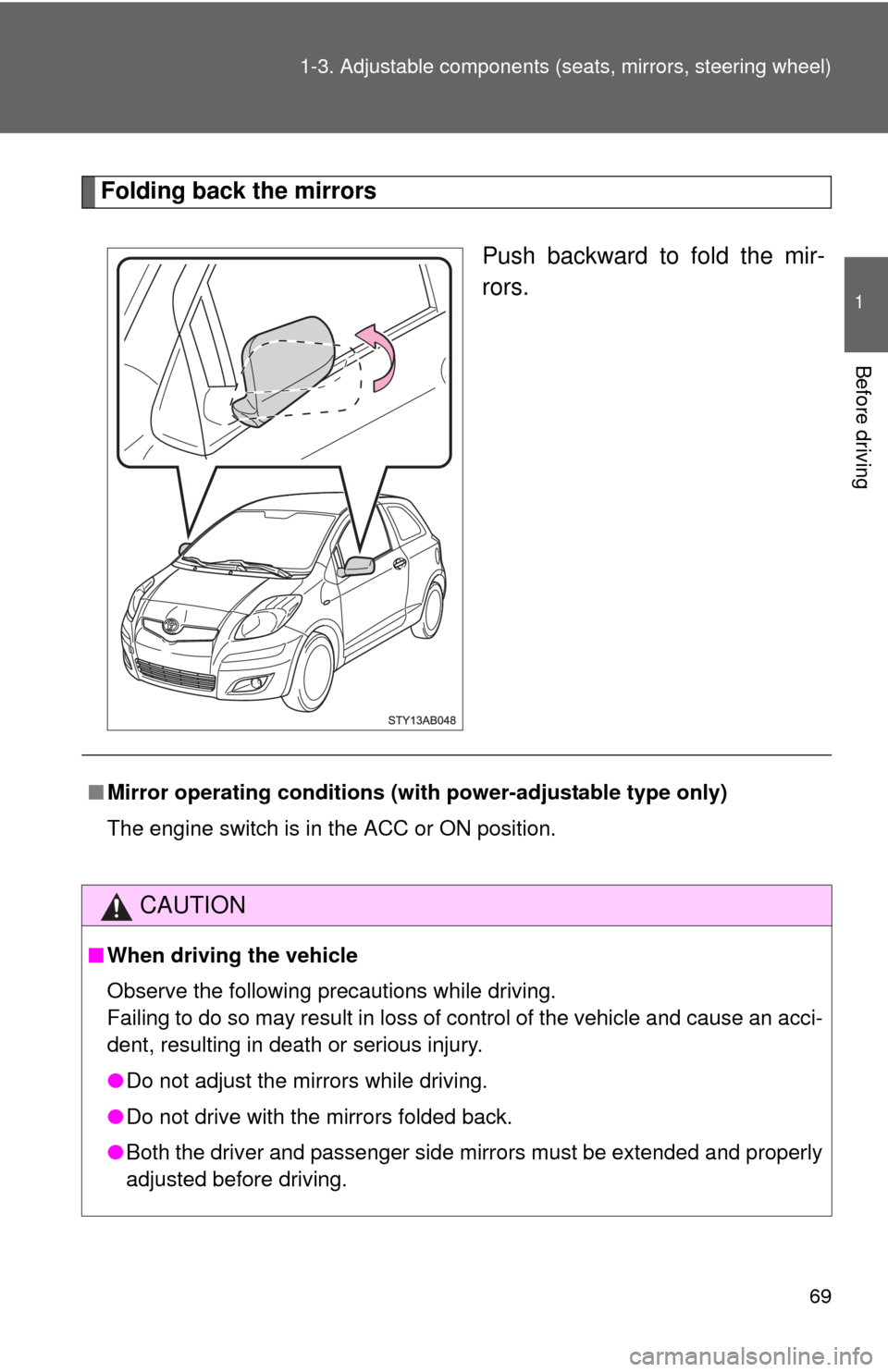
Folding back the mirrors
Push backward to fold the mir-
rors.
■Mirror operating conditions (with power-adjustable type only)
The engine switch is in the ACC or ON position.
CAUTION
■When driving the vehicle
Observe the following precautions while driving.
Failing to do so may result in loss of control of the vehicle and cause an acci-
dent, resulting in death or serious injury.
●Do not adjust the mirrors while driving.
● Do not drive with the mirrors folded back.
● Both the driver and passenger side mirrors must be extended and properly
adjusted before driving.
Page 88 of 416

88 1-7. Safety information
Your vehicle is equipped with ADVANCED AIRBAGS designed based
on US motor vehicle safety standards (FMVSS208). The airbag sys-
tem controls airbag deployment po wer for the driver and front pas-
senger. The driver airbag system consists of the driver seat’s position
sensor etc. The front passenger’s airbag system consists of the front
passenger occupant classification sensor etc.
The main SRS airbag system components are shown above. The
SRS airbag system is controlled by the airbag sensor assembly. The
airbag sensor assembly consists of a safing sensor and an airbag
sensor.
In certain types of severe frontal or side impacts, the SRS airbag sys-
tem triggers the airbag inflators. A chemical reaction in the inflators
quickly fills the airbags with non-toxic gas to help restrain the motion
of the occupants.
■ SRS warning light
This warning light system monitors the airbag sensor assembly, front airbag
sensors, side and curtain shield airbag sensors, curtain shield airbag sen-
sors, driver’s seat position sensor, driver’s seat belt buckle switch, front pas-
senger occupant classification system, AIR BAG ON indicator light, AIR
BAG OFF indicator light, front passenger’s seat belt buckle switch, seat belt
pretensioner assemblies, inflators, interconnecting wiring and power
sources. ( P. 320)
■ If the SRS airbags deploy (inflate)
●Bruising and slight abrasions may result from contact with a deploying
(inflating) SRS airbag.
● A loud noise and white powder will be emitted.
● Vehicles with side and curtain shield airbags: Parts of the airbag module
(steering wheel hub, airbag cover and inflator) as well as the front seats,
and parts of the front and rear pillars and roof side rail, may be hot for
several minutes. The airbag itself may also be hot.
● Vehicles without side and curtain shield airbags: Parts of the airbag mod-
ule (steering wheel hub, airbag cover and inflator) as well as the front
seats may be hot for several minutes. The airbag itself may also be hot.
● The front windshield may crack.
Page 124 of 416

124 2-1. Driving procedures
CAUTION
■When driving the vehicle
●Do not shift the shift lever to N while the vehicle is moving.
Doing so may cause the engine brake to not operate properly and lead to
an accident.
● Do not turn the engine off while driving.
The power steering and brake booster systems will not operate properly if
the engine is not running.
● Use engine braking (downshift) to maintain a safe speed when driving
down a steep hill.
Using the brakes continuously may cause the brakes to overheat and lose
effectiveness. ( P. 133,135)
● When stopped on an inclined surface, use the brake pedal and parking
brake to prevent the vehicle from rolling backward or forward and causing
an accident.
● Do not adjust the position of the steering wheel, the seat, or the inside or
outside rear view mirrors while driving.
Doing so may result in a loss of vehicle control that can cause accidents
that may result in death or serious injury.
● Always check that all passengers’ arms, heads or other parts of their bod-
ies are not outside the vehicle, as this may result in death or serious injury.
● Do not drive in excess of the speed limit. Even if the legal speed limit per-
mits it, do not drive over 85 mph (140 km/h) unless your vehicle has high-
speed capability tires. Driving over 85 mph (140 km/h) may result in tire
failure, loss of control and possible injury. Be sure to consult a tire dealer
to determine whether the tires on your vehicle are high-speed capability
tires or not before driving at such speeds.
■ When driving on slippery road surfaces
●Sudden braking, acceleration and steering may cause tire slippage and
reduce your ability to control the vehicle, resulting in an accident.
● Sudden changes in engine speed, such as engine braking caused by up-
shifting or down-shifting, may cause the vehicle to skid, resulting in an
accident.
● After driving through a puddle, lightly depress the brake pedal to make
sure that the brakes are functioning properly. Wet brake pads may prevent
the brakes from functioning properly. If the brakes on only one side are wet
and not functioning properly, steering control may be affected, resulting in
an accident.
Page 128 of 416

128 2-1. Driving procedures
NOTICE
■When driving the vehicle
Vehicles with a manual transmission
● Do not depress the accelerator and brake pedals at the same time during
driving. If the brake pedal is depressed while driving with the accelerator
pedal depressed, driving torque may be restrained.
● Do not rest your foot on the clutch pedal while driving.
Doing so may cause clutch trouble.
● Do not use any gears other than the first gear when starting off and mov-
ing forward.
Doing so may damage the clutch.
● Do not use the clutch to hold the vehicle when stopping on an uphill grade.
Doing so may damage the clutch.
Vehicles with an automatic transmission
● Do not depress the accelerator and brake pedals at the same time during
driving. If the brake pedal is depressed while driving with the accelerator
pedal depressed, driving torque may be restrained.
● Do not use the accelerator pedal or depress accelerator and brake pedals
together to hold the vehicle on a hill.
■ When parking the vehicle
Vehicles with an automatic transmission: Always put the shift lever in P.
Failure to do so may cause the vehicle to move or the vehicle may acceler-
ate suddenly if the accelerator pedal is accidentally depressed.
■ Avoiding damage to vehicle parts
●Do not turn the steering wheel fully in either direction and hold it there for a
long time.
Doing so may damage the power steering motor.
● When driving over bumps in the road, drive as slowly as possible to avoid
damaging the wheels, underside of the vehicle, etc.
Page 160 of 416
160
2-4. Using other driving systems
Driving assist systems
To help enhance driving safety and performance, the following sys-
tems operate automatically in res ponse to various driving situations.
Be aware, however, that these systems are supplementary and
should not be relied upon too h eavily when operating the vehicle.
■ABS (Anti-lock Brake System) (if equipped)
Helps to prevent wheel lock when the brakes are applied suddenly, or if
the brakes are applied while driving on a slippery road surface.
■Brake Assist (if equipped)
Generates an increased level of braking force after the brake pedal is
depressed, when the system detects a panic stop situation.
■VSC (Vehicle Stability Control) (if equipped)
Helps the driver to control skidding when swerving suddenly or turning
on slippery road surfaces.
■TRAC (Traction Control) (if equipped)
Maintains drive power and prevents the front wheels from spinning
when starting the vehicle or accelerating on slippery roads.
■EPS (Electric Power Steering)
Employs an electric motor to reduce the amount of effort needed to turn
the steering wheel.