Page 131 of 416
131
2-1. Driving procedures
2
When driving
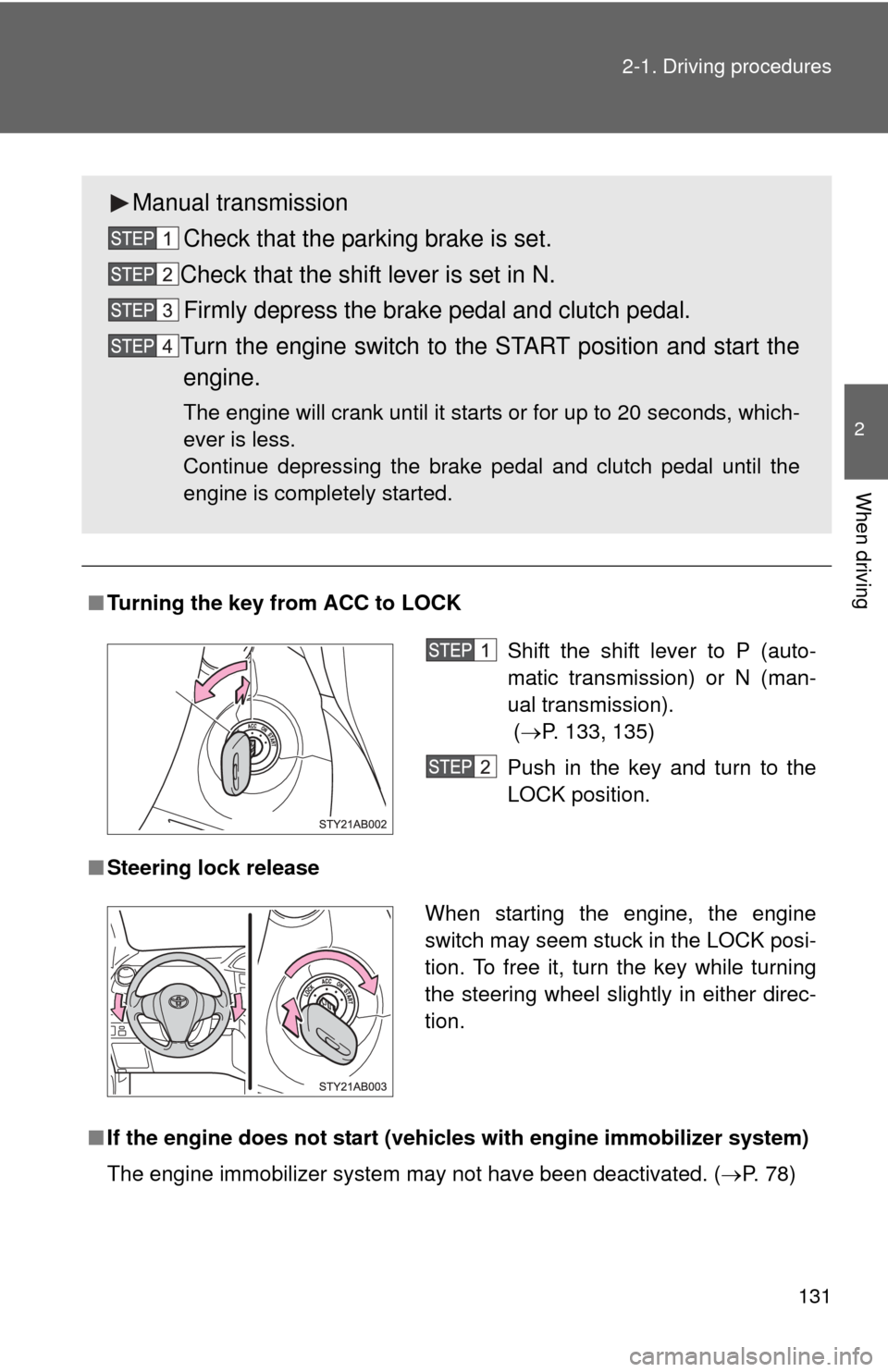
■
Turning the key from ACC to LOCK
■ Steering lock release
■ If the engine does not start (vehic les with engine immobilizer system)
The engine immobilizer system may not have been deactivated. ( P. 78)
Manual transmission
Check that the parking brake is set.
Check that the shift lever is set in N. Firmly depress the brake pedal and clutch pedal.
Turn the engine switch to the START position and start the engine.
The engine will crank until it starts or for up to 20 seconds, which-
ever is less.
Continue depressing the brake pedal and clutch pedal until the
engine is completely started.
Shift the shift lever to P (auto-
matic transmission) or N (man-
ual transmission).
( P. 133, 135)
Push in the key and turn to the
LOCK position.
When starting the engine, the engine
switch may seem stuck in the LOCK posi-
tion. To free it, turn the key while turning
the steering wheel slightly in either direc-
tion.
Page 136 of 416
136
2-1. Driving procedures
Tur n signal lever
■Turn signals can be operated when
The engine switch is in the ON position.
■ If the indicators flash faster than usual
Check that a light bulb in the front or rear turn signal lights has not burned
out.
Left turn
Right turn
Move and hold the lever
partway to signal a lane
change.
The left hand signal will flash
until you release the lever.
Move and hold the lever
partway to signal a lane
change.
The right hand signal will flash
until you release the lever.
Page 137 of 416
137
2-1. Driving procedures
2
When driving
Parking brake
■Usage in winter time
See “Winter driving tips” for parking brake usage in winter time. (P. 169)
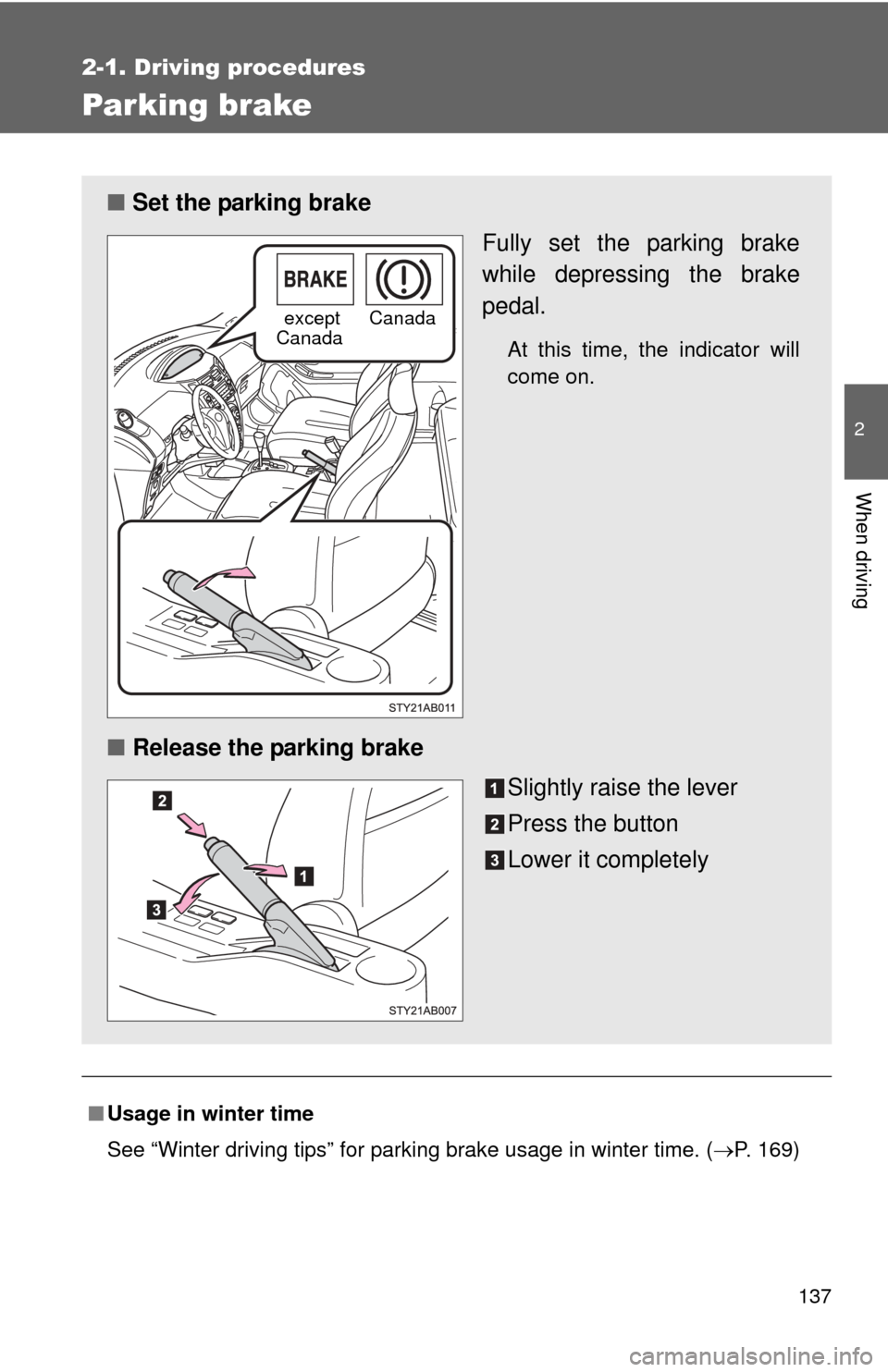
■ Set the parking brake
Fully set the parking brake
while depressing the brake
pedal.
At this time, the indicator will
come on.
■Release the parking brake
Slightly raise the lever
Press the button
Lower it completely
except
CanadaCanada
Page 144 of 416
144 2-2. Instrument cluster
Vehicles without tachometerOdometer
Trip meter A*
Trip meter B*
*:Pushing and holding the buttonwill reset the trip meter.
Instrument panel light control
The brightness of the instrument panel lights can be adjusted.
Brighter
Darker
With the dial turned fully up, the
intensity of the instrument panel
lights will not be reduced even
when the tail lights/headlights are
turned on.
Page 145 of 416
145
2-2. Instrument cluster
2
When driving
NOTICE
■
To prevent damage to the engine and its components
●Do not let the indicator needle of the tachometer enter the red zone, which
indicates the maximum engine speed.
● The engine may be overheating if the high engine coolant temperature
warning light comes on. In this case, immediately stop the vehicle in a safe
place, and check the engine after it has cooled completely. (
P. 349)
Page 146 of 416
146
2-2. Instrument cluster
Indicators and warning lights
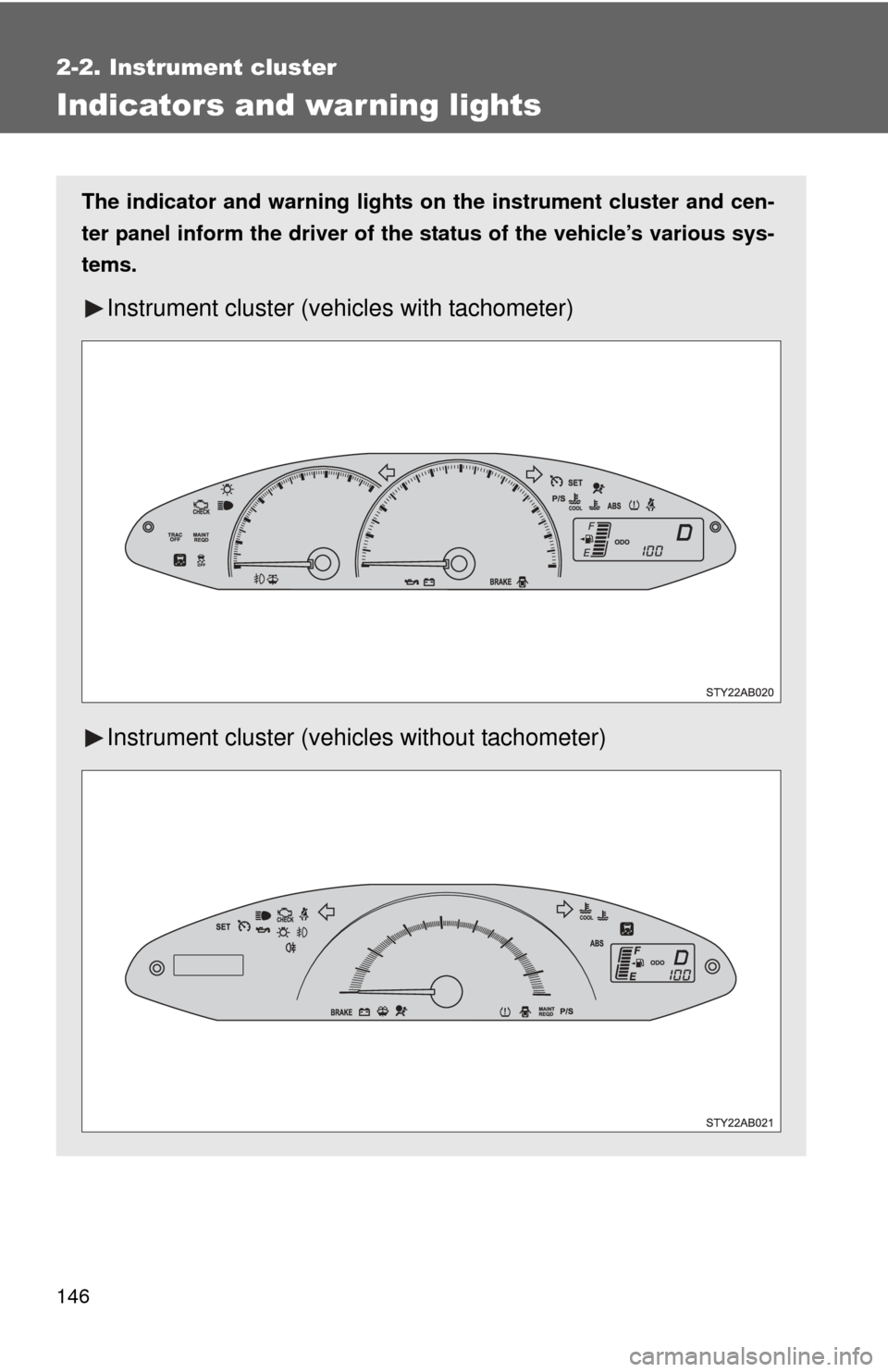
The indicator and warning lights on the instrument cluster and cen-
ter panel inform the driver of the status of the vehicle’s various sys-
tems.
Instrument cluster (vehicles with tachometer)
Instrument cluster (vehicl es without tachometer)
Page 148 of 416
148 2-2. Instrument cluster
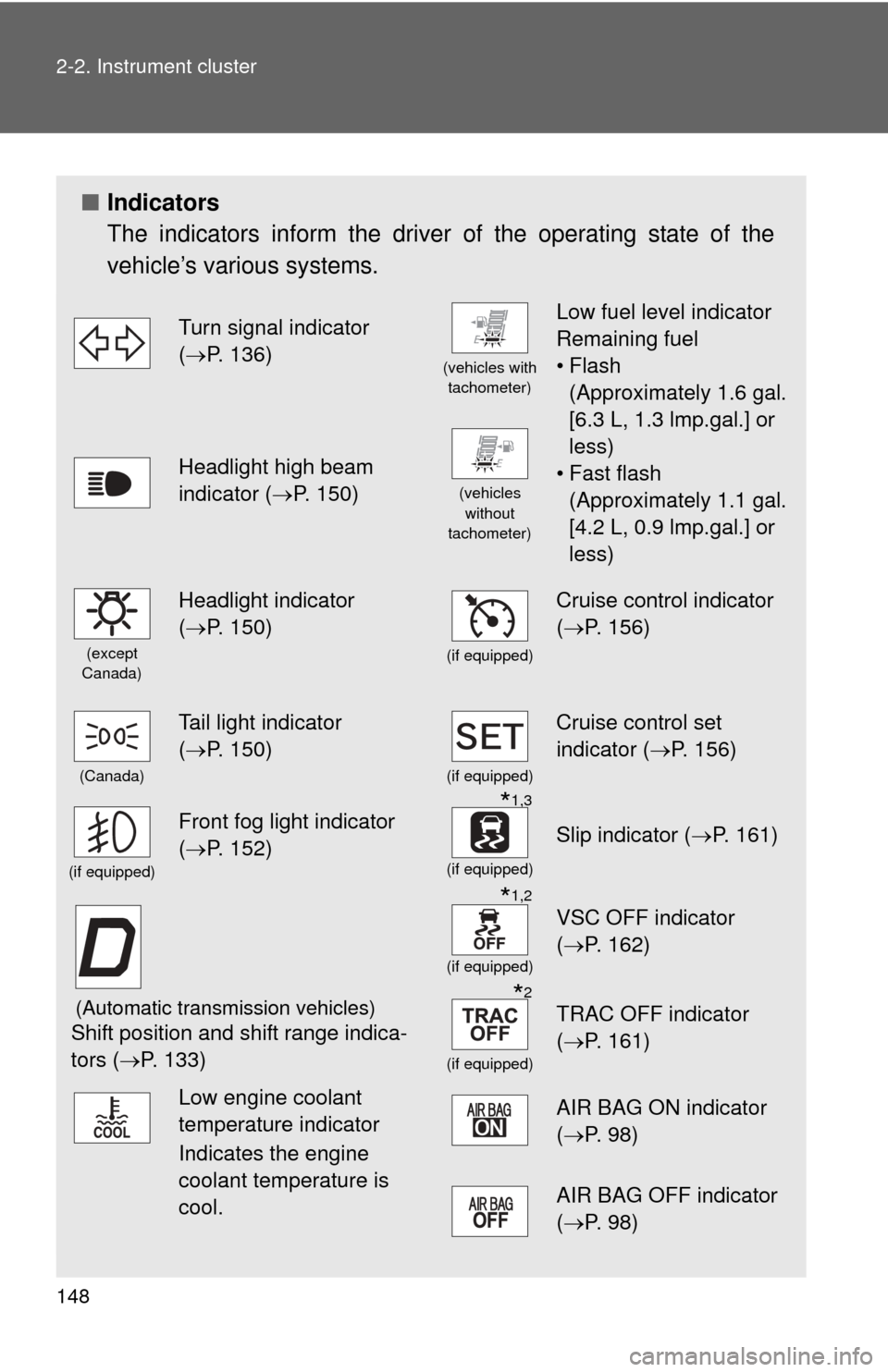
■Indicators
The indicators inform the driver of the operating state of the
vehicle’s various systems.
Turn signal indicator
(P. 136)
(vehicles with
tachometer)
Low fuel level indicator
Remaining fuel
•Flash (Approximately 1.6 gal.
[6.3 L, 1.3 lmp.gal.] or
less)
• Fast flash (Approximately 1.1 gal.
[4.2 L, 0.9 lmp.gal.] or
less)
Headlight high beam
indicator ( P. 150)
(vehicles
without
tachometer)
(except
Canada)
Headlight indicator
( P. 150)
(if equipped)
Cruise control indicator
( P. 156)
(Canada)
Tail light indicator
(P. 150)
(if equipped)
Cruise control set
indicator ( P. 156)
(if equipped)
Front fog light indicator
(P. 152)*1,3
(if equipped)
Slip indicator ( P. 161)
(Automatic transmission vehicles)
Shift position and shift range indica-
tors ( P. 133)
*1,2
(if equipped)
VSC OFF indicator
(P. 162)
*2
(if equipped)
TRAC OFF indicator
(P. 161)
Low engine coolant
temperature indicator
Indicates the engine
coolant temperature is
cool.AIR BAG ON indicator
(P. 98)
AIR BAG OFF indicator
(P. 98)
Page 149 of 416
149
2-2. Instrument cluster
2
When driving
CAUTION
■
If a safety system warning light does not come on
Should a safety system light such as ABS and the SRS airbag warning light
not come on when you start the engine, this could mean that these systems
are not available to help protect you in an accident, which could result in
death or serious injury. Have the vehicle inspected by your Toyota dealer
immediately if this occurs.
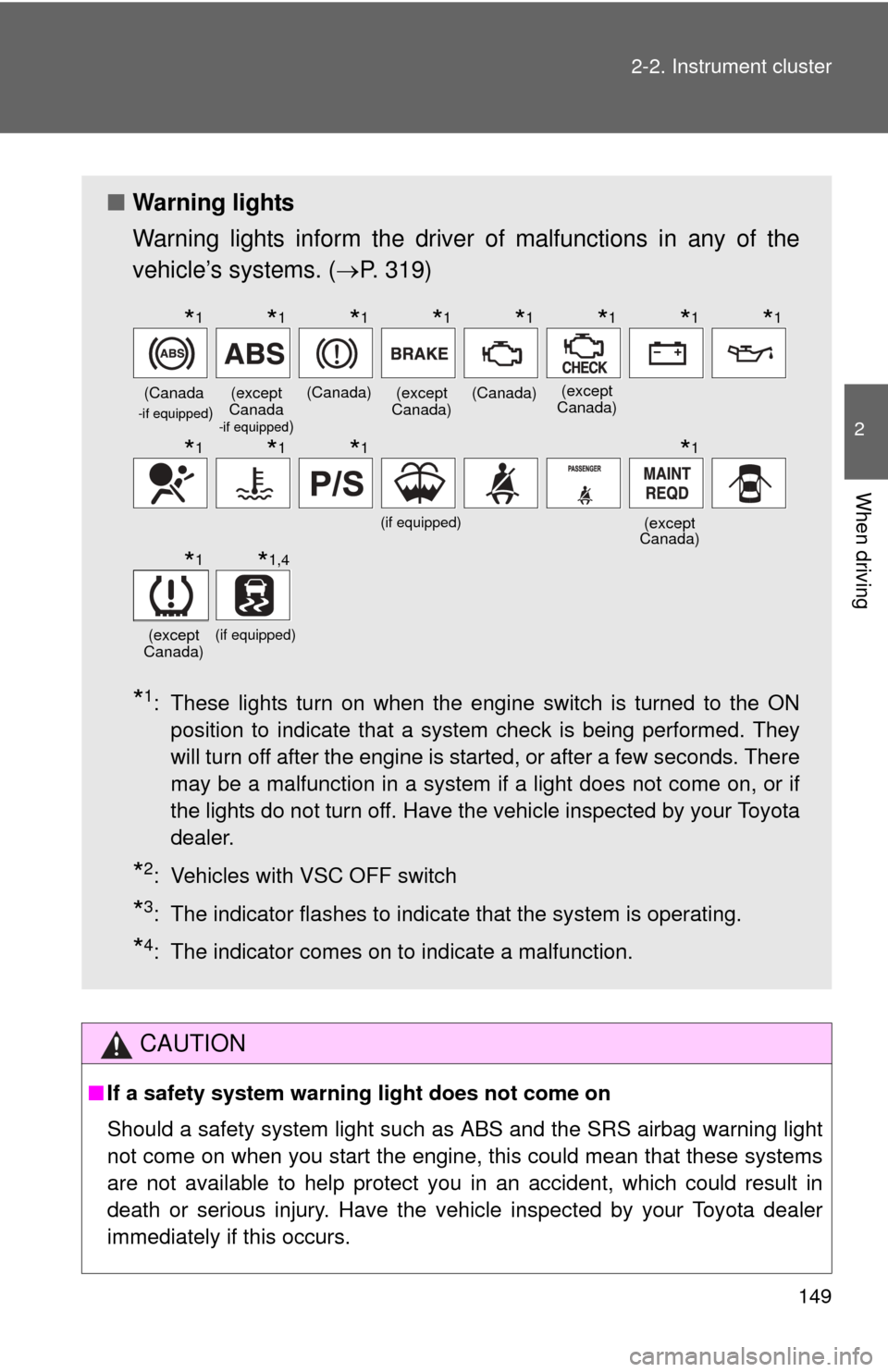
■ Warning lights
Warning lights inform the driver of malfunctions in any of the
vehicle’s systems. ( P. 319)
*1: These lights turn on when the engine switch is turned to the ON
position to indicate that a system check is being performed. They
will turn off after the engine is started, or after a few seconds. There
may be a malfunction in a system if a light does not come on, or if
the lights do not turn off. Have the vehicle inspected by your Toyota
dealer.
*2: Vehicles with VSC OFF switch
*3: The indicator flashes to indicate that the system is operating.
*4: The indicator comes on to indicate a malfunction.
(Canada -if equipped)(except
Canada
-if equipped)
(Canada)(except
Canada)(Canada)(except
Canada)
(if equipped)(except
Canada)
(except
Canada)
(if equipped)
*1*1*1*1*1*1*1*1
*1*1*1*1
*1*1,4