Page 250 of 416
250
4-3. Do-it-yourself maintenance
Do-it-yourself ser vice precautions
If you perform maintenance yourself, be sure to follow the correct
procedures as given in these sections.
ItemsParts and tools
Battery condition ( P. 264)•Warm water
• Baking soda
• Grease
• Conventional wrench
(for terminal clamp bolts)
Brake fluid level ( P. 263)• FMVSS No.116 DOT 3 or SAE
J1703 brake fluid
• Rag or paper towel
Engine coolant level ( P. 261)• “Toyota Super Long Life Coolant”
or similar high quality ethylene
glycol based non-silicate, non-
amine, non-nitrite and non-borate
coolant with long-life hybrid
organic acid technology.
Except Canada:
“Toyota Super Long Life Coolant”
is pre-mixed with 50% coolant
and 50% deionized water.
Canada:
“Toyota Super Long Life Coolant”
is pre-mixed with 55% coolant
and 45% deionized water.
• Funnel (used only for adding engine coolant)
Engine oil level P. 257) • Toyota Genuine Motor Oil or
equivalent
• Rag or paper towel
• Funnel (used only for adding oil)
Fuses ( P. 286)• Fuse with same amperage rating
as original
Page 307 of 416
When trouble arises5
307
5-1. Essential informationEmergency flashers ......... 308
If your vehicle needs to be towed ........................ 309
If you think something is wrong ............................. 315
Fuel pump shut off system ........................... 316
Event data recorder ......... 317 5-2. Steps to take in an
emergency
If a warning light turns on or a warning buzzer
sounds... ........................ 319
If you have a flat tire......... 329
If the engine will not start ................................ 341
If the shift lever cannot be shifted from P (vehicles
with an automatic
transmission) ................. 343
If you lose your keys ........ 344
If the vehicle battery is discharged ..................... 345
If your vehicle overheats ....................... 349
If the vehicle becomes stuck .............................. 352
If your vehicle has to be stopped in an
emergency ..................... 354
Page 309 of 416
5
When trouble arises
309
5-1. Essential information
If your vehicle needs to be towed
Before towingThe following may indicate a problem with your transmission. Contact
your Toyota dealer before towing.
● The engine is running, but the vehicle will not move.
● The vehicle makes an abnormal sound.
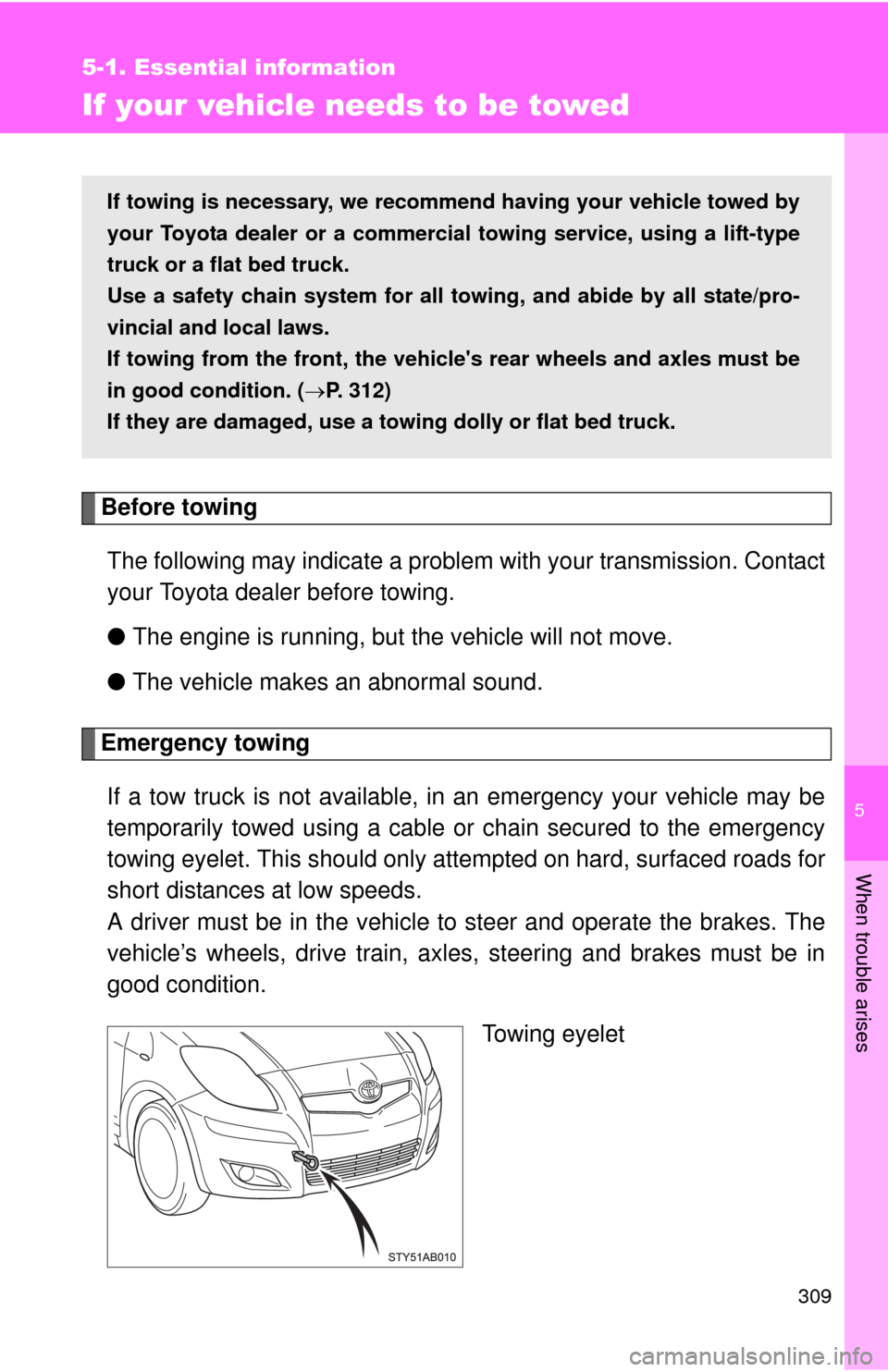
Emergency towing
If a tow truck is not available, in an emergency your vehicle may be
temporarily towed using a cable or chain secured to the emergency
towing eyelet. This should only attempted on hard, surfaced roads for
short distances at low speeds.
A driver must be in the vehicle to steer and operate the brakes. The
vehicle’s wheels, drive train, axles, steering and brakes must be in
good condition.
Towing eyelet
If towing is necessary, we recommend having your vehicle towed by
your Toyota dealer or a commerci al towing service, using a lift-type
truck or a flat bed truck.
Use a safety chain system for all to wing, and abide by all state/pro-
vincial and local laws.
If towing from the front, the vehic le's rear wheels and axles must be
in good condition. (P. 312)
If they are damaged, use a towing dolly or flat bed truck.
Page 310 of 416
310 5-1. Essential information
■Emergency towin g procedure
Release the parking brake.
Put the transmission in N.
Turn the engine switch to the ACC (engine off) or ON (engine run-
ning) position.
CAUTION
■ Caution while towing
●Use extreme caution when towing the vehicle.
Avoid sudden starts or erratic driving maneuvers which place excessive
stress on the emergency towing eyelet and the cables or chains. Always
use caution for the surroundings and other vehicles while towing.
● If the engine is not running, the power assist for the brakes and steering
will not function, making steering and braking more difficult.
NOTICE
■To prevent causing serious dama ge to the transmission
(vehicles with an automatic transmission)
Never tow this vehicle from the rear with the front wheels on the ground.
This may cause serious damage to the transmission.
■ When towing a vehicle without using a towing dolly
(vehicles with a manual transmission)
Do not tow with the key removed or in the LOCK position.
Page 311 of 416
5
When trouble arises
311
5-1. Essential information
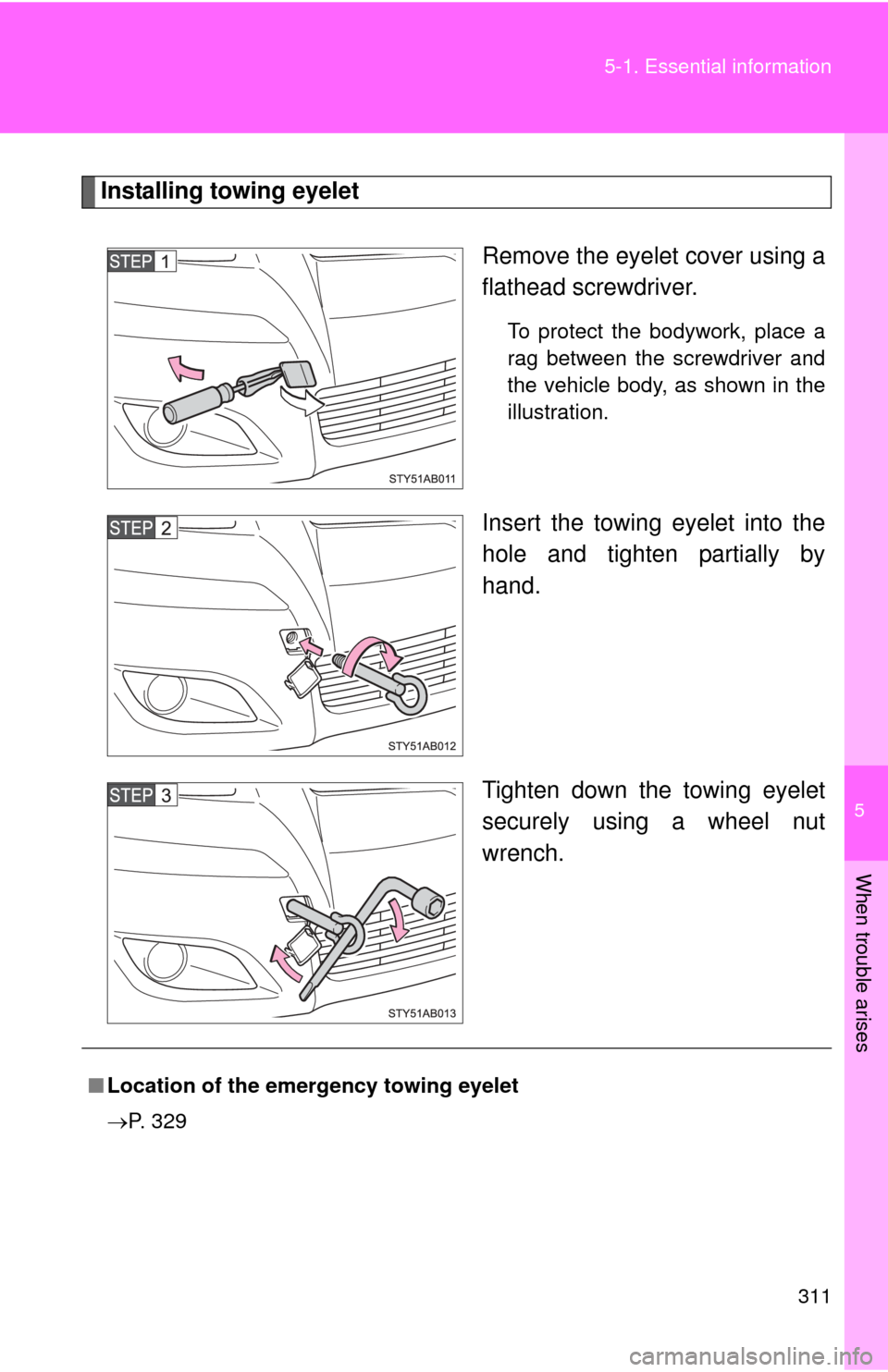
Installing towing eyelet
Remove the eyelet cover using a
flathead screwdriver.
To protect the bodywork, place a
rag between the screwdriver and
the vehicle body, as shown in the
illustration.
Insert the towing eyelet into the
hole and tighten partially by
hand.
Tighten down the towing eyelet
securely using a wheel nut
wrench.
■Location of the emer gency towing eyelet
P. 329
Page 312 of 416
312 5-1. Essential information
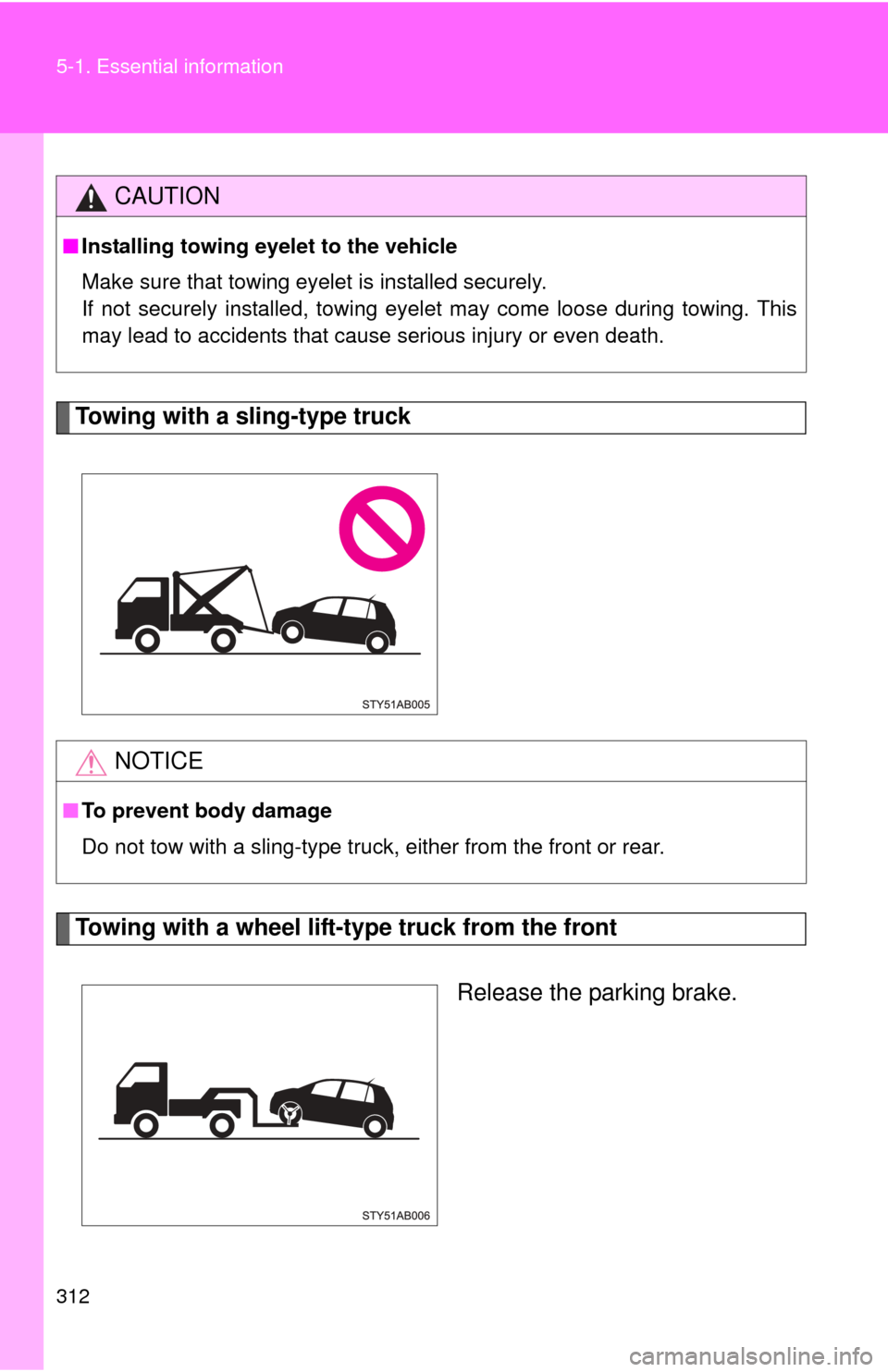
Towing with a sling-type truck
Towing with a wheel lift-type truck from the frontRelease the parking brake.
CAUTION
■Installing towing eyelet to the vehicle
Make sure that towing eyelet is installed securely.
If not securely installed, towing eyelet may come loose during towing. This
may lead to accidents that cause serious injury or even death.
NOTICE
■To prevent body damage
Do not tow with a sling-type truck, either from the front or rear.
Page 313 of 416
5
When trouble arises
313
5-1. Essential information
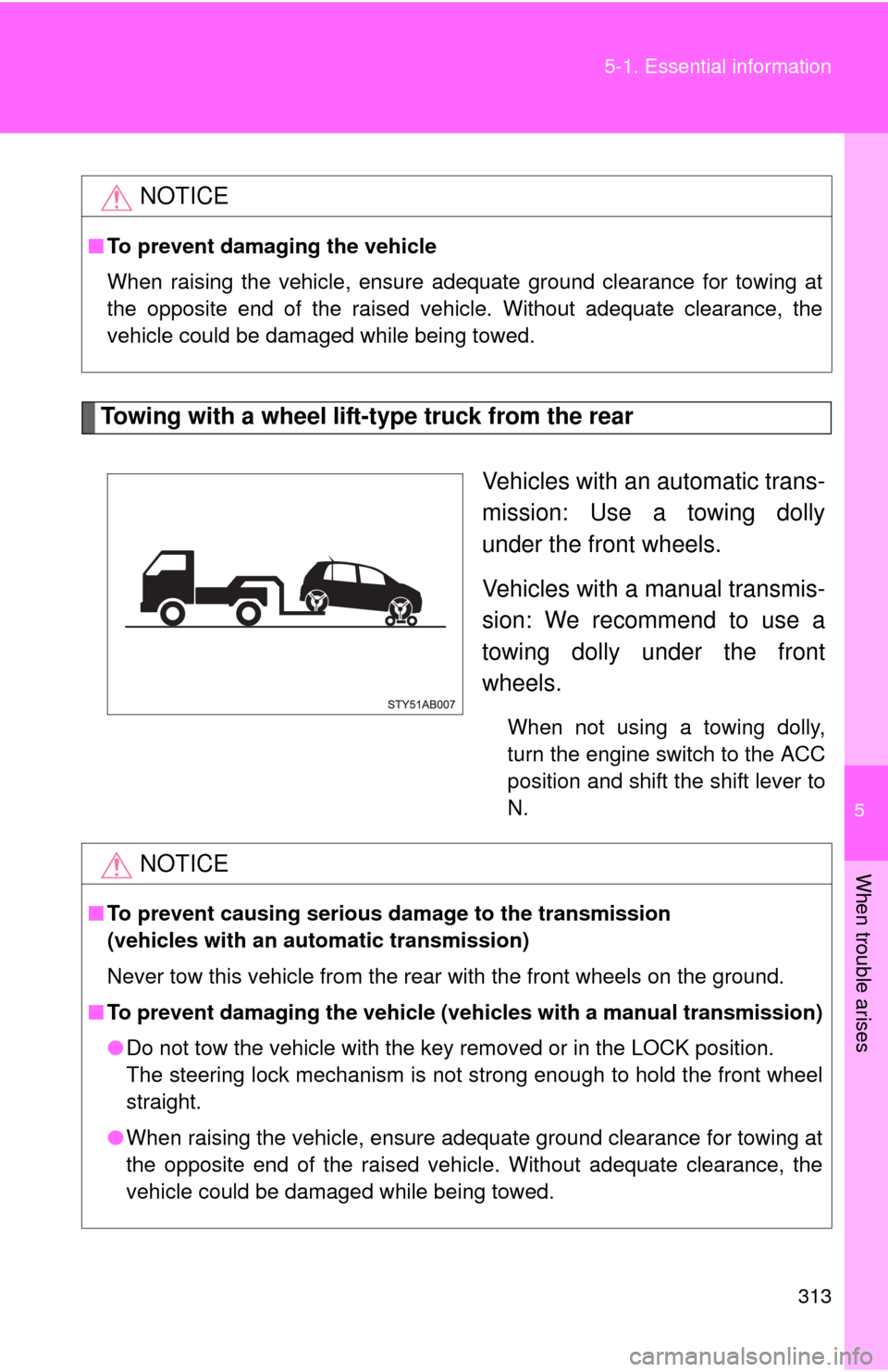
Towing with a wheel lift-type truck from the rear
Vehicles with an automatic trans-
mission: Use a towing dolly
under the front wheels.
Vehicles with a manual transmis-
sion: We recommend to use a
towing dolly under the front
wheels.
When not using a towing dolly,
turn the engine switch to the ACC
position and shift the shift lever to
N.
NOTICE
■To prevent damaging the vehicle
When raising the vehicle, ensure adequate ground clearance for towing at
the opposite end of the raised vehicle. Without adequate clearance, the
vehicle could be damaged while being towed.
NOTICE
■To prevent causing serious da mage to the transmission
(vehicles with an automatic transmission)
Never tow this vehicle from the rear with the front wheels on the ground.
■ To prevent damaging the vehicle (vehicles with a manual transmission)
●Do not tow the vehicle with the key removed or in the LOCK position.
The steering lock mechanism is not strong enough to hold the front wheel
straight.
● When raising the vehicle, ensure adequate ground clearance for towing at
the opposite end of the raised vehicle. Without adequate clearance, the
vehicle could be damaged while being towed.
Page 329 of 416
5
When trouble arises
329
5-2. Steps to take in an emergency
If you have a flat tire
Remove the flat tire and replace it with the spare provided.
■Before jacking up the vehicle
●Stop the vehicle on a hard, flat surface.
● Set the parking brake.
● Shift the shift lever to P (automatic transmission) or R (manual
transmission).
● Stop the engine.
● Turn on the emergency flashers.
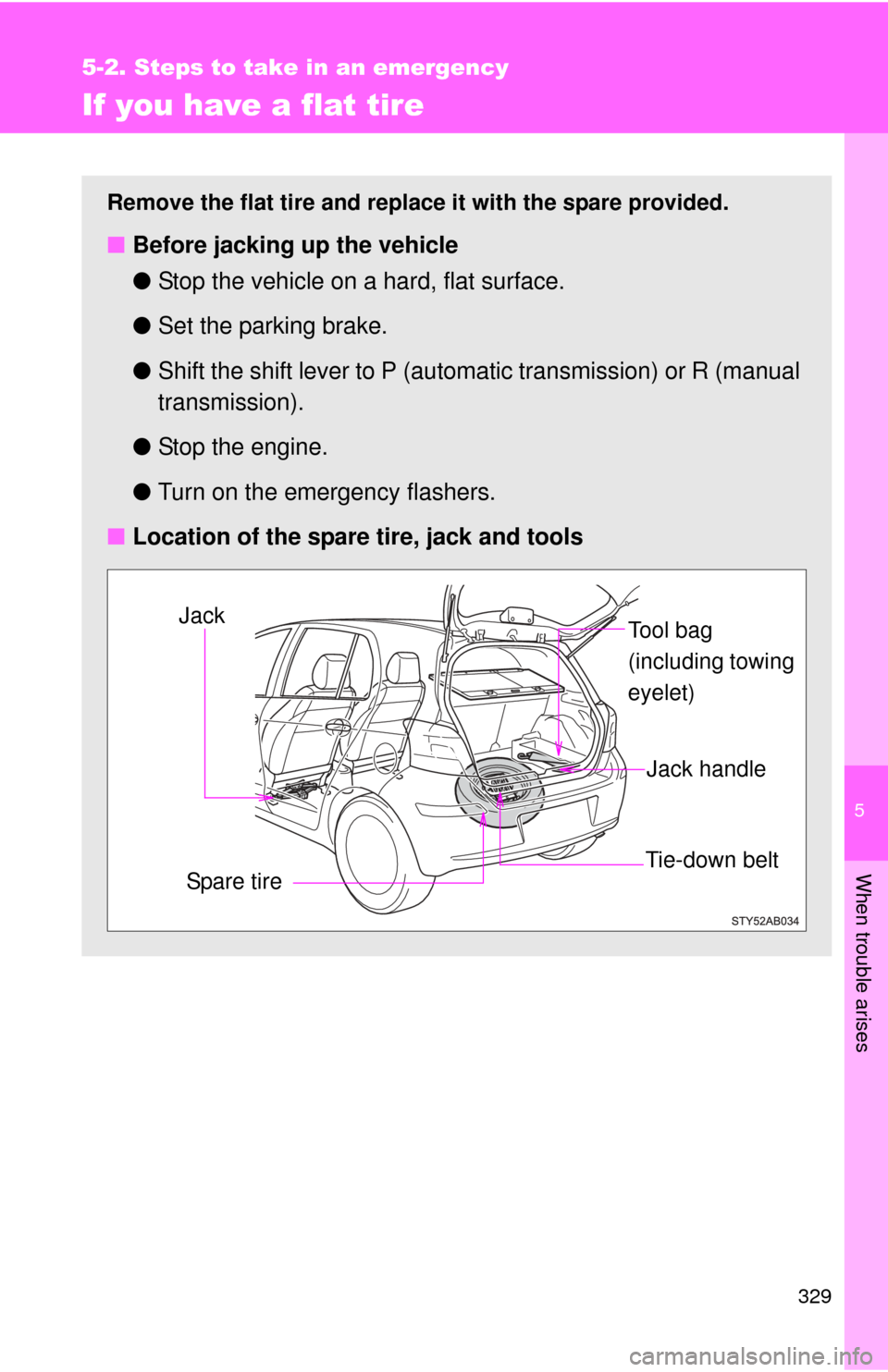
■ Location of the spare tire, jack and tools
Spare tire
Jack
Jack handle
Tie-down belt
Tool bag
(including towing
eyelet)