Page 80 of 416
80
1-6. Theft deterrent system
Alarm (Puerto Rico)
The system sounds the alarm and flashes lights when forcible entry
is detected.
■ Triggering of the alarm
The alarm is triggered in the fo llowing situations when the alarm
is set.
● A locked door is unlocked or opened in any way other than
using the key.
● The hood is opened.
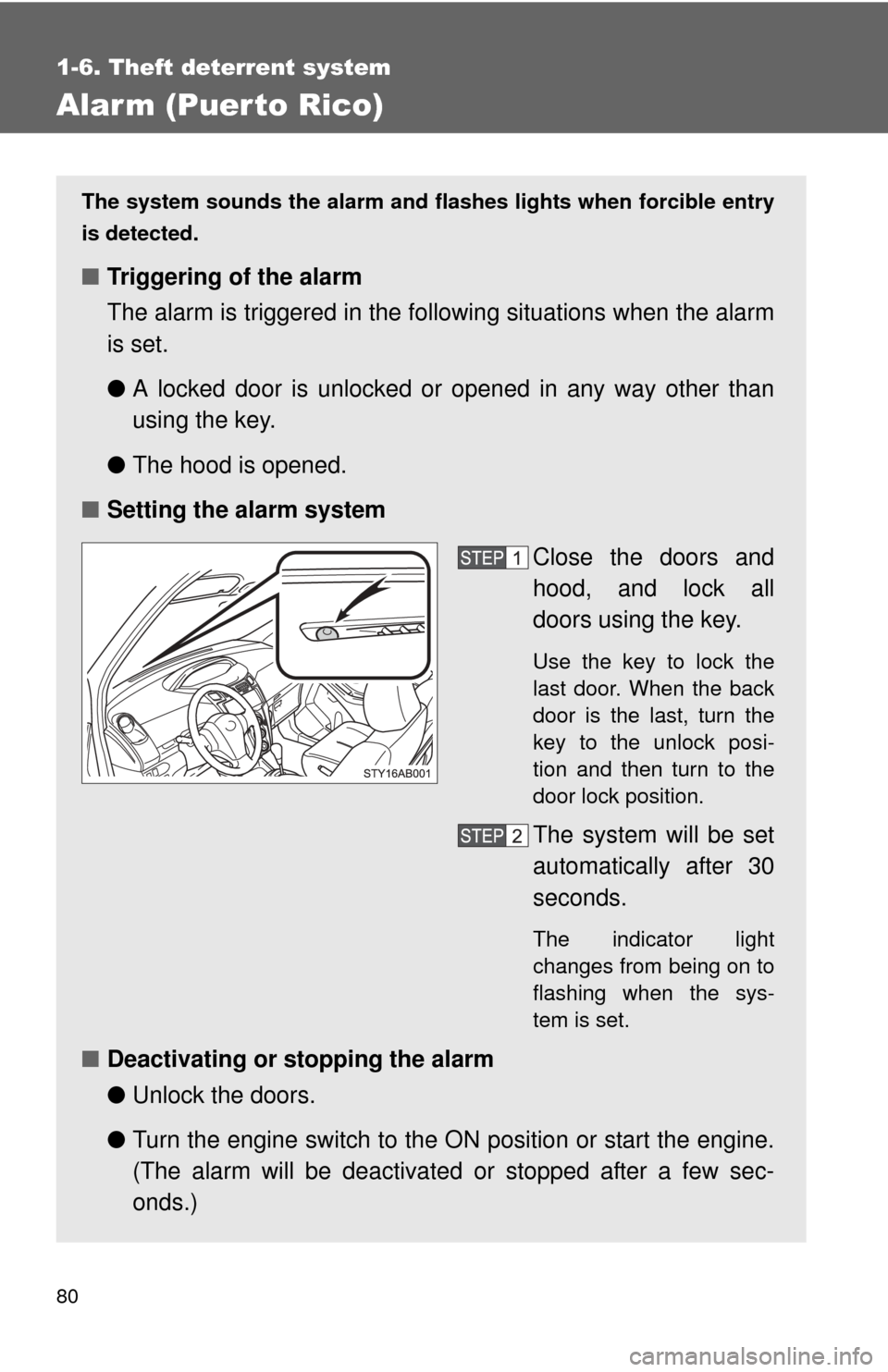
■ Setting the alarm system
Close the doors and
hood, and lock all
doors using the key.
Use the key to lock the
last door. When the back
door is the last, turn the
key to the unlock posi-
tion and then turn to the
door lock position.
The system will be set
automatically after 30
seconds.
The indicator light
changes from being on to
flashing when the sys-
tem is set.
■Deactivating or stopping the alarm
●Unlock the doors.
● Turn the engine switch to the ON position or start the engine.
(The alarm will be deactivated or stopped after a few sec-
onds.)
Page 82 of 416
82 1-6. Theft deterrent system
■Alarm-operated door lock
●When the alarm is operating, the door s are locked automatically to pre-
vent intruders.
● Do not leave the key inside the vehicle when the alarm is operating, and
make sure the key is not inside the vehicle when recharging or replacing
the battery.
NOTICE
■To ensure the system operates correctly
Do not modify or remove the system. If modified or removed, the proper
operation of the system cannot be guaranteed.
Page 121 of 416
121
2-1. Driving procedures
2
When driving
Starting on a steep uphill
Automatic transmission With the brake pedal depressed, firmly set the parking brake
and shift the shift lever to D.
Gently depress the accelerator pedal.
Release the parking brake.
■Parking the vehicle
Automatic transmission
With the shift lever in D, depress the brake pedal.
Set the parking brake. ( P. 137)
Shift the shift lever to P. ( P. 133)
When parking on a hill, if necessary, block the wheels.
Turn the engine switch off to stop the engine.
Lock the door, making sure that you have the key on your
person.
Manual transmission
With the clutch pedal fully depressed, depress the brake
pedal.
Set the parking brake. ( P. 137)
Shift the shift lever to N. ( P. 135)
When parking on a hill, shift the shift lever to 1 or R. If necessary,
block the wheels.
Turn the engine switch off to stop the engine.
Lock the door, making sure that you have the key on your
person.
Page 130 of 416
130
2-1. Driving procedures
Engine (ignition) switch
■Engine switch
LOCK
The steering wheel is locked
and the key can be removed.
(Vehicles with an automatic
transmission: The key can be
removed only when the shift
lever is in P.)
ACC
Some electrical components
such as the audio system can
be used.
ON
All electrical components can
be used.
START
For starting the engine.
■Starting the engine
Automatic transmission
Check that the parking brake is set.
Check that the shift lever is set in P.
Sit in the driver’s seat and firmly depress the brake pedal.
Turn the engine switch to the START position and start the
engine.
The engine will crank until it starts or for up to 20 seconds, which-
ever is less.
Continue depressing the brake pedal until the engine is com-
pletely started.
Page 131 of 416
131
2-1. Driving procedures
2
When driving
■
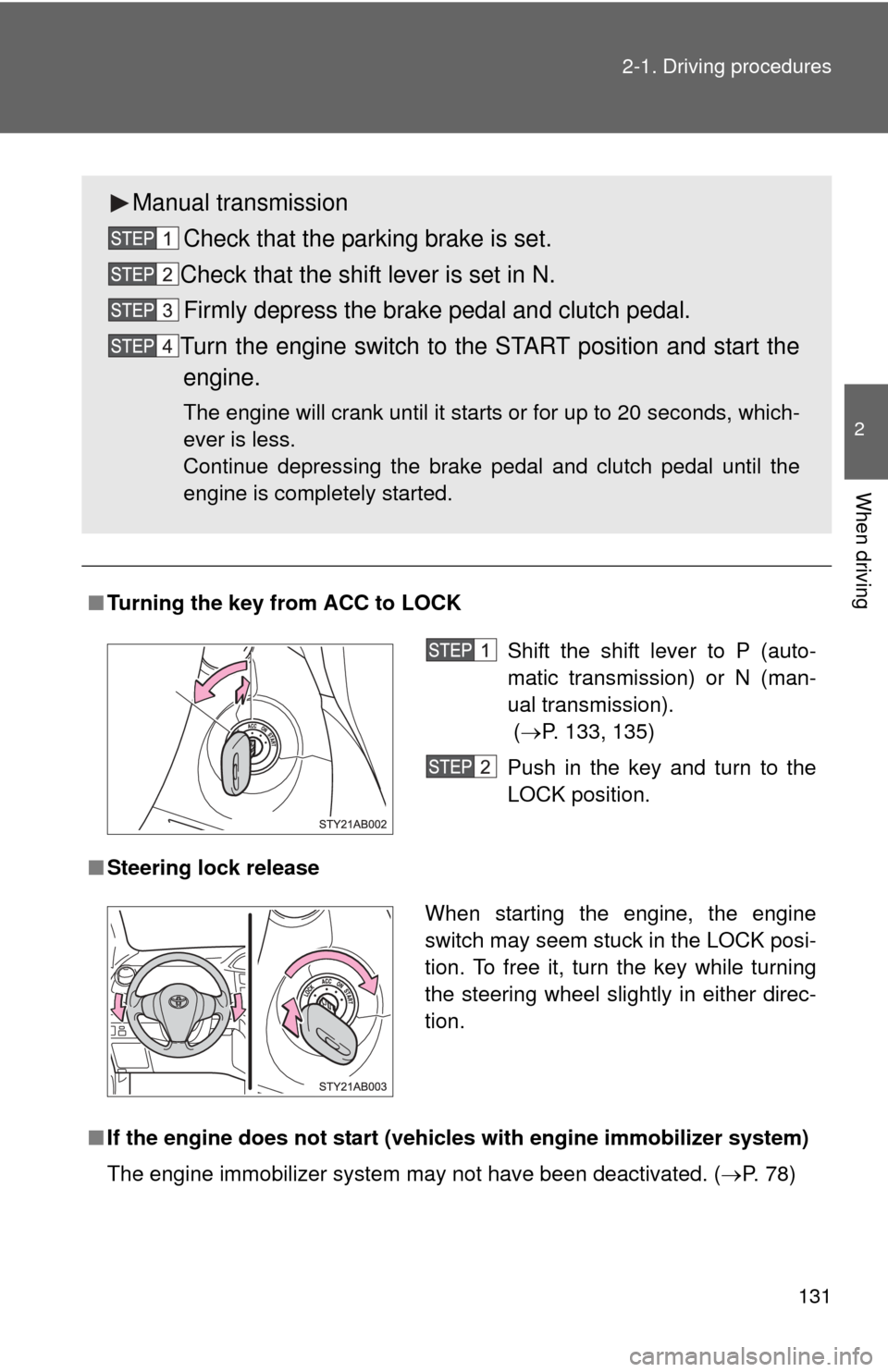
Turning the key from ACC to LOCK
■ Steering lock release
■ If the engine does not start (vehic les with engine immobilizer system)
The engine immobilizer system may not have been deactivated. ( P. 78)
Manual transmission
Check that the parking brake is set.
Check that the shift lever is set in N. Firmly depress the brake pedal and clutch pedal.
Turn the engine switch to the START position and start the engine.
The engine will crank until it starts or for up to 20 seconds, which-
ever is less.
Continue depressing the brake pedal and clutch pedal until the
engine is completely started.
Shift the shift lever to P (auto-
matic transmission) or N (man-
ual transmission).
( P. 133, 135)
Push in the key and turn to the
LOCK position.
When starting the engine, the engine
switch may seem stuck in the LOCK posi-
tion. To free it, turn the key while turning
the steering wheel slightly in either direc-
tion.
Page 132 of 416
132 2-1. Driving procedures
■Key reminder function
A buzzer sounds if the driver’s door is opened, while the engine switch is in
the ACC or LOCK position to remind you to remove the key.
CAUTION
■When starting the engine
Always start the engine while sitting in the driver's seat. Do not depress the
accelerator while starting the engine under any circumstances.
Doing so may cause an accident resulting in death or serious injury.
■ Caution while driving
Do not turn the engine switch to the LOCK position.
If in an emergency, you must turn the engine off while the vehicle is moving,
turn the key only to the ACC position.
NOTICE
■To prevent battery discharge
Do not leave the key in the ACC or ON position for long periods if the engine
is not running.
■ When starting the engine
●Do not crank for more than 30 seconds at a time. This may overheat the
starter and wiring systems.
● Do not race a cold engine.
● If the engine becomes difficult to start or stalls frequently, have the engine
checked immediately.
Page 151 of 416
151
2-3. Operating the lights and wipers
2
When driving
■
Daytime running light system (if equipped)
●To make your vehicle more visible to other drivers, the headlights turn on
automatically (at a reduced intensity) whenever the engine is started and
the parking brake is released. Daytime running lights are not designed for
use at night.
● Compared to turning on the headlights, the daytime running light system
offers greater durability and consumes less electricity, so it can help
improve fuel economy.
■ Light reminder buzzer
A buzzer sounds when the key is removed and the driver's door is opened
while the lights are turned on.
NOTICE
■To prevent battery discharge
Do not leave the lights on longer than necessary when the engine is not run-
ning.
Page 237 of 416
Maintenance and care4
237
4-1. Maintenance and careCleaning and protecting the vehicle exterior......... 238
Cleaning and protecting the vehicle interior.......... 241
4-2. Maintenance Maintenance requirements .................. 244
General maintenance....... 246
Emission inspection and maintenance (I/M)
programs........................ 249 4-3. Do-it-yourself maintenance
Do-it-yourself service precautions .................... 250
Hood ................................ 253
Positioning a floor jack ..... 254
Engine compartment ........ 256
Tires ................................. 269
Tire inflation pressure ...... 275
Wheels ............................. 279
Air conditioning filter......... 281
Key battery ....................... 284
Checking and replacing fuses .............................. 286
Light bulbs........................ 297