2011 TOYOTA VERSO S warning
[x] Cancel search: warningPage 36 of 664
361-1. For safe use
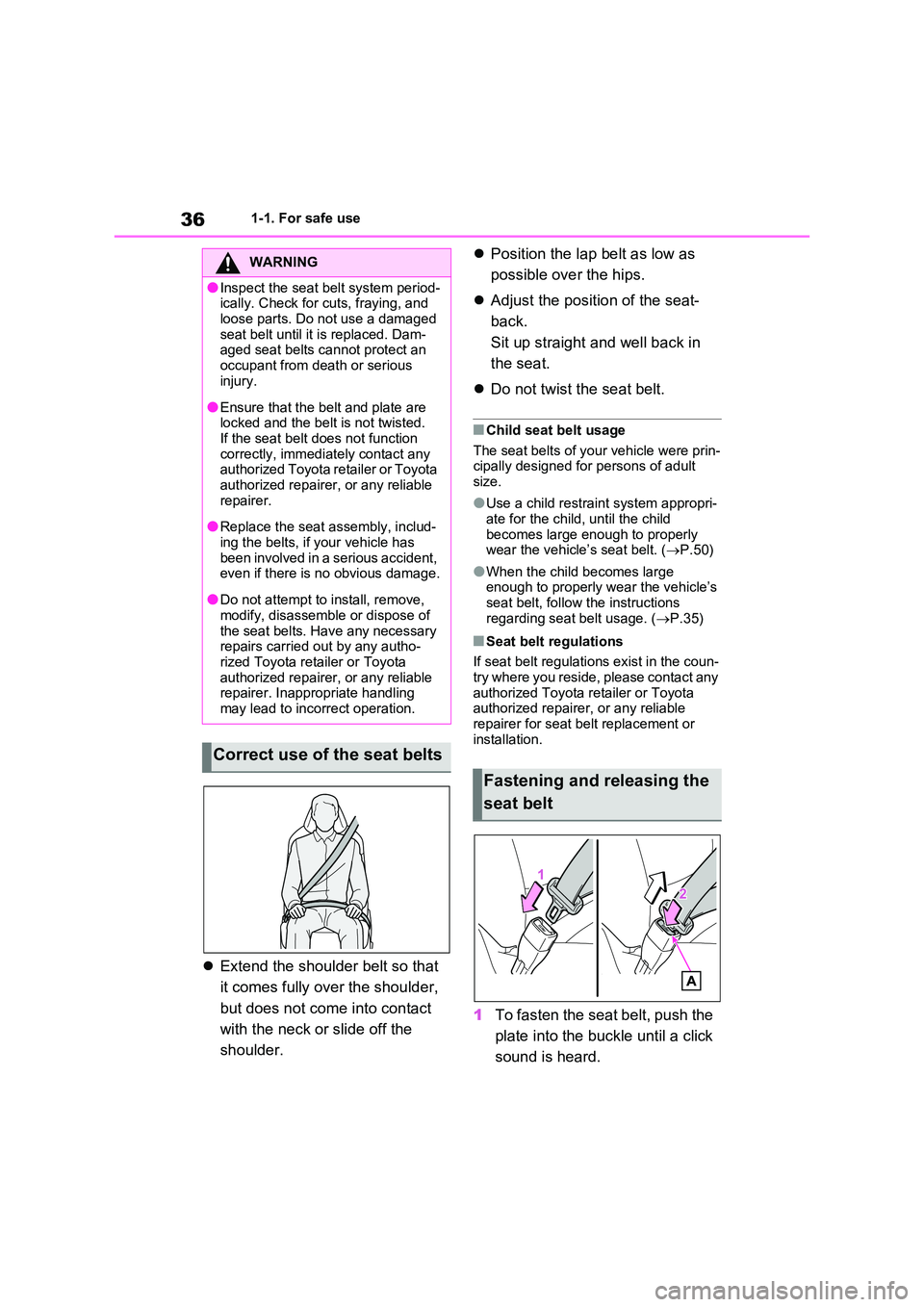
Extend the shoulder belt so that
it comes fully over the shoulder,
but does not come into contact
with the neck or slide off the
shoulder.
Position the lap belt as low as
possible over the hips.
Adjust the position of the seat-
back.
Sit up straight and well back in
the seat.
Do not twist the seat belt.
■Child seat belt usage
The seat belts of your vehicle were prin- cipally designed for persons of adult size.
●Use a child restraint system appropri-ate for the child, until the child
becomes large enough to properly wear the vehicle’s seat belt. ( P.50)
●When the child becomes large enough to properly wear the vehicle’s seat belt, follow the instructions
regarding seat belt usage. ( P.35)
■Seat belt regulations
If seat belt regulations exist in the coun- try where you reside, please contact any
authorized Toyota retailer or Toyota authorized repairer, or any reliable repairer for seat belt replacement or
installation.
1 To fasten the seat belt, push the
plate into the buckle until a click
sound is heard.
WARNING
●Inspect the seat belt system period- ically. Check for cuts, fraying, and
loose parts. Do not use a damaged seat belt until it is replaced. Dam-aged seat belts cannot protect an
occupant from death or serious injury.
●Ensure that the belt and plate are locked and the belt is not twisted.If the seat belt does not function
correctly, immediately contact any authorized Toyota retailer or Toyota authorized repairer, or any reliable
repairer.
●Replace the seat assembly, includ-
ing the belts, if your vehicle has been involved in a serious accident, even if there is no obvious damage.
●Do not attempt to install, remove, modify, disassemble or dispose of
the seat belts. Have any necessary repairs carried out by any autho-rized Toyota retailer or Toyota
authorized repairer, or any reliable repairer. Inappropriate handling may lead to incorrect operation.
Correct use of the seat belts
Fastening and releasing the
seat belt
Page 37 of 664
37
1
1-1. For safe use
For safety and security
2 To release the seat belt, press
the release button .
■Emergency locking retractor (ELR)
The retractor will lock the belt during a sudden stop or on impact. It may also
lock if you lean forward too quickly. A slow, easy motion will allow the belt to extend so that you can move around
fully.
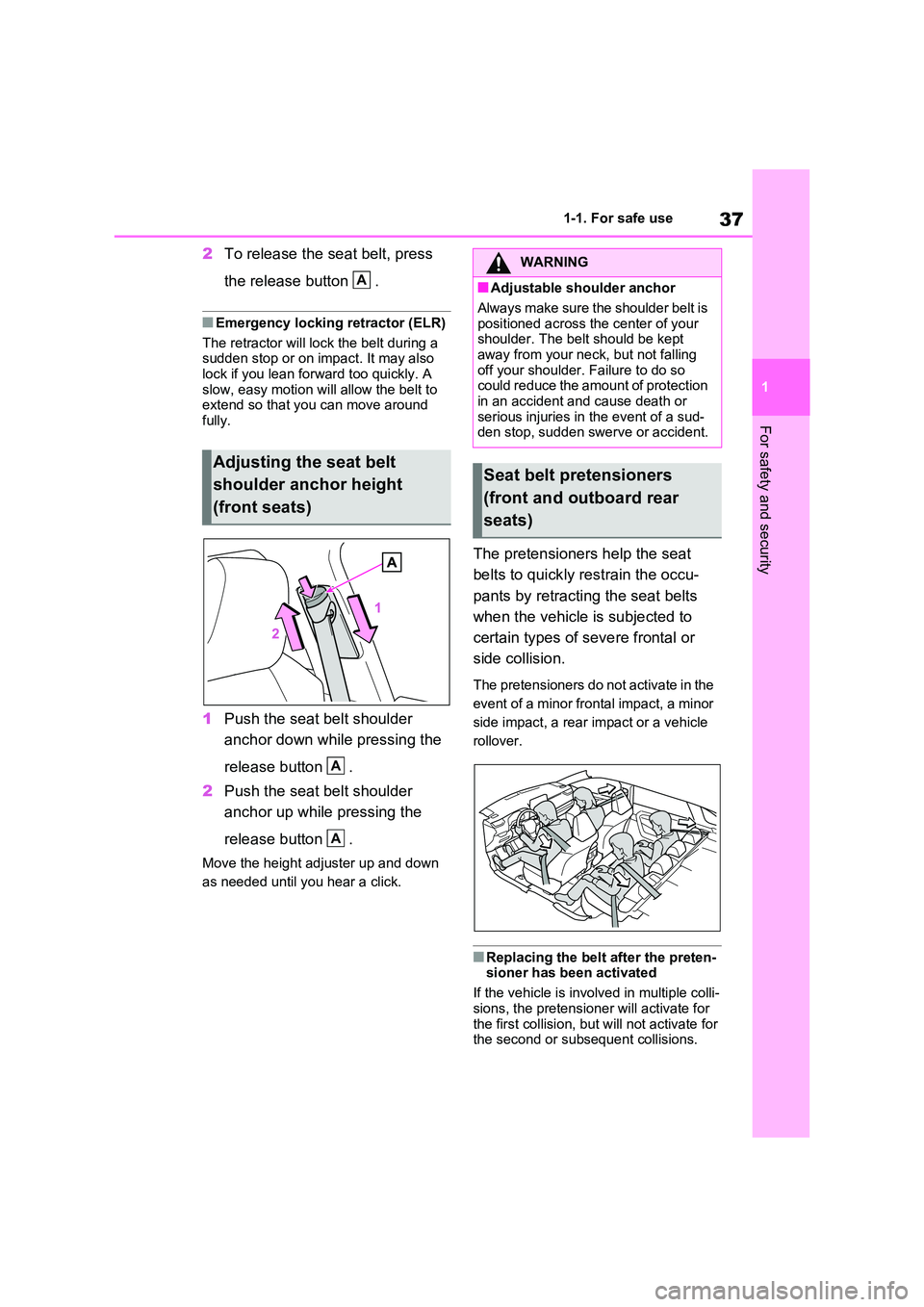
1 Push the seat belt shoulder
anchor down while pressing the
release button .
2 Push the seat belt shoulder
anchor up while pressing the
release button .
Move the height adjuster up and down
as needed until you hear a click.
The pretensioners help the seat
belts to quickly restrain the occu-
pants by retracting the seat belts
when the vehicle is subjected to
certain types of severe frontal or
side collision.
The pretensioners do not activate in the
event of a minor frontal impact, a minor
side impact, a rear impact or a vehicle
rollover.
■Replacing the belt after the preten- sioner has been activated
If the vehicle is involved in multiple colli-
sions, the pretensioner will activate for the first collision, but will not activate for the second or subsequent collisions.
Adjusting the seat belt
shoulder anchor height
(front seats)
A
A
A
WARNING
■Adjustable shoulder anchor
Always make sure the shoulder belt is
positioned across the center of your shoulder. The belt should be kept away from your neck, but not falling
off your shoulder. Failure to do so could reduce the amount of protection in an accident and cause death or
serious injuries in the event of a sud- den stop, sudden swerve or accident.
Seat belt pretensioners
(front and outboard rear
seats)
Page 38 of 664
381-1. For safe use
■PCS-linked seat belt pretensioner
control
If the PCS (Pre-Collision System) deter- mines that the possibility of a collision
with a vehicle is high, the seat belt pre- tensioners will be prepared to operate.
WARNING
■Seat belt pretensioners
If the pretensioner has activated, the SRS warning light will come on. In that case, the seat belt cannot be
used again and must be replaced at any authorized Toyota retailer or Toyota authorized repairer, or any
reliable repairer. Failure to do so may cause death or serious injury.
Page 40 of 664

401-1. For safe use
Can help protect primarily the head of occupants in the outer seats
■SRS airbag system components
Front impact sensors
Airbag manual on-off switch
Front passenger airbag
Side impact sensors (front door)
Curtain shield airbags
Seat belt pretensioners and force limiters (front seats)
Side impact sensors (front)
Side airbags
Side impact sensors (rear)
Seat belt pretensioners and force limiters (outboard rear seats)
Driver airbag
Knee airbag
SRS warning light
Airbag sensor assembly
A
B
C
D
E
F
G
H
I
J
K
L
M
N
Page 43 of 664
43
1
1-1. For safe use
For safety and security
repairer as soon as possible.
●Any of the SRS airbags have been inflated.
●The front of the vehicle is damaged or deformed, or was involved in an acci-
dent that was not severe enough to cause the SRS front airbags to inflate.
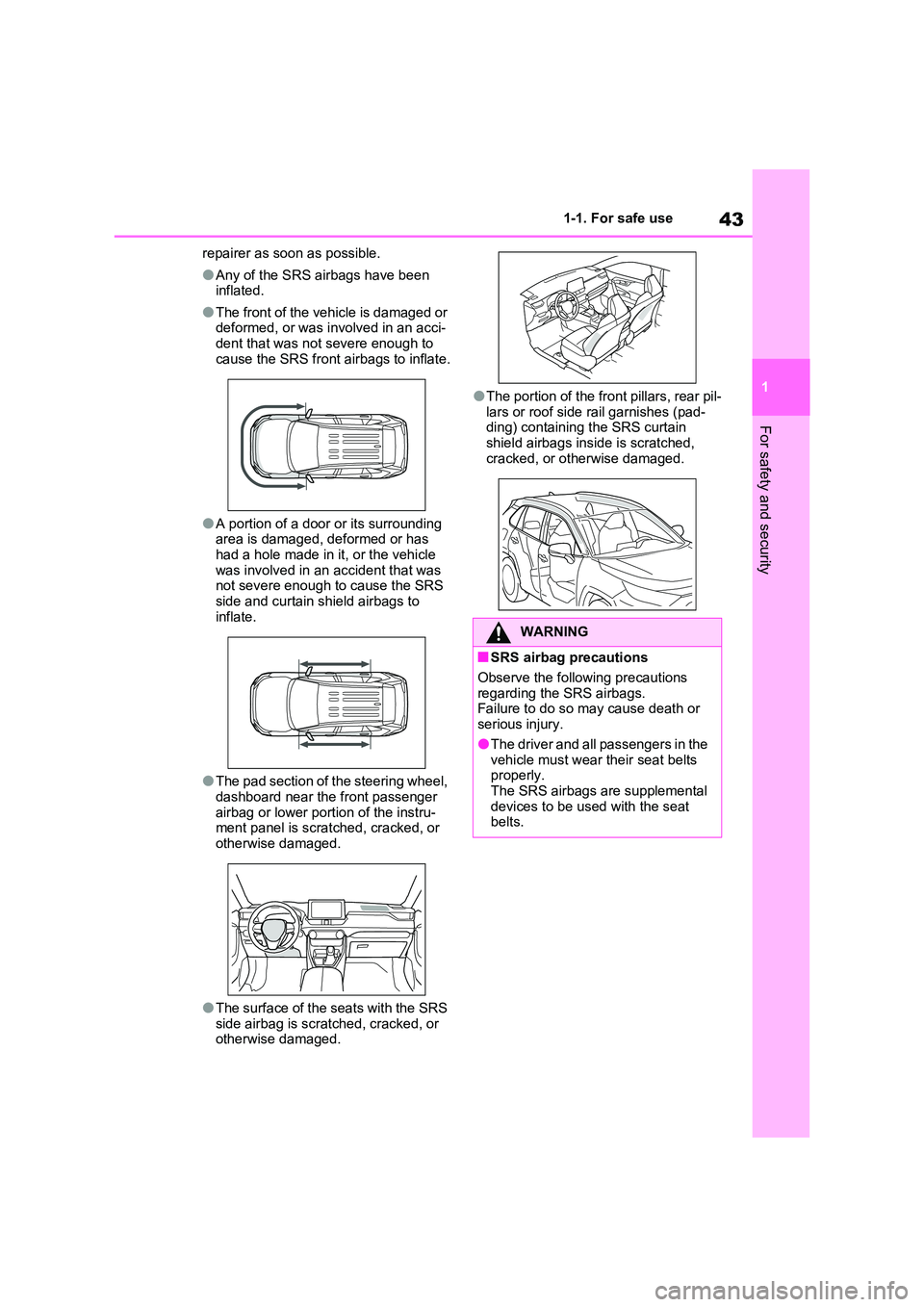
●A portion of a door or its surrounding area is damaged, deformed or has had a hole made in it, or the vehicle
was involved in an accident that was not severe enough to cause the SRS side and curtain shield airbags to
inflate.
●The pad section of the steering wheel,
dashboard near the front passenger airbag or lower portion of the instru-ment panel is scratched, cracked, or
otherwise damaged.
●The surface of the seats with the SRS
side airbag is scratched, cracked, or otherwise damaged.
●The portion of the front pillars, rear pil-
lars or roof side rail garnishes (pad- ding) containing the SRS curtain shield airbags inside is scratched,
cracked, or otherwise damaged.
WARNING
■SRS airbag precautions
Observe the following precautions
regarding the SRS airbags. Failure to do so may cause death or serious injury.
●The driver and all passengers in the vehicle must wear their seat belts properly.
The SRS airbags are supplemental devices to be used with the seat belts.
Page 44 of 664
441-1. For safe use
WARNING
●The SRS driver airbag deploys with considerable force, and can cause
death or serious injury especially if the driver is very close to the air-bag.
Since the risk zone for the driver’s air-
bag is the first 50 - 75 mm (2 - 3 in.) of
inflation, placing yourself 250 mm (10
in.) from your driver airbag provides
you with a clear margin of safety. This
distance is measured from the center
of the steering wheel to your breast-
bone. If you sit less than 250 mm (10
in.) away now, you can change your
driving position in several ways:
• Move your seat to the rear as far as
you can while still reaching the ped- als comfortably.
• Slightly recline the back of the seat. Although vehicle designs vary, many drivers can achieve the 250
mm (10 in.) distance, even with the driver seat all the way forward, sim-ply by reclining the back of the seat
somewhat. If reclining the back of your seat makes it hard to see the road, raise yourself by using a firm,
non-slippery cushion, or raise the seat if your vehicle has that feature.
• If your steering wheel is adjustable, tilt it downward. This points the air-bag toward your chest instead of
your head and neck.
The seat should be adjusted as rec- ommended above, while still main-
taining control of the foot pedals, steering wheel, and your view of the instrument panel controls.
●The SRS front passenger airbag also deploys with considerable force, and can cause death or seri-
ous injury especially if the front pas- senger is very close to the airbag. The front passenger seat should be
as far from the airbag as possible with the seatback adjusted, so the front passenger sits upright.
●Improperly seated and/or restrained infants and children can be killed or
seriously injured by a deploying air- bag. An infant or child who is too small to use a seat belt should be
properly secured using a child restraint system. Toyota strongly recommends that all infants and
children be placed in the rear seats of the vehicle and properly restrained. The rear seats are safer
for infants and children than the front passenger seat. ( P.50)
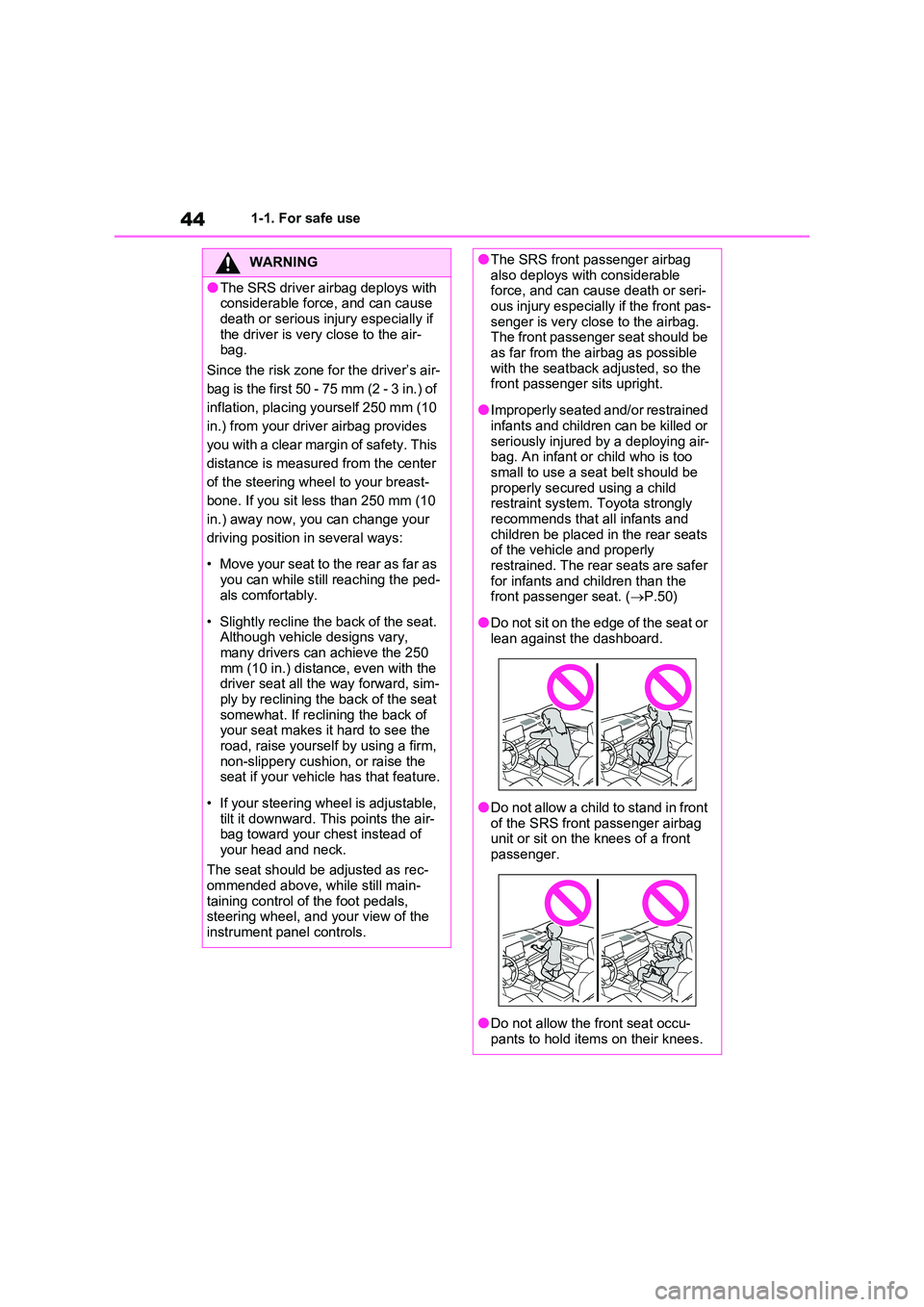
●Do not sit on the edge of the seat or lean against the dashboard.
●Do not allow a child to stand in front of the SRS front passenger airbag unit or sit on the knees of a front
passenger.
●Do not allow the front seat occu-
pants to hold items on their knees.
Page 45 of 664
45
1
1-1. For safe use
For safety and security
WARNING
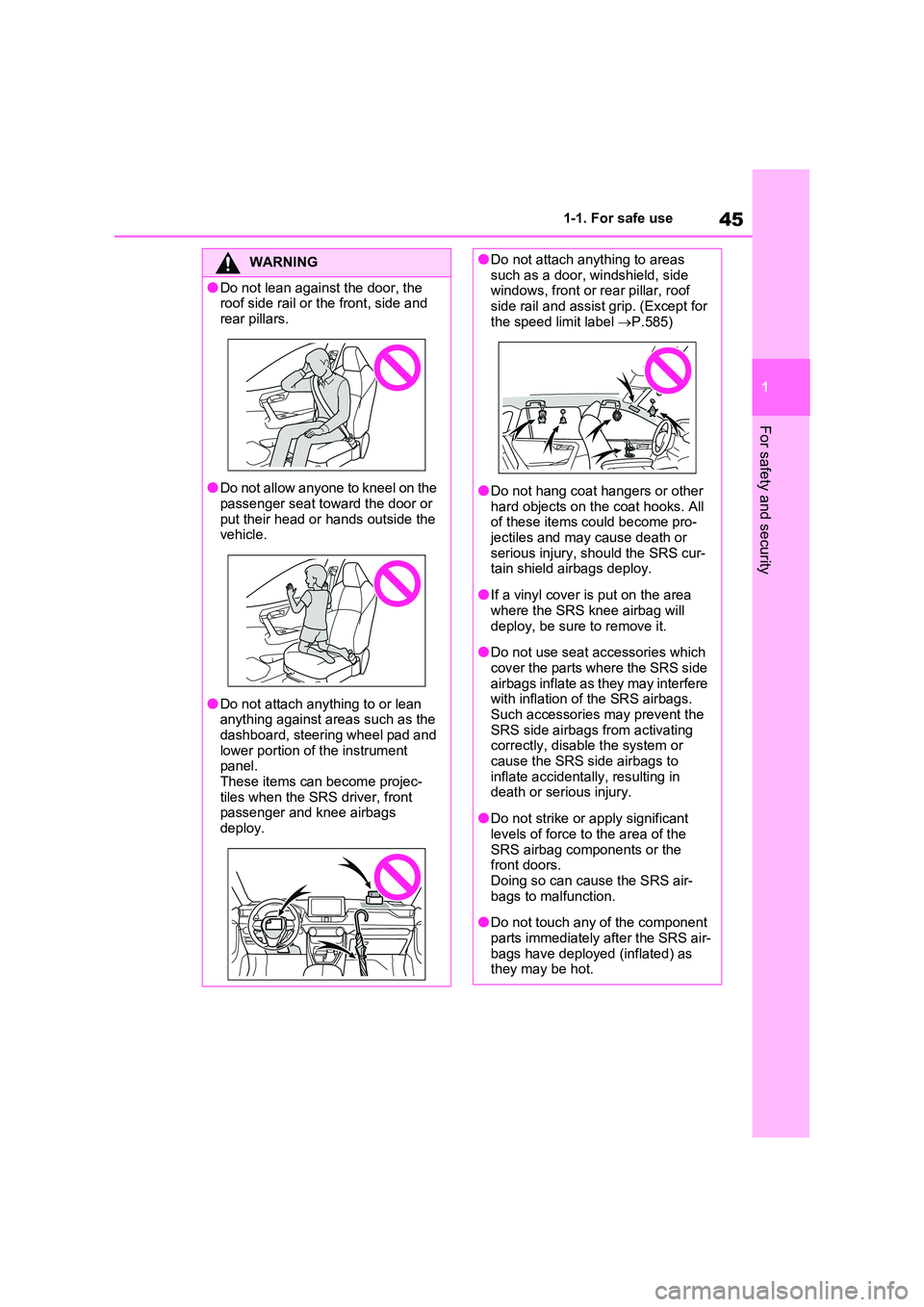
●Do not lean against the door, the roof side rail or the front, side and
rear pillars.
●Do not allow anyone to kneel on the
passenger seat toward the door or put their head or hands outside the vehicle.
●Do not attach anything to or lean anything against areas such as the
dashboard, steering wheel pad and lower portion of the instrument panel.
These items can become projec- tiles when the SRS driver, front passenger and knee airbags
deploy.
●Do not attach anything to areas such as a door, windshield, side windows, front or rear pillar, roof
side rail and assist grip. (Except for the speed limit label P.585)
●Do not hang coat hangers or other hard objects on the coat hooks. All of these items could become pro-
jectiles and may cause death or serious injury, should the SRS cur-tain shield airbags deploy.
●If a vinyl cover is put on the area where the SRS knee airbag will
deploy, be sure to remove it.
●Do not use seat accessories which
cover the parts where the SRS side airbags inflate as they may interfere with inflation of the SRS airbags.
Such accessories may prevent the SRS side airbags from activating correctly, disable the system or
cause the SRS side airbags to inflate accidentally, resulting in death or serious injury.
●Do not strike or apply significant levels of force to the area of the
SRS airbag components or the front doors.Doing so can cause the SRS air-
bags to malfunction.
●Do not touch any of the component
parts immediately after the SRS air- bags have deployed (inflated) as they may be hot.
Page 46 of 664
461-1. For safe use
WARNING
●If breathing becomes difficult after the SRS airbags have deployed,
open a door or side window to allow fresh air in, or leave the vehicle if it is safe to do so. Wash off any resi-
due as soon as possible to prevent skin irritation.
●If the areas where the SRS airbags are stored, such as the steering wheel pad and front and rear pillar
garnishes, are damaged or cracked, have them replaced by any authorized Toyota retailer or
Toyota authorized repairer, or any reliable repairer.
■Modification and disposal of SRS airbag system components
Do not dispose of your vehicle or per-
form any of the following modifica- tions without consulting any authorized Toyota retailer or Toyota
authorized repairer, or any reliable repairer. The SRS airbags may mal-function or deploy (inflate) acciden-
tally, causing death or serious injury.
●Installation, removal, disassembly and repair of the SRS airbags
●Repairs, modifications, removal or replacement of the steering wheel,
instrument panel, dashboard, seats or seat upholstery, front, side and rear pillars, roof side rails, front
door panels, front door trims or front door speakers
●Modifications to the front door panel (such as making a hole in it)
●Repairs or modifications of the front fender, front bumper, or side of the occupant compartment
●Installation of a grille guard (bull bars, kangaroo bar, etc.), snow
plows or winches
●Modifications to the vehicle’s sus-
pension system
●Installation of electronic devices such as mobile two-way radios (RF-transmitter) and CD players