2011 TOYOTA VERSO S warning light
[x] Cancel search: warning lightPage 38 of 664
381-1. For safe use
■PCS-linked seat belt pretensioner
control
If the PCS (Pre-Collision System) deter- mines that the possibility of a collision
with a vehicle is high, the seat belt pre- tensioners will be prepared to operate.
WARNING
■Seat belt pretensioners
If the pretensioner has activated, the SRS warning light will come on. In that case, the seat belt cannot be
used again and must be replaced at any authorized Toyota retailer or Toyota authorized repairer, or any
reliable repairer. Failure to do so may cause death or serious injury.
Page 40 of 664

401-1. For safe use
Can help protect primarily the head of occupants in the outer seats
■SRS airbag system components
Front impact sensors
Airbag manual on-off switch
Front passenger airbag
Side impact sensors (front door)
Curtain shield airbags
Seat belt pretensioners and force limiters (front seats)
Side impact sensors (front)
Side airbags
Side impact sensors (rear)
Seat belt pretensioners and force limiters (outboard rear seats)
Driver airbag
Knee airbag
SRS warning light
Airbag sensor assembly
A
B
C
D
E
F
G
H
I
J
K
L
M
N
Page 44 of 664
441-1. For safe use
WARNING
●The SRS driver airbag deploys with considerable force, and can cause
death or serious injury especially if the driver is very close to the air-bag.
Since the risk zone for the driver’s air-
bag is the first 50 - 75 mm (2 - 3 in.) of
inflation, placing yourself 250 mm (10
in.) from your driver airbag provides
you with a clear margin of safety. This
distance is measured from the center
of the steering wheel to your breast-
bone. If you sit less than 250 mm (10
in.) away now, you can change your
driving position in several ways:
• Move your seat to the rear as far as
you can while still reaching the ped- als comfortably.
• Slightly recline the back of the seat. Although vehicle designs vary, many drivers can achieve the 250
mm (10 in.) distance, even with the driver seat all the way forward, sim-ply by reclining the back of the seat
somewhat. If reclining the back of your seat makes it hard to see the road, raise yourself by using a firm,
non-slippery cushion, or raise the seat if your vehicle has that feature.
• If your steering wheel is adjustable, tilt it downward. This points the air-bag toward your chest instead of
your head and neck.
The seat should be adjusted as rec- ommended above, while still main-
taining control of the foot pedals, steering wheel, and your view of the instrument panel controls.
●The SRS front passenger airbag also deploys with considerable force, and can cause death or seri-
ous injury especially if the front pas- senger is very close to the airbag. The front passenger seat should be
as far from the airbag as possible with the seatback adjusted, so the front passenger sits upright.
●Improperly seated and/or restrained infants and children can be killed or
seriously injured by a deploying air- bag. An infant or child who is too small to use a seat belt should be
properly secured using a child restraint system. Toyota strongly recommends that all infants and
children be placed in the rear seats of the vehicle and properly restrained. The rear seats are safer
for infants and children than the front passenger seat. ( P.50)
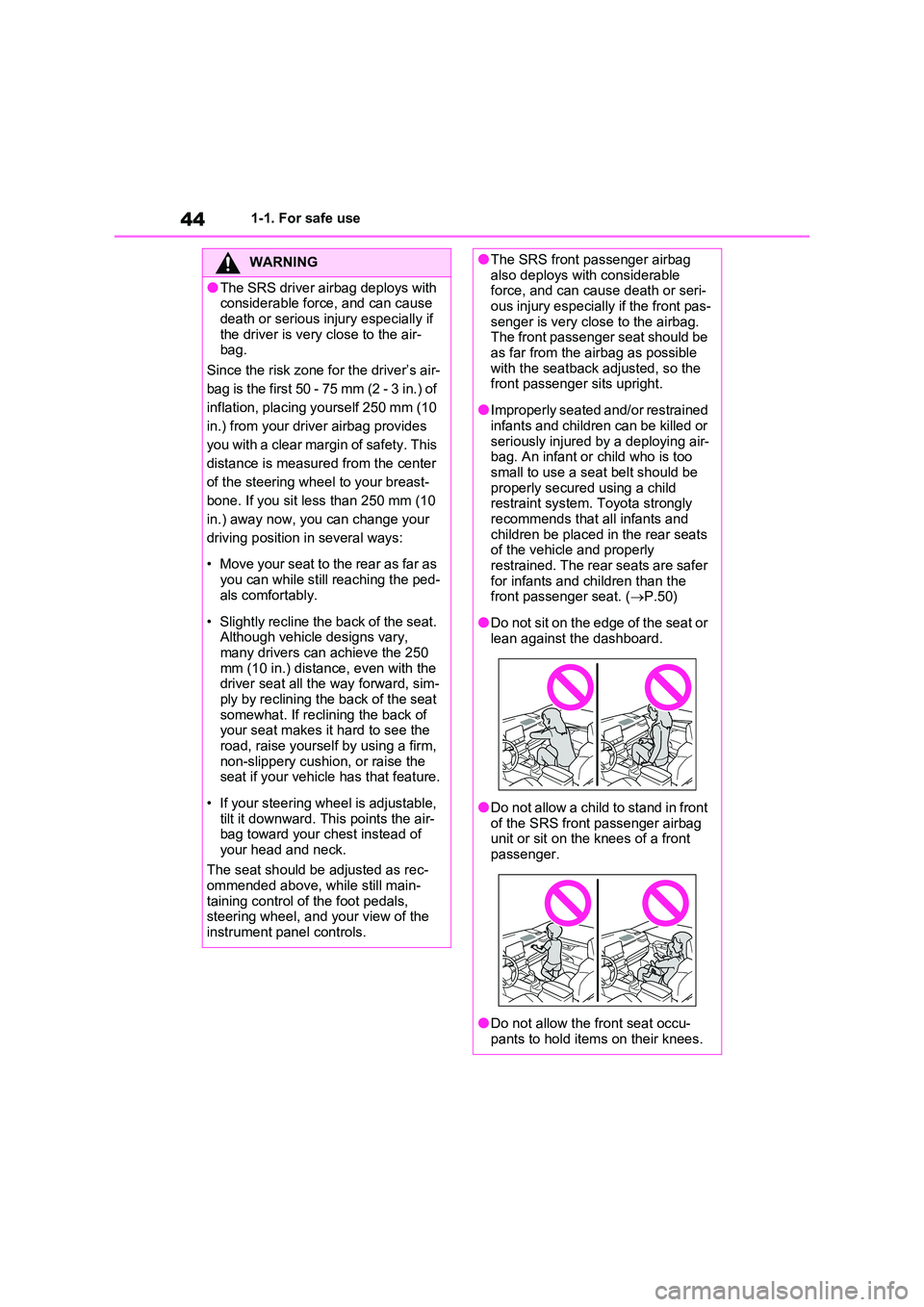
●Do not sit on the edge of the seat or lean against the dashboard.
●Do not allow a child to stand in front of the SRS front passenger airbag unit or sit on the knees of a front
passenger.
●Do not allow the front seat occu-
pants to hold items on their knees.
Page 47 of 664
47
1
1-1. For safe use
For safety and security
Exhaust gas precautions
Harmful substance to the
human body is included in
exhaust gases if inhaled.
WARNING
Exhaust gases contain harmful car-
bon monoxide (CO), which is color- less and odorless. Observe the following precautions.
Failure to do so may cause exhaust gases to enter the vehicle and may lead to an accident caused by light-
headedness, or may lead to death or a serious health hazard.
■Important points while driving
●Keep the back door closed.
●If you smell exhaust gases in the
vehicle even when the back door is closed, open the side windows and have the vehicle inspected at any
authorized Toyota retailer or Toyota authorized repairer, or any reliable repairer as soon as possible.
■When parking
●If the vehicle is in a poorly venti-
lated area or a closed area, such as a garage, stop the hybrid system.
●Do not leave the vehicle with the hybrid system operating for a long time.
If such a situation cannot be avoided, park the vehicle in an open space and ensure that
exhaust fumes do not enter the vehicle interior.
●Do not leave the hybrid system operating in an area with snow build-up, or where it is snowing. If
snowbanks build up around the vehicle while the hybrid system is operating, exhaust gases may col-
lect and enter the vehicle.
■Exhaust pipe
The exhaust system needs to be checked periodically. If there is a hole
or crack caused by corrosion, dam- age to a joint or abnormal exhaust noise, be sure to have the vehicle
inspected and repaired by any autho- rized Toyota retailer or Toyota autho-rized repairer, or any reliable repairer.
Page 67 of 664
67
1
1-3. Emergency assistance
For safety and security
at the following URL.
http://www.opensourceautomotive.com/dcm/toyota/
WARNING
■When the Emergency Call may
not be made
●It may not be possible to make Emergency Calls in any of the fol-
lowing situations. In such cases, report to emergency services pro-vider (112 system etc.) by other
means such as nearby public phones.
• Even when the vehicle is in the cel-
lular phone service area, it may be difficult to connect to the eCall con-trol center if the reception is poor or
the line is busy. In such cases, even though the system attempts to connect to the eCall control center,
you may not be able to connect to the eCall control center to make Emergency Calls and contact emer-
gency services.
• When the vehicle is out of the cellu-
lar phone service area, the Emer- gency Calls cannot be made.
• When any related equipment (such as the “SOS” button panel, indicator lights, microphone, speaker, DCM,
antenna, or any wires connecting the equipment) is malfunctioning, damaged or broken, the Emer-
gency Call cannot be made.
• During an Emergency Call, the sys-
tem makes repeated attempts to connect to the eCall control center. However, if it cannot connect to the
eCall control center due to poor radio wave reception, the system may not be able to connect to the
cellular network and the call may finish without connecting. The red indicator light will blink for approxi-
mately 30 seconds to indicate this disconnection.
●If the 12-volt battery’s voltage decreases or there is a disconnec-tion, the system may not be able to
connect to the eCall control center.
■When the Emergency Call sys-
tem is replaced with a new one
The Emergency Call system should be registered. Contact any authorized
Toyota retailer or Toyota authorized repairer, or any reliable repairer.
■For your safety
●Please drive safely.The function of this system is to
assist you in making the Emer- gency Call in case of accidents such as traffic accidents or sudden
medical emergencies, and it does not protect the driver or passengers in any way. Please drive safely and
fasten your seatbelts at all times for your safety.
●In case of an emergency, make lives the top priority.
●If you smell anything burning or other unusual smells, leave the vehicle and evacuate to a safe area
immediately.
●If the airbags deploy when the sys-
tem is operating normally, the sys- tem makes emergency call. The system also makes emergency call
when the vehicle is struck from the rear or rolls over, even if the air-bags do not deploy.
●For safety, do not make the Emer-gency Call while driving.
Making calls during driving may cause mishandling of the steering wheel, which may lead to unex-
pected accidents. Stop the vehicle and confirm the safety of your surroundings before
making the Emergency Call.
Page 95 of 664
95
2
2-1. Plug-in hybrid system
Plug-in hybrid system
Hybrid battery (traction battery)
Front electric motor (traction motor)
Air conditioning compressor
Junction box
■Running out of fuel
When the vehicle has run out of fuel and
the hybrid system cannot be started, refuel the vehicle with at least enough gasoline to make the low fuel level warn-
ing light ( P.575) go off. If there is only a small amount of fuel, the hybrid sys-tem may not be able to start. (The stan-
dard amount of fuel is about 8.8 L [2.3 gal., 1.9 Imp.gal.], when the vehicle is on a level surface. This value may vary
when the vehicle is on a slope. Add extra fuel when the vehicle is inclined.)
■Electromagnetic waves
●High voltage parts and cables on the hybrid vehicles incorporate electro-magnetic shielding, and therefore emit
approximately the same amount of electromagnetic waves as conven-tional gasoline powered vehicles or
home electronic appliances.
●Your vehicle may cause sound inter-
ference in some third party-produced radio parts.
■Effect of magnetic forces
If objects that generate strong magnetic
forces, such as large speakers, are placed inside the luggage compartment or installed nearby, the generated mag-
netic forces may negatively affect the hybrid system.
■Hybrid battery (traction battery) (lithium-ion battery)
The hybrid battery (traction battery) has a limited service life.
The hybrid battery (traction battery)
capacity (the ability to hold a charge) reduces with time and use in the same way as other rechargeable batteries.
The extent at which capacity reduces
changes drastically depending on the environment (ambient temperature, etc.)
and usage conditions, such as how the vehicle is driven and how the hybrid bat-tery (traction battery) is charged. This is
a natural characteristic of lithium-ion batteries, and is not a malfunction. Also, even though the EV driving range
becomes shorter when the hybrid bat- tery (traction battery) capacity reduces, vehicle performance does not signifi-
cantly become worse.
In order to reduce the possibility of the capacity reducing, follow the directions
listed on P.134, “Capacity reduction of the hybrid battery (traction battery)”.
■Starting the hybrid system in an extremely cold environment
When the hybrid battery (traction bat- tery) is extremely cold (below approxi-mately -30°C [-22°F]) under the
influence of the outside temperature, it may not be possible to start the hybrid system. In this case, try to start the
hybrid system again after the tempera- ture of the hybrid battery increases due to the outside temperature increase etc.
■Declaration of conformity
This model conforms to hydrogen emis- sions according to regulation ECE100 (Battery electric vehicle safety).
I
J
K
L
WARNING
■High voltage precautions
The vehicle has high voltage DC and
AC systems as well as a 12-volt sys- tem. DC and AC high voltage is very dangerous and can cause severe
burns and electric shock that may result in death or serious injury.
Page 99 of 664
99
2 2-1. Plug-in hybrid system
Plug-in hybrid system
stops the fuel pump to minimize the
risk of electrocution and fuel leak-
age.
If the emergency shut off system
activates, your vehicle will not
restart. To restart the hybrid sys-
tem, contact any authorized Toyota
retailer or Toyota authorized
repairer, or any reliable repairer.
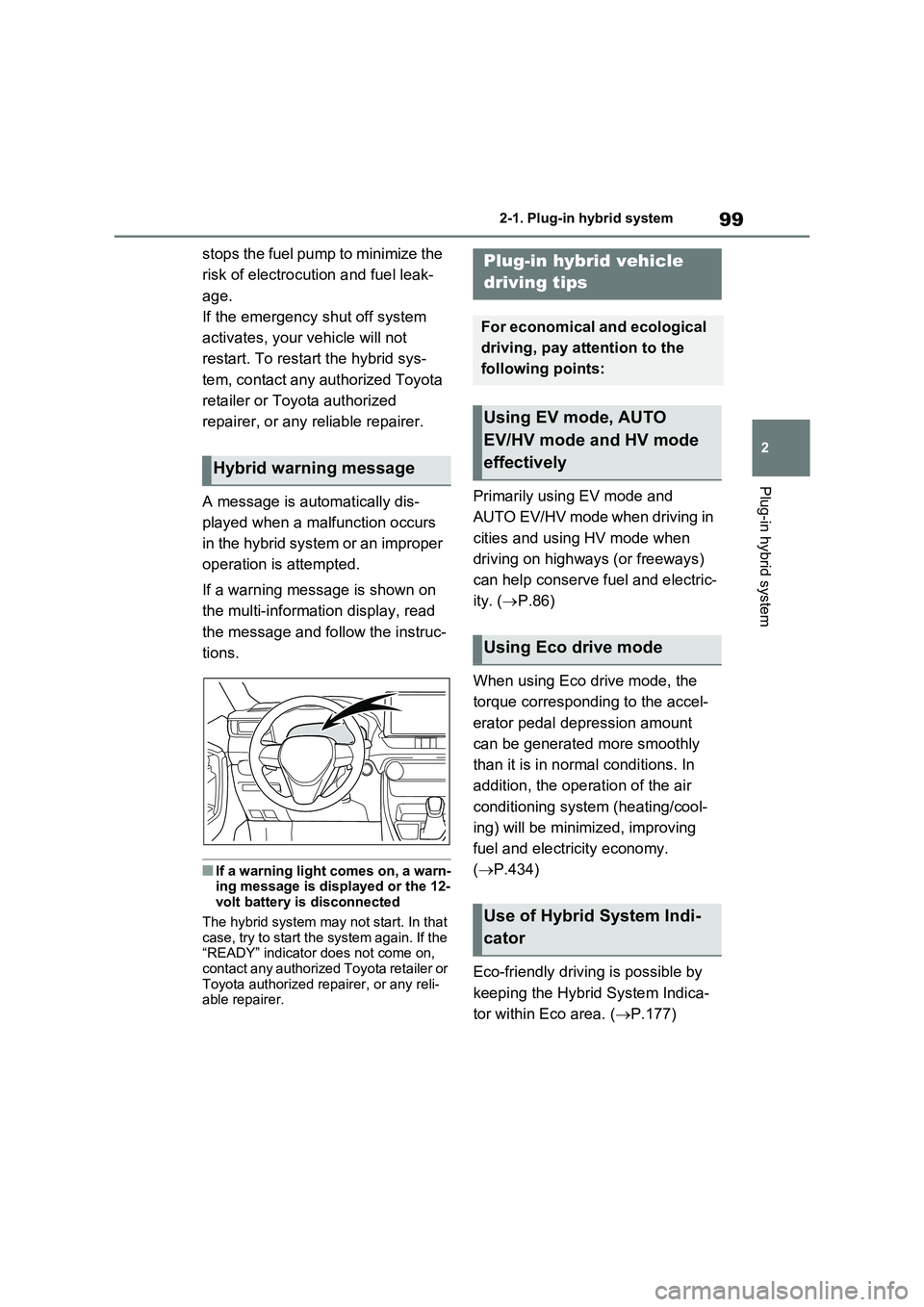
A message is automatically dis-
played when a malfunction occurs
in the hybrid system or an improper
operation is attempted.
If a warning message is shown on
the multi-information display, read
the message and follow the instruc-
tions.
■If a warning light comes on, a warn-
ing message is displayed or the 12-
volt battery is disconnected
The hybrid system may not start. In that
case, try to start the system again. If the
“READY” indicator does not come on,
contact any authorized Toyota retailer or
Toyota authorized repairer, or any reli-
able repairer.
Primarily using EV mode and
AUTO EV/HV mode when driving in
cities and using HV mode when
driving on highways (or freeways)
can help conserve fuel and electric-
ity. (P.86)
When using Eco drive mode, the
torque corresponding to the accel-
erator pedal depression amount
can be generated more smoothly
than it is in normal conditions. In
addition, the operation of the air
conditioning system (heating/cool-
ing) will be minimized, improving
fuel and electricity economy.
(P.434)
Eco-friendly driving is possible by
keeping the Hybrid System Indica-
tor within Eco area. (P.177)
Hybrid warning message
Plug-in hybrid vehicle
driving tips
For economical and ecological
driving, pay attention to the
following points:
Using EV mode, AUTO
EV/HV mode and HV mode
effectively
Using Eco drive mode
Use of Hybrid System Indi-
cator
Page 133 of 664
133
2
2-2. Charging
Plug-in hybrid system
This vehicle has been designed to
allow charging from an external
power source using a AC charging
cable for exclusive use with stan-
dard household AC sockets.
However, the vehicle differs greatly
from standard household electrical
goods in the following ways, and
incorrect usage could cause fire or
electric shock, possibly leading to
death or serious injury.
The charging operation is
designed to operate at 8A-10A
continuously for the charge dura-
tion (approximately 9 hours).
( P.127)
Charging can be conducted out-
doors.
To charge properly, follow the pro-
cedure after reading the explana-
tion below. Charging is intended to
be carried out by licensed drivers
only who properly understand the
charging procedure.
Do not allow children to use the
AC charging cable without
supervision. Also, keep the AC
charging cable out of reach of
infants.
When charging with a charger,
follow the procedures for using
each charger.
When charging using a public
charging facility, check the set-
ting of the charging schedule
function.
• When the charging schedule is regis-
tered, temporarily turn off the function
or turn “Charge Now” on. ( P.145)
• When the charging schedule is set to
on, charging will not start even if the
AC charging cable is connected.
Also, charging fee may occur due to
connection of the AC charging cable.
Before charging, always check the
following items.
The parking brake is applied.
( P.326)
Lights such as the headlights,
emergency flashers and interior
lights etc. are turned off.
If these light switches are turned on,
then these features will consume elec-
tricity, and charging time will increase.
The power switch is turned to
OFF. ( P.320)
Before charging, make sure that
WARNING
■When the AC charging cable is connected to the vehicle
Do not operate the shift lever.
In the unlikely event that the AC charging cable has been damaged,
the shift position may change from P to another position and the vehicle could move, possibly leading to an
accident.
Charging precautions
Confirm the following before
charging
Inspecting the AC charging
cable