Page 508 of 588

508 5-2. Steps to take in an emergency
VERSO_WE_OM64524E
Before putting the sealant into use
Check the degree of the tire damage before making use of the seal-
ant in the emergency tire puncture repair kit.
A tire should only to be repaired
if the damage is caused by a nail
or screw passing through the tire
tread. Perform the repair with the
nail or screw that has punctured
the tire positioned at the bottom,
in contact with the ground.
Emergency repair with the sealant in the kit is not possible in the fol-
lowing cases. Contact any authorized Toyota dealer or repair, or
another duly qualified and equipped professional.
When the wheel is damaged
When two or more tires have been punctured
When the tire is damaged due to driving without sufficient tire infla-
tion pressure
When the tire is visibly disengaged from the wheel
When the tire has lost tire inflation pressure due to a crack or dam-
age in the tire sidewall
When the cut or damage to the tread is 4 mm (0.16 in.) or more
Page 513 of 588
5
513 5-2. Steps to take in an emergency
When trouble arises
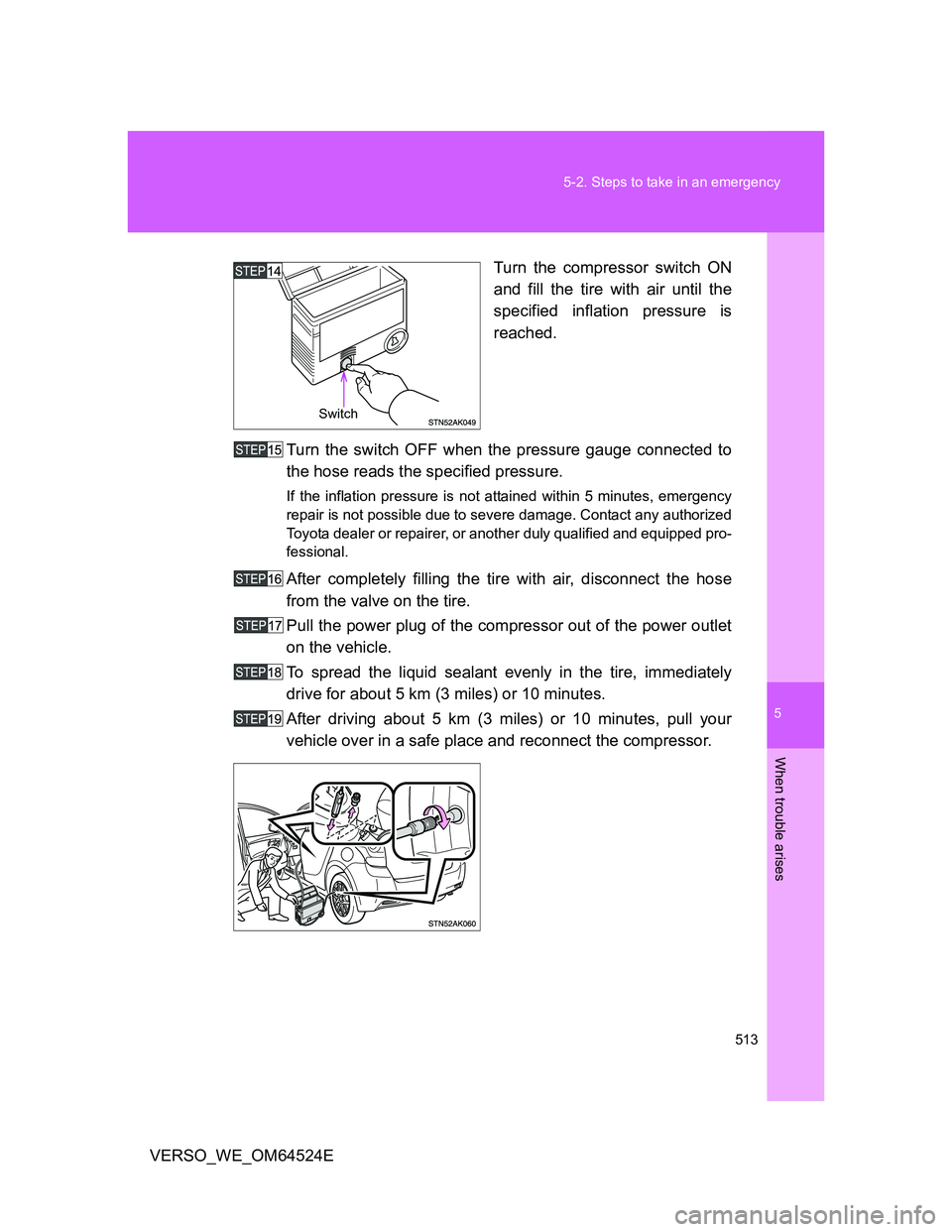
VERSO_WE_OM64524ETurn the compressor switch ON
and fill the tire with air until the
specified inflation pressure is
reached.
Turn the switch OFF when the pressure gauge connected to
the hose reads the specified pressure.
If the inflation pressure is not attained within 5 minutes, emergency
repair is not possible due to severe damage. Contact any authorized
Toyota dealer or repairer, or another duly qualified and equipped pro-
fessional.
After completely filling the tire with air, disconnect the hose
from the valve on the tire.
Pull the power plug of the compressor out of the power outlet
on the vehicle.
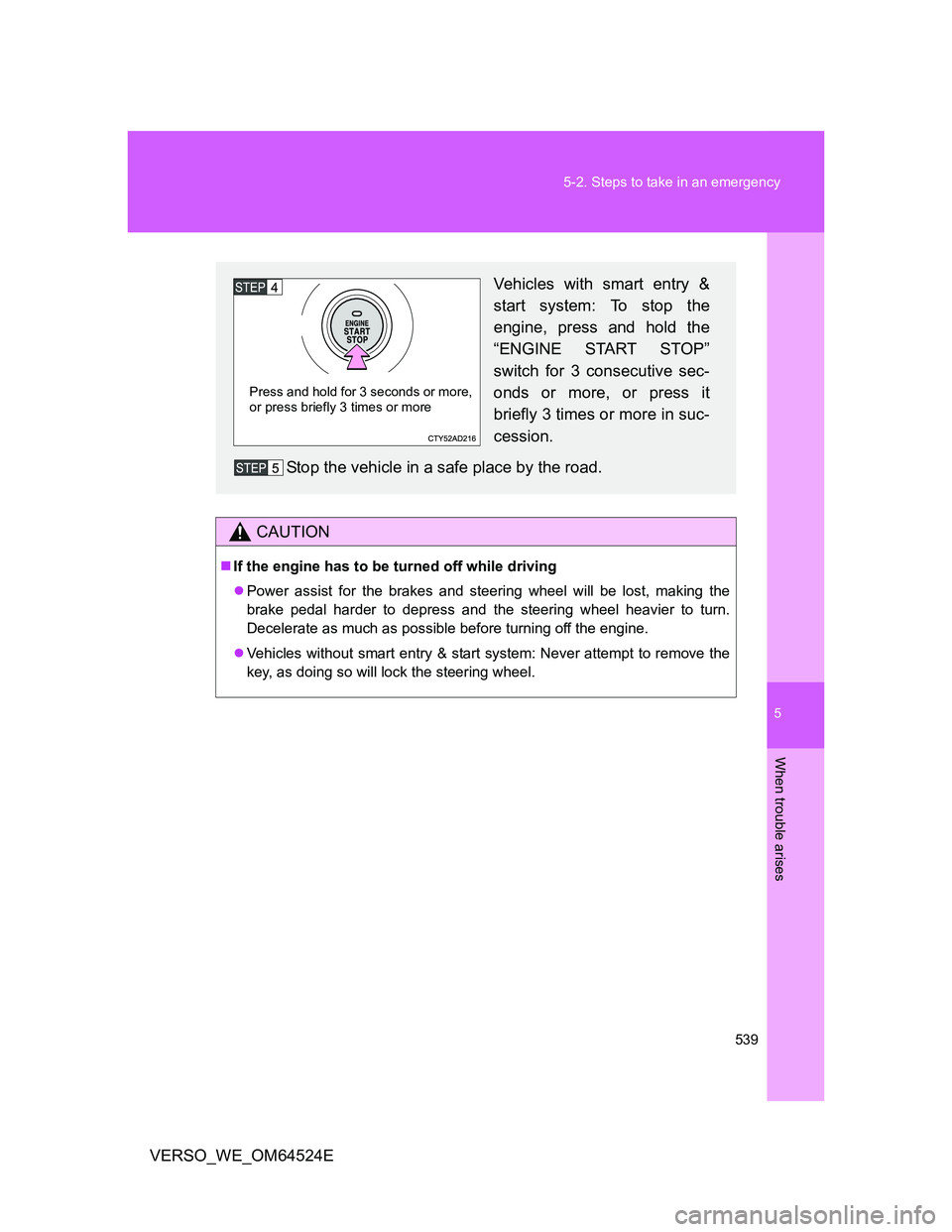
To spread the liquid sealant evenly in the tire, immediately
drive for about 5 km (3 miles) or 10 minutes.
After driving about 5 km (3 miles) or 10 minutes, pull your
vehicle over in a safe place and reconnect the compressor.
Switch
Page 517 of 588
5
517 5-2. Steps to take in an emergency
When trouble arises
VERSO_WE_OM64524E
CAUTION
Precaution for children
Keep the emergency tire puncture repair kit out of the reach of children and
store it properly.
Sealant precautions
The sealant in the emergency tire puncture repair kit is not for human con-
sumption.
If the sealant is consumed inadvertently, drink a large quantity of water
and get medical attention immediately.
If sealant gets in your eyes or on your skin, thoroughly wash with a large
quantity of water. If necessary, get medical attention.
When fixing the flat tire
Stop your vehicle in a safe and flat area.
If force is used to turn the valve core tool while air remains in the tire, spe-
cial care should be taken because the valve core could fly out.
Be careful, as sealant may fly out if you shake the bottle with the hose
installed.
If the hose is not securely installed, sealant may leak out when filling.
Connect the valve and hose securely with the tire installed on the vehicle.
Be careful handling the compressor, as parts of the compressor get hot
during operation. Some parts of the compressor may remain hot after use.
Driving to spread the liquid sealant evenly
Drive your vehicle with due care. Be especially careful when turning and cor-
nering.
Page 518 of 588
518 5-2. Steps to take in an emergency
VERSO_WE_OM64524E
NOTICE
Vehicles with a flat tire
Do not continue driving with a flat tire.
Driving even a short distance with a flat tire can damage the tire and the
wheel beyond repair.
When performing an emergency repair
Perform the emergency repair without removing the nail or screw that has
punctured the tread of the tire. If the object that has punctured the tire is
removed, the repair using the sealant in the emergency tire puncture repair
kit may fail.
When fixing the flat tire
Do not put the valve core on dirty ground or in the sand.
Store it in a clean place.
Do not remove the inside cap of the sealant bottle.
Turn the valve core tool with your hand when screwing it in. If you use
another tool in conjunction with the valve core tool, damage may occur.
Do not operate the compressor continuously for more than 7 minutes. The
motor may overheat and be damaged. Let the compressor cool before
using it again.
Compressor precautions
The compressor power source should be 12V DC suitable for vehicle use.
Do not connect the compressor to 24V DC or any other power source.
The compressor is an oil-less type. Do not lubricate with oil.
Page 529 of 588

5
529 5-2. Steps to take in an emergency
When trouble arises
VERSO_WE_OM64524E
Starting the engine when the battery is discharged (vehicles with a
Multidrive or an automatic transmission)
The engine cannot be started by push-starting.
Avoiding a discharged battery
Turn off the headlights and the audio system while the engine is turned
off.
Turn off any unnecessary electrical components when the vehicle is run-
ning at a low speed for an extended period, such as in heavy traffic, etc.
Charging the battery
The electricity stored in the battery will discharge gradually even when the
vehicle is not in use, due to natural discharge and the draining effects of cer-
tain electrical appliances. If the vehicle is left for a long time, the battery may
discharge, and the engine may be unable to start. (The battery recharges
automatically during driving.)
Vehicles without smart entry & start system: Maintain the
engine speed of the second vehicle and turn the engine
switch to the “ON” position, then start the vehicle’s engine.
Vehicles with smart entry & start system: Maintain the
engine speed of the second vehicle and turn the “ENGINE
START STOP” switch to IGNITION ON mode, then start the
vehicle’s engine.
Once the vehicle’s engine has started, remove the jumper
cables in the exact reverse order in which they were con-
nected.
Once the engine starts, have the vehicle checked at any autho-
rized Toyota dealer or repairer, or another duly qualified and
equipped professional, as soon as possible.
Page 539 of 588
5
539 5-2. Steps to take in an emergency
When trouble arises
VERSO_WE_OM64524E
CAUTION
If the engine has to be turned off while driving
Power assist for the brakes and steering wheel will be lost, making the
brake pedal harder to depress and the steering wheel heavier to turn.
Decelerate as much as possible before turning off the engine.
Vehicles without smart entry & start system: Never attempt to remove the
key, as doing so will lock the steering wheel.
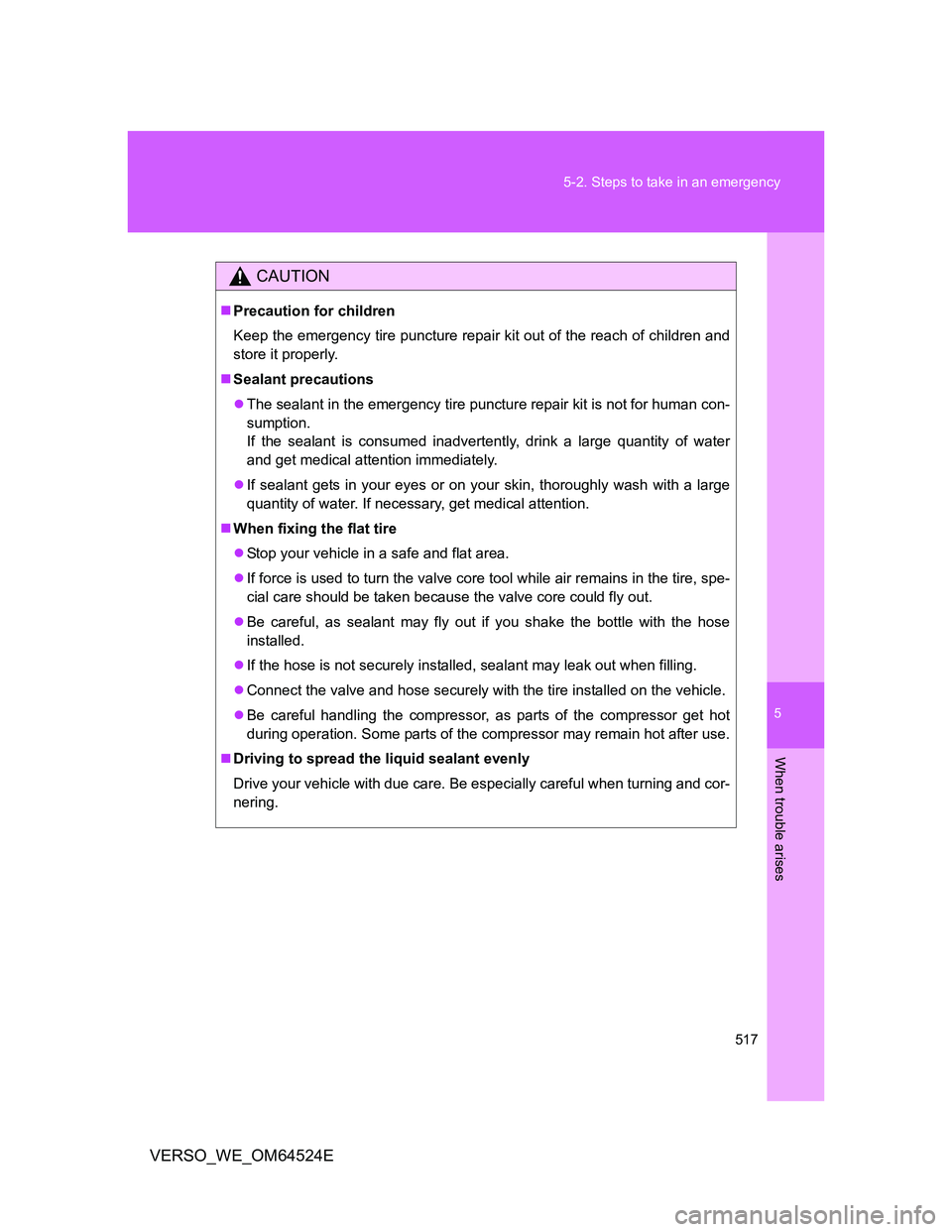
Vehicles with smart entry &
start system: To stop the
engine, press and hold the
“ENGINE START STOP”
switch for 3 consecutive sec-
onds or more, or press it
briefly 3 times or more in suc-
cession.
Stop the vehicle in a safe place by the road.
Press and hold for 3 seconds or more,
or press briefly 3 times or more
Page 566 of 588

566 6-1. Specifications
VERSO_WE_OM64524E
Fuel tank opening for unleaded gasoline (gasoline engine)
To help prevent incorrect fueling, your Toyota has a fuel tank opening that
only accommodates the special nozzle on unleaded fuel pumps.
If you plan to drive in foreign countries (diesel engine)
Low sulphur diesel fuel may not be available, so please confirm the availabil-
ity with your distributor.
If your engine knocks
Consult any authorized Toyota dealer or repairer, or another duly quali-
fied and equipped professional.
You may occasionally notice light knocking for a short time while acceler-
ating or driving uphill. This is normal and there is no need for concern.
*: To distinguish the 1AD-FTV engine, ask any authorized Toyota dealer
or repairer, or another duly qualified and equipped professional.
1AD-FTV (with DPF
catalytic converter)
* and
2AD-FHV engines
EU area:
Your vehicle must use only diesel fuel
conforming to European standard
EN590.
Except EU area (except Russia):
Your vehicle must use only diesel fuel
that contains 50 ppm or less of sulphur
and has a cetane number of 48 or
higher.
Except EU area (Russia):
You must only use diesel fuel with a
cetane number of 48 or higher.
Your vehicle must use only diesel fuel
conforming to GOST R52368-2005
(Sulphur max 50 ppm).
Page 575 of 588

575
VERSO_WE_OM64524E
Alphabetical index
Alphabetical index
A/C
Air conditioning filter.............. 428
Automatic air conditioning
system ................................ 297
Manual air conditioning
system ................................ 292
ABS ........................................... 267
Active head restraint ................. 77
Air conditioning filter .............. 428
Air conditioning system
Air conditioning filter.............. 428
Automatic air conditioning
system ................................ 297
Manual air conditioning
system ................................ 292
Airbags
Airbag manual on-off
system ................................ 167
Airbag operating
conditions ........................... 136
Airbag precautions for your
child .................................... 140
Airbag warning light .............. 476
Curtain shield airbag
operating conditions ........... 136
Curtain shield airbag
precautions ......................... 140
General airbag
precautions ......................... 140
Locations of airbags .............. 133
Modification and disposal of
airbags ................................ 144
Proper driving
posture........................ 131, 140
Side airbag operating
conditions ........................... 136
Side airbag precautions ........ 140
SRS airbags .......................... 133Alarm ........................................ 122
Antenna .................................... 318
Anti-lock brake system .......... 267
Armrest ..................................... 370
Ashtrays ................................... 364
Audio input............................... 345
Audio system
Antenna ................................ 318
Audio input ............................ 345
AUX port ............................... 345
CD player .............................. 319
iPod....................................... 330
MP3/WMA disc ..................... 324
Optimal use........................... 343
Portable music player ........... 345
Radio .................................... 314
Steering wheel audio
switch ................................. 346
Type ...................................... 308
USB memory ........................ 336
Automatic air conditioning
system
Air conditioning filter ............. 428
Automatic air conditioning
system ................................ 297
Automatic headlight
leveling system ..................... 243
Automatic light control
system .................................... 239
Automatic transmission
Automatic transmission......... 202
If the shift lever cannot be
shifted from “P” ................... 522
“M” mode .............................. 205
AUX port ................................... 345
Auxiliary box .................... 358, 379A