Page 5 of 732

1
2
3
4
5
6
7
5
Compass ............................. 510
4-1. Maintenance and care Cleaning and protecting the vehicle exterior............ 516
Cleaning and protecting the vehicle interior............. 519
4-2. Maintenance Maintenance requirements ..................... 522
General maintenance.......... 524
Emission inspection and maintenance (I/M)
programs........................... 527
4-3. Do-it-yourself maintenance Do-it-yourself service precautions ....................... 528
Hood ................................... 532
Engine compartment ........... 533
Tires .................................... 547
Tire inflation pressure ......... 554
Wheels ................................ 558
Air conditioning filter............ 560
Wireless remote control battery ............................... 563
Checking and replacing fuses ................................. 565
Light bulbs........................... 576 5-1. Essential information
Emergency flashers............ 588
If your vehicle needs to be towed........................... 589
If you think something is wrong ............................... 595
Fuel pump shut off system .............................. 596
Event data recorder ............ 597
5-2. Steps to take in an emergency If a warning light turns on or a warning buzzer
sounds... .......................... 599
If a warning message is displayed (vehicles with
multi-information
display) ............................. 608
If you have a flat tire ........... 612
If the engine will not start.... 628
If the shift lever cannot be shifted from P ................... 630
If you lose your keys........... 633
If the vehicle battery is discharged........................ 634
If your vehicle overheats .... 637
If the vehicle becomes stuck ................................. 640
If your vehicle has to be stopped in
an emergency .................. 641
4Maintenance and care
5When trouble arises
Page 9 of 732
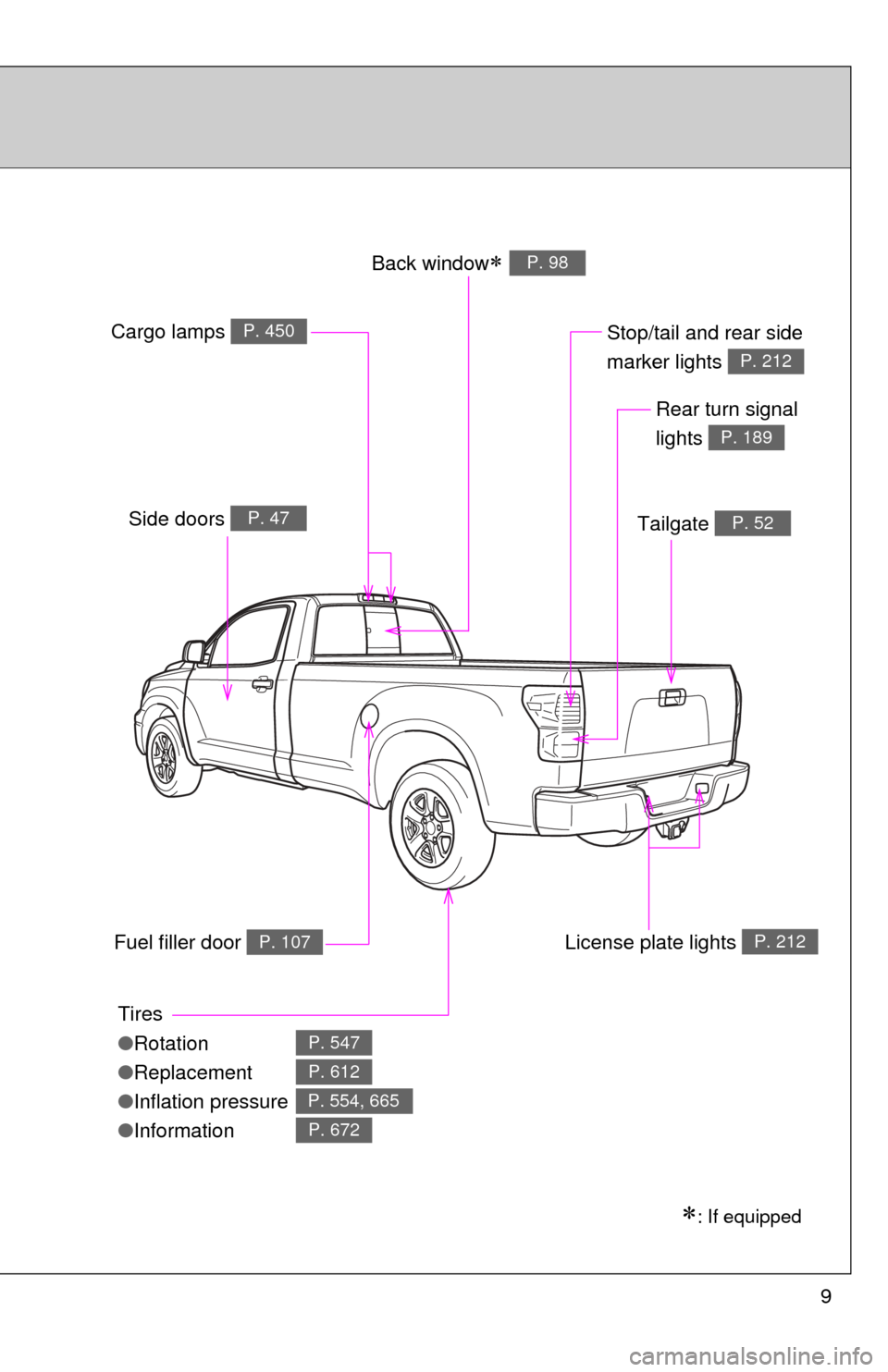
9
Tires
●Rotation
● Replacement
● Inflation pressure
● Information
P. 547
P. 612
P. 554, 665
P. 672
Fuel filler door P. 107
Back windowP. 98
Side doors P. 47
: If equipped
Tailgate P. 52
License plate lights P. 212
Stop/tail and rear side
marker lights
P. 212
Rear turn signal
lights
P. 189
Cargo lamps P. 450
Page 11 of 732
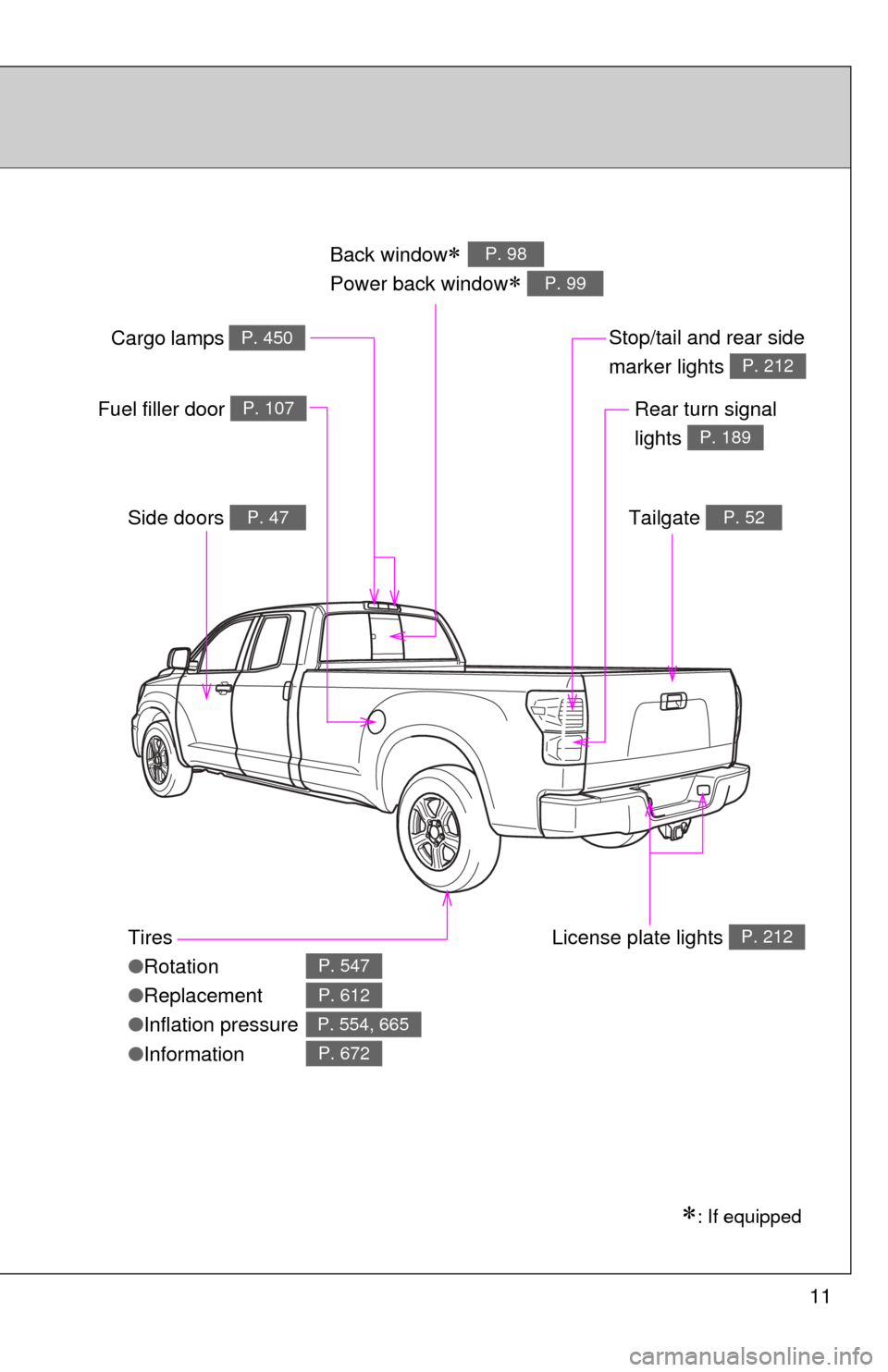
11
Tires
●Rotation
● Replacement
● Inflation pressure
● Information
P. 547
P. 612
P. 554, 665
P. 672
Fuel filler door P. 107
Back window
Power back window
P. 98
P. 99
Side doors P. 47
: If equipped
Tailgate P. 52
License plate lights P. 212
Rear turn signal
lights
P. 189
Cargo lamps P. 450Stop/tail and rear side
marker lights
P. 212
Page 13 of 732
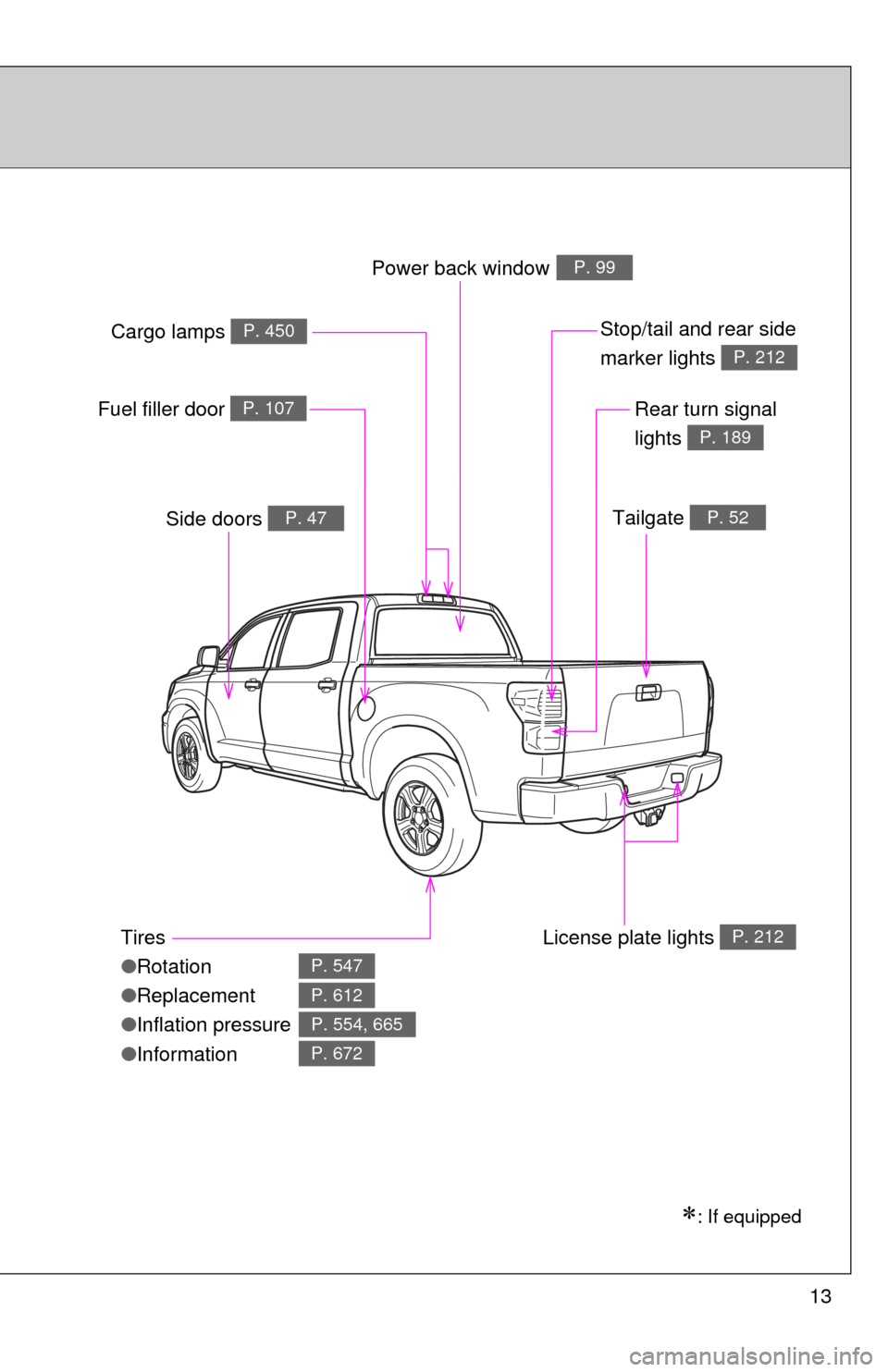
13
Tires
●Rotation
● Replacement
● Inflation pressure
● Information
P. 547
P. 612
P. 554, 665
P. 672
Fuel filler door P. 107
Power back windowP. 99
Side doors P. 47
: If equipped
Tailgate P. 52
License plate lights P. 212
Rear turn signal
lights
P. 189
Cargo lamps P. 450Stop/tail and rear side
marker lights
P. 212
Page 130 of 732

130 1-7. Safety information
CAUTION
■SRS airbag precautions
●If breathing becomes difficult after the SRS airbag has deployed, open a
door or window to allow fresh air in, or leave the vehicle if it is safe to do
so. Wash off any residue as soon as possible to prevent skin irritation.
● If the areas where the SRS airbags are stored, such as the steering wheel
pad and front and rear pillar garnishes, are damaged or cracked, have
them replaced by your Toyota dealer.
■ Modification and disposal of SRS airbag system components
Do not dispose of your vehicle or perform any of the following modifications
without consulting your Toyota dealer.
The SRS airbags may malfunction or deploy (inflate) accidentally, causing
death or serious injury.
● Installation, removal, disassembly and repair of the SRS airbags.
● Repairs, modifications, removal or replacement of the steering wheel,
instrument panel, dashboard, seats or seat upholstery, front, side and rear
pillars or roof side rails.
● Repairs or modifications of the front fender, front bumper, or side of the
occupant compartment.
● Installation of snow plows, winches, etc. to the front grille (bull bars, kan-
garoo bar etc.).
● Modifications to the vehicle’s suspension system.
● Do not use tires or wheels other than the manufacturer’s recommended
size. ( P. 665)
● Installation of electronic devices such as mobile two-way radios or CD
players.
● Modifications to your vehicle for a person with a physical disability.
Page 173 of 732

173
2-1. Driving procedures
2
When driving
Starting on a steep uphill
With the brake pedal depressed, firmly set the parking brake
and shift the shift lever to D.
Gently depress the accelerator pedal.
Release the parking brake.
■Driving in the rain
●Drive carefully when it is raining, because visibility will be reduced, the
windows may become fogged-up, and the road will be slippery.
● Drive carefully when it starts to rain, because the road surface will be
especially slippery.
● Refrain from high speeds when driving on an expressway in the rain,
because there may be a layer of water between the tires and the road
surface, preventing the steering and brakes from operating properly.
■ Breaking in your new Toyota
To extend the life of the vehicle, the following precautions are recommended
to observe:
●For the first 200 miles (300 km):
Avoid sudden stops.
● For the first 500 miles (800 km):
Do not tow a trailer.
● For the first 1000 miles (1600 km):
• Do not drive at extremely high speeds.
• Avoid sudden acceleration.
• Do not drive continuously in the low gears.
• Do not drive at a constant speed for extended periods.
■ Drum-in disc type parking brake system
Your vehicle has a drum-in-disc type parking brake system. This type of
brake system needs bedding-down of the brake shoes periodically or when-
ever the parking brake shoes and/or drum are replaced. Have your Toyota
dealer perform the bedding down.
Page 175 of 732

175
2-1. Driving procedures
2
When driving
CAUTION
■
When driving the vehicle
●Do not under any circumstances shift the shift lever to P, R or N while the
vehicle is moving.
Doing so can cause significant damage to the transmission system and
may result in a loss of vehicle control.
● Do not shift the shift lever to N while the vehicle is moving.
Doing so may cause the engine brake to not operate properly and lead to
an accident.
● Do not turn the engine off while driving.
The power steering and brake booster systems will not operate properly if
the engine is not running.
● Use engine braking (downshift) to maintain a safe speed when driving
down a steep hill.
Using the brakes continuously may cause the brakes to overheat and lose
effectiveness. ( P. 184)
● When stopped on an inclined surface, use the brake pedal and parking
brake to prevent the vehicle from rolling backward or forward and causing
an accident.
● Do not adjust the position of the steering wheel, the seat, or the inside or
outside rear view mirrors while driving.
Doing so may result in a loss of vehicle control that can cause accidents
that may result in death or serious injury.
● Always check that all passengers’ arms, heads or other parts of their bod-
ies are not outside the vehicle, as this may result in death or serious injury.
● Do not drive in excess of the speed limit. Even if the legal speed limit per-
mits it, do not drive over 85 mph (140 km/h) unless your vehicle has high-
speed capability tires. Driving over 85 mph (140 km/h) may result in tire
failure, loss of control and possible injury. Be sure to consult a tire dealer
to determine whether the tires on your vehicle are high-speed capability
tires or not before driving at such speeds.
Page 249 of 732

249
2-4. Using other
driving systems
2
When driving
CAUTION
Any of the following conditions may result in an accident which could cause
death or serious injury.
■The ABS does not opera te effectively when
● The limits of the gripping performance have been exceeded.
● The vehicle hydroplanes while driving at high speed on the wet or slick
road.
■ Stopping distance when the ABS is operating will exceed that of nor-
mal conditions
The ABS is not designed to shorten the vehicle’s stopping distance. Always
maintain a safe distance from the vehicle in front of you in the following situ-
ations.
● When driving on dirt, gravel or snow-covered roads
● When driving with tire chains
● When driving over bumps in the road
● When driving over roads with pothol es or roads with uneven roads
■ When VSC and Trailer Sway Control are activated
The slip indicator flashes. Always drive carefully. Reckless driving may
cause an accident. Exercise particular care when the indicator flashes.
■ TRAC or A-TRAC may not operate effectively when
Directional control and power may not be achievable while driving on slip-
pery road surfaces, even if TRAC or A-TRAC is operating.
Do not drive the vehicle in conditions where stability and power may be lost.
■ Replacing tires
Make sure that all tires are of the same size, brand, tread pattern and total
load capacity. In addition, make sure that the tires are inflated to the appro-
priate tire pressure level.
The ABS, VSC and Trailer Sway Control will not function correctly if different
tires are fitted on the vehicle.
Contact your Toyota dealer for further information when replacing tires or
wheels.