Page 417 of 536
5
When trouble arises
417
5-1. Essential information
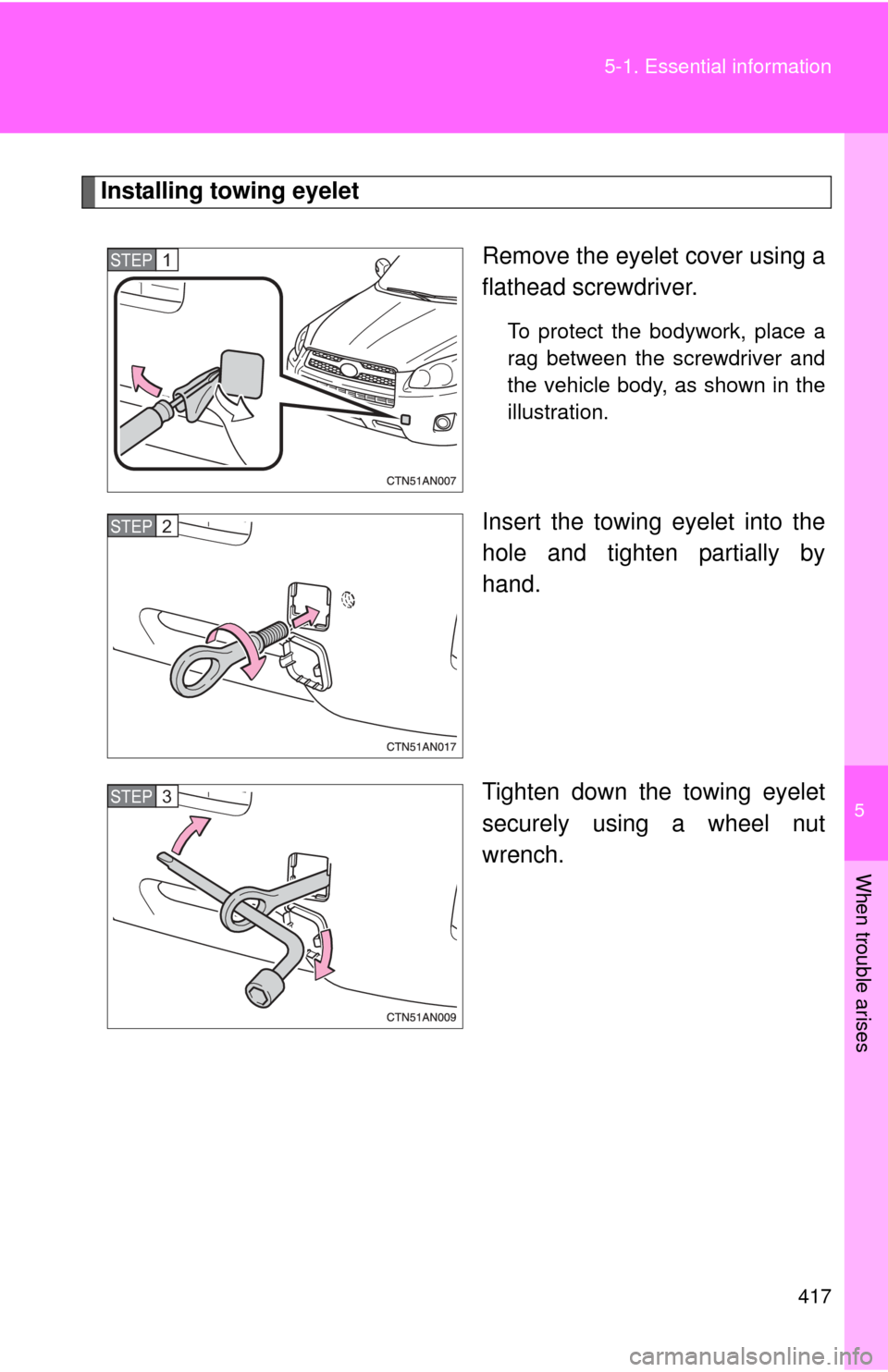
Installing towing eyelet
Remove the eyelet cover using a
flathead screwdriver.
To protect the bodywork, place a
rag between the screwdriver and
the vehicle body, as shown in the
illustration.
Insert the towing eyelet into the
hole and tighten partially by
hand.
Tighten down the towing eyelet
securely using a wheel nut
wrench.
STEP 1
STEP 2
STEP 3
Page 420 of 536
420 5-1. Essential information
CAUTION
■Caution while towing
●Use extreme caution when towing the vehicle.
Avoid sudden starts or erratic driving maneuvers which place excessive
stress on the emergency towing eyelet and the cables or chains. Always
use caution for the surroundings and other vehicles while towing.
● If the engine is not running, the power assist for the brakes and steering
will not function, making steering and braking more difficult.
■ Installing towing eyelet to the vehicle
Make sure that towing eyelet is installed securely.
If not securely installed, towing eyelet may come loose during towing. This
may lead to accidents that cause serious injury or even death.
Page 433 of 536

5
When trouble arises
433
5-2. Steps to take in an emergency
■
If the malfunction indicator lamp comes on while driving
First check the following:
● Is the fuel tank empty?
If it is, fill the fuel tank immediately.
● Is the fuel tank cap loose?
If it is, tighten it securely.
The malfunction indicator lamp will go off after taking several driving trips.
If the malfunction indicator lamp does not go off even after several trips, con-
tact your Toyota dealer as soon as possible.
■ Front passenger detection sensor and passenger seat belt reminder
● If luggage is placed on the front passenger seat, the front passenger
detection sensor may cause the warning light to flash, even if a passen-
ger is not sitting in the seat.
● If a cushion is placed on the seat, the sensor may not detect a passen-
ger, and the warning light may not operate properly.
■ Electric power steering warning light
The electric power steering warning light may come on when the voltage is
low or the voltage drops.
■ Changing the engine oil (U.S.A. only)
Make sure to reset the oil change system. ( P. 363)
■
The tire pressure warning light may turn on due to natural causes
The tire pressure warning light may turn on due to natural causes such
as natural air leaks or tire inflation pressure changes caused by temper-
ature. In this case, adjusting the ti re inflation pressure will turn off the
warning light (after a few minutes).
■When a tire is replaced with a spare tire (vehicles with a tire pres-
sure warning system)
The spare tire is also equipped with the tire pressure warning valve and
transmitter. The tire pressure warning li ght will turn on if the tire inflation
pressure of the spare tire is low. If a tire goes flat, even though the flat
tire is replaced with the spare tire, the tire pressure warning light does
not turn off. Replace the spare tire with the repaired tire and adjust the
proper tire inflation pressure. The ti re pressure warning light will turn off
after a few minutes.
Page 452 of 536
452 5-2. Steps to take in an emergency
Upper slots
Hooks
To install the spare tire cover,
insert the hooks under the
guides to the upper slots and
lower the cover.
Attach the cover by hooking the
2 inner protrusions.
Check that the cover is securely
attached.
Hook
Latch handle
Clasp
Open the back door and lock
the latch handle which is on
the bottom of the cover.
Close the back door.
STEP 6
STEP 7
STEP 8
STEP 9
Page 453 of 536
5
When trouble arises
453
5-2. Steps to take in an emergency
Stow the jack and all tools securely, and replace all the cov-
ers.
■When reinstalling the wheel or
nament (vehicles with 16-inch
wheels)
■After completing the tire change (vehicles with a tire pressure
warning system)
The tire pressure warning system must be reset. (P. 375)
■After repairing the flat tire (veh icles with aluminum wheels and a
steel wheel for the spare)
Be sure to reinstall the plastic rings to the wheel nuts before stowing the
spare tire. If the steel wheel is st owed without reinstalling the plastic
rings to the wheel nuts, the spare tire carrier may produce abnormal
noise when the vehicle is moving.
STEP 10
Align the cutout of the wheel ornament
with the valve stem as shown.
Page 454 of 536

454 5-2. Steps to take in an emergency
CAUTION
■Using the tire jack
Improper use of the tire jack may lead to death or serious injuries due to
the vehicle suddenly falling off the jack.
●Do not use the tire jack for any purpose other than replacing tires or
installing and removing tire chains.
●Only use the tire jack that comes with this vehicle for replacing a flat
tire.
Do not use it on other vehicles, and do not use other tire jacks for
replacing tires on this vehicle.
●Always check that the tire jack is securely set to the jack point.
●Do not put any part of your body under the vehicle while it is supported
by the jack.
●Do not start or run the engine while your vehicle is supported by the
jack.
●Do not raise the vehicle while someone is in it.
●When raising the vehicle, do not put an object on or under the jack.
●Do not raise the vehicle to a hei ght greater than that required to
replace the tire.
●Use a jack stand if it is necessary to get under the vehicle.
●Stop the vehicle on firm, flat and level ground, firmly set the parking
brake and put the transmission in “P”. Block the wheel diagonally
opposite to the one being changed if necessary.
Take particular care when lowering the vehicle to ensure that no one
working on or near the vehicle will be injured.
■Using the jack handle (type A)
Insert the square head securely until you hear a click to prevent the
extension parts from coming apart unexpectedly.
Page 471 of 536
5
When trouble arises
471
5-2. Steps to take in an emergency
CAUTION
■
If the engine has to be turned off while driving
●Power assist for the brakes and steering wheel will be lost, making the
brake pedal harder to depress and the steering wheel heavier to turn.
Decelerate as much as possible before turning off the engine.
● Vehicles without a smart key system: Never attempt to remove the key, as
doing so will lock the steering wheel.
Vehicles with a smart key sys-
tem: Stop the engine by press-
ing and holding the “ENGINE
START STOP” switch for 3
consecutive seconds or more.
Stop the vehicle in a safe place by the road.
Press and hold for 3 seconds or more
STEP 4
STEP 5
Page 499 of 536

499
6-1. Specifications
6
Vehicle specifications
*:Table 1
Occupant loading and distri bution for vehicle normal load
for various designated seating capacities
Tire related termMeaning
Tread That portion of a tire that comes into contact
with the road
Tread rib A tread section running circumferentially
around a tire
Tread separation Pulling away of the tread from the tire carcass
Treadwear indicators
(TWI) The projections within the principal grooves
designed to give a visual indication of the
degrees of wear of the tread
Wheel-holding fixture The fixture used to hold the wheel and tire
assembly securely
during testing
Designated seating
capacity, Number of occupantsVehicle normal load,
Number of occupantsOccupant distribution in a normally loaded vehi- cle
2 through 4 2 2 in front
5 through 10 3 2 in front, 1 in second
seat
11 through 15 5 2 in front, 1 in second
seat, 1 in third seat, 1
in fourth seat
16 through 20 7 2 in front, 2 in second
seat, 2 in third seat, 1
in fourth seat