Page 489 of 608
489
4-3. Do-it-yourself maintenance
4
Maintenance and care
L/C200_U (OM60F74U)
Light bulbs
You may replace the following bulbs yourself. The difficulty level of
replacement varies depending on the bulb. If necessary bulb
replacement seems difficult to perfor m, contact your Toyota dealer.
For more information about replacing other light bulbs, contact your
Toyota dealer.
■ Prepare a replacement light bulb
Check the wattage of the light bulb being replaced. ( P. 567)
■ Remove the engine compartment cover
P. 441
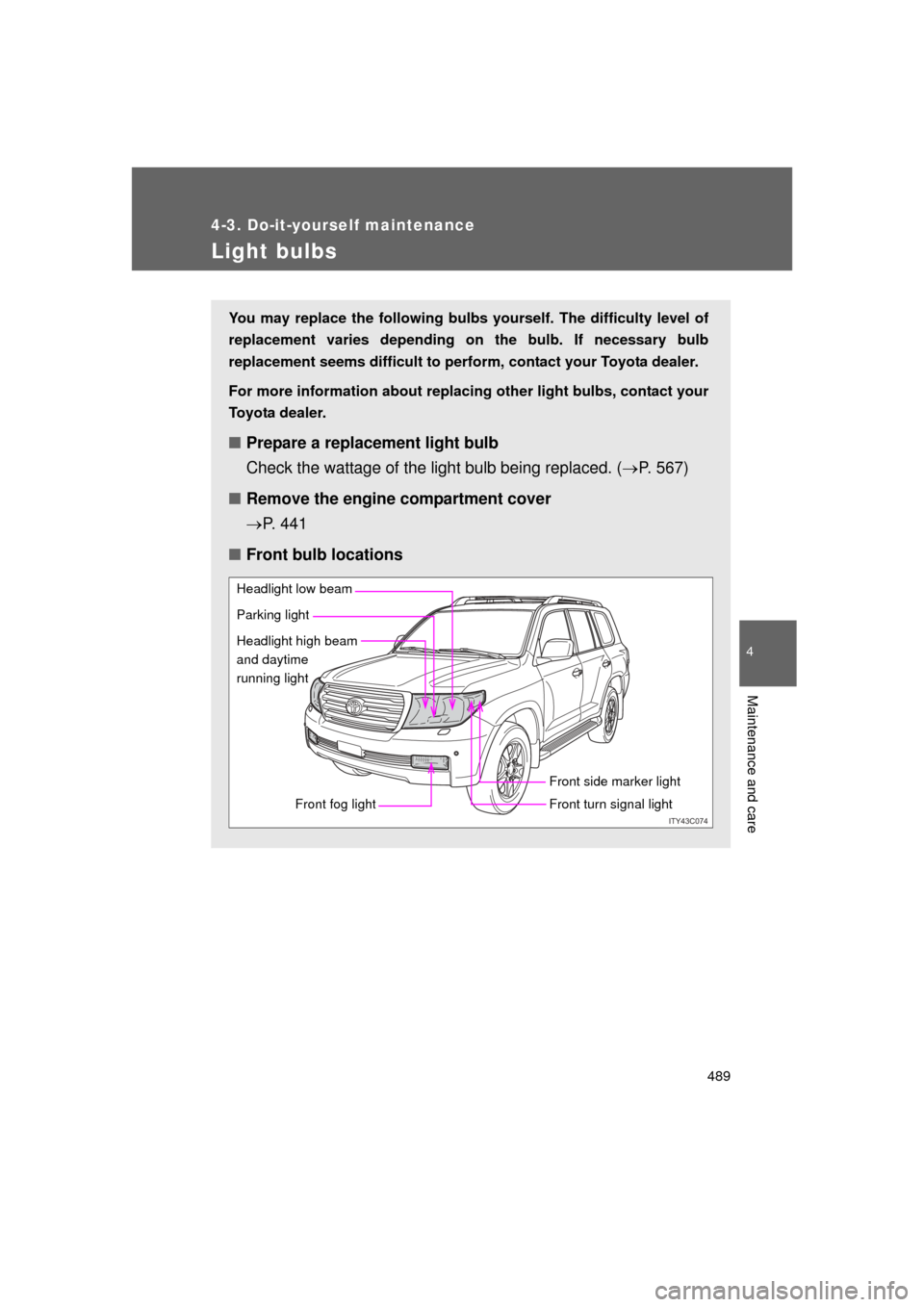
■ Front bulb locations
ITY43C074
Front side marker light
Parking light
Front fog light
Headlight high beam
and daytime
running light
Front turn signal light
Headlight low beam
Page 517 of 608
5
When trouble arises
517
5-2. Steps to take in an emergency
L/C200_U (OM60F74U)
■
If the malfunction indicator lamp comes on while driving
First check the following:
● Is the fuel empty?
If it is, fill the fuel tank immediately.
● Is the fuel tank cap loose?
If it is, tighten it securely.
The malfunction indicator lamp will go off after taking several driving trips. If
the malfunction indicator lamp does not go off even after several trips, con-
tact your Toyota dealer as soon as possible.
■ If the low speed four-wheel drive in dicator light or the center differen-
tial lock indicator light blinks
Take the specified steps. ( P. 203)
If the brake system warning light or the malfunction indicator light also
comes on, or the low speed four-wheel drive indicator light or the center dif-
ferential lock indicator light continues to blink after taking the specified steps,
there may be a malfunction in the engine, the brake system or the four-
wheel drive system. In this case, you may not be able to transfer between
“H4” and “L4” modes, and the center differential lock may not be able to be
locked or unlocked. Have the vehicle inspected by your Toyota dealer imme-
diately.
■ Front passenger detection sensor and passenger seat belt reminder
● If luggage is placed on the front passenger seat, the front passenger
detection sensor may cause the warning light to flash, even if a passen-
ger is not sitting in the seat.
● If a cushion is placed on the seat, the sensor may not detect a passen-
ger, and the warning light may not operate properly.
Page 518 of 608
518 5-2. Steps to take in an emergency
L/C200_U (OM60F74U)
■SRS warning light
This warning light system monitors the following:
● The airbag sensor assembly
● Front airbag sensors
● The curtain shield airbag sensors
● The side and curtain shield airbag sensors
● The seat belt buckle switches
● The driver’s seat position sensor
● The belt tension sensor
● The inflators
● The interconnecting wiring and power sources
● The front passenger occupant classification ECU
● “AIR BAG ON” and “AIR BA G OFF” indicator lights
● The seat belt pretensioners
● The roll sensing of curtain shield airbags off indicator light
■ Changing the engine oil
Make sure to reset oil change system
■
When the tire pressure warning light comes on
Check the tire inflation pressure and adjust to the appropriate level.
Pushing the tire pressure warning reset switch does not turn off the tire
pressure warning light.
■The tire pressure warning light ma y turn on due to natural causes
The tire pressure warning light may turn on due to natural causes such
as natural air leaks or tire inflation pressure changes caused by temper-
ature. In this case, adjusting the ti re inflation pressure will turn off the
warning light (after a few minutes).
Page 520 of 608
520 5-2. Steps to take in an emergency
L/C200_U (OM60F74U)
■If the tire pressure warning light comes on after blinking for 1
minute frequently
If the tire pressure warning light comes on after blinking for 1 minute fre-
quently when the “ENGINE START STOP” switch is turned to IGNITION
ON mode, have it checked by Toyota dealer.
CAUTION
■If the tire pressure warning light comes on
Be sure to observe the following precautions. Failure to do so could
cause loss of vehicle control and re sult in death or serious injury.
●Stop your vehicle in a safe place as soon as possible. Adjust the tire
inflation pressure immediately.
●If the tire pressure warning light comes on even after tire inflation pres-
sure adjustment, it is pr obable that you have a flat tire. Check the tires.
If the tire is flat, change to the spare tire and have the flat tire repaired
by the nearest Toyota dealer.
●Avoid abrupt maneuvering and braking. If the vehicle tires deteriorate,
you could lose control of the steering wheel or the brakes.
■If a blowout or sudden air leakage should occur
The tire pressure warning syste m may not activate immediately.
Page 537 of 608
5
When trouble arises
537
5-2. Steps to take in an emergency
L/C200_U (OM60F74U)
■After completing the tire change
The tire pressure warning
system must be reset. (P. 456)
CAUTION
■Using the tire jack
Improper use of the tire jack may lead to death or serious injuries due to
the vehicle suddenly falling off the jack.
●Do not use the tire jack for any pu rpose other than replacing tires or
installing and removing tire chains.
●Only use the tire jack that comes wi th this vehicle for replacing a flat
tire.
Do not use it on other vehicles, and do not use other tire jacks for
replacing tires on this vehicle.
●Always check that the tire jack is securely set to the jack point.
●Do not raise the vehicle while someone is in it.
●When raising the vehicle, do not put an object on or under the jack.
●Do not raise the vehicle to a hei ght greater than that required to
replace the tire.
●Use a jack stand if it is necessary to get under the vehicle.
●Do not put any part of your body under the vehicle supported by a jack.
●Do not start or run the engine while your vehicle is supported by the
jack.
Take particular care when lowering the vehicle to ensure that no one
working on or near the vehicle may be injured.
■Using the jack handle
Tighten all the jack handle bolts securely using a Phillips-head screw-
driver, to prevent the extension parts from coming apart unexpectedly.
Page 541 of 608
5
When trouble arises
541
5-2. Steps to take in an emergency
L/C200_U (OM60F74U)
Emergency start function
When the engine does not start, the following steps can be used as
an interim measure to start the engine if the “ENGINE START STOP”
switch is functioning normally. Set the parking brake.
Put the shift lever in “P”.
Set the “ENGINE START ST OP” switch to ACCESSORY
mode.
Press and hold the “ENGINE START STOP” switch about 15
seconds while depressing the brake pedal firmly.
Even if the engine can be start ed using the above steps, the system
may be malfunctioning. Have the vehicle checked by your Toyota
dealer.
■ The starter motor does not turn over, the interior lights and
headlights do not turn on, or the horn does not sound
One of the following may be the cause of the problem.
● One or both of the battery terminals may be disconnected.
● The battery may be discharged. ( P. 548)
● There may be a malfunction in the steering lock system.
Contact your Toyota dealer if the problem cannot be repaired, or if
repair procedures are unknown.
STEP1
STEP2
STEP3
STEP4
Page 549 of 608
5
When trouble arises
549
5-2. Steps to take in an emergency
L/C200_U (OM60F74U)
■
Starting the engine when the battery is discharged
The engine cannot be started by push-starting.
■ Avoiding a discharged battery
● Turn off the headlights and the audio system while the engine is turned
off.
● Turn off any unnecessary electrical components when the vehicle is run-
ning at a low speed for an extended period, such as in heavy traffic, etc.
Open and close any of the doors with the “ENGINE START
STOP” switch off.
Maintain the engine speed of the second vehicle and start
your vehicle’s engine.
Once the vehicle’s engine has started, remove the jumper
cables in the exact reverse order in which they were con-
nected.
Once the engine starts, have the vehicle checked at your Toyota
dealer as soon as possible.STEP3
STEP4
STEP5
Page 551 of 608
5
When trouble arises
551
5-2. Steps to take in an emergency
L/C200_U (OM60F74U)
If your vehicle overheats
If your engine overheatsStop the vehicle in a safe place and turn off the air condi-
tioning system.
Check to see if steam is coming out from under the hood.
If you see steam: Stop the engine. Carefully lift the hood after the steam
subsides and then restart the engine.
If you do not see steam: Leave the engine running and carefully lift the hood.
Remove the engine compartment cover. (
P. 441)
Check to see if the cooling fan is operating.
If the fan is operating: Wait until the engine coolant temperature gauge begins
to fall and then stop the engine.
If the fan is not operating: Stop the engine immediately and call your local Toyota
dealer.
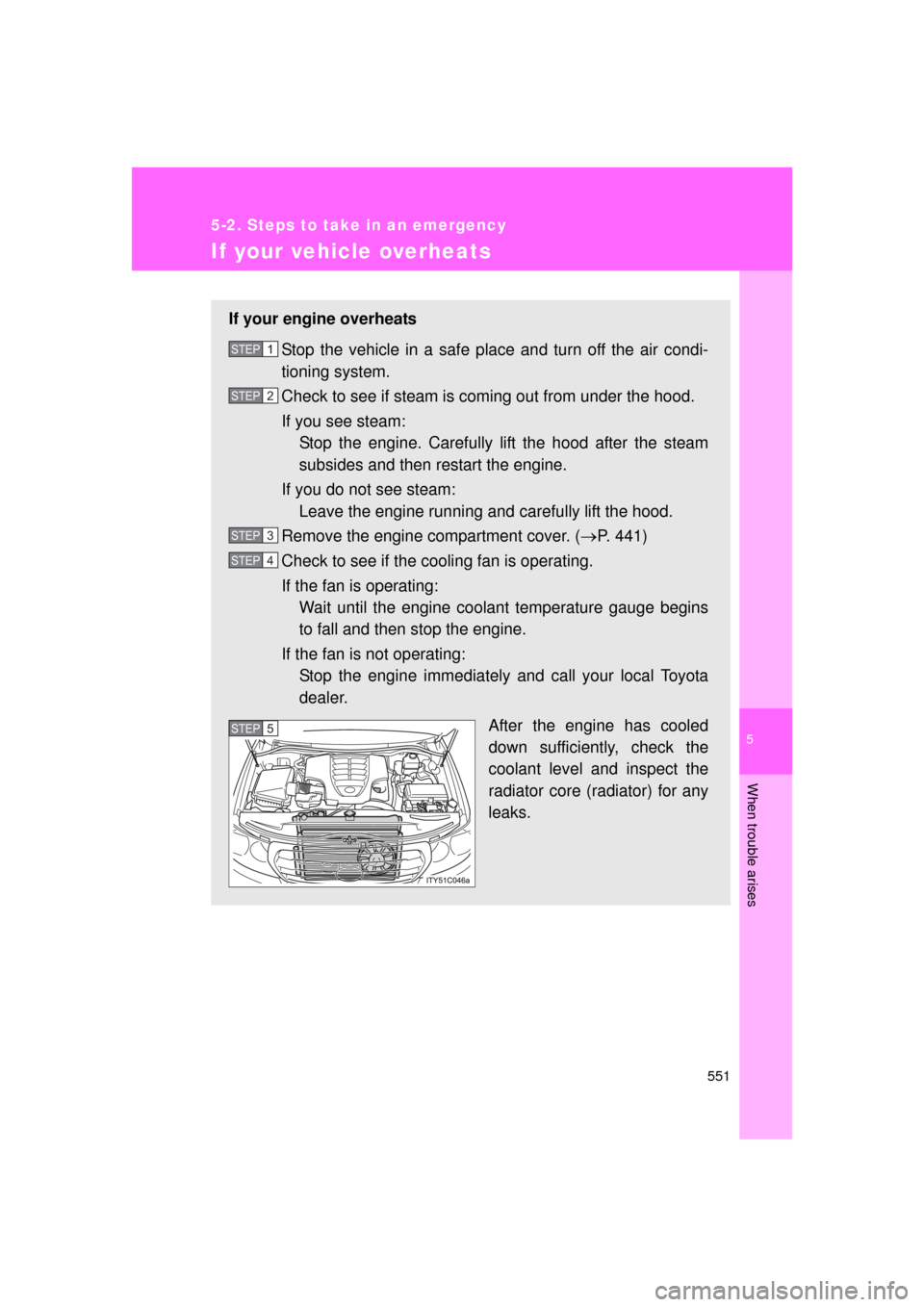
After the engine has cooled
down sufficiently, check the
coolant level and inspect the
radiator core (radiator) for any
leaks.
STEP1
STEP2
STEP3
STEP4
STEP5