Page 368 of 446

&Recommended grade and viscosity
Each oil manufacturer has its own base
oils and additives. Never use different
brands together. For details, refer to“ Manual transmission, front differential
and rear differential gear oil ”F 12-8. Automatic transmission fluid &
Checking the fluid level
The automatic transmission fluid expands
largely as its temperature rises; the fluid
level differs according to fluid temperature.
Therefore, there are two different scales
for checking the level of hot fluid and cold
fluid on the level gauge.
Though the fluid level can be checked
without warming up the fluid on the“ COLD ”range, it is recommended to
check the fluid level when the fluid is at
operating temperature. ! Checking the fluid level when the
fluid is hot
1. Drive the vehicle several miles to raise
the temperature of the transmission fluid
up to normal operating temperature; 158
to 176 8F (70 to 80 8C) is normal.
2. Park the vehicle on a level surface and
set the parking brake.
3. First shift the select lever in each
position. Then shift it in the “P ” position,
and run the engine at idling speed.
1) Yellow handle
1) HOT range
2) COLD range
3) Upper level
4) Lower level
4. Pull out the level gauge and check the Maintenance and service
11-21
– CONTINUED –
Page 369 of 446

11-22Maintenance and service
fluid level on the gauge. If it is below the
lower level on the “HOT ”range, add the
recommended automatic transmission
fluid up to the upper level. ! Checking the fluid level when the
fluid is cold
When the fluid level has to be checked
without time to warm up the automatic
transmission, check to see that the fluid
level is between the lower level and upper
level on the “COLD ”range. If it is below
that range, add fluid up to the upper level.
Be careful not to overfill.
CAUTION
Be careful not to spill automatic
transmission fluid when adding it.
If automatic transmission fluid
touches the exhaust pipe, it may
cause a bad smell, smoke, and/or a
fire. If automatic transmission fluid
gets on the exhaust pipe, be sure to
wipe it off. &
Recommended fluid
Refer to “Fluids ”F 12-9.
NOTE
Using any non-specified type of auto-
matic transmission fluid could result in
damage inside the transmission. When
replacing the automatic transmission
fluid, be sure to use the kind specified. Front differential gear oil (AT
models) &
Checking the oil level
1) Yellow handle
1. Park the vehicle on a level surface and
stop the engine.
2. Pull out the level gauge, wipe it clean,
and insert it again.
Page 371 of 446

11-24Maintenance and service
Power steering fluid &Checking the fluid level
The power steering fluid expands greatly
as its temperature rises; the fluid level
differs according to fluid temperature.
Therefore, the reservoir tank has two
different checking ranges for hot and cold fluids.
Check the power steering fluid level
monthly.
1. Park the vehicle on a level surface,
and stop the engine.
2. Check the fluid level of the reservoir tank.
When the fluid is hot after the vehicle has
been run: Check that the oil level isbetween “HOT MIN ”and “HOT MAX ”on
the surface of the reservoir tank.
When the fluid is cool before the vehicle is
run: Check that the oil level is between“ COLD MIN ”and “COLD MAX ”on the
surface of the reservoir tank.
3. If the fluid level is lower than the
applicable “MIN ”line, add the recom-
mended fluid as necessary to bring the
level between the “MIN ”and “MAX ”line.
If the fluid level is extremely low, it may
indicate possible leakage. Consult your
SUBARU dealer for an inspection.
WARNING
Be careful not to burn yourself
because the fluid may be hot.
CAUTION
. When power steering fluid is
being added, use only clean fluid,
and be careful not to allow any
dirt into the tank. And never use
different brands together.
. Be careful not to spill power
steering fluid when adding it. If
power steering fluid touches the
exhaust pipe, it may cause a bad
smell, smoke, and/or a fire. If
power steering fluid gets on the
exhaust pipe, be sure to wipe it off.
& Recommended fluid
Refer to “Fluids ”F 12-9.
Page 404 of 446
&Engine oil
For the checking, adding and replacing procedure or other details, refer to “Engine oil ”F 11-9.
NOTE
The procedure for changing the engine oil and oil filter should be performed by a properly-trained expert. It is recommended
that you have this service performed by your SUBARU dealer. ! Approved engine oil
Always use the SUBARU approved engine oil. For further details, please contact your SUBARU dealer.
If the approved engine oil is unavailable, use the alternative engine oil described on the next page. Specifications
12-5
– CONTINUED –
Page 407 of 446
12-8Specifications
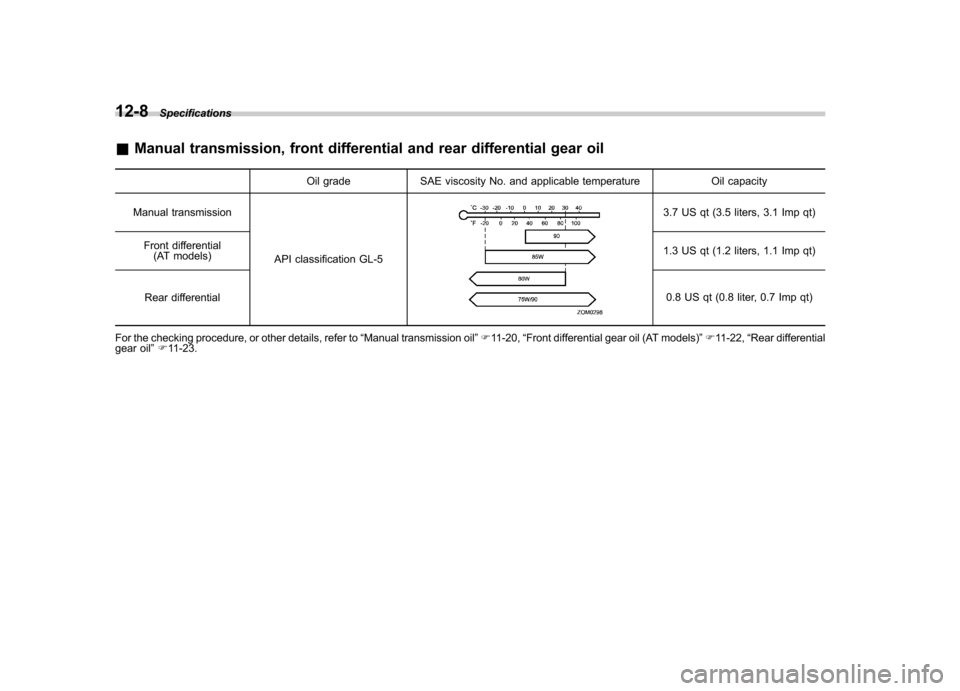
&Manual transmission, front differential and rear differential gear oil
Oil grade SAE viscosity No. and applicable temperature Oil capacity
Manual transmission
API classification GL-5
3.7 US qt (3.5 liters, 3.1 Imp qt)
Front differential (AT models) 1.3 US qt (1.2 liters, 1.1 Imp qt)
Rear differential 0.8 US qt (0.8 liter, 0.7 Imp qt)
For the checking procedure, or other details, refer to “Manual transmission oil ”F 11-20, “Front differential gear oil (AT models) ”F 11-22, “Rear differential
gear oil ”F 11-23.
Page 436 of 446

Parking........................................................ 7-29, 11-30
Pedal .................................................................. 11-27
System ................................................................. 7-22
Brake pedal Free play ............................................................. 11-27
Reserve distance .................................................. 11-28
Brake system ............................................................ 7-22
Warning light ......................................................... 3-20
Braking ..................................................................... 7-22
Tips...................................................................... 7-22
Breaking-in of new brake pads and linings ................... 11-29
Bulb Chart .................................................................. 12-15
Replacing ............................................................. 11-47
C
Cargo area Cover ................................................................... 6-13
Light ............................................................. 6-3, 11-51
Tie-down hooks ..................................................... 6-15
Cargo tray ................................................................. 10-6
Catalytic converter ....................................................... 8-3
Center
Console .................................................................. 6-5
Ventilators ............................................................... 4-3
Center and side ventilators ............................................ 4-3
Changing Coolant ................................................................ 11-14
Flat tire ................................................................... 9-6
Oil and oil filter ..................................................... 11-10
Charge warning light .................................................. 3-17 CHECK ENGINE warning light/Malfunction indicator
lamp ...................................................................... 3-16
Checking
Brake pedal free play ............................................ 11-27
Brake pedal reserve distance ................................. 11-28
Clutch function ..................................................... 11-28
Clutch pedal free play ........................................... 11-28
Coolant level ........................................................ 11-14
Fluid level (automatic transmission fluid) .................. 11-21
Fluid level (brake fluid) .......................................... 11-25
Fluid level (clutch fluid) .......................................... 11-26
Fluid level (power steering fluid) .. ........................... 11-24
Fluid level (washer fluid) ........................................ 11-38
Oil level (engine oil) ................................................ 11-9
Oil level (front differential gear oil) .......................... 11-22
Oil level (manual transmission oil) .......................... 11-20
Child restraint systems ................................................ 1-22
Installation of a booster seat .................................... 1-27
Installation with A/ELR seatbelt ... ............................. 1-24
Lower and tether anchorages ................................... 1-29
Top tether anchorages ............................................ 1-31
Child safety ................................................................... 5
Locks .................................................................... 2-20
Chime Key........................................................................ 3-5Light ..................................................................... 3-29
Seatbelt. ................................................................ 3-13
Cleaning Aluminum wheels ................................................... 10-4
Interior .................................................................. 10-5
Ventilation grille ...................................................... 4-17 Index
14-3