2011 SKODA YETI maintenance
[x] Cancel search: maintenancePage 67 of 252

●
The assignment of the radio remote control to a memory button is retained,
however, after reassigning the seats and exterior mirrors.
● After the successful assignment, the turn signal lights flash and an audible
signal will sound as a confirmation. The setting is stored with the memory button
which you have selected.
Retrieving settings of the seat and mirrors You can retrieve the stored settings either with the memory but-
tons or with the remote control.
Retrieving settings with memory buttons
– In order to retrieve the stored setting, you have two possibilities:
– By briefly pressing:Briefly press the desired memory button B
⇒ fig. 46 . The
seat and exterior mirror are moved automatically into the stored positions (this
applies only if the ignition is switched on and the speed is less than 5 km/h).
– By pressing for a long period of time: press and hold the desired memory but-
ton B pressed long enough until the seat and the exterior mirrors are moved
into the stored positions.
Retrieving settings with remote control
– If the driver door is closed and the ignition is switched off, briefly press the un-
lock button of the remote control ⇒ page 37 and then open the driver door.
– The seat and exterior mirrors now move automatically into the stored posi-
tions.
Retrieving setting of exterior mirror for reversing
– Turn the rotary knob for the exterior mirror setting into the position
⇒ page 58
before engaging the reverse gear.
The mirror returns into its initial position, after the rotary knob is moved out of the
position and put into another position or if the speed is more than 15 km/h.
Emergency Off
You can interrupt the setting operation at any time, if you operate any button of
the driver seat. Head restraints
Fig. 47 Head restraint: Adjusting/pulling out
Best protection is achieved if the top edge of the head restraint is at the same
level as the upper part of your head.
Adjusting the height of a head restraint
–
Grasp the side of the head restraint with both hands and push it in upward di-
rection as desired ⇒ fig. 47 - left.
– Move the head restraint downwards if required by pressing and holding the
safety button with one hand ⇒ fig. 47 - right and by pressing with the other
hand the head restraint downwards.
Removing and installing a head restraint
– Pull the head restraint out of the seat backrest as far as the stop.
– Press the locking button in the direction of arrow ⇒
fig. 47 - right and pull the
head restraint out.
– To re-insert the head restraint, push it down into the seat backrest far enough
until you hear the locking button engage.
The position of the front and rear outer head restraints is adjustable in height.
The middle rear head restraint is adjustable in two positions.
The head restraints must be adjusted to match the size of the seat occupant. Cor-
rectly adjusted head restraints together with the seat belts offer effective protec-
tion for the occupants ⇒ page 129, Correct seated position
.£ 65
Seats and Stowage Using the system Safety Driving Tips General Maintenance Breakdown assistance Technical data
Page 69 of 252

Adjusting the seat backrest
Fig. 50 Adjusting the seat backrest
Adjust the angle of the seat backrest
– Pull the lever ⇒ fig. 50 and adjust the desired angle of the seat backrest.
Folding rear seats forwards Fig. 51 Fold seat forward/secure folded forward seats
Folding rear seats fully forwards and secure
–
Pult the belt tongue into the opening of the wheel housing on the respective
side of the vehicle - safety position.
– Remove the head restraint from the rear middle seat ⇒ page 66
.
– Move the rear exterior seats as far as possible to the rear ⇒
page 66.
– Pull on the levers ⇒ fig. 50 and fold the seat backrests of the rear exterior
seats onto the seat cushion as far as the stop. –
Fold the middle rear seat backrest forwards in the same way, then pull once
more on the lever ⇒
fig. 50 and press the seat backrest downwards until it is
heard to lock into a lower position.
– Pull the lever ⇒
fig. 51 up and then fold the seat fully forwards.
– Secure the folded forward seat with the aid of the fixing belt B to a guide rod
of the head restraint for the front seat ⇒ fig. 51. WARNING
● Immediately secure the folded forward seat with the aid of the fixing belt
to a guide rod of the head restraint for the front seat - there is a risk of injury
as soon as the vehicle starts off.
● If the seat is not in the rear end position, damage can occur to the locking
bolts if the seat is unlocked. CAUTION
Make sure that the storage compartment, the ashtray and the cup holder in the
rear part of the centre console are closed (otherwise these could get damaged)
before folding forward the rear middle seat. Note
Please refer to the following guidelines ⇒
page 129, Correct seated position for
the driver.
Removing seats Fig. 52 Unlocking the folded forward seat/carrying handles on the seat cushion
£ 67
Seats and Stowage Using the system Safety Driving Tips General Maintenance Breakdown assistance Technical data
Page 71 of 252

Folding table on the middle seat backrest
Fig. 55 Rear seats: Armrest
– The middle seat backrest can be folded ⇒ page 67, Folding rear seats forwards
forwards and used as armrest or table with cup holder ⇒ fig. 55 .
– You can place two cups or beverage cans into the recesses. WARNING
● Do not place any hot beverages into the cup holder. If the vehicle moves,
they may spill - risk of scalding!
● Do not use any cups or beakers which are made of brittle material (e.g.
glass, porcelain). This could lead to injuries in the event of an accident. CAUTION
Do not open the beverages in the cup holder while driving. There is a risk of spill-
ing e.g. when braking and therefore the electrical components or the seat uphols-
tery can be damaged. Note
If the middle rear seat backrest should be folded forward for lengthy periods, then
make sure that the belt locks are not located below it - this can result in perma-
nent damage to the upholstery. Seat heating of the front seats Fig. 56 Dash panel: Regulator for front
seat heating
You can electrically heat the seat cushions and the seat backrests of the front
seats.
Front seats
– You can switch on and regulate the seat heating of the driver or front passen-
ger seat by pressing the surface of the regulator at the point at which the
symbol is located ⇒
fig. 56 .
– With one press, you can switch the heating to highest intensity - 3rd stage,
which is indicated by the lighting up of the three warning lights in the switch.
– With repeated pressing of the switch, the intensity of the heating is down-
regulated up to the switch-off. The intensity of the heating is indicated by the
number of illuminated warning lights in the switch. WARNING
If, as an occupant, you have a subdued pain and/or temperature sensitivity,
e.g. through medication, paralysis or because of chronic illness (e.g. diabetes),
we recommend not to use the seat heating. This can lead to burns on the
back, the posterior and the legs which are difficult to heal. If the seat heating
is used, we recommend to make regular breaks in your journey when driving
long distances, so that in specific cases as mentioned above the body can re-
cuperate from the stress of the journey. Please consult your doctor, who can
evaluate your specific condition. £ 69
Seats and Stowage Using the system Safety Driving Tips General Maintenance Breakdown assistance Technical data
Page 73 of 252

Note
Tyre pressure must be adjusted to the load ⇒ page 201.
Vehicles of category N1 On vehicles of the category N1, which are not fitted with a protective grille, a lash-
ing set which complies with the standard EN
12195 (1 - 4) must be used for fasten-
ing the load.
Fastening elements Fig. 57 Luggage compartment: Lashing eyes and fastening elements/attachment points and
fastening strip
Fixing eyes and fastening elements ⇒ fig. 57 or fixing eyes and a fastening strip
are fitted on both sides of the luggage compartment ⇒
fig. 57 - right.
You can also attach the fixing nets for stowing small items of luggage, in the lug-
gage compartment on the fixing eyes and fastening elements or on the fixing
eyes and the fastening strip with integrated hook ⇒ fig. 57.
The fixing nets and the installation instruction are located in the luggage com-
partment. WARNING
● The load to be transported must be fixed in place in such a way that it can-
not move during the journey and when braking.
● If the items of luggage or objects are attached to the lashing eyes with un-
suitable or damaged lashing straps, injuries can occur in the event of braking
manoeuvres or accidents. In order to prevent the items of luggage being
thrown forward, always use suitable lashing straps which are firmly attached
to the lashing eyes.
Folding hooks Fig. 58 Luggage compartment: folding
hooks
Folding hooks for attaching small items of luggage, such as bags etc., are provided
on both sides of the luggage compartment ⇒ fig. 58 .
An item of luggage weighing up to 7.5 kg can be attached to the hook. WARNING
Please refer to the following guidelines ⇒ page 70. 71
Seats and Stowage Using the system Safety Driving Tips General Maintenance Breakdown assistance Technical data
Page 75 of 252

The luggage compartment cover
You can use the luggage compartment cover behind the head re-
straints for storing light and soft items.
Fig. 61 Removing the luggage compart-
ment cover
The luggage compartment cover can be removed as required if one must trans-
port bulky goods.
Removing the luggage compartment cover
– Fold the seat backrests a little forward in order to facilitate the removal of the
luggage compartment cover.
– Unhook the support straps 1
⇒ fig. 61 .
– Place the cover in the horizontal position.
– Pull the luggage compartment cover out of the holders 2 to the rear or press
on the bottom side of the luggage compartment cover in the front area.
– Fold the slackened front part of the luggage compartment cover over the head
restraints of the rear seats.
– Slightly tilt the luggage compartment cover and remove it to the rear.
– Install again by pushing the luggage compartment cover forwards into the
holder 2 and hanging the support straps
1 on the boot lid.
You can stow the removed luggage compartment cover behind the rear seat back-
rest. WARNING
No objects should be placed on the luggage compartment cover, the vehicle
occupants could be endangered if there is sudden braking or the vehicle col-
lides with something. CAUTION
Please ensure that the heating wire of the rear window heater is not damaged as
a result of objects placed in this area. Note
Opening the tailgate also lifts up the luggage compartment cover.
Static separation net Fig. 62 Use of the static separation net behind the rear seats/behind the front seats
Install the static separation net behind the front seats or the rear seats.
Install the static separation net behind the rear seats
–
Remove the luggage compartment cover ⇒ page 73.
– Take the separation net out of the bag.
– Unfold both parts of the cross rod until they are heard to engage.
– Insert the cross rod into the mount B
⇒ fig. 62 first on the one side and push
the cross rod forward. In the same way, fix the cross rod to the other side of
the vehicle, mount B .
– Hang the carabines C at the ends of the strap into the fixing eyes behind the
rear or front seats. £ 73
Seats and Stowage Using the system Safety Driving Tips General Maintenance Breakdown assistance Technical data
Page 77 of 252

Remove carrier rails
Fig. 64 Luggage compartment: Slacken check points/remove carrier rails
Remove carrier rails
– Slacken the check points B
⇒ fig. 64 on the carrier rails using the vehicle key
or a flat screwdriver.
– Grasp the carrier rail A at the position
1 and slacken it by pulling in the direc-
tion of the arrow.
– Grasp the carrier rail A at the position
2 , slacken it by pulling in the direction
of the arrow and take it out.
– The carrier rail on the other side of the luggage compartment can be removed
in the same way.
Install carrier rails
– Position the carrier rails on the sides of the luggage compartment.
– Press both check points on each carrier rail up to the stop.
– Check the attachment of the carrier rails by pulling it. WARNING
Pay attention when installing that the carrier rails and the variable loading
floor are correctly fixed, otherwise the occupants are at risk. Variable loading floor with spare wheel
Use variable loading floor
Fig. 65 Luggage compartment: Fold the side parts of the loading floor/example for using the
variable loading floor
The variable loading floor makes it easier to handle bulky goods and creates an
even luggage compartment floor when the rear seat backrests are folded forward.
The maximum permissible surface load of the variable loading floor is 75
kg.
You can fold down the side parts of the variable loading floor in direction of arrow
in order to enlarge the space foreseen for stowing items of luggage ⇒ fig. 65 . Note
● If the variable loading floor with spare wheel is installed, no flexible storage
compartment can be installed.
● The variable loading floor with spare wheel can be secured in the raised posi-
tion in the same way as the variable loading floor without spare wheel ⇒
page 74,
Secure the variable loading floor in the raised position. 75
Seats and Stowage Using the system Safety Driving Tips General Maintenance Breakdown assistance Technical data
Page 79 of 252

Cup holder
Cup holder in front centre console Fig. 68 Front centre console: Cup holder
You can place two cups or beverage cans into the recesses ⇒ fig. 68 . WARNING
● Do not place any hot beverages into the cup holder. If the vehicle moves,
they may spill - risk of scalding!
● Do not use any cups or beakers which are made of brittle material (e.g.
glass, porcelain). This could lead to injuries in the event of an accident. CAUTION
Do not open the beverages in the cup holder while driving. There is a risk of spill-
ing e.g. when braking and therefore the electrical components or the seat uphols-
tery can be damaged. Cup holder in rear centre console Fig. 69 Centre console at rear: Cup
holder
– Press on the panel in the area A
⇒
fig. 69 - the cup holder comes out.
– Pull the cup holder out as far as the stop.
– Adjust the cup holder by moving the locking plate B .
WARNING
● Do not place any hot beverages into the cup holder. If the vehicle moves,
they may spill - risk of scalding!
● Do not use any cups or beakers which are made of brittle material (e.g.
glass, porcelain). This could lead to injuries in the event of an accident. CAUTION
● The cup holder in the rear part of the centre console must be closed (other-
wise it could get damaged) before folding forward the rear middle seat.
● Do not open the beverages in the cup holder while driving. They may spill
when braking and while doing so damage the vehicle. 77
Seats and Stowage Using the system Safety Driving Tips General Maintenance Breakdown assistance Technical data
Page 81 of 252
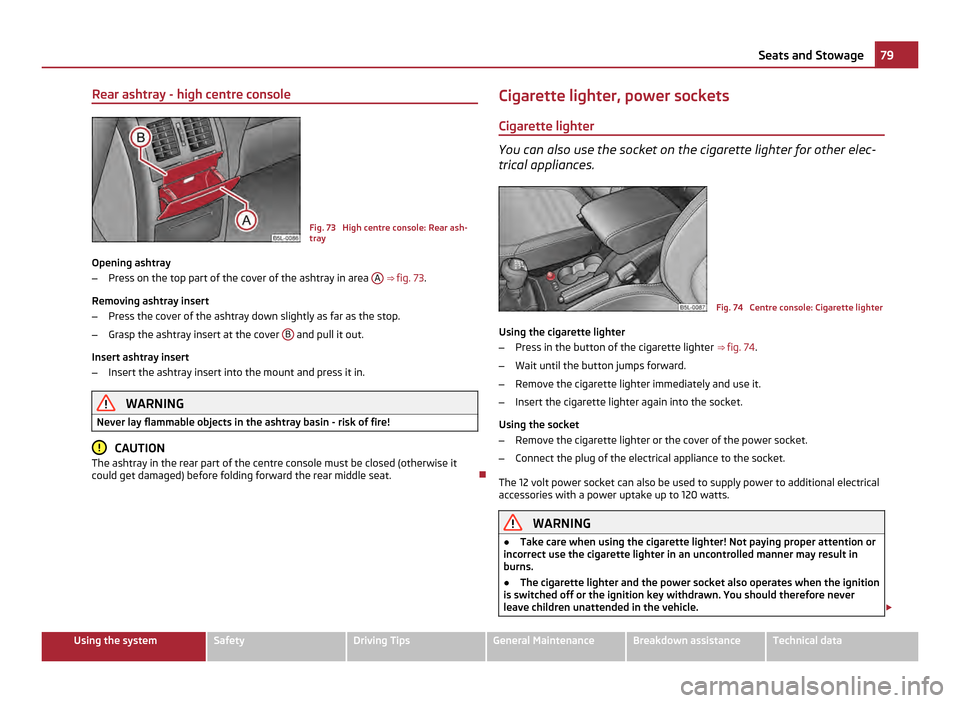
Rear ashtray - high centre console
Fig. 73 High centre console: Rear ash-
tray
Opening ashtray
– Press on the top part of the cover of the ashtray in area A
⇒ fig. 73.
Removing ashtray insert
– Press the cover of the ashtray down slightly as far as the stop.
– Grasp the ashtray insert at the cover B and pull it out.
Insert ashtray insert
– Insert the ashtray insert into the mount and press it in. WARNING
Never lay flammable objects in the ashtray basin - risk of fire! CAUTION
The ashtray in the rear part of the centre console must be closed (otherwise it
could get damaged) before folding forward the rear middle seat. Cigarette lighter, power sockets
Cigarette lighter You can also use the socket on the cigarette lighter for other elec-
trical appliances.
Fig. 74 Centre console: Cigarette lighter
Using the cigarette lighter
– Press in the button of the cigarette lighter ⇒ fig. 74.
– Wait until the button jumps forward.
– Remove the cigarette lighter immediately and use it.
– Insert the cigarette lighter again into the socket.
Using the socket
– Remove the cigarette lighter or the cover of the power socket.
– Connect the plug of the electrical appliance to the socket.
The 12 volt power socket can also be used to supply power to additional electrical
accessories with a power uptake up to 120 watts. WARNING
● Take care when using the cigarette lighter! Not paying proper attention or
incorrect use the cigarette lighter in an uncontrolled manner may result in
burns.
● The cigarette lighter and the power socket also operates when the ignition
is switched off or the ignition key withdrawn. You should therefore never
leave children unattended in the vehicle. £ 79
Seats and Stowage Using the system Safety Driving Tips General Maintenance Breakdown assistance Technical data