2011 SKODA YETI weight
[x] Cancel search: weightPage 177 of 252

Exiting the vehicle on a hillside
If the vehicle comes to a standstill at a steep angle on a hillside and you and your
passengers must exit the vehicle, then all the occupants should exit on the side
facing up the hill
⇒
fig. 149 on the right. WARNING
● Never attempt to drive uphill or downhill if it is too steep for your vehicle.
The vehicle could slip, tilt or roll over - risk of accident!
● When driving at an angle on a hillside, the vehicle can lose its grip and
slide sideways. The vehicle can tilt or roll over and then roll down the hillside.
This can lead to serious injuries.
● Always make sure that when the vehicle is at an angle, the wheels on the
low side do not sink deeply into the ground or into troughs and do not drive
over stones, tree stumps or other obstructions with the alternate raised
wheels - risk of accident!
● Before you drive at an angle on a hillside ⇒
fig. 149 , make sure that you can
steer and maintain your trajectory. If this is not possible, choose a different
path. If you drive at an angle on a hillside and there is a risk your vehicle may
tilt, steer immediately downhill on your trajectory and lightly depress the ac-
celerator.
● If the vehicle is stationary on a hillside with a too great angle of lateral in-
clination, avoid sudden and uncontrolled movements in the vehicle. The vehi-
cle can roll over and then roll down the hillside. This can lead to serious inju-
ries.
● If the vehicle is stationary on a hillside with a too great angle of lateral in-
clination, neither you nor your occupants must exit the vehicle through the
doors facing downhill. This can lead to a shift of the overall centre of gravity.
The vehicle can tilt or roll over and then roll down the hillside. This can lead to
serious injuries. To avoid this, you and your occupants must exit the vehicle
only on the side facing uphill ⇒ fig. 149 .
● When you exit the vehicle, make sure that the door which faces uphill does
not close by its own weight or by carelessness - risk of injury!
● Observe the important guidelines ⇒
page 168.
Driving over rutted roads and troughs You will always encounter ruts when driving on forest roads, through wet mead-
ows and fields as well as on rutted stretches of terrain. If the ruts and troughs are on firm and soft ground, you can simply follow the ruts.
Do not drive over ruts and troughs which are too deep. If you cannot avoid this, it
is better that you turn back. CAUTION
If the ruts or troughs become too deep, the underbody of the vehicle can touch
the ground, which might cause the underbody to get damaged. Therefore, avoid
driving in deep ruts and troughs.
Crossing a trench If possible, drive through the trench at an acute angle. Make sure when driving
through the trench that the tilt angle is not too steep.
WARNING
Never attempt to drive through a trench if its embankment is too steep. The
vehicle could slip, tilt or roll over - risk of accident! CAUTION
If you drive into the trench at a right angle, the front wheels will sink into the
trench. There is also the danger that the underbody of the vehicle touches the
ground and is damaged. For these reasons (even with four-wheel drive) it is rarely
possible to get out of the trench.
Driving in sand and mud You should therefore always drive at a constant speed through sand or mud
whenever possible and at the same time do not shift gears or change the driving
stage.
–
Switch on the Off-road mode ⇒ page 160
.
– Select a suitable gear or driving stage and maintain the gear or driving stage.
– Keep your vehicle in constant motion and do not stop until you have reached
firm ground.
Never drive too fast, otherwise the wheels may spin and the vehicle can get stuck.
If you feel that the tyres do no longer grip, then turn the steering wheel quickly
back and forth. This leads to an improved adhesion of the front tyres of the vehi-
cle for a short period of time. £ 175
Driving and the environment Using the system Safety Driving Tips General Maintenance Breakdown assistance Technical data
Page 180 of 252

Towing a trailer
Towing a trailer
Technical requirements Your vehicle is designed primarily for transporting persons and luggage. It can,
however, also be used for towing a trailer - provided certain technical equipment
is fitted.
If your vehicle has been
factory-fitted with a towing device or has a towing device
from
ŠKODA Original Accessories, the towing device satisfies all technical and le-
gal requirements.
Your vehicle is fitted with a 13-pin power socket for the electrical connection be-
tween the vehicle and trailer. If the trailer which you wish to tow has a 7-pin con-
nector , you can use a suitable adapter from ŠKODA Original Accessories.
This work must be carried out in accordance with the manufacturer's specifica-
tions if a towing device is retrofitted.
Authorised ŠKODA Service Partners can provide detailed information about retro-
fitting a towing device and for any necessary modifications to the cooling system. WARNING
We recommend that you have the towing device from ŠKODA Original Acces-
sories installed by an authorised
ŠKODA Service Partner. He is familiar with all
the relevant details relating to retrofitting such equipment. There is a risk of
an accident if the towing device is not properly fitted!
General Maintenance Trailer load
The permissible trailer load must on no account be exceeded.
You can negotiate appropriately steeper inclines and descents if you do not make
full use of the permissible trailer load.
The trailer loads specified only apply for
altitudes up to 1000 metres above mean
sea level. The fact that the engine power output drops with increasing height due
to a lowering of air pressure and thus the ability to climb, means that the towed
weight must be reduced by 10 % for every further increase of 1 000 metres in height above sea level. The towed weight is the weight of the (laden) vehicle and
the (laden) trailer together. One should take this into account before driving up to
higher altitudes.
The trailer and drawbar load information on the type plate of the towing device
are merely test data for the towing device The data relating to your vehicle,
which is often less than this test data, can be found in your vehicle registration
documents.
Distribution of the load
Distribute the load in the trailer in such a way that any heavy items are located as
close as possible to the axle. Secure the items to prevent them slipping.
Tyre pressure
Correct the tyre inflation pressure on your vehicle for that of
“fully laden”
⇒ page 201. The inflation pressure of the tyres fitted to the trailer adjust in ac-
cordance with the manufacturer's recommendation.
Exterior mirrors
You have to have additional exterior mirrors fitted if you are not able to see the
traffic behind the trailer with the standard rear-view mirrors. Both exterior mirrors
should be attached to folding arms. Adjust the mirrors so that they provide you
with an adequate field of view to the rear.
Headlights
Before starting off with a hitched trailer, also check the setting of the headlights.
Alter the setting as necessary with the aid of the headlight beam adjuster
⇒ page 50.
Detachable ball head
The ball head is detachable on vehicles with towing device and can be obtained
from ŠKODA Original Accessories. It is stowed together with separate fitting in-
structions in the spare wheel well in the luggage compartment of the vehicle. Note
● We recommend that you also have your vehicle inspected between service in-
tervals if you tow a trailer frequently.
● The handbrake on the towing vehicle must be put on when coupling and de-
coupling the trailer. 178
Towing a trailer
Page 181 of 252

Driving Tips
–
Do not, as far as possible, drive with your vehicle unladen and the trailer laden.
– Do not make full use of the legal maximum speeds. This applies in particular to
downhill sections.
– Apply the brakes in good time.
– Keep a check on the coolant temperature gauge if the outside temperature is
high.
Distribution of weight
The distribution of the weight is very poor if your vehicle is unladen and the trailer
is laden. Maintain a particularly low speed if you cannot avoid driving with this
combination.
Driving speed
Do not drive faster than 80 km/hour for safety reasons. This also applies for coun-
tries in which higher speeds are allowed.
The fact that the driving stability of the vehicle + trailer combination reduces with
increasing speed means that the legally allowed speed should not be used when
there are unfavourable road, weather or wind conditions, particularly near acci-
dent black spots.
You must always reduce your speed immediately as soon as you detect even just
the slightest swaying of the trailer. On no account attempt to stop the trailer
from “swaying” by accelerating.
Apply the brakes in good time! If the trailer is fitted with a trailer brake, apply the
brakes gently at first and then brake firmly. This will avoid brake jolts resulting
from the trailer wheels locking. Shift down gears in good time before negotiating
a downhill section to allow the engine to also act as a brake.
Engine overheating
Please keep a check on the coolant temperature gauge if you have to negotiate a
lengthy slope in a low gear at a high engine speed when the outside temperature
is very high ⇒ page 11, Coolant temperature gauge
.
If the needle of the coolant temperature gauge moves into the right-hand area or
even the red area of the scale, reduce your speed immediately. Stop and switch
off the engine if the warning light in the instrument cluster begins flashing.
Wait a few minutes and check the level of coolant in the coolant expansion bottle
⇒ page 193, Inspecting the coolant level. Please refer to the following guidelines
⇒
page 26, Coolant temperature/Coolant
quantity .
The coolant temperature can be reduced by switching on the heating.
Any increase in the cooling effect of the coolant fan through shifting down a gear
and increasing the engine speed is not possible since the fan speed is independ-
ent of the engine speed. One should also not drop a gear for this reason when
towing a trailer as long as the engine can manage the slope without any drop in
speed. 179
Towing a trailer Using the system Safety Driving Tips General Maintenance Breakdown assistance Technical data
Page 230 of 252

Technical data
Technical data General information The details given in the official vehicle registration documents always take prece-
dence over the details in the Owner's Manual. Please refer to the official vehicle
registration documents or consult a specialist garage concerning the engine with
which your vehicle is equipped.
Used abbreviations Abbreviation Importance
kW Kilowatt, measuring unit for the engine output
rpm Engine revolutions per minute
Nm Newton meter, measuring unit for the engine torque
CO
2 in g/km discharged quantity of carbon dioxide in grams per driven
kilometre
TSI Petrol engine with a turbocharger and a direct fuel injec-
tion system TDI CR Diesel engine with turbocharger and injection system
Common Rail
M5/M6 5-speed/6-speed manual gearbox
DQ6/DQ7 6 speed-/7 speed automatic gearbox DSG
N1 The vehicles of this category are designed and construc-
ted for conveying goods with a maximum weight of
3.5
tons DPF Diesel particle filter
Performances The listed performance values were determined without performance-reducing
equipment, e.g. air conditioning system.
Weight
Fig. 190 Type plate
The indicated unloaded weight is for orientation purposes only. It is for the basic
equipment variant of the vehicle not including special features or accessories.
The kerb weight contains a fuel tank topped up to 90 % and a driver weight of
75 kg.
It is possible to calculate the approximate loading capacity from the difference be-
tween the permissible total weight and the unloaded weight.
You need to include the following into the loading capacity:
● passengers,
● all items of luggage and other loads,
● roof loads incl. the roof rack,
● when using a trailer hitch, the corresponding trailer nose weight (max. 80 kg).
The following specifications are listed on the type plate ⇒
fig. 190 :
Permissible gross weight
The permissible overall weight of the vehicle/trailer combination when the
vehicle is being operated with a trailer
Maximum permissible front axle load
Maximum permissible rear axle load £
1 2
3
4228
Technical data
Page 231 of 252

The identification plate is affixed to the lower part of the column between the
front and rear doors on the front passenger side.
WARNING
Do not exceed the permissible overall weight - risk of accident and damage to
the vehicle.
Identification details Fig. 191 Vehicle data sticker
Vehicle data sticker
The vehicle data sticker ⇒ fig. 191 is located on the floor of the luggage compart-
ment and is also stated in the Service schedule.
The vehicle data sticker contains the following data:
Vehicle identification number (VIN)
Vehicle type
Gearbox code, paint number, interior equipment number, engine output, en-
gine code
Partial description of the vehicle
7GG, 7MB, 7MG - vehicles with DPF ⇒ page 159
Vehicle identification number (VIN)
The vehicle identification number - VIN (vehicle body number) is stamped into the
engine compartment on the right hand shock absorber dome. This number is also
located on a sign on the lower left hand edge below the windscreen.
Engine number
The engine number is stamped into the engine block. 1 2
3
4
5 Sticker on inside of fuel filler flap
The stickers are affixed to the inside of the fuel filler flap and contain the follow-
ing information:
● The prescribed types of fuel,
● Tyre size,
● Tyre pressure.
Fuel consumption according to the ECE standards
and EU guidelines Depending on the range of the special equipment, style of driving, traffic situa-
tion, weather influences and vehicle condition, the consumption values which in
practice result when using the vehicle can deviate from the indicated values.
Urban traffic
The consumption measurement in urban traffic begins with starting of the cold
engine. Afterwards the normal urban traffic is simulated.
Non-urban traffic
For the consumption measurement in non-urban traffic the vehicle, as in daily mo-
toring, is accelerated and braked several times in all gears. The vehicle speed
changes within the range from 0 to 120 km/h.
Combined traffic
The consumption value in the combined traffic consists of 37 % from the value for
the urban traffic and of 63 % from the value for the non-urban traffic. Note
● Please note that the information stated in the official vehicle registration
documents always takes priority. 229
Technical data Using the system Safety Driving Tips General Maintenance Breakdown assistance Technical data
Page 234 of 252

Engine 1.2 l/77 kW TSI - EU5
Output (kW per rpm) Max. torque (Nm per rpm) Number of cylinders/Displacement (cm
3
) 77/5000 175/1550-4100 4/1197
Performances M6 DQ7
Maximum speed (km/h) 175 173
Acceleration 0 - 100 km/h (s) 11.8 12.0
Fuel consumption (in ltr./100 km) and CO
2 (in g/km) Urban 7.6 7.8
a)
/8.0 b) Non-urban 5.9 5.7
a)
/5.8 b) Combination 6.4 6.4
a)
/6.6 b) CO
2 emission - combination 149 149
a)
/154 b) Weight (in kg)
Permissible gross weight 1885/1940
c) 1915/1970
c)Kerb weight ready for operation 1340 1370
Permissible trailer loads, trailer braked 1200
d)
/1500 e)Permissible trailer loads, trailer unbraked 670 680
a)
Unloaded weight with special equipment up to 1,505 kg.
b) Unloaded weight with special equipment more than 1,505 kg.
c) Vehicles of the group N1.
d) Uphills up to 12 %
e) Uphills up to 8 % 232
Technical data
Page 235 of 252
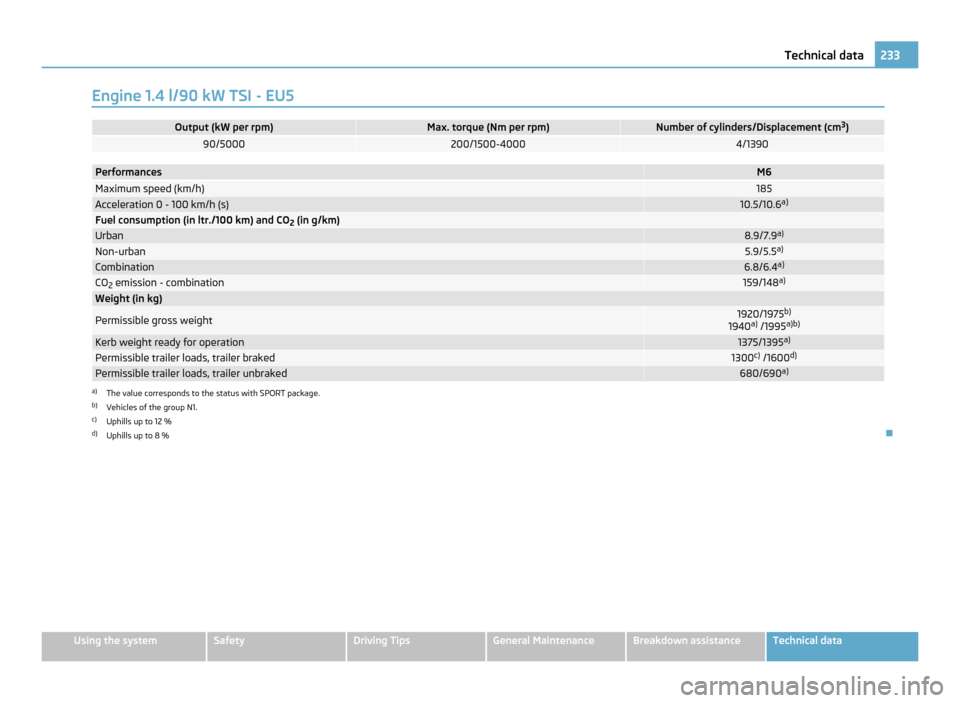
Engine 1.4 l/90 kW TSI - EU5
Output (kW per rpm) Max. torque (Nm per rpm) Number of cylinders/Displacement (cm
3
) 90/5000 200/1500-4000 4/1390
Performances M6
Maximum speed (km/h) 185
Acceleration 0 - 100 km/h (s) 10.5/10.6
a) Fuel consumption (in ltr./100 km) and CO
2 (in g/km) Urban 8.9/7.9
a) Non-urban 5.9/5.5
a) Combination 6.8/6.4
a) CO
2 emission - combination 159/148
a) Weight (in kg)
Permissible gross weight 1920/1975
b)
1940 a)
/1995 a)
b)Kerb weight ready for operation 1375/1395
a) Permissible trailer loads, trailer braked 1300
c)
/1600 d) Permissible trailer loads, trailer unbraked 680/690
a) a)
The value corresponds to the status with SPORT package.
b) Vehicles of the group N1.
c) Uphills up to 12 %
d) Uphills up to 8 % 233
Technical data Using the system Safety Driving Tips General Maintenance Breakdown assistance Technical data
Page 236 of 252

Engine 1.8 ltr./118 kW TSI - EU2, EU5 (1.8 ltr./112 kW TSI - EU5)
Output (kW per rpm) Max. torque (Nm per rpm) Number of cylinders/Displacement (cm
3
) 118/4500-6200 (112/4300 - 6200)
a) 250/1500-4500 (250/1500 - 4200)
a) 4/1798
a)
1.8 ltr./112 kW TSI Performances M6 4x4 DQ6
a) Maximum speed (km/h) 200/196
a) 192
Acceleration 0 - 100 km/h (s) 8.4/8.7
a) 9.0
Fuel consumption (in ltr./100 km) and CO
2 (in g/km) Urban 10.1 10.6
Non-urban 6.9 6.8
Combination 8.0 8.0
CO
2 emission - combination 189
Weight (in kg)
Permissible gross weight 2050/2105
b) 2085/2140
b)Unloaden weight ready for work 1505 1540
Permissible trailer loads, trailer braked 1800
Permissible trailer loads, trailer unbraked 750
a)
1.8 ltr./112 kW TSI
b) Vehicles of the group N1. 234
Technical data