2011 SKODA OCTAVIA TOUR lock
[x] Cancel search: lockPage 74 of 183

Starting-off and Driving73
Using the system
Safety
Driving Tips
General Maintenance
Breakdown assistance
Technical Data
Starting-off and DrivingSetting steering wheel positionFig. 83 Adjustable steering wheel: Lever below steering columnYou can set the height and the forward/back position of the steering wheel to the
desired position.
– Adjust the driver seat page 11.
– Pull the lever below the steering column down fig. 83 - left. Observe the
guidelines .
– Set the steering wheel to the desired position (concerning height and forward/back position).
– Push the lever upwards as far as the stop.
WARNING
•
You must not adjust the steering wheel when the vehicle is moving!
•
The driver must maintain a distance of at least 25 cm to the steering wheel
fig. 83 - right. Not maintaining this minimum distance will mean that the
airbag system will not be able to properly protect you - hazard!
•
For safety reasons the lever must always be firmly pushed up to avoid the
steering wheel altering its position unin tentionally when driving - risk of acci-
dent!
•
If you adjust the steering wheel further towards the head, you will reduce
the protection offered by the driver airbag in the event of an accident. Make sure
the steering wheel is aligned to the chest.
•
When driving, hold the steering wheel with both hands firmly on the outer
edge in the 9 o'clock and 3 o'clock positi on. Never hold the steering wheel firmly
in the 12 o'clock position or in another way (e.g. in the middle of the steering
wheel or at the inner steering wheel edge). In such cases, injuries to the arms,
the hands and the head can occur when the driver airbag is deployed.
Ignition lockPetrol engines
- ignition switched off, engine off, the steering can be locked.
- ignition switched on
- start engine
Diesel engines - interruption of fuel suppl y, ignition switched off, engine off, the steering can
be locked.
- heating glow plugs on, ignition switched on•
You should not switch on any major elec trical components during the heating
period. Otherwise the vehicle battery will be drained unnecessarily.
- start engineWARNING (continued)
Fig. 84 Ignition lock positions
123123
s2lk.2.book Page 73 Monday, April 18, 2011 7:41 AM
Page 75 of 183

Starting-off and Driving
74
Applies to all models:
Position
To lock the steering , with the ignition key withdrawn, turn the steering wheel until
the steering locking pin is heard to engage. You should always lock the steering as
a general rule if you leave your vehicle. This acts as a deterrent against possible
theft of your vehicle .
Position
Move the steering wheel back and forward a little if the ignition key cannot, or
cannot easily be turned into this positi on, in order to release the steering lock.
Position
The engine is started in this position. At the same time any switched on low beam
or main beam or other electrical compon ents with major electrical consumers are
briefly switched off. The ignition key moves back into position after being
released.
The ignition key must be turned back into position each time before starting the
engine again. The starter repeat lock in the ignition lock prevents the starter being
engaged when the engine is running and thus getting damaged.
WARNING
•
When driving, the ignition key must al ways be in the position (ignition
switched on) without the engine running. This position is indicated by the
warning lights coming on. If this is not the case, it could result in unexpected
locking of the steering wheel - risk of accident!
•
Do not withdraw the ignition key from the lock until the vehicle has come to
a stop. The steering lock can engage immediately - risk of accident!
•
Always withdraw the ignition key if you are going to leave the vehicle, even
for a short time. This is particularly import ant if children are left in the vehicle.
Children might otherwise start the engine or switch on electrical equipment (e.g.
power windows) - risk of accident or injury!
Starting the engineGeneral
You can only start the engine only using an original ignition key.•
Place the gearshift lever into neutral an d put on the handbrake firmly before
starting the engine.
•
Before starting, it is necessary to depress the clutch pedal and to keep it pressed
down until the engine starts. If you try and start the engine without pressing the
clutch pedal, the engine will not start. A message in the information display of the
instrument cluster will also appear indicate the need to press the clutch pedal.
•
Let go of the ignition key as soon as the engine starts otherwise you may
damage the starter.
The engine running noises may louder at first be louder for a short time after
starting the cold engine until oil pressure can be built up in the hydraulic valve clear-
ance compensation. This is quite norm al and is not an operating problem.
If the engine does not start ...
You can use the battery of anothe r vehicle as a jump-start aid page 153.
It is only possible to tow-start vehicles fitted with a manual gearbox. The tow-
starting distance must not be more than 50 metres. Observe the following
guidelines page 154, “Tow-starting and towing vehicle”.
WARNING
•
Never run the engine in non ventilated or enclosed areas. The exhaust gases
of the engine contain besides the odourless and colourless carbon monoxide a
poisonous gas - hazard! Carbon mono xide can cause unconsciousness and
death.
•
Never leave your vehicle unattended with the engine running.Caution
•
The starter may only be operated (ignitio n key position ), if the engine is not
running. If the starter is immediately operated after switching off the engine, the
starter or the engine can be damaged.
•
Avoid high engine revolutions, full throttle and high engine loads as long as the
engine has not yet reached its normal operating temperature - risk of damaging the
engine!
•
Vehicles which are fitted with an exhaus t gas catalytic converter should not be
tow-started over a distance of more than 50 metres.For the sake of the environment
Never warm up the engine when the vehicle is standing. Drive off right away.
Through this the engine reaches its operating temperature more rapidly and the
pollutant emissions are lower.
123
2
1
2
3
s2lk.2.book Page 74 Monday, April 18, 2011 7:41 AM
Page 77 of 183
Starting-off and Driving
76
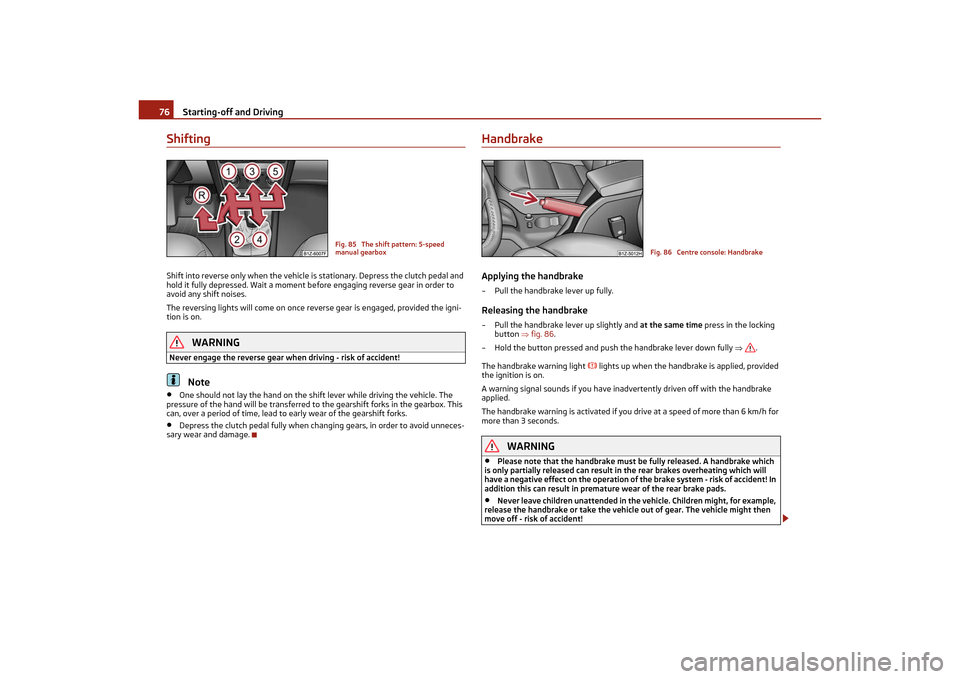
ShiftingShift into reverse only when the vehicle is stationary. Depress the clutch pedal and
hold it fully depressed. Wait a moment be fore engaging reverse gear in order to
avoid any shift noises.
The reversing lights will come on once reverse gear is engaged, provided the igni-
tion is on.
WARNING
Never engage the reverse gear when driving - risk of accident!
Note
•
One should not lay the hand on the shift lever while driving the vehicle. The
pressure of the hand will be transferred to the gearshift forks in the gearbox. This
can, over a period of time, lead to early wear of the gearshift forks.
•
Depress the clutch pedal fully when changing gears, in order to avoid unneces-
sary wear and damage.
HandbrakeApplying the handbrake– Pull the handbrake lever up fully.Releasing the handbrake– Pull the handbrake lever up slightly and at the same time press in the locking
button fig. 86.
– Hold the button pressed and push the handbrake lever down fully .
The handbrake warning light
lights up when the handbrake is applied, provided
the ignition is on.
A warning signal sounds if you have inadvertently driven off with the handbrake
applied.
The handbrake warning is activated if you drive at a speed of more than 6 km/h for
more than 3 seconds.
WARNING
•
Please note that the hand brake must be fully released. A handbrake which
is only partially released can result in the rear brakes overheating which will
have a negative effect on the operation of the brake system - risk of accident! In
addition this can result in premat ure wear of the rear brake pads.
•
Never leave children unattended in the vehicle. Children might, for example,
release the handbrake or take the vehicl e out of gear. The vehicle might then
move off - risk of accident!
Fig. 85 The shift pattern: 5-speed
manual gearbox
Fig. 86 Centre console: Handbrake
s2lk.2.book Page 76 Monday, April 18, 2011 7:41 AM
Page 84 of 183

Passive Safety83
Using the system
Safety
Driving Tips
General Maintenance
Breakdown assistance
Technical Data
•
The driver must maintain a distance of at least 25 cm to the steering wheel
page 82, fig. 89 - left. Not maintaining this minimum distance will mean that
the airbag system will not be able to properly protect you - hazard!
•
When driving, hold the steering wheel with both hands firmly on the outer
edge in the 9 o'clock and 3 o'clock positi on. Never hold the steering wheel firmly
in the 12 o'clock position or in another way (e.g. in the middle of the steering
wheel or at the inner steering wheel edge). In such cases, injuries to the arms,
the hands and the head can occur when the driver airbag is deployed.
•
The seat backrests must not be angled too far back when driving otherwise
this will affect proper operation of the se at belts and of the airbag system - risk
of injury!
•
Ensure that there are no objects in the footwell as any objects may get
behind the pedals during a driving or braking manoeuvre. You would then no
longer be able to operate the clutch, to brake or accelerate.
Correct seated position for the front passenger
The front passenger must maintain a distance of at least 25 cm from
the dash panel so that the airbag offers him the greatest possible
safety it is deployed.For the safety of the front passenger and to reduce the risk of injury in the event of
an accident, we recommend the following setting:•
Adjust the front passenger seat as far as possible to the rear.
•
Adjust the head restraint so that the top edge of the head restraint is at the
same level as the upper part of your head page 82, fig. 89 - right.
•
Fasten the seat belt correctly page 87, “How are seat belts correctly
fastened?”.
In exceptional cases the front passenger airbag can be deactivated page 95,
“Deactivating an airbag”.
Manual front passenger adjustment page 11, “Adjusting the front seats”.
WARNING
•
The front seats and the head restraints must always be adjusted to match
the body size of the seat occupant as well as the seat belts must always be
correctly fastened in order to provide an optimal protection for you and your
occupants.
•
The front passenger must maintain a distance of at least 25 cm to the dash
panel. Not maintaining this minimum dist ance will mean that the airbag system
will not be able to prop erly protect you - hazard!
•
Keep your feet in the footwell at all times while driving. Never place your feet
on the dash panel, out of the window or on the seats. You will be exposed to
increased risk of injury if it becomes ne cessary to apply the brake or in the event
of an accident. If an airbag is deployed, you may suffer fatal injuries when
adopting an incorrect seated position!
•
The seat backrests must not be angled too far back when driving otherwise
this will affect proper operation of the seat belts and of the airbag system - risk
of injury!
Correct seated position for the occupants on the rear seats
Occupants on the rear seats must sit upright, keep the feet in the
footwell and must have their seat belts correct ly fastened.To reduce the risk of injury in the event of a sudden braking manoeuvre or an acci-
dent, the occupants on the rear seats must observe the following:•
Adjust the head restraints so that the top edge of the head restraints is at the
same level as the upper part of your head page 82, fig. 89 - on the right.
•
Fasten the seat belt correctly page 87, “How are seat belts correctly
fastened?”.
•
If you are transporting page 97, “Transporting children safely” children in the
vehicle, please use a suitable child restraint system.
WARNING
•
The head restraints must always be adju sted to match the body size, in order
to offer an optimal protection for you and your occupants.
•
Keep your feet in the footwell at all times while driving. Never place your feet
out of the window or on the seats. You will be exposed to increased risk of injury
if it becomes necessary to apply the brak e or in the event of an accident. If an
airbag is deployed, you may suffer fata l injuries when adopting an incorrect
seated position!
•
If the occupants on the rear seats are not sitting upright, the risk of injury is
increased due to incorrect routing of the seat belt.
WARNING (continued)
WARNING (continued)
s2lk.2.book Page 83 Monday, April 18, 2011 7:41 AM
Page 87 of 183

Seat belts
86
T h e c o m m o n o p i n i o n t h a t i t i s p o s s i b l e t o s u p p o r t y o u r b o d y i n a m i n o r a c c i d e n t w i t h
your hands, is incorrect. Even in a collision at only a low speed, the forces acting on
the body are such that it is no longer possible to support your body.
Even if you only drive at a speed within the range from 30 km/hour to 50 km/hour,
the forces which are produced on your body in the event of an accident can easily
exceed 10.000 N (Newton). This equals a weight of one tonne (1 000 kg).
In the event of a frontal collision, occupa nts of the vehicle not wearing a seat belt,
are thrown forward and strike in an uncont rolled way parts of the interior of the
vehicle, such as steering wheel, dash panel, windscreen, page 85, fig. 91 - left.
The occupants of a vehicle who have not fastened their seat belts may even be
thrown out of the vehicle. This can result in fatal injuries.
It is also important that rear seat occupa nts fasten their seat belts as they will
otherwise be thrown through the vehicle in an uncontrolled manner in the event of
an accident A rear seat pa ssenger who has not fastened the seat belt is a danger
not only to himself but also for those seated at the front page 85, fig. 91 - right.Important safety information regarding the use of seat beltsThe correct use of the seat belts considerably reduces the risk of
injury!
WARNING
•
The belt webbing must not be jammed in -between at any point or twisted,
or chafe against any sharp edges.
•
It is important that the belt webbing is properly routed if the seat belts are
to offer their maximum protection page 87.
•
No two persons (also not children) should ever use a single seat belt
together.
•
The maximum protection which seat belts can offer is only achieved if you
are correctly seated page 82, “Correct seated position”.
•
The belt webbing must not run across so lid or fragile objects (e.g. spectacles,
ball-point pens, keys etc.) as th is may be a cause of injuries.
•
Bulky, loose clothing (e.g. a winter coat over a jacket) does not allow you to
be correctly seated and impairs pr oper operation of the seat belts.
•
It is prohibited to use clamps or othe r objects to adjust seat belts (e.g. for
shortening the belts for smaller persons).
•
The lock tongue should only be inserted into the lock which is the correct one
for your seat. Wrong use of the safety belt will reduce its capacity to protect and
the risk of injury increases.
•
The seat backrests of the front seats must not be tilted too far to the rear
otherwise the seatbelts can lose their effectiveness.
•
The belt webbing must always be kept clean. A soiled belt webbing may
impair proper operation of the inertia reel page 126, “Seat belts”.
•
The slot of the belt tongue must not be blocked by paper or similar objects
otherwise the belt tongue will not lock in place properly.
•
Inspect the seat belts regularly to ensure they are in good condition. If you
find seat belts which have damage to th e seat belt webbing, seat belt connec-
tions, to the inertia reels or to the lock, t h e r e l e v a n t s a f e t y b e l t m u s t b e r e p l a c e d
by a specialist garage.
•
The seat belts must not be removed or changed in any way. Do not make an
attempt to repair the seat belts yourself.
•
Damaged seat belts which have been subjected to stress in an accident and
were therefore stretched, must be replaced - this is best done by a specialist
garage. The anchorage points of the belts must also be inspected. The
anchorage points for the belts should also be checked.
•
In certain countries it is possible to use seat belts which differ in terms of
their operation from the seat belts wh ich are described on the pages which
follow.WARNING (continued)
s2lk.2.book Page 86 Monday, April 18, 2011 7:41 AM
Page 88 of 183

Seat belts87
Using the system
Safety
Driving Tips
General Maintenance
Breakdown assistance
Technical Data
How are seat belts correctly fastened?Fastening three-point seat belts
Fasten your seat belt before starting!Fig. 92 Routing of webbing over the shoulders and the lap belt– Correctly adjust the front seat and the he ad restraint before fastening your seat
belt page 50.
– Slowly pull the belt webbing at the tongue of the lock over your chest and pelvis .
– Insert the tongue of the lock into the seat belt buckle belonging to the seat until it is heard to lock in place.
– Pull on the seat belt to check that it has also reliably engaged in the lock.
Each three-point seat belt is equipped with an inertia reel. This inertia reel offers
you complete freedom of movement if the belt is unreeled slowly. If the brakes are
applied suddenly, the inertia reel will block. It also blocks the seat belts when the
car accelerates, when driving uphill and when cornering.
Expectant mothers must also wear seat belts .
WARNING
•
The shoulder part of the seat belt must never run across your neck but must
run approximately over the middle of th e shoulder and fit snugly against the
chest. The lap part of the belt must run across the hip and must never be routed
across the stomach. It must always fit snugly page 87, fig. 92 - left. Adjust the
belt webbing as required.
•
The lap part of the belt should be positi oned as low as possible at the pelvis
of an expectant mother in order to avoid exerting any pressure on the lower
abdomen page 87, fig. 92 - right.
•
Always ensure that the webbing of the seat belts is properly routed. Seat
belts which are not correctly adjusted c an themselves cause injuries even in
minor accidents.
•
A seat belt which is hanging too loose can result in injuries as your body is
moved forward by the kinetic energy pr oduced in an accident and is then
suddenly held firm by the belt.
•
Only insert the lock tongue into the lock which is the correct one for your
seat. This will affect the protection which th e b el t of f ers a n d i n c rea s e th e ri sk of
an injury.
Seat belt height adjusterThe seat belt height adjuster makes it po ssible for you to adapt the routing of the
three-point seat belt in the area of the shoulder to match your body size.
– Move the height adjuster in the desired direction up or down fig. 93 .
– Then pull firmly on the belt to ensure that the seat belt height adjuster has correctly locked in place.
WARNING
Adjust the height of the belt in such a wa y that the shoulder part of the belt is
positioned approximately ac ross the middle of your shoulder - on no account
across your neck.
WARNING (continued)
Fig. 93 Front seat: Seat belt height
adjuster
s2lk.2.book Page 87 Monday, April 18, 2011 7:41 AM
Page 89 of 183
Seat belts
88Note
It is also possible to adapt the routing of the belt webbing at the front seats by
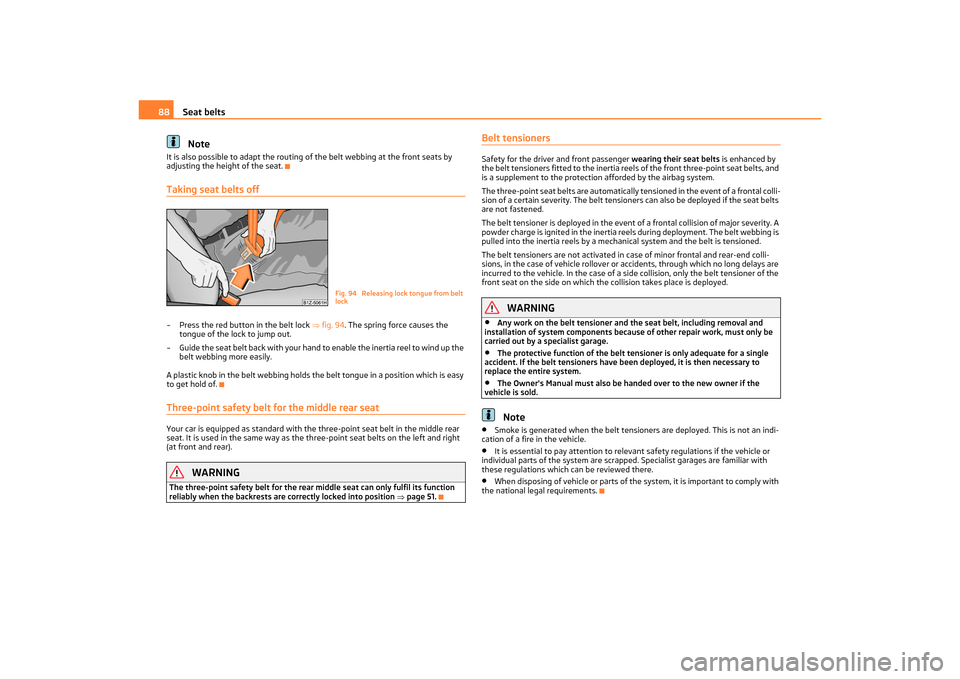
adjusting the height of the seat.Taking seat belts off– Press the red button in the belt lock fig. 94 . The spring force causes the
tongue of the lock to jump out.
– Guide the seat belt back with your hand to enable the inertia reel to wind up the
belt webbing more easily.
A plastic knob in the belt webbing holds the belt tongue in a position which is easy
to get hold of.Three-point safety belt for the middle rear seatYour car is equipped as standard with the three-point seat belt in the middle rear
seat. It is used in the same way as the th ree-point seat belts on the left and right
(at front and rear).
WARNING
The three-point safety belt for the rear middle seat can only fulfil its function
reliably when the backrests are correctly locked into position page 51.
Belt tensionersSafety for the driver and front passenger wearing their seat belts is enhanced by
the belt tensioners fitted to the inertia reel s of the front three-point seat belts, and
is a supplement to the protection afforded by the airbag system.
The three-point seat belts are automatically tensioned in the event of a frontal colli-
sion of a certain severity. The belt tensioners can also be deployed if the seat belts
are not fastened.
The belt tensioner is deployed in the event of a frontal collision of major severity. A
powder charge is ignited in the inertia reels during deployment. The belt webbing is
pulled into the inertia reels by a mechan ical system and the belt is tensioned.
The belt tensioners are not activated in case of minor frontal and rear-end colli-
sions, in the case of vehicle rollover or accidents, through which no long delays are
incurred to the vehicle. In the case of a si de collision, only the belt tensioner of the
front seat on the side on which the collision takes place is deployed.
WARNING
•
Any work on the belt tensioner and the seat belt, including removal and
installation of system components because of other repair work, must only be
carried out by a specialist garage.
•
The protective function of the belt te nsioner is only adequate for a single
accident. If the belt tensioners have b een deployed, it is then necessary to
replace the entire system.
•
The Owner's Manual must also be handed over to the new owner if the
vehicle is sold.Note
•
Smoke is generated when the belt tensioners are deployed. This is not an indi-
cation of a fire in the vehicle.
•
It is essential to pay attention to releva nt safety regulations if the vehicle or
individual parts of the system are scrapped. Specialist garages are familiar with
these regulations which can be reviewed there.
•
When disposing of vehicle or parts of the system, it is important to comply with
the national legal requirements.
Fig. 94 Releasing lock tongue from belt
lock
s2lk.2.book Page 88 Monday, April 18, 2011 7:41 AM
Page 91 of 183
Airbag system
90
The airbags are not deployed in the case of minor frontal and side collisions, in the
case of rear-end collisions and vehicle rollover.
Deployment factors
It is not possible to state globally which deployment conditions apply to the airbag
system in every situation as the circumstances which exist in the case of accidents
vary greatly. An important role in this case is played by factors such as the type of
object against which the vehicle impacts (hard, soft), the angle of impact, the rela-
tive speed during the accident etc.
A decisive factor for the deployment of th e airbags is the deceleration which occurs
during a collision. The control unit analyses the nature of the collision and activates
the relevant restraint system. If the vehicle deceleration which occurs and is meas-
ured during the collision remains below the prescribed reference values specified in
the control unit, the airbags are not deployed although the vehicle may well suffer
severe damage to the bodywork as a consequence of the accident.
The airbags are not deployed if:•
ignition off,
•
a minor frontal collision,
•
a minor side collision,
•
a rear-end collision,
•
Rollover of the vehicle.Note
•
A grey white, non harmful gas is released when airbag is inflated. This is
perfectly normal and is not an indi cation of a fire in the vehicle.
•
In the event of an accident in which the airbags are deployed:
−The interior lighting comes on (if the switch for the interior light is in the door
contact position),
− The hazard warning light is switched on,
− All the doors are unlocked,
− the fuel supply to the engine is interrupted.
Front airbagsDescription of the front airbags
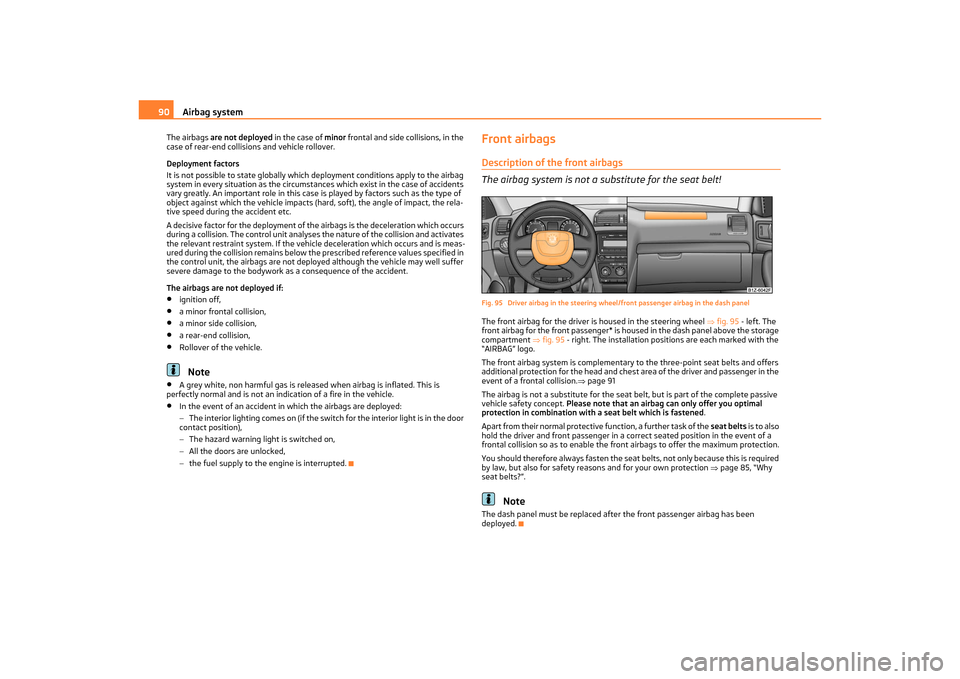
The airbag system is not a substitute for the seat belt!Fig. 95 Driver airbag in the steering wheel /front passenger airbag in the dash panelThe front airbag for the driver is housed in the steering wheel fig. 95 - left. The
front airbag for the front passenger* is housed in the dash panel above the storage
compartment fig. 95 - right. The installation positions are each marked with the
“AIRBAG” logo.
The front airbag system is complementary to the three-point seat belts and offers
additional protection for the head and chest area of the driver and passenger in the
event of a frontal collision. page 91
The airbag is not a substitute for the seat belt, but is part of the complete passive
vehicle safety concept. Please note that an airbag can only offer you optimal
protection in combination with a seat belt which is fastened .
Apart from their normal protective function, a further task of the seat belts i s t o a l s o
hold the driver and front passenger in a co rrect seated position in the event of a
frontal collision so as to enable the fron t airbags to offer the maximum protection.
You should therefore always fasten the seat belts, not only because this is required
by law, but also for safety reasons and for your own protection page 85, “Why
seat belts?”.
Note
The dash panel must be replaced after the front passenger airbag has been
deployed.
s2lk.2.book Page 90 Monday, April 18, 2011 7:41 AM