2011 SKODA OCTAVIA warning
[x] Cancel search: warningPage 75 of 248

Install
–
Position the luggage net partition housing into the mounts in the rear seat
backrests.
– Push the luggage net partition housing in the opposite direction of arrow 1as far as the stop.
– Fold the rear seats back into its original position. WARNING
Pay attention that the rear seat backrest is correctly interlocked. It is only
then that the three-point seat belt for the middle seat can reliably fulfil its
function.
The roof rack Description CAUTION
● Only use roof racks approved by ŠKODA.
● If you use other roof rack systems or if the roof bars are not properly fitted,
then any damage which may result to your car is not covered by the warranty
agreements. It is therefore essential to pay attention to the fitting instructions
supplied with the roof luggage rack system.
● On models fitted with a power sliding/tilting roof, ensure that the opened slid-
ing/tilting roof does not strike any items of luggage transported on the roof.
● Ensure that the opened boot lid does not collide with the roof load. For the sake of the environment
The increased aerodynamic drag results in a higher fuel consumption. Note
If a vehicle is not factory-equipped with a roof rack, it can be purchased from the
ŠKODA Original Accessories Lashing points (Octavia)
Fig. 66 Attachment points for base roof
carrier
Perform the assembly and the disassembly according to the attached instructions. Note
● If you have any questions, please contact a specialist garage.
● The figure is not valid for an estate car.
Roof load Distribute the weight evenly over the roof luggage rack system. The maximum
permissible roof load (including roof rack system) of
75 kg and the maximum per-
missible total weight of the vehicle should not be exceeded.
You cannot make full use of the permissible roof load if you use a roof luggage
rack system with a lower load carrying capacity. The load transported on the roof
luggage rack system must not exceed the weight limit which is stated in the fit-
ting instructions. WARNING
● The items which you transport on the roof bar system must be reliably at-
tached - risk of accident!
● You must on no account exceed the permissible roof load, the permissible
axle loads and the permissible gross weight of your vehicle - risk of accident!
● Please note that the handling properties of your vehicle change when you
transport heavy or bulky items on the roof bar system as a result of the dis-
placement of the centre of gravity and the increased wind attack area - risk of
accident! You must absolutely adapt your style of driving and the speed of the
vehicle to the specific circumstances. 73
Seats and Stowage Using the system Safety Driving Tips General Maintenance Breakdown assistance Technical data
Page 76 of 248
Cup holder
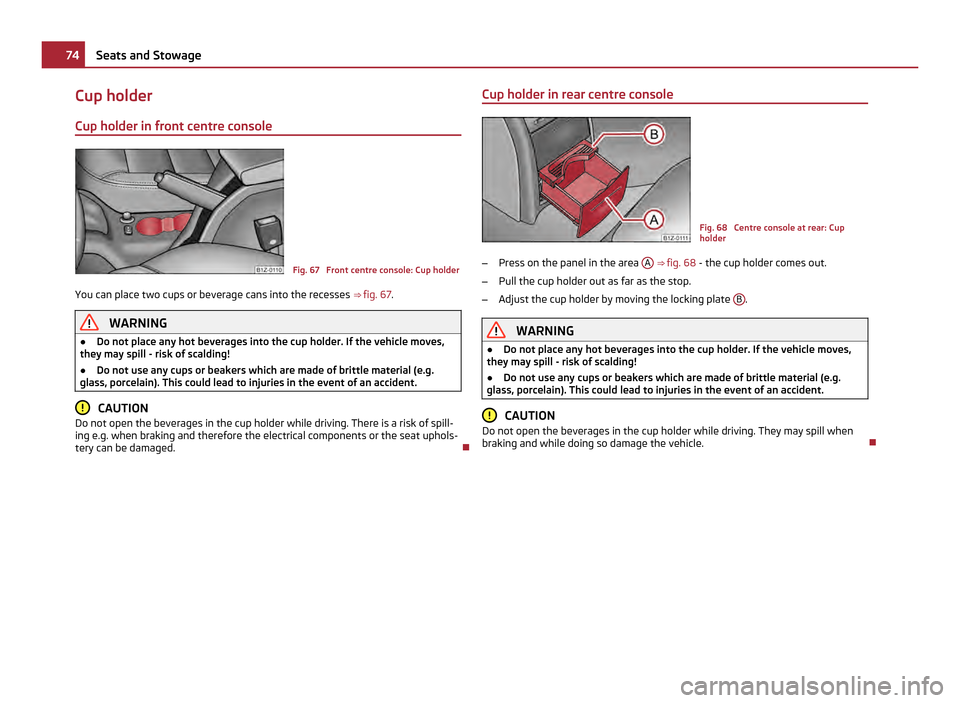
Cup holder in front centre console Fig. 67 Front centre console: Cup holder
You can place two cups or beverage cans into the recesses ⇒ fig. 67. WARNING
● Do not place any hot beverages into the cup holder. If the vehicle moves,
they may spill - risk of scalding!
● Do not use any cups or beakers which are made of brittle material (e.g.
glass, porcelain). This could lead to injuries in the event of an accident. CAUTION
Do not open the beverages in the cup holder while driving. There is a risk of spill-
ing e.g. when braking and therefore the electrical components or the seat uphols-
tery can be damaged. Cup holder in rear centre console Fig. 68 Centre console at rear: Cup
holder
– Press on the panel in the area A
⇒
fig. 68 - the cup holder comes out.
– Pull the cup holder out as far as the stop.
– Adjust the cup holder by moving the locking plate B .
WARNING
● Do not place any hot beverages into the cup holder. If the vehicle moves,
they may spill - risk of scalding!
● Do not use any cups or beakers which are made of brittle material (e.g.
glass, porcelain). This could lead to injuries in the event of an accident. CAUTION
Do not open the beverages in the cup holder while driving. They may spill when
braking and while doing so damage the vehicle. 74
Seats and Stowage
Page 77 of 248

Note holder
Fig. 69 Windscreen: Note holder
The parking ticket holder is designed e.g. for attaching a car park ticket in parking
areas.
The attached note has to always be removed before starting off in order not to
restrict the driver's vision.
Ashtray Front ashtray Fig. 70 Centre console: Front ashtray/remove front ashtray insert
Opening ashtray
– Press on the bottom part of the cover of the ashtray - refer to A
⇒ fig. 70. Removing ashtray insert
–
Press on the ashtray insert in the area B (the insert comes out) and you can
take it out.
Insert ashtray insert
– Insert the ashtray insert into the mount and press it in. WARNING
Never lay flammable objects in the ashtray basin - risk of fire!
Rear ashtray - low centre console Fig. 71 Low centre console: Rear ashtray
Opening ashtray
– Grasp the ashtray cover at the lower edge A and fold it open in the direction
of arrow ⇒ fig. 71 .
Removing ashtray
– Grasp the ashtray at the handle B and pull it out in an upward direction.
Replacing ashtray
– Insert the ashtray into the console and press it in. WARNING
Never lay flammable objects in the ashtray basin - risk of fire! 75
Seats and Stowage Using the system Safety Driving Tips General Maintenance Breakdown assistance Technical data
Page 78 of 248

Rear ashtray - high centre console
Fig. 72 High centre console: Rear ash-
tray
Opening ashtray
– Press on the top part of the cover of the ashtray in area A
⇒ fig. 72.
Removing ashtray insert
– Press the cover of the ashtray down slightly as far as the stop.
– Grasp the ashtray insert at the cover B and pull it out.
Insert ashtray insert
– Insert the ashtray insert into the mount and press it in. WARNING
Never lay flammable objects in the ashtray basin - risk of fire! Cigarette lighter, power sockets
Cigarette lighter You can also use the socket on the cigarette lighter for other elec-
trical appliances.
Fig. 73 Centre console: Cigarette lighter
Using the cigarette lighter
– Press in the button of the cigarette lighter ⇒ fig. 73.
– Wait until the button jumps forward.
– Remove the cigarette lighter immediately and use it.
– Insert the cigarette lighter again into the socket.
Using the socket
– Remove the cigarette lighter or the cover of the power socket.
– Connect the plug of the electrical appliance to the socket.
The 12 volt power socket can also be used to supply power to additional electrical
accessories with a power uptake up to 120 watts. WARNING
● Take care when using the cigarette lighter! Not paying proper attention or
incorrect use the cigarette lighter in an uncontrolled manner may result in
burns.
● The cigarette lighter and the power socket also operates when the ignition
is switched off or the ignition key withdrawn. You should therefore never
leave children unattended in the vehicle. £76
Seats and Stowage
Page 79 of 248

CAUTION
Always use matching plugs to avoid damaging the power socket. Note
● Connecting electrical components when the engine is not running will drain
the battery of the vehicle - risk of battery draining!
● Further information ⇒ page 197, Accessories, changes and replacement of
parts .
Power socket in the luggage compartment (Estate car) Fig. 74 Luggage compartment: Power
socket
– Open the cover of the power socket ⇒
fig. 74.
– Connect the plug of the electrical appliance to the socket.
You can only use the power socket for the connection of approved electrical ac-
cessories with a power uptake up to 120 watts. The vehicle battery will be dis-
charged in the process if the engine is stationary.
The same remarks apply here as for ⇒ page 76, Cigarette lighter, power sockets
.
Further information ⇒ page 197, Accessories, changes and replacement of parts.
Storage compartments Overview You will find the following storage facilities in your vehicle: Storage compartment on the front passenger side ⇒ page 78
Storage compartment on the driver's side ⇒ page 78
Storage compartment on the dash panel ⇒
page 79 Stowage compartment in front centre console ⇒
page 79 Storage net on the front centre console ⇒
page 79 Stowage compartment for spectacles ⇒ page 80
Storage compartment in the front doors ⇒ page 80
Stowage compartment below front passenger seat ⇒ page 80
Front seat armrest with storage compartment ⇒ page 80
Rear armrest with storage compartment ⇒
page 81 Stowage compartment in rear centre console ⇒
page 81 Seat backrest with opening for skis ⇒
page 82 Removable through-loading bag ⇒
page 82 Side compartment ⇒
page 83 Stowage compartment behind the rear seats (Estate
car) ⇒
page 83 Clothes hooks ⇒
page 83 WARNING
● Please do not place anything on top of the dash panel. Such objects might
slide or fall down when driving (when accelerating or cornering) and may dis-
tract you from concentrating on the traffic situation - risk of accident!
● Ensure that when driving no objects from the centre console of from other
storage possibilities may get into the footwell of the driver. You would then
no longer be able to apply the brakes, operate the clutch or accelerator - risk
of accident! 77
Seats and Stowage Using the system Safety Driving Tips General Maintenance Breakdown assistance Technical data
Page 80 of 248
Storage compartment on the front passenger side
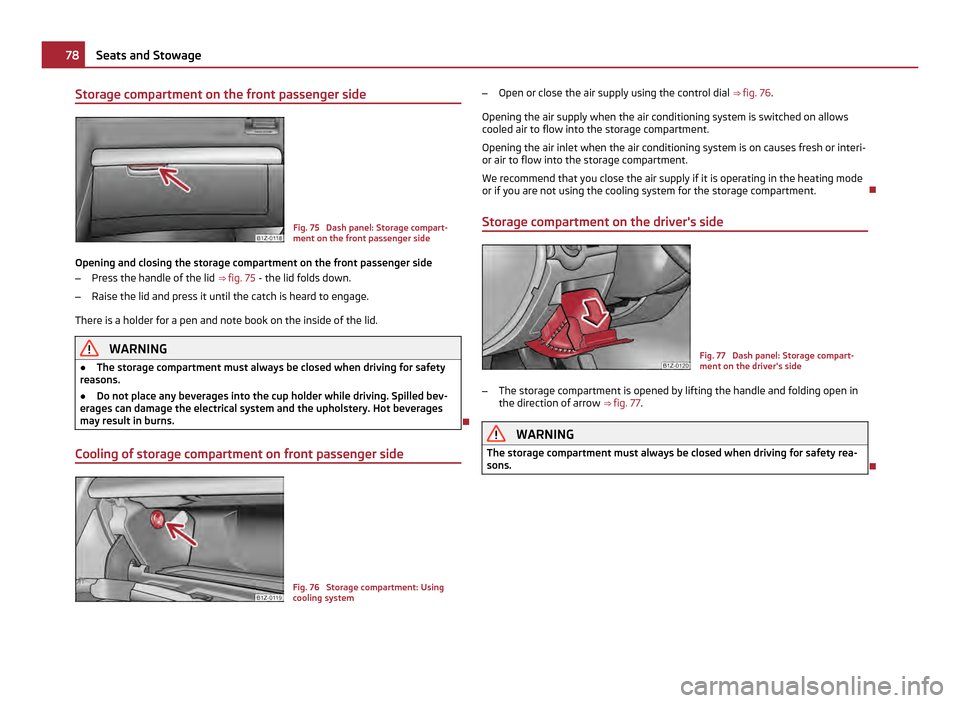
Fig. 75 Dash panel: Storage compart-
ment on the front passenger side
Opening and closing the storage compartment on the front passenger side
– Press the handle of the lid ⇒ fig. 75 - the lid folds down.
– Raise the lid and press it until the catch is heard to engage.
There is a holder for a pen and note book on the inside of the lid. WARNING
● The storage compartment must always be closed when driving for safety
reasons.
● Do not place any beverages into the cup holder while driving. Spilled bev-
erages can damage the electrical system and the upholstery. Hot beverages
may result in burns.
Cooling of storage compartment on front passenger side Fig. 76 Storage compartment: Using
cooling system–
Open or close the air supply using the control dial ⇒ fig. 76.
Opening the air supply when the air conditioning system is switched on allows
cooled air to flow into the storage compartment.
Opening the air inlet when the air conditioning system is on causes fresh or interi-
or air to flow into the storage compartment.
We recommend that you close the air supply if it is operating in the heating mode
or if you are not using the cooling system for the storage compartment.
Storage compartment on the driver's side Fig. 77 Dash panel: Storage compart-
ment on the driver's side
– The storage compartment is opened by lifting the handle and folding open in
the direction of arrow ⇒
fig. 77. WARNING
The storage compartment must always be closed when driving for safety rea-
sons. 78
Seats and Stowage
Page 81 of 248

Storage compartment on the dash panel
Fig. 78 Dash panel: Storage compart-
ment
– Press in the middle of the storage compartment ⇒ fig. 78 - the lid folds open
Certain model versions are equipped without lid for the storage compartment. WARNING
● The storage compartment is not a substitute for the ashtray and must also
not be used for such purposes - risk of fire!
● The storage compartment must always be closed when driving for safety
reasons.
● Do not put any highly inflammable objects or objects which are sensitive to
heat (e.g. lighters, sprays, spectacles, carbonated drinks) in the storage com-
partment.
Stowage compartment in front centre console Fig. 79 Front centre console: Storage
compartment–
Press on the bottom part of the storage compartment in the area A ⇒
fig. 79 -
the lid opens. WARNING
The storage compartment is not a substitute for the ashtray and must also
not be used for such purposes - risk of fire!
Storage net on the front centre console Fig. 80 Front centre console: Storage
net
The storage net in the front centre console ⇒ fig. 80 is designed for the transport
of smaller objects. WARNING
● In the storage net you must only stow objects (up to a total weight of 0.5
kg). Heavy objects are not secured sufficiently - risk of injury!
● No objects with sharp edges should be stored in the luggage net, because
they can damage the luggage net. 79
Seats and Stowage Using the system Safety Driving Tips General Maintenance Breakdown assistance Technical data
Page 82 of 248
Stowage compartment for spectacles
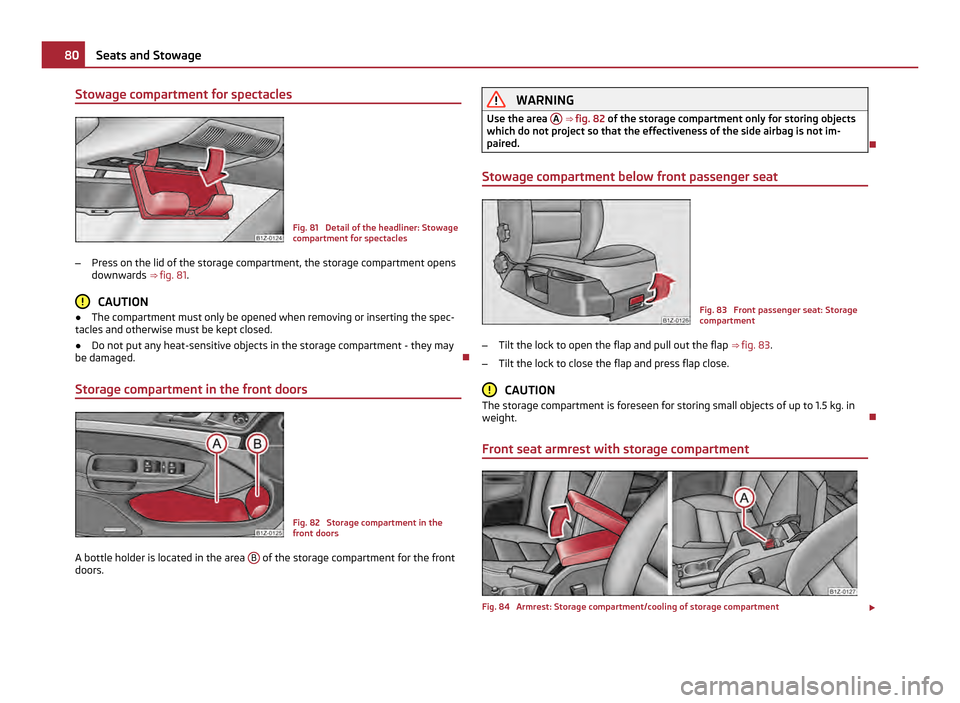
Fig. 81 Detail of the headliner: Stowage
compartment for spectacles
– Press on the lid of the storage compartment, the storage compartment opens
downwards ⇒ fig. 81 . CAUTION
● The compartment must only be opened when removing or inserting the spec-
tacles and otherwise must be kept closed.
● Do not put any heat-sensitive objects in the storage compartment - they may
be damaged.
Storage compartment in the front doors Fig. 82 Storage compartment in the
front doors
A bottle holder is located in the area B of the storage compartment for the front
doors. WARNING
Use the area A ⇒ fig. 82 of the storage compartment only for storing objects
which do not project so that the effectiveness of the side airbag is not im-
paired.
Stowage compartment below front passenger seat Fig. 83 Front passenger seat: Storage
compartment
– Tilt the lock to open the flap and pull out the flap ⇒ fig. 83 .
– Tilt the lock to close the flap and press flap close. CAUTION
The storage compartment is foreseen for storing small objects of up to 1.5 kg. in
weight.
Front seat armrest with storage compartment Fig. 84 Armrest: Storage compartment/cooling of storage compartment
£80
Seats and Stowage