2011 SKODA OCTAVIA warning lights
[x] Cancel search: warning lightsPage 36 of 248
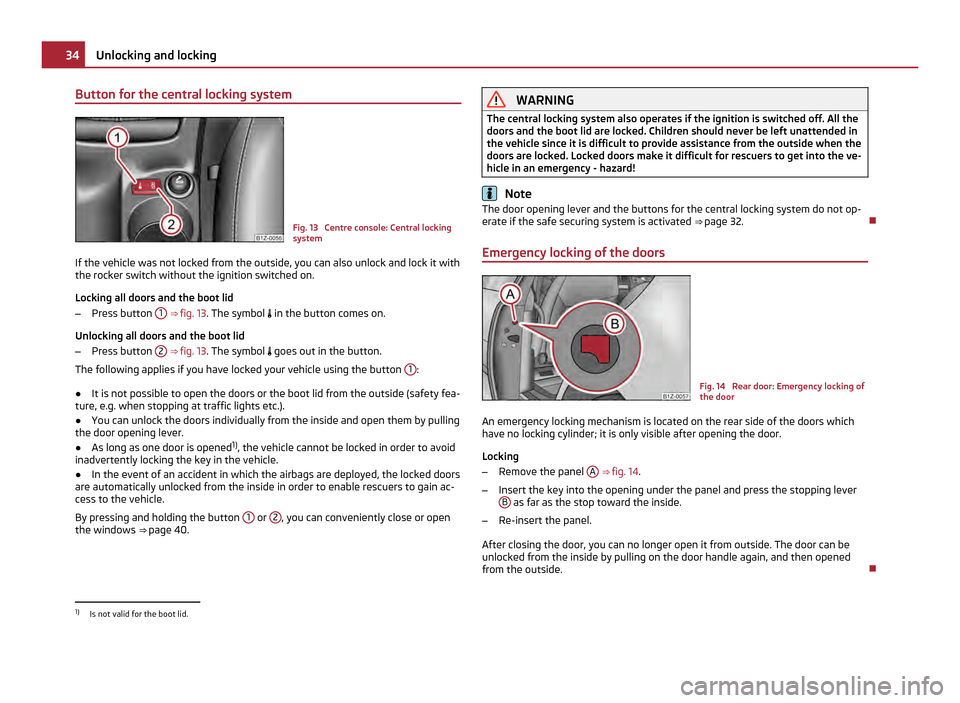
Button for the central locking system
Fig. 13 Centre console: Central locking
system
If the vehicle was not locked from the outside, you can also unlock and lock it with
the rocker switch without the ignition switched on.
Locking all doors and the boot lid
– Press button 1
⇒ fig. 13 . The symbol in the button comes on.
Unlocking all doors and the boot lid
– Press button 2
⇒
fig. 13 . The symbol goes out in the button.
The following applies if you have locked your vehicle using the button 1 :
● It is not possible to open the doors or the boot lid from the outside (safety fea-
ture, e.g. when stopping at traffic lights etc.).
● You can unlock the doors individually from the inside and open them by pulling
the door opening lever.
● As long as one door is opened 1)
, the vehicle cannot be locked in order to avoid
inadvertently locking the key in the vehicle.
● In the event of an accident in which the airbags are deployed, the locked doors
are automatically unlocked from the inside in order to enable rescuers to gain ac-
cess to the vehicle.
By pressing and holding the button 1 or
2 , you can conveniently close or open
the windows ⇒ page 40. WARNING
The central locking system also operates if the ignition is switched off. All the
doors and the boot lid are locked. Children should never be left unattended in
the vehicle since it is difficult to provide assistance from the outside when the
doors are locked. Locked doors make it difficult for rescuers to get into the ve-
hicle in an emergency - hazard! Note
The door opening lever and the buttons for the central locking system do not op-
erate if the safe securing system is activated ⇒ page 32.
Emergency locking of the doors Fig. 14 Rear door: Emergency locking of
the door
An emergency locking mechanism is located on the rear side of the doors which
have no locking cylinder; it is only visible after opening the door.
Locking
– Remove the panel A
⇒ fig. 14 .
– Insert the key into the opening under the panel and press the stopping lever
B as far as the stop toward the inside.
– Re-insert the panel.
After closing the door, you can no longer open it from outside. The door can be
unlocked from the inside by pulling on the door handle again, and then opened
from the outside. 1)
Is not valid for the boot lid. 34
Unlocking and locking
Page 39 of 248
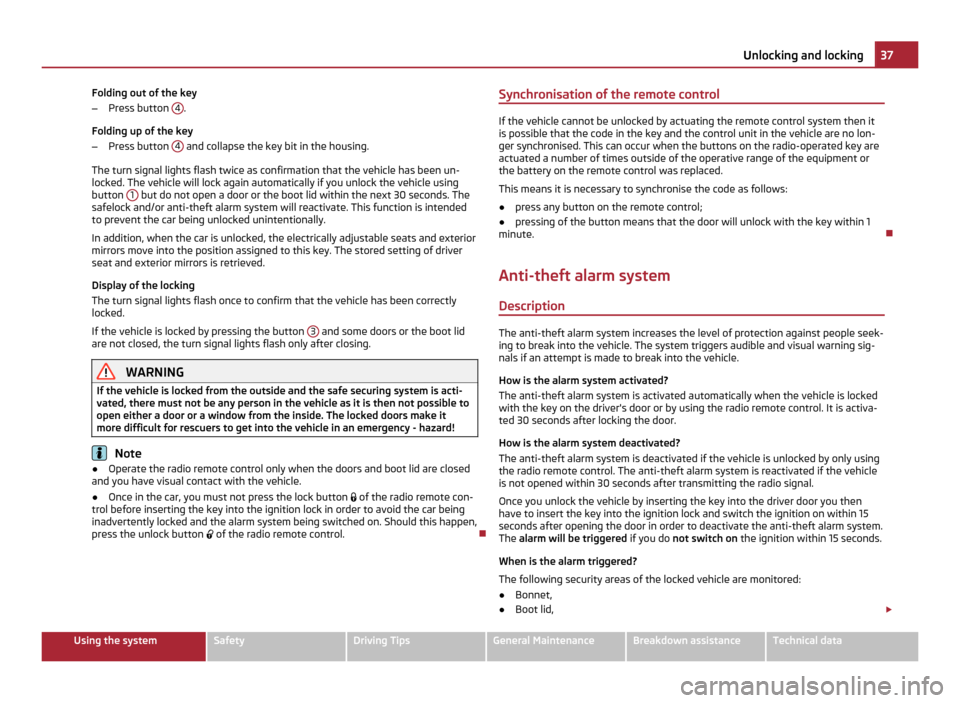
Folding out of the key
–
Press button 4 .
Folding up of the key
– Press button 4 and collapse the key bit in the housing.
The turn signal lights flash twice as confirmation that the vehicle has been un-
locked. The vehicle will lock again automatically if you unlock the vehicle using
button 1 but do not open a door or the boot lid within the next 30 seconds. The
safelock and/or anti-theft alarm system will reactivate. This function is intended
to prevent the car being unlocked unintentionally.
In addition, when the car is unlocked, the electrically adjustable seats and exterior
mirrors move into the position assigned to this key. The stored setting of driver
seat and exterior mirrors is retrieved.
Display of the locking
The turn signal lights flash once to confirm that the vehicle has been correctly
locked.
If the vehicle is locked by pressing the button 3 and some doors or the boot lid
are not closed, the turn signal lights flash only after closing. WARNING
If the vehicle is locked from the outside and the safe securing system is acti-
vated, there must not be any person in the vehicle as it is then not possible to
open either a door or a window from the inside. The locked doors make it
more difficult for rescuers to get into the vehicle in an emergency - hazard! Note
● Operate the radio remote control only when the doors and boot lid are closed
and you have visual contact with the vehicle.
● Once in the car, you must not press the lock button of the radio remote con-
trol before inserting the key into the ignition lock in order to avoid the car being
inadvertently locked and the alarm system being switched on. Should this happen,
press the unlock button of the radio remote control. Synchronisation of the remote control If the vehicle cannot be unlocked by actuating the remote control system then it
is possible that the code in the key and the control unit in the vehicle are no lon-
ger synchronised. This can occur when the buttons on the radio-operated key are
actuated a number of times outside of the operative range of the equipment or
the battery on the remote control was replaced.
This means it is necessary to synchronise the code as follows:
● press any button on the remote control;
● pressing of the button means that the door will unlock with the key within 1
minute.
Anti-theft alarm system
Description The anti-theft alarm system increases the level of protection against people seek-
ing to break into the vehicle. The system triggers audible and visual warning sig-
nals if an attempt is made to break into the vehicle.
How is the alarm system activated?
The anti-theft alarm system is activated automatically when the vehicle is locked
with the key on the driver's door or by using the radio remote control. It is activa-
ted 30 seconds after locking the door.
How is the alarm system deactivated?
The anti-theft alarm system is deactivated if the vehicle is unlocked by only using
the radio remote control. The anti-theft alarm system is reactivated if the vehicle
is not opened within 30 seconds after transmitting the radio signal.
Once you unlock the vehicle by inserting the key into the driver door you then
have to insert the key into the ignition lock and switch the ignition on within 15
seconds after opening the door in order to deactivate the anti-theft alarm system.
The alarm will be triggered if you do not switch on the ignition within 15 seconds.
When is the alarm triggered?
The following security areas of the locked vehicle are monitored:
● Bonnet,
● Boot lid, £ 37
Unlocking and locking Using the system Safety Driving Tips General Maintenance Breakdown assistance Technical data
Page 41 of 248

–
Additionally you can open the window automatically (fully opened) by pressing
the button up to the stop. Renewed pressing of the button causes the window
to stop immediately.
Closing a window
– A window is closed through pulling lightly on the respective button in the
door. The closing process stops when one releases the button.
– Additionally you can close the window automatically (fully closed) by pulling
the button up to the stop. Renewed pulling of the button causes the window
to stop immediately.
The buttons for the individual windows are located in the armrest of the driver's
door ⇒
fig. 20, front passenger seat and in the rear doors ⇒ page 40.
Buttons for the power windows in the armrest for the driver A Button for the power window in the driver's door
B Button for the power window in the front passenger's door
C Button for the power window at the rear right door
D Button for the power window at the rear left door
S Safety switch
Safety pushbutton
You can deactivate the buttons for power windows at rear doors by pressing the
safety pushbutton S
⇒ fig. 20 . The buttons for power windows at rear doors are
activated again by pressing the safety pushbutton S again.
If the buttons for the rear doors are deactivated, the indicator light in the safe-
ty switch S lights up. WARNING
● If you lock the vehicle from the outside, do not leave any person in the ve-
hicle since it is no longer possible to open the windows from the inside in an
emergency.
● The system is fitted with a force limiter ⇒ page 40
. If there is an obstacle,
the closing process is stopped and the window goes down by several centime-
tres. You should then take particular care when closing the windows! You may
otherwise suffer severe injuries as a result of getting an arm, for example,
jammed in the window!
● It is recommended to deactivate the electrically operated power windows
in the rear doors (safety pushbutton) S ⇒
fig. 20 when children are being
transported on the rear seats. CAUTION
● Keep the window glass clean to ensure correct function of the electric win-
dows.
● In the event of a freezing up of the windscreen, first of all eliminate the ice
⇒
page 172 and then operate the power windows otherwise the power window
mechanism could be damaged. Note
● After switching the ignition off, it is still possible to open or close the windows
for a further 10 minutes. During this time the automatic closing and opening func-
tions of the window will operate. The power windows are switched off completely
once you open the driver or front passenger door.
● When driving always use the existing heating, air conditioning and ventilation
system for ventilating the interior of the vehicle. If the windows are opened, dust
as well as other dirt can get into the vehicle and in addition the wind noise is more
at certain speeds. 39
Unlocking and locking Using the system Safety Driving Tips General Maintenance Breakdown assistance Technical data
Page 46 of 248

Lights and Visibility
Lights
Switching lights on and off Fig. 24 Dash panel: Light switch
Switching on side lights
– Turn the light switch ⇒ fig. 24 into position .
Switching on the low beam and main beam
– Turn the light switch into position .
– Push the main beam lever slightly forward in the spring-tensioned position in
order to switch on the main beam ⇒ fig. 30 .
Switching off lights (except daylight driving lights)
– Turn the light switch into position.
The dipped beam continues to shine while the ignition is switched on and the
light switch is in the position or . After switching off the ignition, the low
beam is switched off automatically and only the side lights come on. The parking
light also goes out after the ignition key is removed.
On vehicles with separate lights for daylight driving lights in the fog lights or in
the front bumper, the low beam does not light up when the light switch is in posi-
tion 0 even if the ignition is switched on.
On models fitted with right-hand steering the position of certain switches differs
from that shown in ⇒
fig. 24. The symbols which mark the switch positions are
identical, however. WARNING
Never drive with only the side lights on - risk of accident! The side lights are
not bright enough to light up the road sufficiently in front of you or to be seen
by other oncoming traffic. In this case, always switch on the low beam when it
is dark or if visibility is poor. Note
● If the light switch is in the position , the ignition key is removed and the
driver's door is open, an acoustic warning signal will sound. The acoustic warning
signal is switched off over the door contact when the driver's door is closed (igni-
tion off). The vehicle can be parked with the side lights on.
● If the light switch is in the position and the ignition key is removed, the
lights will go out.
● If the car is parked for a lengthy period, we recommend switching off all lights,
or leaving only the parking lights switched on.
● The switching on of the described lights should only be undertaken in accord-
ance with the legal requirements.
● If a fault occurs in the light switch, the low beam comes on automatically
● In the event of cool or humid weather conditions, the headlights can be misted
up from inside.
–The temperature difference between interior and external area of the head-
light lenses is decisive.
– When the driving lights are switched on, the light outlet surfaces are free
from mist after a short period. The headlight lenses can possibly mist up at the
border areas.
– It also concerns reverse light and turn signal lights.
– This mist has no influence on the life of the lighting system.
“DAY LIGHT” Switching on daylight driving lights
–
Switch on the ignition without turning the light switch out of the position 0 or
. £44
Lights and Visibility
Page 48 of 248

Rain lights
If you switch on the windscreen wipe in the operation rain sensor for longer than
10 seconds or in the operation permanent wipe (position
2 or 3) ⇒ page 53
switching on for longer than 15 seconds, the side lights and low beam are switch-
ed on automatically. The light switches off if the windscreen wipe is in operation
rain sensor for more than around 4 minutes or is not switched on in the operation
permanent wipe. WARNING
The automatic light control only operates as a support. The driver is not re-
leased from his responsibility to inspect the light and if necessary to switch on
the light depending on the light conditions. The light sensor cannot detect for
example rain or snow. For these conditions we recommend to switch on the
low beam ! Note
● Do not affix any stickers in front of the light sensor, so that you do not impair
its function or put it out of operation.
● The same principles as for using the automatic light control also apply to the
light which is switched on manually ⇒
page 44.
Cornering lights The cornering lights are used to illuminate the curves by means of the cone of
light swivelling together with the front headlight with Xenon lights. This function
is active when the speed of the car increases to more than 10
km/h.
The swivelling function of the headlights can be switched off/on via the menu
point Assistants in the main menu of the information display ⇒ page 18.WARNING
If the cornering lights are defective, the headlights are automatically lowered
to the emergency position, which prevents a possible dazzling of oncoming
traffic. Thus the illuminated length of the road is shortened. Drive carefully
and have the car inspected immediately by a specialist garage. Parking light Parking light
– Switch off the ignition.
– Pull the turn signal light lever ⇒
fig. 30 upwards or downwards - the parking
light on the right and left side of the vehicle will be switched on respectively.
The parking light only operates if the ignition is switched off.
If you have switched on the right or left turn signal light and you switch off the
ignition, the parking light is not automatically switched on.
Parking light on both sides
– Turn the light switch into the position and lock the vehicle.
Coming Home Function The function makes it possible to switch on the lights in the darkness for a short
time after leaving the vehicle.
Switching on Coming Home Function
– The light switch is in the position automatic driving lamp control and the
low beam illuminates.
– Switch off the ignition.
– After opening the driver's door, the function Coming Home is switched on.
– Close all the doors and the boot lid and lock the vehicle. After a short time,
switch all lights off.
Depending on equipment fitted the function Coming Home switches on the fol-
lowing lights:
● Parking lights,
● Low beam,
● Entry lighting in the exterior mirrors,
● Licence plate light.
Coming Home Function
The lights go out 10 seconds after closing all the doors and the boot lid.
If a door or the boot lid remains open, the lights go out 60 seconds after switching
off the ignition. £46
Lights and Visibility
Page 50 of 248

The warning light
lights up in the instrument cluster when the fog lights are
switched on ⇒
page 21.
Fog lights with the function “CORNER” The fog lights with the function “CORNER” are designed for a bet-
ter illumination of the surrounding area near the vehicle when
corning, parking etc.
The fog lights with the function
“CORNER” are adjusted according to the steering
angle or after switching on the turn signal light 1)
in the following circumstances:
● the vehicle is stationary and the engine is running or it moves with a speed of
maximum 40 km/h;
● the daylight driving lights are not switched on;
● the low beam is switched on or the light switch is in the position
and the
intensity of the ambient light causes the low beam to be switched on;
● the fog lights are not switched on;
● no reverse gear is engaged. Note
If you engage the reverse gear during the active function “CORNER”, both fog
lights illuminate.
Rear fog light Switching on the rear fog light
–
First of all turn the light switch into position or ⇒
fig. 26 .
– Pull the switch into position 2 .
The warning light
lights up in the instrument cluster when the rear fog light is
switched on ⇒ page 21.
Only the rear fog light of the trailer lights up if the vehicle has a factory-fitted
towing device or a towing device from ŠKODA original accessories and when you
are towing a trailer which is fitted with the rear fog light. The rear fog light is located in the rear light array on the driver's side. CAUTION
The rear fog light should only be switched on if visibility is particularly poor (con-
form with any varying legal provisions) to avoid dazzling vehicles behind your ve-
hicle.
Instrument lighting You can adjust the brightness of the instrument lighting.
Fig. 27 Dash panel: Instrument lighting
Instrument lighting
– Switch on the light.
– Turn the control dial ⇒
fig. 27 to the desired intensity of the instrument light-
ing.
The illumination intensity of the Information display ⇒ page 17 is set automatically.
It is only possible to adjust the instrument lighting with the control dial if the light
intensity drops below the set value of the light sensor. 1)
If both switch on versions are conflicting, for example if the steering wheel is turned to the left and
the right turn signal light is switched on, the turn signal light has the higher priority. 48
Lights and Visibility
Page 51 of 248

Headlamp range adjustment
Once the low beam is switched on you can then adapt the range of
the headlights to the load of the vehicle. Fig. 28 Dash panel: Lights and Visibility
– Turn the control dial ⇒ fig. 28 until you have adjusted the low beam so that
oncoming traffic is not dazzled.
Settings
The positions correspond approximately to the following vehicle loads: Front seats occupied, luggage compartment empty.
All seats occupied, luggage compartment empty.
All seats occupied, luggage compartment laden.
Driver seat occupied, luggage compartment laden. CAUTION
Headlamp range adjustment should always be adjusted in a way that:
● it does not dazzle other road users, especially oncoming traffic,
● and the range is sufficient for safe driving. Note
Headlights fitted with Xenon bulbs adapt automatically to the load and driving
state of the vehicle (e.g. accelerating, braking) when the ignition is switched on
and when driving. Vehicles which are equipped with Xenon bulbs do not have a
manual headlight range adjustment control.
- 1
2
3 Switch for hazard warning lights
Fig. 29 Dash panel: Switch for hazard
warning lights
– Press switch ⇒ fig. 29 to switch the hazard warning light system on or off.
All the turn signal lights on the vehicle flash at the same time when the hazard
warning light system is switched on. The indicator light for the turn signals and
the indicator light in the switch also flash at the same time. You can also switch
on the hazard warning light system if the ignition is switched off.
The hazard warning light system is switched on automatically if an airbag is de-
ployed in the event of an accident.
Please comply with any legal requirements when using the hazard warning light
system. Note
Switch on the hazard warning light system if, for example:
● you encounter traffic congestion;
● your vehicle breaks down or an emergency situation occurs. 49
Lights and Visibility Using the system Safety Driving Tips General Maintenance Breakdown assistance Technical data
Page 52 of 248

The turn signal
and main beam lever The parking lights and headlight flasher are also switched on and
off using the turn signal and main beam lever.
Fig. 30 Turn signal and main beam lever
The turn signal and main beam lever perform the following functions:
Right and left turn signal light
– Push the lever upwards A or downwards
⇒ fig. 30 B .
– If you only wish to flash three times (the so-called convenience turn signal),
push the lever briefly up to the upper or lower pressure point and release it.
This function can be activated/deactivated in the Information display
⇒ page 17.
– Turn signal for changing lanes - in order to only flash briefly, move the lever up
or down to the pressure point and hold it in this position.
Main beam
– Switch on the low beam.
– Push the lever forwards in direction of arrow C (spring-tensioned position).
– If you push the lever towards the steering wheel in direction of arrow D(spring-tensioned position) the main beam is switched off.
Headlight flasher
– Pull the lever towards the steering wheel (spring-tensioned position) in direc-
tion of arrow D - the main beam and warning light
in the instrument clus-
ter come on.
Parking light
For a description of the operation, see ⇒ page 46
, Parking light. Information concerning the function of the lights.
● The turn signal system only operates when the ignition is switched on. The
corresponding warning light or in the instrument cluster also flashes.
● The turn signal is automatically cancelled after negotiating a curve.
● The indicator light flashes at twice its normal rate if a bulb of the turn signal
light fails. CAUTION
Use main beam or the headlight flasher only if this does not risk dazzling other
road users. Note
Use only in accordance with the legal requirements the described lighting and sig-
nal systems.
Interior lighting Interior vehicle lighting - Variant 1 Fig. 31 Interior vehicle lighting - Variant
1
Switching on the interior lighting
– Press switch A towards the edge of the light, the symbol
⇒
fig. 31 appears.
Switching off the interior lighting
– Press the switch A into the middle position
O.
Operating the lights with the door contact switch
– Press switch A towards the centre of the light, the symbol
appears. £50
Lights and Visibility