2011 SKODA OCTAVIA Oil
[x] Cancel search: OilPage 187 of 248
Inspecting the coolant level
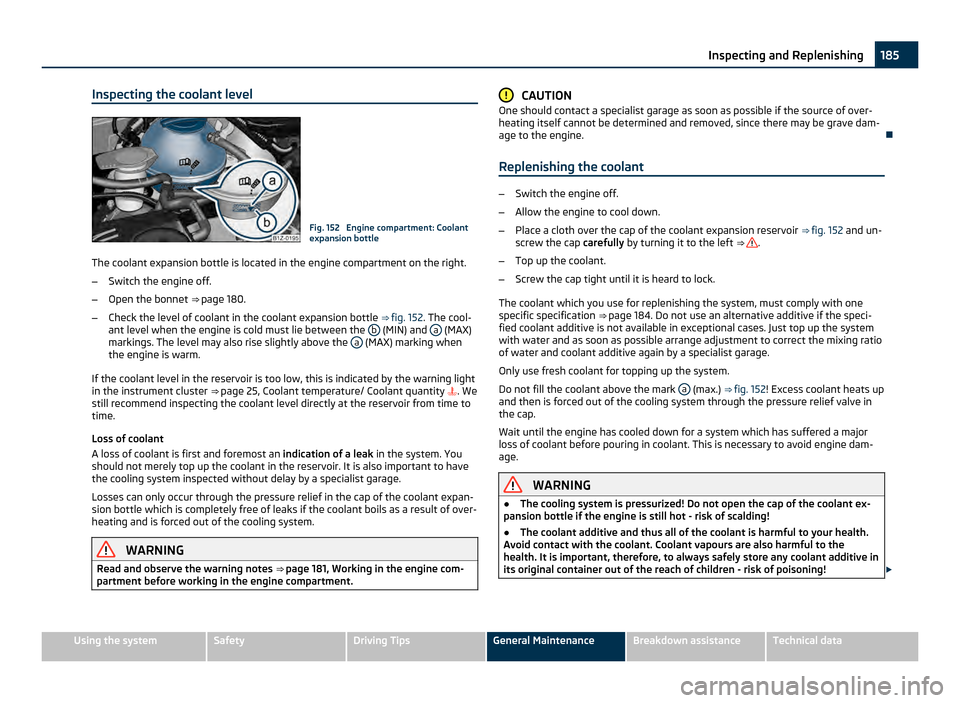
Fig. 152 Engine compartment: Coolant
expansion bottle
The coolant expansion bottle is located in the engine compartment on the right.
– Switch the engine off.
– Open the bonnet ⇒ page 180 .
– Check the level of coolant in the coolant expansion bottle ⇒ fig. 152 . The cool-
ant level when the engine is cold must lie between the b (MIN) and
a (MAX)
markings. The level may also rise slightly above the a (MAX) marking when
the engine is warm.
If the coolant level in the reservoir is too low, this is indicated by the warning light
in the instrument cluster ⇒ page 25, Coolant temperature/ Coolant quantity
. We
still recommend inspecting the coolant level directly at the reservoir from time to
time.
Loss of coolant
A loss of coolant is first and foremost an indication of a leak in the system. You
should not merely top up the coolant in the reservoir. It is also important to have
the cooling system inspected without delay by a specialist garage.
Losses can only occur through the pressure relief in the cap of the coolant expan-
sion bottle which is completely free of leaks if the coolant boils as a result of over-
heating and is forced out of the cooling system. WARNING
Read and observe the warning notes ⇒ page 181, Working in the engine com-
partment
before working in the engine compartment. CAUTION
One should contact a specialist garage as soon as possible if the source of over-
heating itself cannot be determined and removed, since there may be grave dam-
age to the engine.
Replenishing the coolant –
Switch the engine off.
– Allow the engine to cool down.
– Place a cloth over the cap of the coolant expansion reservoir ⇒
fig. 152 and un-
screw the cap carefully by turning it to the left ⇒ .
– Top up the coolant.
– Screw the cap tight until it is heard to lock.
The coolant which you use for replenishing the system, must comply with one
specific specification ⇒ page 184
. Do not use an alternative additive if the speci-
fied coolant additive is not available in exceptional cases. Just top up the system
with water and as soon as possible arrange adjustment to correct the mixing ratio
of water and coolant additive again by a specialist garage.
Only use fresh coolant for topping up the system.
Do not fill the coolant above the mark a (max.)
⇒ fig. 152 ! Excess coolant heats up
and then is forced out of the cooling system through the pressure relief valve in
the cap.
Wait until the engine has cooled down for a system which has suffered a major
loss of coolant before pouring in coolant. This is necessary to avoid engine dam-
age. WARNING
● The cooling system is pressurized! Do not open the cap of the coolant ex-
pansion bottle if the engine is still hot - risk of scalding!
● The coolant additive and thus all of the coolant is harmful to your health.
Avoid contact with the coolant. Coolant vapours are also harmful to the
health. It is important, therefore, to always safely store any coolant additive in
its original container out of the reach of children - risk of poisoning! £ 185
Inspecting and Replenishing Using the system Safety Driving Tips General Maintenance Breakdown assistance Technical data
Page 189 of 248

Replacing brake fluid
Brake fluid absorbs moisture. This causes the fluid to absorb moisture from the
surrounding air over a period of time. Excessive water in the brake fluid may be
the cause of corrosion in the brake system. The water content also lowers the
boiling point of the brake fluid.
Only new genuine brake fluid from
ŠKODA may be used.
The brake fluid must comply with one of the following standards or specifications:
● VW 50114
● FMVSS 116 DOT4
● DIN ISO 4925 CLASS 4
We recommend that you have the brake fluid replaced by an authorised ŠKODA
Service Partner as part of an Inspection Service. WARNING
Using old brake fluid can result in severe stress on the brakes because of the
formation of vapour bubbles in the brake system. This greatly impairs the
braking efficiency and thus also the safety of your vehicle. CAUTION
Brake fluid damages the paintwork of the vehicle. For the sake of the environment
Due to issues with disposal, the special tools and knowledge required, we recom-
mend you have the brake fluid replaced by an authorised ŠKODA Service Partner.
Battery General information Improper handling of the vehicle battery can cause damage. We therefore recom-
mend you have work on the vehicle battery carried out by an authorised
ŠKODA
service partner. There is a risk of injuries, scalding, accidents and burns when carrying out any
work on the battery and on the electrical system. For this reason, it is essential to
comply with the warning instructions ⇒ stated below and with the general ap-
plicable rules of safety. WARNING
● The battery acid is strongly corrosive and must, therefore, be handled with
the greatest of care. Always wear protective gloves, eye and skin protection
when handling batteries. Corrosive fumes in the air irritate the air passages
and lead to conjunctivitis and inflammation of the air passages in the lungs.
Battery acid corrodes dental enamel and creates deep wounds after contact
with the skin which take a long time to heal. Repeated contact with diluted
acids causes skin diseases (inflammations, ulcers, slin cracks). Acids coming in-
to contact with water are diluted accompanied by significant development of
heat.
● Do not tilt the battery otherwise battery electrolyte may flow out of the
battery vent openings. Protect the eyes with safety glasses or a shield! There
is the danger of suffering blindness! If any battery electrolyte gets into your
eye, rinse out your eye immediately with clear water for several minutes. Con-
tact a doctor without delay.
● Splashes of acid on your skin or clothes should be neutralised as soon as
possible using soap suds and then rinsed with plenty of water. If acid was
swallowed, seek immediate medical attention.
● Keep batteries out of the reach of children.
● Hydrogen is released when you charge a battery and a highly explosive gas
mixture is produced. An explosion can be caused through sparkling over dur-
ing unclamping or loosening of the cable plug while the ignition is on.
● Bridging of the poles will create a short circuit (e.g. through metal objects,
cables). Possible consequences of a short circuit: Melting of lead struts, explo-
sion and burning of the battery, jets of acid spurting out.
● It is prohibited to work with a naked flame and light, to smoke or to carry
out any activities which produce sparks. Avoid creating sparks when working
with cables and electrical devices. Strong sparking represents a risk of injury.
● Before carrying out any work on the electrical system, switch off the en-
gine, the ignition as well as all electrical components and disconnect the neg-
ative cable (-) on the battery. If you wish to replace a bulb it is sufficient to
switch off the appropriate light. £ 187
Inspecting and Replenishing Using the system Safety Driving Tips General Maintenance Breakdown assistance Technical data
Page 194 of 248

Wheels and Tyres
Wheels
General information ●
New tyres do not offer optimal grip at first. They should therefore be run in for
about 500 km at a moderate speed and an appropriately cautious style of driving.
You will also profit from longer tyre life.
● The tread depth of new tyres may differ because of design features and the
configuration of the tread (depending on the type of tyre and the manufacturer).
● Drive over curbs on the side of the road and other such obstacles slowly and,
where possible, at a right angle in order to avoid damage to tyres and wheel trims.
● We recommend you Inspect your tyres and rims from time to time for damage
(punctures, cuts, splits and bulges). Remove foreign bodies from the tyre profile.
● Damage to tyres is frequently not visible. Unusual vibrations or pulling of the
vehicle to one side could be a sign of tyre damage. Please reduce your speed im-
mediately and stop if you suspect that a wheel is damaged. Inspect the tyres for
signs of damage (bulges, splits, etc.) If no visible damage is present, please drive
at an appropriately slow speed and carefully to the nearest specialist garage in or-
der to have your vehicle inspected.
● Also protect your tyres from contact with oil, grease and fuel.
● Immediately replace any dust caps of the valves which have got lost.
● Mark wheels before removing them so that their previous direction of running
can be maintained when mounted them again.
● Always store wheels or tyres which been removed in a cool, dry and, where
possible, dark place. Tyres which are not fixed to a wheel trim should be stored
upright.
Unidirectional tyres
The direction of rotation of the tyres is marked by arrows on the wall of the tyre.
This indicates the direction of rotation of the tyre, and it is essential that the tyres
are fitted on to run in this direction. Only then are the tyres able to provide the
optimal properties in terms of grip, low noise, wear-and-tear and aquaplaning.
Further information concerning the use of unidirectional tyres ⇒
page 196. WARNING
● New tyres during the first approximately 500 km do not offer optimal grip
and should therefore be run appropriately - risk of accident!
● Never drive with damaged tyres - risk of accident! Note
Please observe the various differing legal requirements regarding tyres.
Tyre life Fig. 157 An opened fuel filler flap with a
tyre size and tyre inflation pressure ta-
ble
The life of your tyres very much depends on the following points:
Tyre pressure
The working life of tyres will be shortened considerably if the tyres are insuffi-
ciently or over-inflated and this will have an adverse effect on the handling of
your vehicle.
Correctly inflated tyres are of particular importance when travelling at high
speeds . It is therefore good to check the tyre pressure, including that of the spare
wheel, at least once a month and also before setting off on a long trip.
The tyre inflation pressures for summer tyres are indicated on the inside of the
fuel filler flap ⇒ fig. 157. The inflation pressures for winter tyres are 20
kPa
(0.2 bar) higher than those for summer tyres ⇒ page 195. £192
Wheels and Tyres
Page 197 of 248

WARNING
● Only use those tyres or wheel rims which have been approved for your
model of ŠKODA vehicle. Failure to observe this instruction will adversely af-
fect the road safety of your vehicle - risk of accident! Approval and licensing of
your vehicle on public roads may also become void as a result.
● You must on no account drive at a higher speed than is permissible for
your tyres - risk of an accident resulting from tyre damage and loss of control
over your vehicle.
● Tyres which are 6 years old or more should only be fitted in exceptional ca-
ses and when adopting an appropriately cautious style of driving.
● Never fit tyres which have already been used without having adequate
knowledge of their previous history. Tyres age even if they have not been
used at all or only very little. A spare tyre must only be used in exceptional ca-
ses and only then when adopting an appropriately cautious style of driving.
● Do not, where possible, replace individual tyres but at least replace them
on both wheels of a given axle at the same time. Always fit the tyres with the
deeper tread depth to the front wheels. For the sake of the environment
Old tyres must be disposed of in conformity with the appropriate regulations. Note
It is not normally possible to fit wheels from other models of cars for technical
reasons. This may also apply in certain circumstances to the wheels of the same
type of vehicle.
Wheel bolts Wheels and
wheel bolts are matched to each other in terms of design. Each time
you fit other wheels - e.g. light alloy wheels or wheels with winter tyres - you
must therefore also use the matching wheel bolts of the correct length and shape
of spherical cap. This is essential to ensure that the wheels are tightly fitted and
that the brake system operates properly.
If you retrofit wheel trims (or have this done), please also ensure that an ade-
quate flow of air remains assured for cooling the brake system.
Authorised
ŠKODA Service Partners are instructed in the technical possibilities
which exist regarding converting or retrofitting tyres, wheels and wheel trims. WARNING
● In case of incorrect treatment of the wheel bolts, the wheel can loosen
when the car is moving - risk of accident!
● The wheel bolts must be clean and must turn easily. However, they must
never be treated with grease or oil.
● If the wheel bolts are tightened to a too low tightening torque, the rim can
come loose when the car is moving - risk of accident! A tightening torque
which is too high can damage the bolts and threads and this can result in per-
manent deformation of the contact surfaces on the rim. CAUTION
The prescribed tightening torque of the wheel bolts for steel and light alloy
wheels is 120 Nm.
Winter tyres The handling of your vehicle will be significantly improved when driving on wintry
roads if you fit winter tyres. Summer tyres do not offer the same grip on ice, snow
and at temperatures below 7 °C because of their construction (width, rubber
blend, tread pattern). This particularly applies to vehicles which are equipped with
low-profile tyres
or high-speed tyres (code index H or V on wall of tyre).
Winter tyres must be mounted on all four wheels to obtain the best handling
characteristics.
You must only fit those types of winter tyre which are approved for your vehicle.
The permissible sizes of winter tyres are stated in your vehicle documents. Ap-
provals may differ because of national legislation.
Please remember that the tyres should be inflated to 20
kPa (0.2 bar) more than is
the case for summer tyres ⇒ page 192.
Winter tyres no longer offer the same winter performance once the tyre tread has
worn down to a depth of about 4 mm.
Ageing also causes winter tyres to lose most of their winter performance proper-
ties - even in cases where the remaining tread depth is still clearly more than 4
mm.
Speed restrictions apply to winter tyres as well as to summer tyres ⇒ page 194,
⇒ .
£ 195
Wheels and Tyres Using the system Safety Driving Tips General Maintenance Breakdown assistance Technical data
Page 203 of 248

Note
● All bolts must be clean and must turn easily.
● You must never grease or oil the wheel bolts!
● When fitting on unidirectional tyres, ensure that the tyres rotate in the correct
direction ⇒ page 192
.
Subsequent steps After changing the wheel, you must perform the following steps.
–
Stow and attach the replaced wheel in the spare wheel well using a special
screw ⇒ fig. 163 .
– Stow the vehicle tool kit in the space provided.
– Check the tyre pressure on the spare wheel just mounted as soon as possible.
– Have the tightening torque of the wheel bolts checked with a torque wrench
as soon as possible. Steel and light alloy wheels must be tightened to a tight-
ening torque of 120 Nm.
– Change the damaged wheel or consult a specialist garage about possibilities
for getting repairs done. WARNING
It is necessary to observe the guidelines given on ⇒
page 194 if the vehicle is
subsequently fitted with tyres which are different to those it was fitted with
at the works. Note
● If you find, when changing the wheel, that the wheel bolts are corroded and
difficult to turn, the bolts must be replaced before checking the tightening torque.
● Drive cautiously and only at a moderate speed to a workshop where the tight-
ening torque can be checked.
Full wheel trim Pulling off
–
Hook the clamp found in the vehicle tool kit into the reinforced edge of the full
wheel trim. –
Push the wheel key through the clamp, support the wheel key at the tyre and
pull off the wheel trim.
Install
– First press the full wheel trim onto the wheel at the valve opening provided.
Then press the full wheel trim into the wheel in such a way that its entire cir-
cumference locks correctly in place. CAUTION
● Use the pressure of your hand, do not knock on the full wheel trim! Heavy
knocks mainly on the points where the full wheel trim has not been inserted into
the wheel, can result in damage to the guide and centring elements of the full
wheel trim.
● Check for yourself that the safety wheel bolt is located in the hole in the area
of the valve before fitting the full wheel trim onto a steel wheel which is attached
with a safety wheel bolt ⇒
page 203, Securing wheels against being stolen.
Wheel bolts with caps Fig. 164 Removing the cap.
Pulling off
– Push the plastic clip sufficiently far onto the cap until the inner catches of the
clip are positioned at the collar of the cap and detach the cap ⇒ fig. 164 .
Install
– Push the caps fully onto the wheel bolts.
The caps are located in the well of the luggage compartment. 201
Breakdown assistance Using the system Safety Driving Tips General Maintenance Breakdown assistance Technical data
Page 210 of 248

Jump-starting in vehicles with the “START-STOP” system
Fig. 172 Jump-starting on vehicles with
the START-STOP system
On vehicles with the “START STOP” system, the negative cable of the charger
must never be connected directly to the negative pole of the vehicle battery, but
only to the engine earth ⇒ fig. 172.
Towing the vehicle General Vehicles with manual transmission can be towed in with a tow bar or a tow rope
or with the front or rear wheels raised.
Vehicles with automatic transmission can be towed in with a tow bar or a tow
rope or with the front wheels raised. If the vehicle is raised at rear, the automatic
gearbox is damaged!
Vehicles with four-wheel drive can be towed in with a tow bar or a tow rope or
with the front wheels raised.
A tow bar
is safest way of towing a vehicle and also minimizes any shocks. You
can use a tow rope only if a suitable tow bar is not available.
Refer to the following guidelines when towing:
Driver of the towing vehicle
– Release the clutch particularly gently when starting off or depress the acceler-
ator particularly gently if your vehicle is fitted with an automatic gearbox.
– On vehicles with manual transmission, only push down on the accelerator ped-
al once the rope is taught. The maximum towing speed is
50 km/h.
Driver of the towed vehicle
– Switch the ignition on so that the steering wheel is not blocked and you can
also operate the turn signal lights, the headlight flasher, the windscreen wip-
ers and windscreen washer system.
– Take the vehicle out of gear or move the selector lever into position N if your
vehicle is fitted with an automatic gearbox.
Note that the brake servo unit and power steering only operate if the engine is
running. You will require significantly greater physical force to depress the brake
pedal and to steer the vehicle if the engine is not running.
When using a tow rope, always ensure that the tow rope is always kept taught. CAUTION
● Do not tow start the engine - danger of damaging the engine. On vehicles with
a catalytic converter, unburnt fuel may get into the catalytic converter where it
may ignite. This in turn may damage or destroy the catalytic converter. You can
use the battery of another vehicle as a jump-start aid ⇒ page 206, Jump-starting
.
● If the gearbox of your vehicle no longer contains any oil because of a defect,
your vehicle must only be towed in with the driven wheels raised clear of the
ground, or on a special vehicle transporter or trailer.
● The vehicle must be transported on a special vehicle or trailer if it is not possi-
ble to tow in the vehicle in the way described or if the towing distance is greater
than 50
km.
● To protect both vehicles when tow-starting or towing, the tow rope should be
elastic. Thus one should only use plastic fibre rope or a rope made out of a similar-
ly elastic material.
● One should be constantly vigilant not to allow impermissibly high towing
forces or jerky loadings. There is always a risk of excessive stresses and damage
resulting at the points to which you attach the tow rope or tow bar when you at-
tempt to tow a vehicle which is not standing on a paved road.
● Attach the tow rope or the tow bar only to the towing eyes provided for this
purpose ⇒ page 209
, Front towing eye and ⇒ page 210, Rear towing eye. £208
Breakdown assistance
Page 226 of 248

Engine oil specifications
The grade of engine oil should be selected in accordance with pre-
cise specifications.
The engine of your vehicle has been factory-filled with a high-grade oil which you
can use throughout the year - except in extreme climatic regions.
You can mix various oils together with each other when refilling with oil. This does
not, however, apply for models with flexible service intervals (QG1).
Engine oils are, of course, undergoing continuous further development. Thus the
information stated in this Owner's Manual is only correct at the time of publica-
tion.
Authorised
ŠKODA Service Partners will be informed about the latest changes of
ŠKODA. This why you should always have engine oil changed by an authorised
ŠKODA Service Partner.
The specifications (VW standards) stated in the following must be indicated sepa-
rately or together with other specifications on the bottle.
Engine oil specifications for models with flexible service intervals (QG1) Petrol engines Specification Content
a)1.2/77 kW - EU5 VW 504 00 3,6
1.4 ltr./59 kW - EU4 VW 503 00, VW 504 00 3,2
1.4 ltr./90 kW TSI - EU5 VW 503 00, VW 504 00 3,6
1.6 ltr./75 kW - EU4, EU2 VW 503 00, VW 504 00 4,5
1.6 ltr./75 kW MultiFuel - EU4, EU2 VW 503 00, VW 504 00 4,5
1.8 ltr./118 kW TSI - EU5, EU2 DDK
(1.8 ltr./112 kW TSI - EU5)
VW 504 00 4,6
2.0 ltr./147 kW TSI - EU5 VW 504 00 4,6
a)
Oil capacity with oil filter change. Inspect oil level when filling; do not fill up too much. The oil level
must be between the markings ⇒ page 182. Diesel engines Specification Content
a)1.6 l/77 kW TDI CR - EU5 VW 507 00 4,3
1.9 ltr./77 kW TDI PD - EU4, EU3 VW 506 01, VW 507 00 3,8
1.9 ltr./77 kW TDI PD DPF - EU4 VW 507 00 4,3
2.0 ltr./81 kW TDI CR - EU4, EU5 VW 507 00 4,3 Diesel engines Specification Content
a) 2.0 ltr./103 kW TDI CR DPF - EU4, EU5 VW 507 00 4,3
2.0 l/125 kW TDI CR - EU5 VW 507 00 4,3
a)
Oil capacity with oil filter change. Inspect oil level when filling; do not fill up too much. The oil level
must be between the markings ⇒ page 182.
Engine oil specifications for vehicles with fixed service intervals (QG2) Petrol engines Specification Content
a) 1.2/77 kW - EU5 VW 502 00 3,6
1.4 ltr./59 kW - EU4 VW 501 01, VW 502 00 3,2
1.4 ltr./90 kW TSI - EU5 VW 501 01, VW 502 00 3,6
1.6 ltr./75 kW - EU4, EU2 VW 501 01, VW 502 00 4,5
1.6 ltr./75 kW MultiFuel - EU4, EU2 VW 502 00 4,5
1.8 ltr./118 kW TSI - EU5, EU2 DDK
(1.8 ltr./112 kW TSI - EU5)
VW 502 00 4,6
2.0 ltr./147 kW TSI - EU5 VW 502 00 4,6
a)
Oil capacity with oil filter change. Inspect oil level when filling; do not fill up too much. The oil level
must be between the markings ⇒ page 182.
If the oils specified above are not available, oils according to ACEA A2 or ACEA A3
can be used once for refilling. Diesel engines Specification Content
a) 1.6 l/77 kW TDI CR - EU5 VW 507 00 4,3
1.9 ltr./77 kW TDI PD - EU4, EU3 VW 505 01 3,8
1.9 ltr./77 kW TDI PD DPF - EU4 VW 507 00 4,3
2.0 ltr./81 kW TDI CR - EU4, EU5 VW 507 00 4,3
2.0 ltr./103 kW TDI CR DPF - EU4, EU5 VW 507 00 4,3
2.0 l/125 kW TDI CR - EU5 VW 507 00 4,3
a)
Oil capacity with oil filter change. Inspect oil level when filling; do not fill up too much. The oil level
must be between the markings ⇒ page 182.
If the oils specified above are not available, oils according to ACEA B3 or ACEA B4
can be used once for refilling. £224
Technical data
Page 227 of 248

CAUTION
Only the above-mentioned oils may be used on vehicles with flexible service inter-
vals (QG1). We recommend always refilling with oil of the same specification since
this will maintain the properties of the oil. In exceptional cases, you must top up
only once engine oil complying with Specification VW 502 00 (only for petrol en-
gines) or Specification VW 505 01 (only for diesel engines) to maximum 0.5 litres.
You must not use other engine oils - risk of engine damage! Note
● Before a long drive we recommend that you purchase and carry with you en-
gine oil which complies with the specification for your vehicle. Consequently, you
will always have the correct engine oil for refilling.
● We recommend using oils from the ŠKODA Original Accessories.
● For further information - see Service schedule. 225
Technical data Using the system Safety Driving Tips General Maintenance Breakdown assistance Technical data