2011 SKODA FABIA lock
[x] Cancel search: lockPage 134 of 220

Operating principle
The brake pressure will be reduced on a wheel which is rotating at a speed which
is too low for the speed of the vehicle and tending to lock. This control cycle is
noticeable from a
pulsating movement of the brake pedal which is accompanied
by noises. This is consciously intended to provide the driver with the information
that the wheels are tending to lock (ABS control range). You must always keep the
brake pedal depressed to enable the ABS to optimally control the brake applica-
tion in this braking range. Never interrupt the application of the brakes!
As soon as the vehicle speed has increased to about 20 km/hour an automatic
test procedure is conducted during which you will be able to hear a pumping noise
for about 1 second. WARNING
● The ABS can also not overcome the physical limits of your vehicle. Please
do not forget this, particularly when driving on icy or wet road surfaces. If the
ABS is operating within the control range, adapt your speed immediately to
the conditions of the road surface and the traffic situation. The increased
safety offered by the ABS must not tempt you to take greater risks than oth-
erwise - risk of an accident!
● The normal braking system is still fully functional if there is an ABS fault.
Visit a specialist garage immediately and adjust your style of driving according
to the damage to the ABS as you will not know how great the damage is and
the limitation it is placing on the braking efficiency. Note
● A warning light comes on if a fault occurs in the ABS system ⇒ page 25.
● Changes to vehicle (e.g. on engine, on the brakes, on chassis or another combi-
nation of tyres and wheels) can influence the function of the ABS ⇒ page 169
,
Accessories, changes and replacement of parts.
Brake Assist During a severe brake application (e.g. if a hazard exists), the Brake Assist increa-
ses the braking force and thus makes it possible to rapidly produce the pressure
required in the brake system. The majority of drivers do apply the brakes in good time in dangerous situations,
but do not depress the brake pedal with sufficient pressure. Consequently, it is
not possible for the car to achieve its maximum deceleration and the car covers a
greater distance than necessary.
The Brake Assist is activated by the very quick operation of the brake pedal. In
such cases, a much greater braking pressure exists than during a normal brake ap-
plication. This makes it possible, even with a relatively low resistance of the brake
pedal, to produce an adequate pressure in the brake system in the shortest possi-
ble time, which is required for maximum deceleration of the car. You must apply
the brake pedal firmly and hold it in this position in order to achieve the shortest
possible braking distance.
The Brake Assist is able to help you achieve a shorter braking distance in emer-
gency situations by rapidly producing the pressure required in the brake system. It
fully exploits the attributes of the ABS. After you release the brake pedal, the
function of the Brake Assist is automatically switched off and the brakes operate
in the normal way.
WARNING
● The Brake Assist is also not able to overcome the physical limits of your car
in terms of the braking distance required.
● Adapt your speed to the conditions of the road surface and to the traffic
situation.
● The increased safety offered by the Brake Assist must not tempt you to
take a greater safety risk than otherwise.
● If a fault occurs in the ESP, the Brake Assist function is also deactivated
Further information on the ESP ⇒ page 128.
Uphill Start Assist The uphill start assist makes it easier to start off on steep hills. The system assists
a start off by holding the brake pressure produced by the brake pedal actuation
for approx. 2 seconds after releasing the brake pedal. The driver can therefore
move his foot from the brake pedal to the accelerator pedal and start off on the
slope, without having to actuate the handbrake. The brake pressure drops gradu-
ally the more you operate the accelerator pedal. If the vehicle does not start off
within 2 seconds, it starts to roll back.
£132
Intelligent Technology
Page 135 of 220
The uphill start assist is active as of a 3 % slope, if the driver door is closed. It is
always active on slopes when in forward or reverse start off. When driving down-
hill, it is inactive.
Electrohydraulic power steering The power steering enables you to steer the vehicle with less physical force.
The steering characteristics can be changed by a specialist garage.
You will place great stresses on the power steering system if the steering is
turned to full lock when the vehicle is stationary. Turning the steering to full lock
in such a situation will be accompanied by noises.
It is still possible to fully steer the vehicle if the power steering fails or if the en-
gine is not running (vehicle being towed in). The only difference is that greater
physical effort is required.
It is possible that the hydraulic pump of the power steering will not run due to the
low vehicle network voltage if the battery has gone flat and the engine must star-
ted with the help off jump leads. This condition will be indicated by lighting up of
the warning light.
The power steering operates again if the battery is charged to a specific range
when engine is running. It also operates again, if the engine can be started with
its own battery.
If there is a fault in the power steering, the warning light lights up in the instru-
ment cluster
⇒ page 20. WARNING
Contact your specialist garage if the power steering is defective. CAUTION
Never leave the steering wheel at full lock for more than 15 seconds when the en-
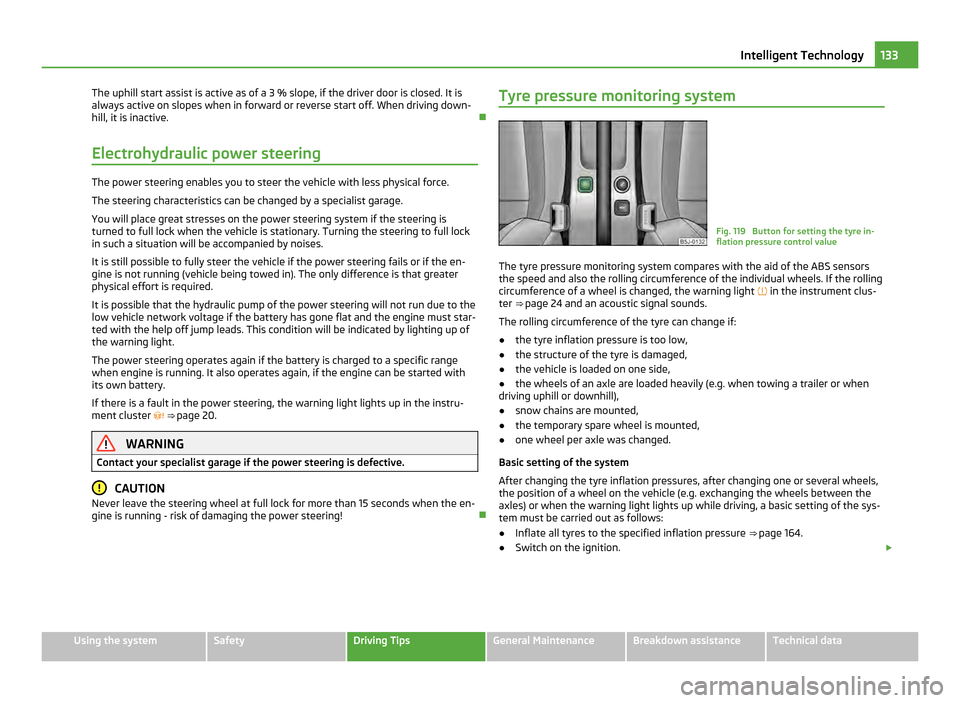
gine is running - risk of damaging the power steering! Tyre pressure monitoring system Fig. 119 Button for setting the tyre in-
flation pressure control value
The tyre pressure monitoring system compares with the aid of the ABS sensors
the speed and also the rolling circumference of the individual wheels. If the rolling
circumference of a wheel is changed, the warning light in the instrument clus-
ter ⇒ page 24 and an acoustic signal sounds.
The rolling circumference of the tyre can change if:
● the tyre inflation pressure is too low,
● the structure of the tyre is damaged,
● the vehicle is loaded on one side,
● the wheels of an axle are loaded heavily (e.g. when towing a trailer or when
driving uphill or downhill),
● snow chains are mounted,
● the temporary spare wheel is mounted,
● one wheel per axle was changed.
Basic setting of the system
After changing the tyre inflation pressures, after changing one or several wheels,
the position of a wheel on the vehicle (e.g. exchanging the wheels between the
axles) or when the warning light lights up while driving, a basic setting of the sys-
tem must be carried out as follows:
● Inflate all tyres to the specified inflation pressure ⇒ page 164.
● Switch on the ignition. £ 133
Intelligent Technology Using the system Safety Driving Tips General Maintenance Breakdown assistance Technical data
Page 145 of 220

Driving Tips
–
Do not, as far as possible, drive with your vehicle unladen and the trailer laden.
– Do not make full use of the legal maximum speeds. This applies in particular to
downhill sections.
– Apply the brakes in good time.
– Keep a check on the coolant temperature gauge if the outside temperature is
high.
Distribution of weight
The distribution of the weight is very poor if your vehicle is unladen and the trailer
is laden. Maintain a particularly low speed if you cannot avoid driving with this
combination.
Driving speed
Do not drive faster than 80 km/h for safety reasons. This also applies for countries
in which higher speeds are allowed.
The fact that the driving stability of the vehicle + trailer combination reduces with
increasing speed means that the legally allowed speed should not be used when
there are unfavourable road, weather or wind conditions, particularly near acci-
dent black spots.
You must always reduce your speed immediately as soon as you detect even just
the slightest swaying
of the trailer. On no account attempt to stop the trailer
from “swaying” by accelerating.
Apply the brakes in good time! If the trailer is fitted with a trailer brake, apply the
brakes gently at first and then brake firmly. This will avoid brake jolts resulting
from the trailer wheels locking. Shift down gears in good time before negotiating
a downhill section to allow the engine to also act as a brake.
Engine overheating
Please keep a check on the coolant temperature gauge if you have to negotiate a
lengthy slope in a low gear at a high engine speed when the outside temperature
is very high ⇒ page 11.
If the needle of the coolant temperature gauge moves into the right-hand area or
even the red area of the scale, reduce your speed immediately. Stop and switch
off the engine if the warning light in the instrument cluster begins flashing.
Wait a few minutes and check the level of coolant in the coolant expansion bottle
⇒ page 157, Inspecting the coolant level. Please refer to the following guidelines
⇒ page 23
, Coolant temperature/ Coolant
quantity .
The coolant temperature can be reduced by switching on the heating.
Any increase in the cooling effect of the coolant fan through shifting down a gear
and increasing the engine speed is not possible since the fan speed is independ-
ent of the engine speed. One should also not drop a gear for this reason when
towing a trailer as long as the engine can manage the slope without any drop in
speed. 143
Towing a trailer Using the system Safety Driving Tips General Maintenance Breakdown assistance Technical data
Page 147 of 220

Automatic vehicle wash systems
The paintwork of the vehicle is sufficiently resistant that the vehicle can be wash-
ed normally in automatic vehicle wash plants without any problem. The actual
stress to which the paintwork is subjected, however, depends greatly on the de-
sign of the vehicle wash system, the filtering of the water and the type of wash-
ing and care products used. If the paintwork of your vehicle appears mat after be-
ing washed or even has scratches, point this out to the operator of the vehicle
wash plant. Use a different vehicle wash plant, if necessary.
There are no particular points to note before washing your vehicle in an automatic
vehicle wash system other than the usual precautionary measures (closing the
windows, unscrewing the aerial, etc.).
If you have any particular attached parts fitted to your car - such as spoiler, roof
rack system, two-way radio aerial - it is best to first of all consult the operator of
the car wash plant.
It is important to degrease the lips of the windscreen wiper rubbers after passing
through the automatic vehicle wash system.
Washing vehicle by hand It is important to first soften the dirt with plenty of water and rinse it off as thor-
oughly as possible before washing your vehicle by hand.
One should then clean the vehicle using a soft
washing sponge, washing glove or
a washing brush and only slight pressure. Work from the top to the bottom - be-
ginning with the roof. Only place slight pressure on the vehicle paintwork during
cleaning Only use a car shampoo for stubborn dirt.
Wash out the sponge or washing glove thoroughly at short intervals.
Clean wheels, door sills and similar parts last. Use a second sponge for such areas.
Rinse off the vehicle well after giving it a wash and dry it off using a chamois
leather. WARNING
● The ignition should always be switched off when you wash your vehicle -
risk of accident!
● Protect your hands and arms from sharp-edged metal parts when you are
cleaning the underfloor, the inside of the wheel housings or the wheel trims -
risk of cuts. CAUTION
● Do not wash your vehicle in bright sunlight - risk of paint damage.
● Ensure that the jet of water is not aimed directly at the locking cylinders or at
the door and panel joints if you spray your vehicle in winter down with a hose -
risk of freezing.
● Do not use any insect sponges, rough kitchen sponges or similar cleaning
products - risk of damage to the surface of paintwork. For the sake of the environment
Only wash your vehicle at washing bays specifically reserved for this purpose. This
ensures that no water which may be contaminated by oil flows into the sewage
system. It is not even permitted to wash your vehicle in certain areas except at
such specific washing bays.
Washing with a high-pressure cleaner When you wash your vehicle with a high-pressure cleaner, it is essential to comply
with the instructions for use of the cleaning equipment. This applies in particular
to the pressure
used and to the spraying distance. Maintain a sufficiently large
distance to soft materials such as rubber hoses or insulation material.
On no account use circular spray nozzles or so-called dirt cutters! WARNING
It is particularly important that you do not clean tyres with circular spray jets.
Damage may occur even at a relatively large spraying distance and if sprayed
only for a short time. CAUTION
The wash water must be no hotter than 60 °C, otherwise the vehicle can be dam-
aged.
Wax treatment Good wax treatment is an effective way of protecting the paintwork from harmful
environmental influences and minor mechanical damage.
The vehicle must be treated with a high-quality hard wax polish at the latest,
when no more drops form on the clean paintwork.
£ 145
Taking care of your vehicle and cleaning the vehicle Using the system Safety Driving Tips General Maintenance Breakdown assistance Technical data
Page 149 of 220

The headlight lenses
Please do not use any aggressive cleaning or chemical solvent products for clean-
ing the front headlights - risk of damage to the plastic lenses.
Please use soap
and clean warm water. CAUTION
Never wipe the headlights dry and do not use any sharp objects for cleaning the
plastic lenses, this may result in damage to the protective paintwork and conse-
quently in formation of cracks on the headlight lenses, e.g. through effect of
chemical products.
Door and window seals The rubber seals on the doors, boot lid, bonnet and windows remain supple and
last longer if you treat them regularly with a rubber care product (e.
g. with a spray
with silicone-free oil). You also avoid premature wear of the seals and prevent
leakages in this way. It is also easier to open the doors. Rubber seals which are
well cared for also do not stick together in cold winter weather.
Locking cylinder Use specific products for de-icing locking cylinders.
Note
When washing your vehicle, ensure that as little water as possible gets into the
locking cylinders.
Wheels Steel wheels
You should also thoroughly wash the wheels and wheel trims when giving your
vehicle its regular wash. This prevents any brake dust, dirt and road salt from
sticking to the wheel hubs. You can remove stubborn brake abrasion adhering to
the wheels with an industrial cleaner. Touch up any damage to the paintwork on
the wheels before rust is able to form. Light alloy wheels
Regular care of light alloy wheels is necessary in order to retain their decorative
appearance over long periods. It is particularly important to remove regularly any
road salt and brake abrasion from light alloy wheels, otherwise the light metal will
suffer. Wash thoroughly and then treat the wheels with a protective product for
light alloy wheels which does not contain any acidic components. We recommend
to apply a hard wax layer onto the wheel hubs every three months. You must not
use any products which cause abrasion when treating the wheel hubs. Any dam-
age to the paint layer on the wheel hubs must be touched up immediately.
WARNING
One should remember when cleaning the wheels that moisture, ice and road
salt may adversely affect braking efficiency - risk of an accident! Note
Severe layers of dirt on the wheels can also result in wheel imbalance. This may
show itself in the form of a wheel vibration which is transmitted to the steering
wheel which, in certain circumstances, can cause premature wear of the steering.
This means it is necessary to remove the dirt.
Underbody protection The underside of your vehicle is protected for life against chemical and mechanical
influences.
One cannot, however, completely rule out damage to the
protective layer when
driving so we recommend that you inspect the protective layer on the underside
of your vehicle and on the chassis at certain intervals - this is best done at the be-
ginning and end of the winter - and to touch up any damaged areas.
The authorised
ŠKODA Service Partners have suitable spray products available as
well as the necessary equipment and are familiar with the instructions for use.
Therefore, we recommend you have such touch-up work or additional corrosion
protection measures carried out by an authorised ŠKODA Service Partner. WARNING
Never use additional underbody protection or corrosion-protection agents for
the exhaust pipes, catalytic converters, diesel particle filter or heat shields.
When the engine reaches its operating temperature, these substances might
ignite - risk of fire! 147
Taking care of your vehicle and cleaning the vehicle Using the system Safety Driving Tips General Maintenance Breakdown assistance Technical data
Page 151 of 220

CAUTION
● You must on no account treat the leather with solvents (e.g. gasoline, turpen-
tine), floor wax, shoe cream or such like.
● Avoid leaving your vehicle for lengthy periods in bright sunlight in order to
avoid bleaching the leather. If you leave your vehicle parked in the open for
lengthy periods, protect the leather from the direct rays of the sun by covering it
over.
● Sharp-edged objects on items of clothing such as zip fasteners, rivets, sharp-
edged belts may leave permanent scratches or signs of rubbing on the surface.
● The use of a mechanical steering wheel lock may damage the leather surface
of the steering wheel. Note
● Use a care cream with light blocker and impregnation effect regularly and each
time after cleaning the leather. The cream nourishes the leather, allows it to
breathe and keeps it supple and also provides moisture. It also creates surface
protection.
● Clean the leather every 2 to 3 months, remove fresh soiling each time this oc-
curs.
● Remove fresh stains such as those from ball-point pens, ink, lipstick, shoe
cream, etc., as quickly as possible.
● Care also for the leather dye. Refreshen areas which have lost their colour
with a special coloured leather cream as required.
● The leather is a natural material with specific properties. During the use of the
vehicle, minor optical changes can occur on the leather parts of the covers (e. g
wrinkles or creases as a result of the stress of the covers).
Seat belts –
Keep the seat belts clean!
– Wash seat belts which have become soiled using a mild soapy solution.
– Inspect the seat belts regularly to ensure they are in good condition.
Belt webbing which has become severely soiled may prevent the inertia reel from
reeling up the belt properly. WARNING
● The seat belts must not be removed for cleaning.
● Never clean the seat belts chemically as dry cleaning may destroy the fab-
ric. The seat belts must also not be allowed to come into contact with corro-
sive liquids (such as acids etc.).
● Seat belts which have damage to the webbing, the connections, the inertia
reel or the lock should be replaced by a specialist garage.
● Inertia reel belts must be completely dried before being reeled up. 149
Taking care of your vehicle and cleaning the vehicle Using the system Safety Driving Tips General Maintenance Breakdown assistance Technical data
Page 153 of 220

Diesel
Diesel fuel Your vehicle can only be operated with
diesel fuel, which complies with the stand-
ard EN 590 (standard DIN 51628 in Germany, standard ÖNORM C
1590 in Austria,
GOST R 52368-2005/EN 590:2004 in Russia).
Fuel additives
You must not use fuel additives, so-called “flow improvers” (petrol and similar
products) in diesel fuel.
You can find information on refuelling ⇒ page 151, Refuelling.CAUTION
● Your vehicle can only be operated with diesel fuel, which complies with the
standard EN 590 (standard DIN 51628 in Germany, standard ÖNORM C
1590 in
Austria, GOST R 52368-2005/EN 590:2004 in Russia). Filling the tank even only
once with diesel fuel which does not comply with the standard, can result in dam-
age to the engine parts, the lubrication system, the fuel and exhaust system.
● If by mistake you have refuelled with a different fuel other than the diesel fuel
which complies to the above mentioned standards (e. g. petrol), do not start the
engine or switch on the ignition! Severe damage damage is possible! Contact a
specialist garage and have the fuel system of the engine cleaned.
● Water which has collected in the fuel filter can result in engine problems.
● Your vehicle is not adapted for use of biofuel (RME), therefore this fuel must
not be refuelled and driven. The use of biofuel (RME) can lead to damage to the
engine or the fuel system.
Operation in winter Winter-grade diesel fuel
A different grade of diesel fuel is available at filling stations in winter than during
the summer. Using
“
summer-grade diesel fuel” at temperatures below 0°C can re-
sult in operational problems because the diesel becomes viscous as a result of
paraffin separation. It is therefore the case that the standard
EN 590 (standard DIN 51628 in Germany,
standard ÖNORM C 1590
in Austria, GOST R 52368-2005/EN 590:2004 in Russia)
is the diesel fuel class prescribed for certain periods of the year which can also be
purchased at the corresponding time during the year. “Winter-grade diesel fuel”
will still operate properly even at a temperature of -20°C.
It is often the case in countries with different climatic conditions that diesel fuels
available have a different temperature characteristic. The authorised ŠKODA Serv-
ice Partners and filling stations in the country concerned will be able to provide
you with information regarding the diesel fuels available.
Prewarming fuel
The vehicle is fitted with a fuel filter prewarming system. This secures operation
of a vehicle using diesel fuel down to an environmental temperature of -25°C. CAUTION
It is not permitted to add the various fuel additives on the market, including pet-
rol, to diesel fuel in order to improve its flow properties.
Refuelling Fig. 125 Right rear side of the vehicle: Fuel filler flap/fuel filler flap with cap unscrewed
Opening the fuel filler cap
–
Open the fuel filler flap with the hand ⇒ fig. 125
- left.
– Hold the fuel tank cap of the fuel filler tube with one hand and unlock it by
turning with the vehicle key to the left.
– Unscrew the fuel filler cap anti-clockwise and place the fuel filler cap from
above on the fuel filler flap ⇒ fig. 125 - right. £ 151
Fuel Using the system Safety Driving Tips General Maintenance Breakdown assistance Technical data
Page 154 of 220

Closing fuel filler cap
–
Screw on the cap by turning it to the right until it is heard to lock.
– Hold the fuel filler cap on the fuel filler tube with one hand and lock it by turn-
ing the vehicle key to the right and withdraw the key.
– Press the fuel tank flap closed.
The correct grade of fuel for your vehicle as well as the tyre size and inflation
pressures are stated on a sticker affixed to the inside of the fuel filler flap. Further
information on fuel ⇒
page 150.WARNING
Pay attention to any legal requirements if you do carry a spare canister in the
vehicle. We do not recommend carrying any fuel canisters in your vehicle for
safety reasons. The canister can be damaged in the event of an accident and
fuel may leak out. CAUTION
● Remove any fuel which has spilled onto the paintwork of your vehicle immedi-
ately - risk of paint damage!
● On vehicles fitted with a catalytic converter, never let the fuel tank run com-
pletely empty. An irregular supply of fuel to the engine can result in misfiring and
unburnt fuel may get into the exhaust system, which may result in overheating
and damage to the catalytic converter.
● Make sure that the valve is not pressed into the filler tube when inserting the
pump nozzle into the filler tube. Otherwise you are unintentionally filling up the
volume, which in case of heat can cause an expansion of the fuel. This can lead to
an overflow of fuel or damage to parts of the fuel reservoir.
● The fuel tank is full just as soon as the pump nozzle switches off for the first
time, provided the nozzle has been operated properly. Do not continue refuelling -
otherwise the expansion volume is filled up. Note
The fuel tank has a capacity of about 45 litres, containing a reserve of 7 litres.152
Fuel