Page 202 of 278
200Checking and refilling levels
Coolant
Coolant specifications
Coolant is a mixture of water and at least 40% coolant addi-
tive. The cooling system must be filled with a mixture of water and at least 40 %
of our coolant additive G 12++ or an additive with the specification TT-VW
774 G (known for its purple colour). This mixture gives the necessary frost
protection down to -25 °C and protects the alloy parts of the cooling system
against corrosion. It also prevents scaling and raises the boiling point of the
coolant.
The concentration of coolant must always be at least 40% - even if freeze
protection is not required.
If greater freeze protection is required in very cold climates, the proportion
of the antifreeze additive G 12++ can be increased. However, the percent-
age of coolant additives should not exceed 60%, as this would reduce the
freeze protection. It would also reduce the cooling effect. A mixture with
60% coolant additive will give frost protection to approx. -40 °C.
WARNING
● The coolant additive is toxic. There is a toxic risk. Always keep the
coolant additive in the original container which should be stored out of
the reach of children. The same applies to coolant which you have
drained off.
● The coolant additive G 12++ must be added in sufficient quantities to
provide anti-freeze protection at the coldest ambient temperatures that
can be expected. At extremely cold outside temperatures, the coolant
could freeze, causing the vehicle to breakdown. As the heater would not
work either, there is a risk of freezing to death.
CAUTION
● Other additives may give considerably inferior corrosion protection. The
resulting corrosion in the cooling system can lead to a loss of coolant, caus-
ing serious damage to the engine.
● If additive G12++ is not available, this can be mixed with G12+, bearing
in mind that the protection against corrosion will be reduced.
Checking the coolant level and topping up
The correct coolant level is important for fault-free function-
ing of the engine cooling system.
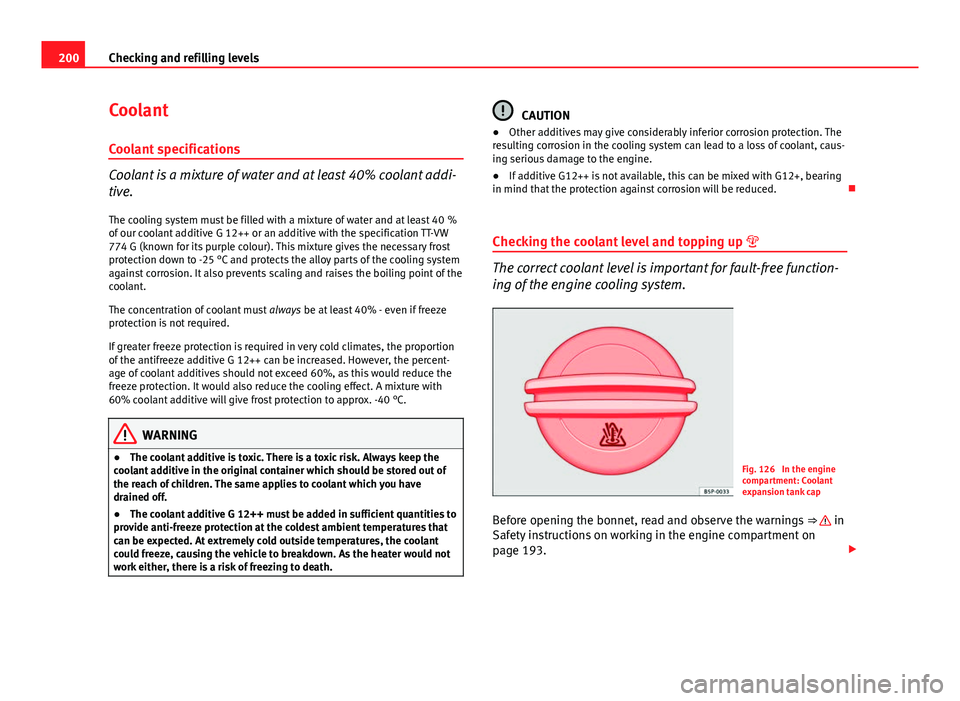
Fig. 126 In the engine
compartment: Coolant
expansion tank cap
Before opening the bonnet, read and observe the warnings ⇒
in
Safety instructions on working in the engine compartment on
page 193.
Page 203 of 278

201
Checking and refilling levels
Opening the coolant expansion tank
– Switch off the engine and allow it to cool.
– To prevent scalding, cover the cap on the expansion tank with a
thick cloth and carefully unscrew the cap ⇒
.
Checking coolant level
– Look into the open coolant expansion tank and read off the
coolant level.
– If the level is below the “MIN” mark, top up with coolant.
Topping up coolant
– Only use new coolant liquid.
– Do not fill above the “MAX” mark.
Closing the coolant expansion tank
– Screw the cap on again tightly.
The position of the coolant expansion reservoir is shown in the correspond-
ing engine compartment illustration ⇒ page 250.
Ensure the coolant conforms to the required specifications. Do not use a dif-
ferent type of additive if additive G 12++ is not available. In this case use
only water and bring the coolant concentration back up to the correct level
as soon as possible by putting in the specified additive.
Always top up with new coolant.
Do not fill above the “MAX” mark. Otherwise the excess coolant will be
forced out of the cooling system when the engine is hot.
The additive G 12++ can be mixed with the G 12+ in any proportion.
WARNING
Any work carried out in the engine compartment or on the engine must
be carried out cautiously.
● When working in the engine compartment, always observe the safety
warnings ⇒ page 193.
● When the engine is warm or hot, the cooling system is pressurised!
Do not unscrew the cap on the expansion tank when the engine is hot.
This is a burn injury risk.
CAUTION
● If you notice a change in the colour of the liquid because it has been in
use for a long time, it is recommended to change it, as it will have lost some
of its properties and could cause damage to the vehicle.
● If a lot of coolant fluid has been lost, wait for the engine to cool down
before putting in cold coolant. This avoids damaging the engine. Large cool-
ant losses are an indication of leaks in the cooling system. See a special-
ised workshop immediately and have the cooling system checked. Other-
wise, there is a risk of engine damage.
Safety FirstOperating InstructionsPractical TipsTechnical Specifications
Page 276 of 278
Vehicle interior heating or cooling system . . . 129
Vehicle modifications . . . . . . . . . . . . . . . . . . . 183
Vehicle paintworkMaintenance . . . . . . . . . . . . . . . . . . . . . . . . 177
Products for vehicle maintenance . . . . . . . 174
Vehicle tools Storage . . . . . . . . . . . . . . . . . . . . . . . . . . . . 215
Vehicle washing . . . . . . . . . . . . . . . . . . . . . . . . 175
Ventilation . . . . . . . . . . . . . . . . . . . . . . . . . . . . 126
Ventilation slits . . . . . . . . . . . . . . . . . . . . . . . . . 17
W Warning lamp . . . . . . . . . . . . . . . . . . . . . . . . . . . 30
Warning lamps . . . . . . . . . . . . . . . . . . . . . . . . . . 61
Warning reports Red . . . . . . . . . . . . . . . . . . . . . . . . . . . . . . . . 64
Yellow . . . . . . . . . . . . . . . . . . . . . . . . . . . . . . 65
Warning symbols . . . . . . . . . . . . . . . . . . . . . . . . 64
Warning triangle . . . . . . . . . . . . . . . . . . . . . . . . 122
Washer fluid . . . . . . . . . . . . . . . . . . . . . . . . . . . 202
Washing by hand . . . . . . . . . . . . . . . . . . . . . . . 175
Washing the vehicle . . . . . . . . . . . . . . . . . . . . . 175
Washing tunnel . . . . . . . . . . . . . . . . . . . . . . . . 175
Washing with high pressure cleaners . . . . . . . 176
Water in the windscreen washer tank . . . . . . . 202
Wear indicators . . . . . . . . . . . . . . . . . . . . . . . . 211
Wearing suitable shoes . . . . . . . . . . . . . . . . . . . 16
Wheel bolts . . . . . . . . . . . . . . . . . . . . . . . . 218, 249 Tightening torque . . . . . . . . . . . . . . . . . . . . 213
Wheel change . . . . . . . . . . . . . . . . . . . . . . . . . . 216 Wheels . . . . . . . . . . . . . . . . . . . . . . . . . . . 209, 249
Why assume the correct sitting position? . . . . . 29
Why should head restraints be correctly adjus-
ted? . . . . . . . . . . . . . . . . . . . . . . . . . . . . . . . . . 13
Why wear seat belts? . . . . . . . . . . . . . . . 18, 20, 29
Windows . . . . . . . . . . . . . . . . . . . . . . . . . . . . . . . 89
Windscreen defrosting . . . . . . . . . . . . . . . . . . . 126
Windscreen washer fluid Warning lamp . . . . . . . . . . . . . . . . . . . . . . . . 67
Windscreen wiper blades Cleaning . . . . . . . . . . . . . . . . . . . . . . . . . . . 178
Windscreen wipers . . . . . . . . . . . . . . . . . . . . . . 103 Changing blades . . . . . . . . . . . . . . . . . . . . 203
Changing the rear wiper blade . . . . . . . . . 204
Winter driving Diesel engine . . . . . . . . . . . . . . . . . . . . . . . 193
Winter tyres . . . . . . . . . . . . . . . . . . . . . . . . . . . . 213
Wooden trim cleaning . . . . . . . . . . . . . . . . . . . 181
Working in the engine compartment . . . . . . . 193
274 Index