2011 Seat Altea service
[x] Cancel search: servicePage 235 of 317
Checking and refilling levels233
Safety First
Operating Instructions
Practical Tips
Technical Specifications
•Never touch the radiator fan. It is temperature controlled and could
start automatically, even when the engine has been switched off and the
key removed from the ignition!•Do not unscrew the cap on the expansion tank when the engine is hot.
If the coolant is hot, the cooling system will be pressurised!•Protect face, hands and arms by covering the cap with a large, thick
cloth to protect against escaping coolant and steam.•A l w ays ma ke s u re yo u ha v e n o t l e f t a n y obj e c ts , s u ch as c l ea n in g cl o t h s
and tools, in the engine compartment.•If you have to work underneath the vehicle, you must use suitable
stands additionally to support the vehicle, there is a risk of accident!. A
hydraulic jack is insufficient for securing the vehicle and there is a risk of
injury.•If any work has to be performed when the engine is started or with the
engine running, there is an additional, potentially fatal, safety risk from the
rotating parts, such as the drive belts, alternator, radiator fan, etc., and
from the high-voltage ignition system. You should also observe the
following points:
−Never touch the electrical wiring of the ignition system.
− Ensure that jewellery, loose clothing and long hair do not get
trapped in rotating engine parts. Danger of death. Before starting any
work remove jewellery, tie back and cover hair, and wear tight-fitting
clothes.
− Never accelerate with a gear engaged without taking the necessary
precautions. The vehicle could move, even if the handbrake is applied.
Danger of death.•If work has to be carried out on the fuel system or on electrical compo-
nents, you must observe the following safety notes in addition to the above
warnings:
−Always disconnect the battery. The vehicle must be unlocked when
this is done, otherwise the alarm will be triggered. −
Do not smoke.
− Never work near naked flames.
− Always have a fire extinguisher on hand.
Caution
When topping up service fluids, make sure not to mistake them. Using the
wrong fluids could cause serious malfunctions and engine damage!
For the sake of the environment
Service fluids leaks are harmful to th e environment. For this reason you
should make regular checks on the ground underneath your vehicle. If you
find spots of oil or other fluids, have your vehicle inspected in a specialised
workshop.
WARNING (continued)
WARNING (continued)
Altea_EN.book Seite 233 Donnerstag, 2. September 2010 2:00 14
Page 237 of 317

Checking and refilling levels235
Safety First
Operating Instructions
Practical Tips
Technical Specifications
If the bonnet does not close, do not press downwards. Open it once more and
let it fall as before.
WARNING
If the bonnet is not closed properly, it could open while you are driving and
completely obscure your view of the road. Risk of accident.•After closing the bonnet, always check that it is properly secured. The
bonnet must be flush with the surrounding body panels.•If you notice that the bonnet latch is not secured when the vehicle is
moving, stop the vehicle immediately and close the bonnet properly. Risk
of accident.
Engine oilGeneral notesThe engine comes with a special, high quality, multi grade oil that can be
used in all seasons of the year except for those regions affected by extreme
cold.
As the use of good quality oil is necessary for the correct operation and long
service life of the engine, when it becomes necessary to replenish or change
the oil, always use an oil that complies to the VW standards.
The specifications (VW standards) set out in the following page should
appear on the container of the service oil; when the container displays the
specific standards for petrol and diesel engines together, it means that the
oil can be used for both types of engines.
We recommend that the oil change, indicated in the Maintenance
Programme, be performed by an Authorised Service Centre or a specialised
workshop. The correct oil specifications for your engine are listed in
⇒page 236, “Oil
properties”.
Service intervals
Service intervals can be flexible (LongLife service) or fixed (dependent on
time/distance travelled).
If the PR code that appears on the back of the Maintenance Programme
booklet is QG1, this means that your vehicle has the LongLife service
programmed. If it has the codes QG0 or QG2 the interval service is dependent
on time/distance travelled.
Flexible service intervals (LongLife*)
Special oils and processes have been developed which, depending on the
characteristics and individual driving profiles, allow to extend the oil change
service (LongLife service intervals).
Because this oil is essential for extending the service intervals, it must only
be used observing the following indications:
•Avoid mixing it with oil for fixed service intervals.•Only in exceptional circumstances, if the engine oil level is too low
⇒ page 236 and LongLife oil is not available, it is permitted to top up (once)
with oil for fixed service intervals ⇒ page 236 (up to a maximum of 0.5
litres).
Fixed service intervals*
If your vehicle does not have the “LongLife service interval” or it has been
disabled (by request), you may use oils for fixed service intervals, which also
appear in ⇒page 236, “Oil properties”. In this case, your vehicle must be
serviced after a fixed interval of 1 year / 15,000 km (whatever comes first)
⇒ Booklet “Maintenance Programme”.•In exceptional circumstances, if the engine oil level is too low
⇒ page 236 and you cannot obtain the oil specified for your vehicle, you can
put in a small quantity of oil conforming to the specification ACEA A2 or
ACEA A3 (petrol engines) or ACEA B3 or ACEA B4 (diesel engines) (up to 0.5 l).
Altea_EN.book Seite 235 Donnerstag, 2. September 2010 2:00 14
Page 238 of 317

Checking and refilling levels
236Vehicles with diesel particulate filter*
The “Maintenance Programme” states whether your vehicle is fitted with a
diesel particulate filter.
Only VW 507 00 engine oil, with reduced ash formation, may be used in
diesel engines equipped with particulate filter. Using other types of oil will
cause a higher soot concentration and reduce the life of the DPF. Therefore:•Avoid mixing this oil with other engine oils.•Only in exceptional circumstances, if the engine oil level is too low
⇒ page 236 and you cannot obtain the oil specified for your vehicle, you can
use a small quantity of oil (once) conforming to the VW 506 00, VW 506 01,
VW 505 00, VW 505 01 or ACEA B3 / ACEA B4 specification. (up to 0.5 l).Oil properties
Engine oil additives
No type of additive should be mixed with the engine oil. The deterioration
caused by these additives is not covered by the warranty.
Note
Before a long trip, we recommend finding an engine oil that conforms to the
corresponding VW specifications and keeping it in the vehicle. This way, the
correct engine oil will always be available for a top-up if needed.Checking the engine oil level
The engine oil dipstick indicates the level of the oil.Checking oil level
– Park the vehicle in a horizontal position.
Engine type
Specification
Petrol without flexible service inter-
val
VW 502 00/ VW 504 00
Petrol with flexible service interval
(LongLife)
VW 504 00
Diesel. Engines without Particulate
filter (DPF)
VW 505 01 / VW 506 01 / VW 507 00
Diesel. Engines with particulate filter
(DPF)
With or without flexible service inter-
val (with or without LongLife)
a)
a)Only use recommended oils, otherwise you may damage the engine.
VW 507 00
Fig. 163 Engine oil
dipstick
Altea_EN.book Seite 236 Donnerstag, 2. September 2010 2:00 14
Page 239 of 317
Checking and refilling levels237
Safety First
Operating Instructions
Practical Tips
Technical Specifications
– Briefly run the engine at idle speed until the service temperature
is reached and stop.
– Wait two minutes.
– Pull out the dipstick. Wipe the dipstick with a clean cloth and insert it again, pushing it in as far as it will go.
– Then pull it out once more and check the oil level ⇒ page 236,
fig. 163. Top up with engine oil if necessary.Oil level in area
–Do not add oil.
Oil level in area
–Oil can be topped up. The indicated oil level should be after the zone
Oil level in area
–Oil must be topped up. The indicated oil level should be after in zone
Depending on how you drive and the conditions in which the vehicle is used,
oil consumption can be up to 0.5 l/1000 km. Oil consumption is likely to be
higher for the first 5000 km. For this reason the engine oil level must be
checked at regular intervals, preferably when filling the tank and before a
journey.
WARNING
Any work carried out in the engine compartment or on the engine must be
carried out cautiously.•When working in the engine compartment, always observe the safety
warnings ⇒page 232.
Caution
If the oil level is above the area do not start the engine. This could result
in damage to the engine and catalytic converter. Contact an Authorised
Service Centre.Topping up engine oil
E
Top up gradually with small quantities of oil.
Before opening the bonnet, read and observe the warnings ⇒ in
“Safety instructions on working in the engine compartment” on
page 232.
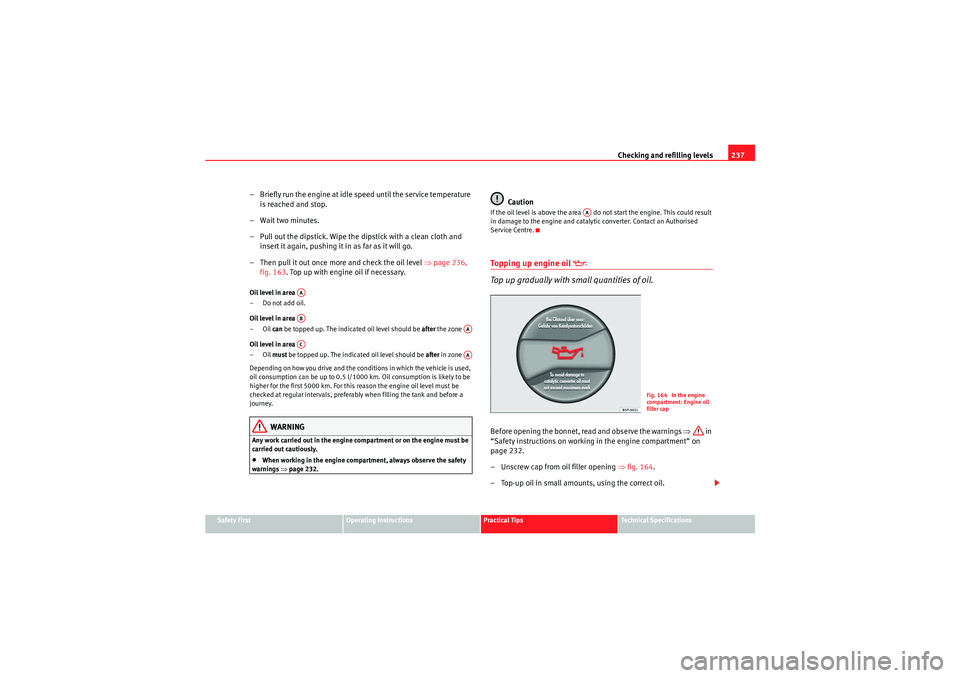
– Unscrew cap from oil filler opening ⇒fig. 164 .
– Top-up oil in small amounts, using the correct oil.
AAAB
AA
AC
AA
AA
Fig. 164 In the engine
compartment: Engine oil
filler cap
Altea_EN.book Seite 237 Donnerstag, 2. September 2010 2:00 14
Page 240 of 317

Checking and refilling levels
238
– To avoid over-filling with engine oil, you should top-up using small quantities, wait a while and check the oil level before
adding any more oil.
– As soon as the oil level is in area , carefully close the cap.The position of the oil filler opening is shown in the corresponding engine
compartment illustration ⇒page 291.
Engine oil specification ⇒page 235.
WARNING
Oil is highly inflammable! Ensure that no oil comes into contact with hot
engine components when topping up.
Caution
If the oil level is above the area do not start the engine. This could result
in damage to the engine and catalytic converter. Contact a specialised work-
shop.
For the sake of the environment
The oil level must never be above area . Otherwise oil can be drawn in
through the crankcase breather and escape into the atmosphere via the
exhaust system.
Changing engine oil
The engine oil must be changed at the intervals given in the
service schedule.We recommend that you have the engine oil changed by an Authorised
Service Centre.
The oil change intervals are shown in the Maintenance Programme.
WARNING
Only change the oil yourself if you have the specialist knowledge required!•Before opening the bonnet, read and observe the warnings
⇒ page 232, “Safety instructions on working in the engine compartment”.•Wait for the engine to cool down. Hot oil may cause burn injuries.•Wear eye protection to avoid injuries caused by splashes of oil.•When removing the oil drain plug with your fingers, keep your arm hori-
zontal to help prevent oil from running down your arm.•Wash your skin thoroughly if it comes into contact with engine oil.•Engine oil is poisonous! Used oil must be stored in a safe place out of
the reach of children.Caution
No additives should be used with engine oil. This could result in engine
damage. Any damage caused by the use of such additives would not be
covered by the factory warranty.
For the sake of the environment
•Because of the disposal problems, the necessary special tools and
specialist knowledge required, we recommend that you have the engine oil
and filter changed by an Authorised Service Centre.
AB
AA
AA
Altea_EN.book Seite 238 Donnerstag, 2. September 2010 2:00 14
Page 244 of 317

Checking and refilling levels
242
WARNING
Any work carried out in the engine compartment or on the engine must be
carried out cautiously.•When working in the engine compartment, always observe the safety
warnings ⇒page 232.Caution
•Never put radiator anti-freeze or other additives into the windscreen
washer fluid.•Always use approved windscreen cleansing products diluted as per
instructions. If you use other washer fluids or soap solutions, the tiny holes
in the fan-shaped nozzles could become blocked.
Changing windscreen wiper blades
If the windscreen wiper blades are in perfect condition, you
will benefit from an improved visibility. Damaged wiper
blades should be replaced immediately.
Fig. 167 Windscreen
wipers in the service posi-
tionFig. 168 Changing the
front wiper blades
Altea_EN.book Seite 242 Donnerstag, 2. September 2010 2:00 14
Page 245 of 317

Checking and refilling levels243
Safety First
Operating Instructions
Practical Tips
Technical Specifications
To change the blades it is necessary to change the rest position of
the wipers to the service position.
Service position (For changing wiper blades)
– Ensure that the wiper blades are not frozen.
– Turn ignition on and off and then (before approx. 8 seconds have
elapsed), move the windscreen wiper lever to the intermittent
wipe position. The windscreen wipers will move to the service
position.
Changing the windscreen wiper blades
– Lift the wiper arm away from the windscreen.
– Push the side buttons, free the blade and pull in the direction of the arrow ⇒fig. 168
Fitting the wiper blade
– Insert a blade of identical length and design into the wiper arm.
– Slide the blade until it clicks into position.
– Push the wiper arms back against the windscreen.If the windscreen wipers smear , t h e y s h o u l d b e r e p la ce d i f t h e y a r e d a m a ge d ,
or cleaned if they are soiled.
If this does not produce the desired results, the setting angle of the wind-
screen wiper arms might be incorrect. They should be checked by a special-
ised workshop and corrected if necessary.
WARNING
Do not drive unless you have good visibility through all windows!
•Clean the windscreen wiper blades and all windows regularly.•The wiper blades should be changed once or twice a year.Caution
•Damaged or dirty windscreen wipers could scratch the windscreen.•Never use fuel, nail varnish remover, paint thinner or similar products to
clean the windows. This could damage the windscreen wiper blades.•Never move the windscreen wiper or windscreen wiper arm manually. This
could cause damage.•Do not pull the windscreen wipers forward unless they are in the service
position. Otherwise the bonnet could be damaged.Note
•The wiper arms can be moved to the service position only when the
bonnet is properly closed.WARNING (continued)
Altea_EN.book Seite 243 Donnerstag, 2. September 2010 2:00 14
Page 247 of 317

Checking and refilling levels245
Safety First
Operating Instructions
Practical Tips
Technical Specifications
Brake fluidChecking the brake fluid level
The brake fluid is checked at the intervals given in the service
schedule.– Read off the fluid level at the transparent brake fluid reservoir. It
should always be between the “MIN” and “MAX” marks.The position of the brake fluid reservoir is shown in the corresponding engine
compartment illustration ⇒page 291. The brake fluid reservoir has a black
and yellow cap.
The brake fluid level drops slightly when the vehicle is being used as the
brake pads are automatically adjusted as they wear. However, if the level goes down noticeably in a short time, or drops below the
“MIN” mark, there may be a leak in the brake system. A display on the instru-
ment panel will warn you if the brake fluid level is too low
⇒page 77.
WARNING
Before opening the bonnet to check the brake fluid level, read and observe
the warnings ⇒page 232.Changing the brake fluid
The Maintenance Programme indicates the brake fluid
change intervals.We recommend that you have the brake fluid changed by an Authorised
Service Centre.
Before opening the bonnet, please read and follow the warnings ⇒ in
“Safety instructions on working in the engine compartment” on page 232 in
section “Safety notes for working in the engine compartment”.
Brake fluid absorbs moisture. In the course of time, it will absorb water from
the ambient air. If the water content in the brake fluid is too high, the brake
system could corrode. This also considerably reduces the boiling point of the
brake fluid. Heavy use of the brakes may then cause a vapour lock which
could impair the braking effect.
It is important that you use only brake fluid compliant with US standard
FMVSS 116 DOT 4. We recommend the use of Genuine SEAT brake fluid.
WARNING
Brake fluid is poisonous. Old brake fluid impairs the braking effect.
Fig. 171 In the engine
compartment: Brake fluid
reservoir cover
Altea_EN.book Seite 245 Donnerstag, 2. September 2010 2:00 14