2011 Seat Altea service interval
[x] Cancel search: service intervalPage 205 of 317
Intelligent technology203
Safety First
Operating Instructions
Practical Tips
Technical Specifications
Brake servo
The brake servo increases the pressure you apply to the brake pedal. The
brake servo works only when the engine is running.
WARNING
•When applying the brakes to clean off deposits on the pads and discs,
select a clear, dry road. Be sure not to inconvenience or endanger other
road users. Risk of accident.•Ensure the vehicle does not move while in neutral, when the engine is
stopped. Failure to do so could result in an accident.Caution
•Never let the brakes “drag” by leaving your foot on the pedal when it is
not necessary to brake. This overheats the brakes, resulting in longer stop-
ping distances and greater wear.•Before driving down a long, steep gradient, it is advisable to reduce speed
and change to a lower gear (or move the gear lever to a lower gear position if
your vehicle has automatic transmission). This makes use of engine braking
and prolongs the service life of the brakes. If you still have to use the brakes,
it is better to brake firmly at intervals than to apply the brakes continuously.Note
•If the brake servo is not functioning due to a malfunction, or if the vehicle
has to be towed, you will have to press the brake pedal considerably harder
to make up for the lack of servo assistance.•If you wish to equip the vehicle with accessories such as a front spoiler or
wheel covers, it is important that the flow of air to the front wheels is not
obstructed, otherwise the brakes can overheat.
Power steering (servotronic*)
Power steering makes it easier to turn the steering wheel
when the engine is running.Power steering assists the driver by reducing the force needed to turn the
steering wheel. In cars equipped with servotronic* power steering the degree
of power assistance is regulated electronically according to road speed.
The power steering will keep on working even if the servotronic* device fails.
The degree of power assistance will, however, no longer adapt to different
speeds. If the electronic regulating system is not working properly, this is
most noticeable when turning the steering wheel at low speeds (for instance
when parking), as more effor t will be required than usual. The fault should be
corrected by a specialised workshop as soon as possible.
Power steering does not work if the engine is off. In this case the steering
wheel requires much more force to turn.
If the steering is held at its turning limit when the vehicle is stationary, this
will place an excessive load on the power steering system. Turning the
steering wheel to its limit places a load on the system, which causes noise. It
will also reduce the idling speed of the engine.
Caution
When the engine is running, do not turn the steering wheel to its limit for
more than 15 seconds. Otherwise, there is a risk of damaging the power
steering.
Note
•If the power steering should fail at any time or the engine is switched off
(for instance when being towed), the vehicle can still be steered. However,
more effort will be required to turn the steering wheel.•If the system is leaking or malfunctioning, please take the vehicle to a
specialised workshop as soon as possible.
Altea_EN.book Seite 203 Donnerstag, 2. September 2010 2:00 14
Page 213 of 317

Trailer towing211
Safety First
Operating Instructions
Practical Tips
Technical Specifications
Trailer towingInstructions to followYour vehicle may be used to tow a trailer when fitted with the correct equip-
ment.
If the vehicle is supplied with a factory-fitted towing bracket it will already
have the necessary technical modifications and meet the statutory require-
ments for towing a trailer. For the after-market fitting of a trailer towing
bracket see ⇒page 213.
Connectors
Your vehicle is fitted with a 12-pin connector for the electrical connection
between the trailer and the vehicle.
If the trailer has a 7-pin plug you will need to use an adapter cable. This is
available in any SEAT dealer.
Trailer weight / drawbar load
Never exceed the authorised trailer weight. If you do not load the trailer up to
the maximum permitted trailer weight, you can then climb correspondingly
steeper slopes.
The maximum trailer weights listed are only applicable for altitudes up to
1000m above sea level. With increasing altitude the engine power and there-
fore the vehicle’s climbing ability are impaired because of the reduced air
density. The maximum trailer weight has to be reduced accordingly. The
weight of the vehicle and trailer combination must be reduced by 10% for
every further 1000 m (or part thereof). The gross combination weight is the
actual weight of the laden vehicle plus the actual weight of the laden trailer.
When possible, operate the trailer with the maximum permitted drawbar load
on the ball joint of the towing bracket, but do not exceed the specified limit. The figures for
trailer weights and drawbar loads that are given on the data
plate of the towing bracket are for certification purposes only. The correct
figures for your specific model, which may be lower than these figures for the
towing bracket, are given in the vehicle documents or in ⇒Section “Tech-
nical Data”.
Distributing the load
Distribute loads in the trailer so that heavy objects are as near to the axle as
possible. Loads carried in the trailer must be secured to prevent them
moving.
Tyre pressure
Set tyre pressure to the maximum permissible pressure shown on the sticker
on the inside of the fuel tank flap. Set the tyre pressure of the trailer tyres in
accordance with the trailer manufacturer’s recommendations.
Exterior mirrors
Check whether you can see enough of the road behind the trailer with the
standard mirrors. If this is not the case, you should have additional mirrors
fitted. Both exterior mirrors should be mounted on hinged extension
brackets. Adjust the mirrors to give sufficient vision to the rear.
WARNING
Never transport people in a trailer. This could result in fatal accidents.
Note
•Towing a trailer places additional demands on the vehicle. We recom-
mend additional services between the normal inspection intervals if the
vehicle is used frequently for towing a trailer.
Altea_EN.book Seite 211 Donnerstag, 2. September 2010 2:00 14
Page 237 of 317

Checking and refilling levels235
Safety First
Operating Instructions
Practical Tips
Technical Specifications
If the bonnet does not close, do not press downwards. Open it once more and
let it fall as before.
WARNING
If the bonnet is not closed properly, it could open while you are driving and
completely obscure your view of the road. Risk of accident.•After closing the bonnet, always check that it is properly secured. The
bonnet must be flush with the surrounding body panels.•If you notice that the bonnet latch is not secured when the vehicle is
moving, stop the vehicle immediately and close the bonnet properly. Risk
of accident.
Engine oilGeneral notesThe engine comes with a special, high quality, multi grade oil that can be
used in all seasons of the year except for those regions affected by extreme
cold.
As the use of good quality oil is necessary for the correct operation and long
service life of the engine, when it becomes necessary to replenish or change
the oil, always use an oil that complies to the VW standards.
The specifications (VW standards) set out in the following page should
appear on the container of the service oil; when the container displays the
specific standards for petrol and diesel engines together, it means that the
oil can be used for both types of engines.
We recommend that the oil change, indicated in the Maintenance
Programme, be performed by an Authorised Service Centre or a specialised
workshop. The correct oil specifications for your engine are listed in
⇒page 236, “Oil
properties”.
Service intervals
Service intervals can be flexible (LongLife service) or fixed (dependent on
time/distance travelled).
If the PR code that appears on the back of the Maintenance Programme
booklet is QG1, this means that your vehicle has the LongLife service
programmed. If it has the codes QG0 or QG2 the interval service is dependent
on time/distance travelled.
Flexible service intervals (LongLife*)
Special oils and processes have been developed which, depending on the
characteristics and individual driving profiles, allow to extend the oil change
service (LongLife service intervals).
Because this oil is essential for extending the service intervals, it must only
be used observing the following indications:
•Avoid mixing it with oil for fixed service intervals.•Only in exceptional circumstances, if the engine oil level is too low
⇒ page 236 and LongLife oil is not available, it is permitted to top up (once)
with oil for fixed service intervals ⇒ page 236 (up to a maximum of 0.5
litres).
Fixed service intervals*
If your vehicle does not have the “LongLife service interval” or it has been
disabled (by request), you may use oils for fixed service intervals, which also
appear in ⇒page 236, “Oil properties”. In this case, your vehicle must be
serviced after a fixed interval of 1 year / 15,000 km (whatever comes first)
⇒ Booklet “Maintenance Programme”.•In exceptional circumstances, if the engine oil level is too low
⇒ page 236 and you cannot obtain the oil specified for your vehicle, you can
put in a small quantity of oil conforming to the specification ACEA A2 or
ACEA A3 (petrol engines) or ACEA B3 or ACEA B4 (diesel engines) (up to 0.5 l).
Altea_EN.book Seite 235 Donnerstag, 2. September 2010 2:00 14
Page 238 of 317

Checking and refilling levels
236Vehicles with diesel particulate filter*
The “Maintenance Programme” states whether your vehicle is fitted with a
diesel particulate filter.
Only VW 507 00 engine oil, with reduced ash formation, may be used in
diesel engines equipped with particulate filter. Using other types of oil will
cause a higher soot concentration and reduce the life of the DPF. Therefore:•Avoid mixing this oil with other engine oils.•Only in exceptional circumstances, if the engine oil level is too low
⇒ page 236 and you cannot obtain the oil specified for your vehicle, you can
use a small quantity of oil (once) conforming to the VW 506 00, VW 506 01,
VW 505 00, VW 505 01 or ACEA B3 / ACEA B4 specification. (up to 0.5 l).Oil properties
Engine oil additives
No type of additive should be mixed with the engine oil. The deterioration
caused by these additives is not covered by the warranty.
Note
Before a long trip, we recommend finding an engine oil that conforms to the
corresponding VW specifications and keeping it in the vehicle. This way, the
correct engine oil will always be available for a top-up if needed.Checking the engine oil level
The engine oil dipstick indicates the level of the oil.Checking oil level
– Park the vehicle in a horizontal position.
Engine type
Specification
Petrol without flexible service inter-
val
VW 502 00/ VW 504 00
Petrol with flexible service interval
(LongLife)
VW 504 00
Diesel. Engines without Particulate
filter (DPF)
VW 505 01 / VW 506 01 / VW 507 00
Diesel. Engines with particulate filter
(DPF)
With or without flexible service inter-
val (with or without LongLife)
a)
a)Only use recommended oils, otherwise you may damage the engine.
VW 507 00
Fig. 163 Engine oil
dipstick
Altea_EN.book Seite 236 Donnerstag, 2. September 2010 2:00 14
Page 239 of 317
Checking and refilling levels237
Safety First
Operating Instructions
Practical Tips
Technical Specifications
– Briefly run the engine at idle speed until the service temperature
is reached and stop.
– Wait two minutes.
– Pull out the dipstick. Wipe the dipstick with a clean cloth and insert it again, pushing it in as far as it will go.
– Then pull it out once more and check the oil level ⇒ page 236,
fig. 163. Top up with engine oil if necessary.Oil level in area
–Do not add oil.
Oil level in area
–Oil can be topped up. The indicated oil level should be after the zone
Oil level in area
–Oil must be topped up. The indicated oil level should be after in zone
Depending on how you drive and the conditions in which the vehicle is used,
oil consumption can be up to 0.5 l/1000 km. Oil consumption is likely to be
higher for the first 5000 km. For this reason the engine oil level must be
checked at regular intervals, preferably when filling the tank and before a
journey.
WARNING
Any work carried out in the engine compartment or on the engine must be
carried out cautiously.•When working in the engine compartment, always observe the safety
warnings ⇒page 232.
Caution
If the oil level is above the area do not start the engine. This could result
in damage to the engine and catalytic converter. Contact an Authorised
Service Centre.Topping up engine oil
E
Top up gradually with small quantities of oil.
Before opening the bonnet, read and observe the warnings ⇒ in
“Safety instructions on working in the engine compartment” on
page 232.
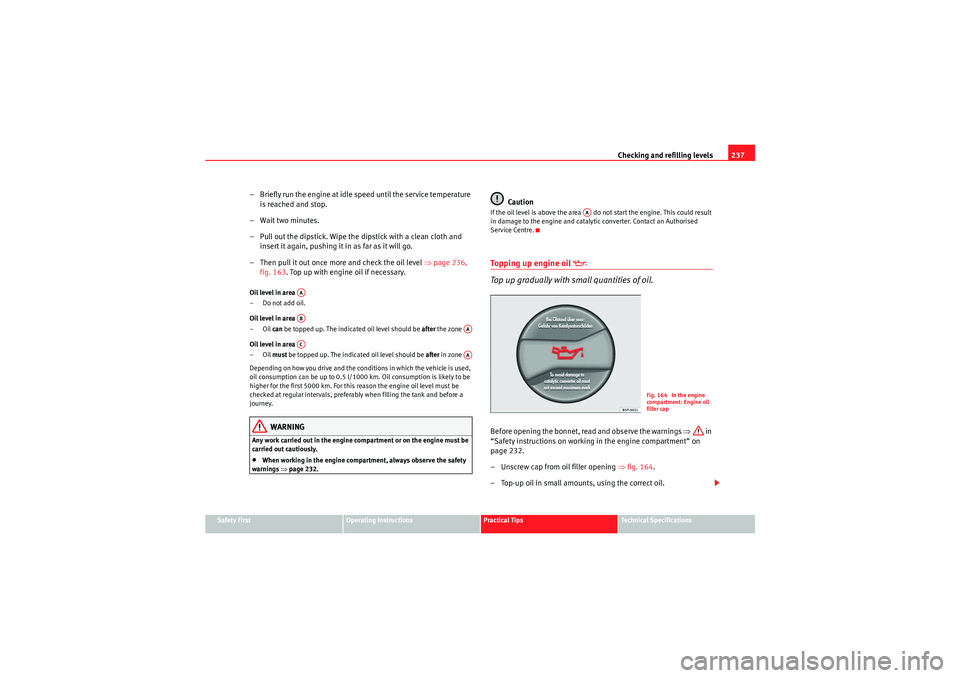
– Unscrew cap from oil filler opening ⇒fig. 164 .
– Top-up oil in small amounts, using the correct oil.
AAAB
AA
AC
AA
AA
Fig. 164 In the engine
compartment: Engine oil
filler cap
Altea_EN.book Seite 237 Donnerstag, 2. September 2010 2:00 14
Page 240 of 317

Checking and refilling levels
238
– To avoid over-filling with engine oil, you should top-up using small quantities, wait a while and check the oil level before
adding any more oil.
– As soon as the oil level is in area , carefully close the cap.The position of the oil filler opening is shown in the corresponding engine
compartment illustration ⇒page 291.
Engine oil specification ⇒page 235.
WARNING
Oil is highly inflammable! Ensure that no oil comes into contact with hot
engine components when topping up.
Caution
If the oil level is above the area do not start the engine. This could result
in damage to the engine and catalytic converter. Contact a specialised work-
shop.
For the sake of the environment
The oil level must never be above area . Otherwise oil can be drawn in
through the crankcase breather and escape into the atmosphere via the
exhaust system.
Changing engine oil
The engine oil must be changed at the intervals given in the
service schedule.We recommend that you have the engine oil changed by an Authorised
Service Centre.
The oil change intervals are shown in the Maintenance Programme.
WARNING
Only change the oil yourself if you have the specialist knowledge required!•Before opening the bonnet, read and observe the warnings
⇒ page 232, “Safety instructions on working in the engine compartment”.•Wait for the engine to cool down. Hot oil may cause burn injuries.•Wear eye protection to avoid injuries caused by splashes of oil.•When removing the oil drain plug with your fingers, keep your arm hori-
zontal to help prevent oil from running down your arm.•Wash your skin thoroughly if it comes into contact with engine oil.•Engine oil is poisonous! Used oil must be stored in a safe place out of
the reach of children.Caution
No additives should be used with engine oil. This could result in engine
damage. Any damage caused by the use of such additives would not be
covered by the factory warranty.
For the sake of the environment
•Because of the disposal problems, the necessary special tools and
specialist knowledge required, we recommend that you have the engine oil
and filter changed by an Authorised Service Centre.
AB
AA
AA
Altea_EN.book Seite 238 Donnerstag, 2. September 2010 2:00 14
Page 247 of 317

Checking and refilling levels245
Safety First
Operating Instructions
Practical Tips
Technical Specifications
Brake fluidChecking the brake fluid level
The brake fluid is checked at the intervals given in the service
schedule.– Read off the fluid level at the transparent brake fluid reservoir. It
should always be between the “MIN” and “MAX” marks.The position of the brake fluid reservoir is shown in the corresponding engine
compartment illustration ⇒page 291. The brake fluid reservoir has a black
and yellow cap.
The brake fluid level drops slightly when the vehicle is being used as the
brake pads are automatically adjusted as they wear. However, if the level goes down noticeably in a short time, or drops below the
“MIN” mark, there may be a leak in the brake system. A display on the instru-
ment panel will warn you if the brake fluid level is too low
⇒page 77.
WARNING
Before opening the bonnet to check the brake fluid level, read and observe
the warnings ⇒page 232.Changing the brake fluid
The Maintenance Programme indicates the brake fluid
change intervals.We recommend that you have the brake fluid changed by an Authorised
Service Centre.
Before opening the bonnet, please read and follow the warnings ⇒ in
“Safety instructions on working in the engine compartment” on page 232 in
section “Safety notes for working in the engine compartment”.
Brake fluid absorbs moisture. In the course of time, it will absorb water from
the ambient air. If the water content in the brake fluid is too high, the brake
system could corrode. This also considerably reduces the boiling point of the
brake fluid. Heavy use of the brakes may then cause a vapour lock which
could impair the braking effect.
It is important that you use only brake fluid compliant with US standard
FMVSS 116 DOT 4. We recommend the use of Genuine SEAT brake fluid.
WARNING
Brake fluid is poisonous. Old brake fluid impairs the braking effect.
Fig. 171 In the engine
compartment: Brake fluid
reservoir cover
Altea_EN.book Seite 245 Donnerstag, 2. September 2010 2:00 14
Page 310 of 317

Index
308Specifications . . . . . . . . . . . . . . . . . . . . . . . 235
Topping up . . . . . . . . . . . . . . . . . . . . . . . . . . 237
Engine oil dipstick . . . . . . . . . . . . . . . . . . . . . . . 236
Engine oil pressure Warning lamp . . . . . . . . . . . . . . . . . . . . . 66, 87
Environment . . . . . . . . . . . . . . . . . . . . . . . . . . . 207 Environmental friendliness . . . . . . . . . . . . 209
Environmental tip Avoiding pollution . . . . . . . . . . . . . . . . . . . . 227
Environmentally friendly driving . . . . . . . . . . . 207
ESP . . . . . . . . . . . . . . . . . . . . . . . . . . . . . . . . 88, 199 See also Electronic Stability Programme . . 172
Example of menu use Program a speed limit warning . . . . . . . . . . 69
To activate and deactivate the speed limit warning . . . . . . . . . . . . . . . . . . . . . . . . . . . . 69
Example of the use of the menus Open the Configuration menu with the MFI lever68
Open the Configuration menu with the steering wheel controls . . . . . . . . . . . . . . . . . . . . . . 69
Examples of menu use Open the main menu . . . . . . . . . . . . . . . . . . 68
Open the winter tyres menu . . . . . . . . . . . . . 69
To close the winter tyres menu . . . . . . . . . . . 69
Exhaust gas purification system . . . . . . . . . . . 206
Exterior mirrors . . . . . . . . . . . . . . . . . . . . . . . . . 218FFabric trim cleaning . . . . . . . . . . . . . . . . . . . . . 222 Fastening rings . . . . . . . . . . . . . . . . . . . . . . . . . . 18
Fire extinguisher . . . . . . . . . . . . . . . . . . . . . . . . 155
First-aid kit . . . . . . . . . . . . . . . . . . . . . . . . . . . . . 155
Flexible service interval display . . . . . . . . . . . . . 62
Floor mats . . . . . . . . . . . . . . . . . . . . . . . . . . . . . . 16
Fog lights . . . . . . . . . . . . . . . . . . . . . . . . . . . . . . 118
Fog lights with cornering function . . . . . . . . . . 123
Folding the seat backrests down . . . . . . . . . . . 143
Folding tray* . . . . . . . . . . . . . . . . . . . . . . . . . . . 145
Front airbags . . . . . . . . . . . . . . . . . . . . . . . . . . . . 34
Description . . . . . . . . . . . . . . . . . . . . . . . . . . 34
Operation . . . . . . . . . . . . . . . . . . . . . . . . . . . . 35
Safety notes . . . . . . . . . . . . . . . . . . . . . . . . . . 37
Front drinks holders . . . . . . . . . . . . . . . . . . . . . 148
Front passenger airbag deactivation . . . . . . . . . 44
Front reading lights . . . . . . . . . . . . . . . . . . . . . . 128
Front seat adjustment Lumbar support . . . . . . . . . . . . . . . . . . . . . . 140
Fuel Diesel . . . . . . . . . . . . . . . . . . . . . . . . . . . . . . 231
Petrol . . . . . . . . . . . . . . . . . . . . . . . . . . . . . . 230
Fuel level Indicator . . . . . . . . . . . . . . . . . . . . . . . . . . . . . 58
Fuel reserve . . . . . . . . . . . . . . . . . . . . . . . . . . . . . 82 Warning message . . . . . . . . . . . . . . . . . . . . . 67
Fuel Tank Opening the fuel tank flap . . . . . . . . . . . . . 226
Fuel tank See Fuel reserve . . . . . . . . . . . . . . . . . . . . . . 82
Fuel: save . . . . . . . . . . . . . . . . . . . . . . . . . . . . . . 207 Fuses . . . . . . . . . . . . . . . . . . . . . . . . . . . . . . . . . 267
GG 12 . . . . . . . . . . . . . . . . . . . . . . . . . . . . . . . . . . 239
Gear shift pattern . . . . . . . . . . . . . . . . . . . . . . . 181
General overview of the engine compartment 291
Glove compartment . . . . . . . . . . . . . . . . . . . . . 144
Glow plug system . . . . . . . . . . . . . . . . . . . . . . . 175
Warning lamp . . . . . . . . . . . . . . . . . . . . . . . . 83
GRA . . . . . . . . . . . . . . . . . . . . . . . . . . . . . . . . . . 192HHandbrake . . . . . . . . . . . . . . . . . . . . . . . . . . . . . 187 Warning lamp . . . . . . . . . . . . . . . . . . . . 86, 187
Hazard warning lights . . . . . . . . . . . . . . . . . . . . 123
HBA . . . . . . . . . . . . . . . . . . . . . . . . . . . . . . . . . . 197
Head restraints Adjusting . . . . . . . . . . . . . . . . . . . . . . . 138, 139
Adjustment of the head restraint angle . . . 139
Removing . . . . . . . . . . . . . . . . . . . . . . . . . . . 139
Headlight flashers . . . . . . . . . . . . . . . . . . . . . . . 125
Headlight range control . . . . . . . . . . . . . . . . . . 122
Headlights Driving abroad . . . . . . . . . . . . . . . . . . . . . . . 210
Fog lights . . . . . . . . . . . . . . . . . . . . . . . . . . . 118
Headlight washer . . . . . . . . . . . . . . . . . . . . 134
Heated front seats . . . . . . . . . . . . . . . . . . . . . . 141
Altea_EN.book Seite 308 Donnerstag, 2. September 2010 2:00 14