2011 Seat Alhambra headlight bulb
[x] Cancel search: headlight bulbPage 97 of 385
95
Lights and visibility
Lights and visibility
Lights Introduction The legal requirements regarding the use of vehicle lights in each country
mus
t
be observed.
The driver is personally responsible for the correct use and adjustment of
the lights in all situations.
Additional information and warnings:
● SEAT information system ⇒ page 62
● Ch
anging bulbs ⇒ page 326 WARNING
If the headlights are set too high and the main beam is not used correct-
ly, ther e i
s a risk of dazzling or distracting other road users. This could
result in serious accident.
● Always make sure that the headlamps are correctly adjusted.
● Never use the main beam or flashed headlamps as this could dazzle
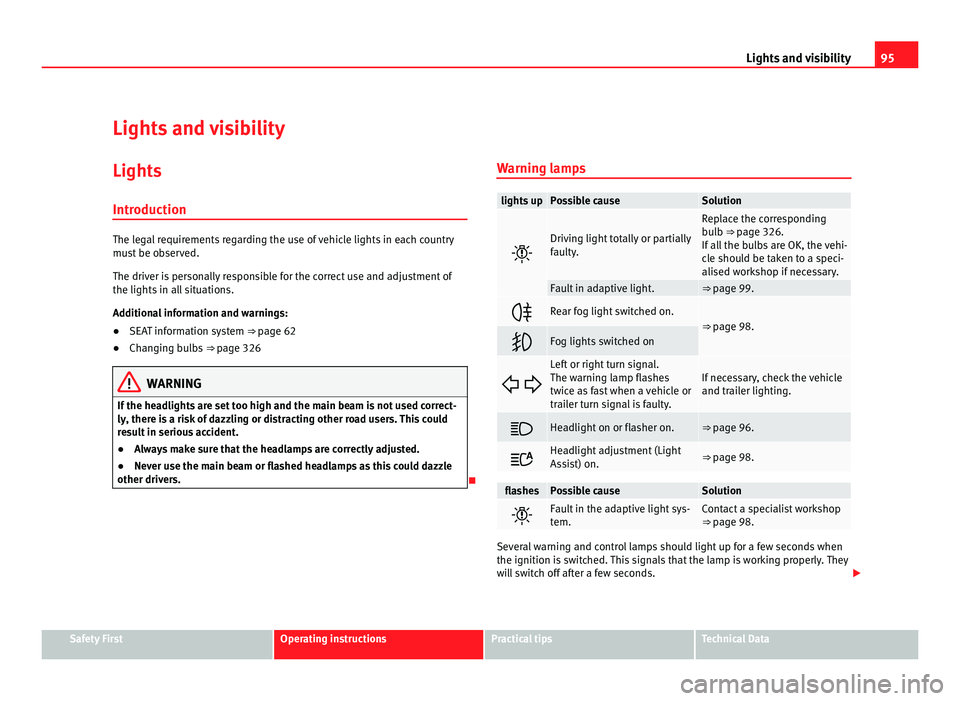
other drivers. Warning lamps lights up Possible cause Solution
Driving light totally or partially
fau
lty
. Replace the corresponding
bu
l
b ⇒ page 326.
If all the bulbs are OK, the vehi-
cle should be taken to a speci-
alised workshop if necessary. Fault in adaptive light. ⇒ page 99.
Rear fog light switched on.
⇒ page 98.
Fog lights switched on
Left or right turn signal.
The warnin
g l
amp flashes
twice as fast when a vehicle or
trailer turn signal is faulty. If necessary, check the vehicle
and trai
l
er lighting. Headlight on or flasher on. ⇒ page 96.
Headlight adjustment (Light
Ass
i
st) on. ⇒ page 98.
flashes Possible cause Solution
Fault in the adaptive light sys-
tem. Contact a specialist workshop
⇒ pag
e 98. Several warning and control lamps should light up for a few seconds when
the ignition is
sw
itched. This signals that the lamp is working properly. They
will switch off after a few seconds. Safety First Operating instructions Practical tips Technical Data
Page 269 of 385

267
Checking and refilling levels
Closing the tank cap
● Screw on the tank cap clockwise until it you hear it click into position.
● Press the tank flap until you hear it click into place. The tank flap must
be flush w ith the body
contour. WARNING
Do not continue refilling once the fuel nozzle has switched itself off. The
fuel t
ank may be filled too much. As a result, fuel may spurt out and spill.
This could lead to a fire, explosion and severe injuries. CAUTION
● Always remove any fuel spilled on the vehicle paintwork immediately to
av oid d
amage to the wheel housing, the tyre and vehicle paintwork. For the sake of the environment
Spilt fuel can contaminate the environment.
Refilling precautions Information on bulb replacement
⇒ pag
e 326.
Checklist
Never work on the engine or in the engine compartment if you are not famil-
iar with the operations to be carried out, the applicable safety standards
and especially if you do not have the instruments, liquids and tools neces-
sary ⇒ page 275, Working in the engine compartment! Have the work car-
ried out by a Technical Service if you are uncertain. Check the following reg-
ularly, preferably when you refuel:
● Windscreen washer fluid level ⇒ pag
e 105
● Engine oil level ⇒ pag
e 279 ●
Engine coolant level ⇒ p
age 283
● Brake fluid level ⇒ pag
e 183
● Tyre pressure ⇒ pag
e 293
● Vehicle lighting required to guarantee road safety:
Indicator
s
Side lights, dipped headlights and full beam headlights
Rear lights
Brake lights
Rear fog light ⇒ page 97 WARNING
Not following the checklist prepared for your own safety could lead to ac-
cident s
and severe injuries.
● Always follow the check list and perform the necessary operations.
Fuel Introduction You will find a factory-fitted sticker containing information on the type of
fuel
f
or your vehicle on the inside of the fuel tank flap.
Additional information and warnings:
● ⇒ Bookl et Maintenance Programme
● R
efuelling ⇒ pag e 264
● En
gine and exhaust system management ⇒ page 228
–
–
–
–
–
Safety First Operating instructions Practical tips Technical Data
Page 329 of 385

327
If and when
Several warning and control lamps should light up for a few seconds when
the ignition is sw
itched. This signals that the lamp is working properly. They
will switch off after a few seconds.
Checking the bulbs of a trailer
For vehicles with the factory fitted trailer system, certain trailer lights are al-
so controlled if the socket is correctly connected.
A fault on a trailer turn indicator is indicated on the instrument panel by the
indicator blinking twice as fast ( or ) ⇒ page 95.
● General fault of all indicators on one side.
● Fault in one tail light (on some models, also the registration light).
● Fault in two brake lights. WARNING
If the warning lamps and messages are ignored, the vehicle may stall in
traffic, or m a
y cause accidents and severe injuries.
● Never ignore the warning lamps or text messages.
● Stop the vehicle safely as soon as possible. CAUTION
Failure to heed the warning lamps and text messages when they appear
ma y
result in faults in the vehicle. Note
A fault in the LED on the tail lights will not be indicated. However, if the fault
affects al
l the LEDs then this will be indicated by the indicator . Information for replacing bulbs Checklist
To r
ep
lace a bulb, carry out the following operations always in the order giv-
en ⇒ :
Park the
vehicle a safe distance from traffic and on suitable ground.
Connect the electronic parking brake ⇒ page 183.
Turn the light switch to position 0 ⇒ page 95.
Move the gear lever into the neutral position ⇒ page 95.
Automatic gearbox: Move selector lever to position P ⇒ page 174.
Stop the engine and remove the key from the ignition ⇒ page 170.
Manual gearbox: Select a gear ⇒ page 174.
Wait until all of the passenger compartment lights are turned off
⇒ page 95.
Allow the corresponding bulb to cool. Visually inspect fuses to see if any are blown ⇒ page 322.
Replace the bulb according to the instructions ⇒ . Bulbs should only
be rep l
aced by new identical models. Bulb information is displayed on
the bulb socket or on the bulb itself.
In general, never touch the bulb glass directly. The heat of the bulb
would cause the fingerprint to evaporate and condense on the reflector.
This will impair the brightness of the headlight.
Check if the new bulb is working. If the bulb is not working, it may not
have been correctly fitted, it could be damaged or the connector may
not be correctly connected.
Every time a bulb for the headlights is replaced, visit a specialised
workshop to check the headlights.
1.
2.
3.
4.
5.
6.
7.
8.
9.
10.
11.
12.
13.
14.
Safety First Operating instructions Practical tips Technical Data
Page 330 of 385

328
If and when WARNING
Failure to follow the checklist prepared for your own safety could lead to
acc ident
s and severe injuries.
● Always complete the operations given in the checklist and observe
the genera
l rules of safety. CAUTION
Always remove and fit headlights carefully to avoid damage to the paint-
work and other
vehicle parts.
To replace halogen headlight bulbs Fig. 203 In the engine
comp
ar
tment: Left-hand
side headlight lining. A dipped beam headlights,
B daytime lights and
C main beam headlights
and side light
s. Fig. 204 Left headlight
There is no need to remove the headlight to replace bulbs.
Comp l
ete operations only in the sequence given: fig. 203,
fig. 204 A B C
Indicators (small lamp
holder) Dipped beam head-
lights Daylight driving lights Main beam headlights Side lights
1. Always take the checklist into account and take the necessary actions
⇒ pag
e 327.2. Open the bonnet
⇒ page 275.
Page 331 of 385

329
If and when fig. 203,
fig. 204 A B C
Indicators (small lamp
holder) Dipped beam head-
lights Daylight driving lights Main beam headlights Side lights
3. Remove the rubber cover on the rear of the headlight.
4. Rotate the lamp holder
1 to the left all the way
and pu l
l it out back-
wards with the bulb. Rotate the lamp holder to the left all the way and
pul
l it out backwards with the bulb. Press the wire clip down-
war d
s and pull the lamp
holder 2 out with the
bu l
b. Pull the lamp holder
3 out backwards with the
bul
b. 5. Depending on the model, the bulb is removed directly from the lamp holder or it may need to be rotated and then removed.
6. Replace the faulty bulb by a new identical bulb.
7. Place the bulb holder in the headlight and rotate to the right all the way. Place the lamp holder in
the hea
dlight
and pull the
wire clip upwards until it
clicks into place. Place the lamp holder in
the hea dlight
and insert
completely. 8. Insert the rubber cover.
Note
The images show the left hand headlight from behind. The structure of the
right h and s
ide headlight is symmetric. Safety First Operating instructions Practical tips Technical Data
Page 332 of 385

330
If and when
To replace the xenon headlights bulb Fig. 205 In the engine
comp
ar
tment: Turn signal
cover. Fig. 206 Turn signal in-
dicat
or l
amp holder 1 and turning light
2 .
There is no need to remove the headlight to replace bulbs.
Comp l
ete operations only in the sequence given: Turn signal indicators
1 Turning lights
2 1. Always take the checklist into account and take the necessary ac-
tions ⇒
page 327. 2. Open the bonnet
⇒ page 275. 3. Rotate the cover ⇒
fig. 205 in the dir
ection of the arrow and remove
it. 4. Rotate the lamp holder
1 ⇒ fig. 206 to the left all the way
and p
u
ll it out backwards with
the bulb. Press the wire clip downwards
and pu
l
l the lamp holder 2 ⇒ fig. 206 out w
ith the b
ulb. 5. Depending on the model, the bulb is removed directly from the
lamp ho l
der or it may need to be rotated and then removed. 6. Replace the faulty bulb by a new identical bulb.
7. Place the bulb holder in the
hea
dlight
and rotate to the right
all the way. Place the lamp holder in the
hea
dlight
and pull the wire clip
upwards until it clicks into place. 8. Rotate the cover ⇒
fig. 205 in the op
posite direction to the arrow as
far as it will go. Always seek the help of a specialist when changing the Xenon dipped beam
and fu
l
l beam headlamps ⇒ in Introduction on page 326.
Note
The illustrations show the left hand headlight. The structure of the right
hand s ide he
adlight is symmetric.
Page 333 of 385

331
If and when
To replace the front bumper bulbs Fig. 207 On the right-
hand s
ide of
the front
bumper: Removing the
headlights Fig. 208 Changing the
bu
l
bs in the headlights.
Complete operations only in the sequence given: 1. Always take the checklist into account and take the necessary ac-
tions
⇒
page 327. 2. Pull the cover forwards, in the direction of the arrow
⇒ fig. 207. 3. Unscrew the attachment screw
⇒ fig. 207 1 using the screwdriver
from the on-bo ar
d tools ⇒ page 320. 4. Tilt the headlight slightly forward and extract it from its lateral at-
tac
hments
⇒ fig. 208 (small arrows). 5. Release the connector ⇒ fig. 208
1 and remove it.
6. Rotate the lamp holder ⇒ fig. 208
2 to the left all the way, in the
direction of the arr
ow, and pull it out backwards with the bulb. 7. Replace the faulty bulb by a new identical bulb.
8. Place the bulb holder in the headlight and rotate to the right all the
wa
y
. 9. Insert the connector
⇒ fig. 208 1 on the lamp holder
⇒ fig. 208 2 . The connector must audibly click into place.
10. Place the headlight into its position
⇒ fig. 208 (small
arrows) and
tilt it backwards. 11. Tighten the attachment screw
⇒ fig. 207 1 using the screwdriver.
12. Replace the cover on the bumper ⇒ fig. 207.
Safety First Operating instructions Practical tips Technical Data
Page 369 of 385

Brakes
Assi
sted braking systems . . . . . . . . . . . . . 189
Brake fluid . . . . . . . . . . . . . . . . . . . . . . . . . 191
Brake fluid level . . . . . . . . . . . . . . . . . . . . . 192
Brake pads . . . . . . . . . . . . . . . . . . . . . . . . . 187
Changing the brake fluid . . . . . . . . . . . . . . 192
Control lamp . . . . . . . . . . . . . . . . . . . . . . . . 184
Emergency brake indicator in case of sud- den braking . . . . . . . . . . . . . . . . . . . . . . . 313
Running-in brake pads . . . . . . . . . . . . . . . . 187
Warning lamp . . . . . . . . . . . . . . . . . . . . . . . 184
Brake servo . . . . . . . . . . . . . . . . . . . . . . . . 187, 189
Brake system Malfunction . . . . . . . . . . . . . . . . . . . . . . . . 187
Brake systems . . . . . . . . . . . . . . . . . . . . . . . . . 189
Braking assist . . . . . . . . . . . . . . . . . . . . . . . . . . 190 Braking assist system (BAS) . . . . . . . . . . . 190
Braking assist system (BAS) . . . . . . . . . . . . . . 190
Breakdown Securing the vehicle . . . . . . . . . . . . . . . . . 312
Bulb fault See changing bulbs . . . . . . . . . . . . . . . . . . 326
C
Card compartments . . . . . . . . . . . . . . . . . . . . . 144
Care See "Care of your vehicle" . . . . . . . . . . . . . 242
Vehicle interior . . . . . . . . . . . . . . . . . . . . . . 249
Care of your vehicle Exterior . . . . . . . . . . . . . . . . . . . . . . . . . . . . 242
Caring for paintwork . . . . . . . . . . . . . . . . . . . . . 247 Carrier system . . . . . . . . . . . . . . . . . . . . . . . . . . 138
Catalytic
converter . . . . . . . . . . . . . . . . . . . . . . 229
Malfunction . . . . . . . . . . . . . . . . . . . . . . . . 229
Warning lamp . . . . . . . . . . . . . . . . . . . . . . . 228
CD changer . . . . . . . . . . . . . . . . . . . . . . . . 141, 148
Central locking . . . . . . . . . . . . . . . . . . . . . . . 74, 77 Antitheft alarm . . . . . . . . . . . . . . . . . . . . . . . 78
Locking and unlocking the vehicle . . . . . . . 76
Central locking system After airbag deployment . . . . . . . . . . . . . . . 75
Description . . . . . . . . . . . . . . . . . . . . . . . . . . 75
Opening doors individually . . . . . . . . . . . . . 75
Centre armrest . . . . . . . . . . . . . . . . . . . . . . . . . 125
Changing Windscreen wiper blades . . . . . . . . . . . . . 246
Changing a wheel . . . . . . . . . . . . . . . . . . . . . . 305 Changing a wheel . . . . . . . . . . . . . . . . . . . 311
Preparations . . . . . . . . . . . . . . . . . . . . . . . . 306
Raising the vehicle . . . . . . . . . . . . . . . . . . . 309
Wheel bolts . . . . . . . . . . . . . . . . . . . . . . . . . 307
Changing bulbs . . . . . . . . . . . . . . . . . . . . . . . . 326 Bodywork . . . . . . . . . . . . . . . . . . . . . . . . . . 333
Checklist . . . . . . . . . . . . . . . . . . . . . . . . . . . 327
Front bumper . . . . . . . . . . . . . . . . . . . . . . . 331
Halogen headlights . . . . . . . . . . . . . . . . . . 328
Indicator . . . . . . . . . . . . . . . . . . . . . . . . . . . 326
Initial operations . . . . . . . . . . . . . . . . . . . . 327
Number plate light . . . . . . . . . . . . . . . . . . . 335
Sea changing bulbs . . . . . . . . . . . . . . . . . . 326
Tailgate . . . . . . . . . . . . . . . . . . . . . . . . . . . . 332
Tail lights . . . . . . . . . . . . . . . . . . . . . . 332, 333
Xenon headlights . . . . . . . . . . . . . . . . . . . . 330 Changing gear . . . . . . . . . . . . . . . . . . . . . . . . . 174
Automatic gearbox . . . . . . . . . . . . . . . . . . . 178
Engaging gears (manual gearbox) . . . . . . 177
Manual gearbox . . . . . . . . . . . . . . . . . . . . . 177
Manually unlocking the gear selection lev- er . . . . . . . . . . . . . . . . . . . . . . . . . . . . . . . 319
Selecting gears (automatic gearbox) . . . . 178
Warning and control lamps . . . . . . . . . . . . 175
Changing gears Gear recommendation . . . . . . . . . . . . . . . . 182
Tiptronic . . . . . . . . . . . . . . . . . . . . . . . . . . . 180
Changing the battery of the vehicle key . . . . . . . . . . . . . . . . . . . . . 73
Changing the wheel After changing the wheel . . . . . . . . . . . . . . 311
Checking Tyre pressures . . . . . . . . . . . . . . . . . . . . . . . 298
Checking the oil level . . . . . . . . . . . . . . . . . . . . 281
Check list . . . . . . . . . . . . . . . . . . . . . . . . . . . . . . . 7
Checklist Before working in the engine compart-ment . . . . . . . . . . . . . . . . . . . . . . . . . . . . . 277
Changing bulbs . . . . . . . . . . . . . . . . . . . . . 327
In case of an emergency . . . . . . . . . . . . . . 312
Check list Preparations for changing a wheel . . . . . . 306
Raising the vehicle with the jack . . . . . . . . 310
Checklist Refilling precautions . . . . . . . . . . . . . . . . . 267
Seat belts . . . . . . . . . . . . . . . . . . . . . . . . . . . 21
Transporting children in the vehicle . . . . . . 40
Check list Upholstery . . . . . . . . . . . . . . . . . . . . . . . . . 250 367
Index