2011 RENAULT SCENIC heater
[x] Cancel search: heaterPage 313 of 365

13B-313
MR-372-J84-13B200$756.mif
V13
DIESEL INJECTION
Fault finding – Interpretation of commands
EDC16
Program No: C1
Vdiag No: 18, 1C, 20,
50, 58, 5C
13B
AC063
CONTINUED
vdiag 18, 1C, 20:
If the additional heater no. 1 relay does not operate when running command AC063:
Check the additional heater no. 1 relay mounting.
Check the engine management computer connectors.
Repair if necessary.
if the fault is still present, check as follows that this relay is controlled by the engine management computer:
Disconnect the additional heater no. 1 relay, fit a 50 Ω < X < 100 Ω resistor on the relay mounting in place of the
coil, and connect a voltmeter as follows:
Positive terminal to the +12 V battery.
Negative terminal to connection 3JA of component 597.
Clear the fault and actuate the relay using command AC063.
If the voltmeter shows the battery voltage (two, 2-second ON-OFF cycles), replace the additional heater no. 1
relay.
If the voltmeter does not show the battery voltage (two, 2-second ON-OFF cycles), contact the Techline.
If the additional heater no. 1 relay is supplied by command AC063, but there is still a fault with the passenger
compartment heating and demisting, check the following using a wiring diagram:
– the conformity of the thermoplunger maxi-fuse,
–+12V battery on connection 3FB of component 597.
– the conformity of the additional heater no. 1 relay,
– the continuity between connection 3JB of component 597 and connection 3JB of component 898,
– the conformity of the thermoplunger resistance: 0.40 Ω < X < 0.50 Ω at 20°C,
– the presence of earth at the water chamber (thermoplunger mounting).
Also check the level of the cooling circuit and that there are no leaks.
Carry out the necessary repairs.
Page 314 of 365
13B-314
MR-372-J84-13B200$756.mif
V13
DIESEL INJECTION
Fault finding – Interpretation of commands
EDC16
Program No: C1
Vdiag No: 18, 1C, 20,
50, 58, 5C
13B
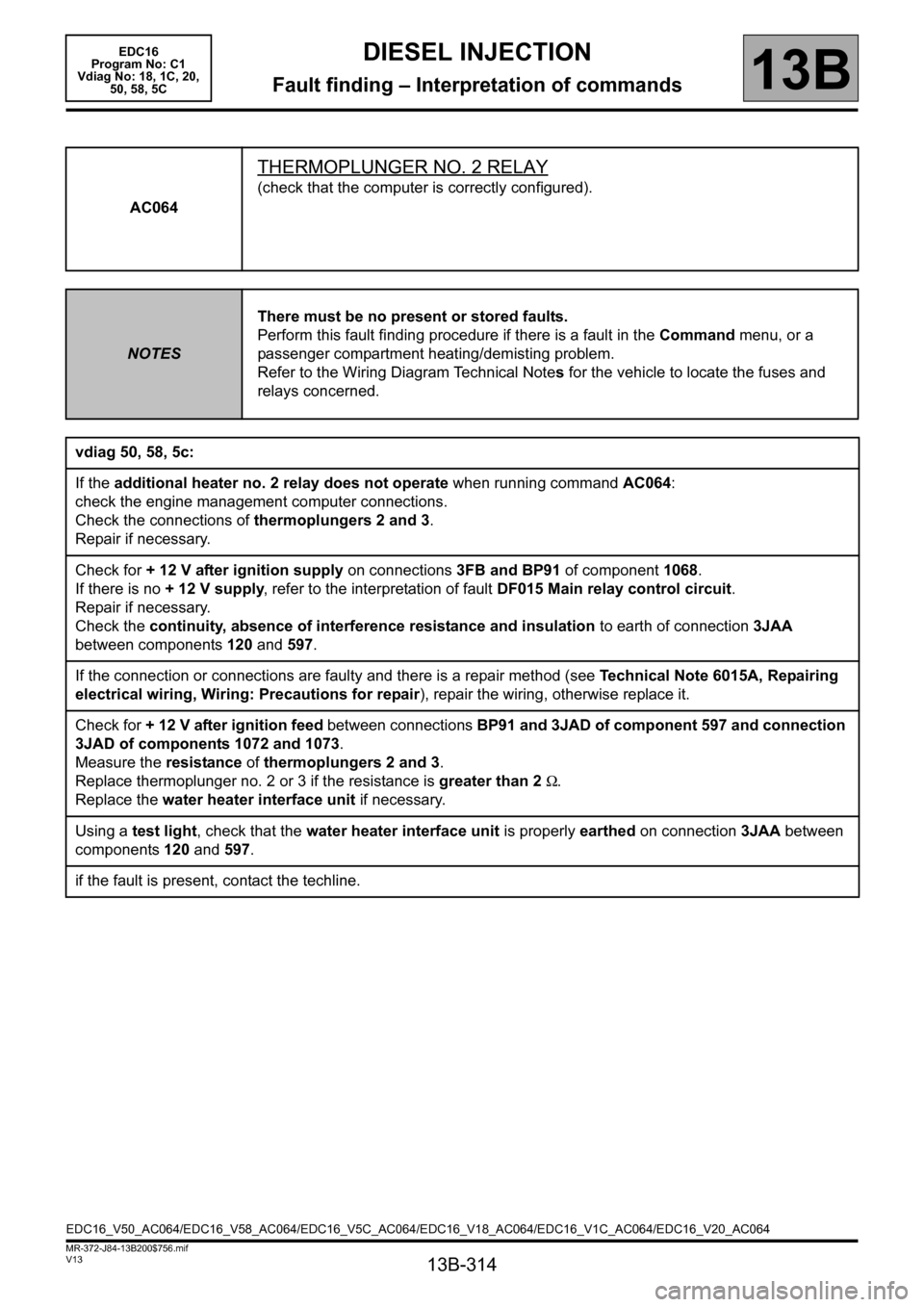
AC064
THERMOPLUNGER NO. 2 RELAY
(check that the computer is correctly configured).
NOTESThere must be no present or stored faults.
Perform this fault finding procedure if there is a fault in the Command menu, or a
passenger compartment heating/demisting problem.
Refer to the Wiring Diagram Technical Notes for the vehicle to locate the fuses and
relays concerned.
vdiag 50, 58, 5c:
If the additional heater no. 2 relay does not operate when running command AC064:
check the engine management computer connections.
Check the connections of thermoplungers 2 and 3.
Repair if necessary.
Check for + 12 V after ignition supply on connections 3FB and BP91 of component 1068.
If there is no + 12 V supply, refer to the interpretation of fault DF015 Main relay control circuit.
Repair if necessary.
Check the continuity, absence of interference resistance and insulation to earth of connection 3JAA
between components 120 and 597.
If the connection or connections are faulty and there is a repair method (see Technical Note 6015A, Repairing
electrical wiring, Wiring: Precautions for repair), repair the wiring, otherwise replace it.
Check for + 12 V after ignition feed between connections BP91 and 3JAD of component 597 and connection
3JAD of components 1072 and 1073.
Measure the resistance of thermoplungers 2 and 3.
Replace thermoplunger no. 2 or 3 if the resistance is greater than 2 Ω.
Replace the water heater interface unit if necessary.
Using a test light, check that the water heater interface unit is properly earthed on connection 3JAA between
components 120 and 597.
if the fault is present, contact the techline.
EDC16_V50_AC064/EDC16_V58_AC064/EDC16_V5C_AC064/EDC16_V18_AC064/EDC16_V1C_AC064/EDC16_V20_AC064
Page 315 of 365

13B-315
MR-372-J84-13B200$756.mif
V13
DIESEL INJECTION
Fault finding – Interpretation of commands
EDC16
Program No: C1
Vdiag No: 18, 1C, 20,
50, 58, 5C
13B
AC064
CONTINUED
vdiag 18, 1c, 20:
If the additional heater no. 2 relay does not operate when running command AC064,
check the additional heater no. 2 relay mounting,
check the connectors on the engine management computer.
Repair if necessary.
if the fault is still present, check as follows that this relay is controlled by the engine management computer:
Disconnect the additional heater no. 2 relay, fit a 50 Ω < X < 100 Ω resistor on the mounting in place of the coil,
and connect a voltmeter as follows:
Positive terminal to the +12 V battery.
Negative terminal to connection 3JAA of component 597.
Clear the fault and actuate the relay via command AC064.
If the voltmeter shows the battery voltage (two 2-second ON-OFF cycles), replace the additional heater 1 relay.
If the voltmeter does not show the battery voltage (two 2 second ON-OFF cycles), contact the Techline.
If the additional heater no. 2 relay is supplied by command AC064, but there is still a fault with the passenger
compartment heating and demisting, use the wiring diagram to check the following:
– the conformity of the thermoplunger maxi-fuse,
–+12V battery on connection BP91 of component 597,
– the conformity of the additional heater no. 2 relay,
– the continuity of connection 3JAD between components 597 and 1072.
– the conformity of the thermoplunger resistance: 0.40 Ω < X < 0.50 Ω at 20°C,
– the presence of earth at the water chamber (thermoplunger mounting).
Also check the level of the cooling circuit and that there are no leaks.
Carry out the necessary repairs.
Page 319 of 365

13B-319
MR-372-J84-13B200$828.mif
V13
EDC16
Program No.: C1
Vdiag no.: 18, 1C, 20,
50, 58, 5CDIESEL INJECTION
Fault finding – Fault Finding Chart13B
ALP 2 Starting difficult (or impossible)
NOTESBefore dealing with this customer complaint, check that there are no faults, and
the conformity (or otherwise) of the parameters and statuses using the
diagnostic tool.
If the customer complaint is not eliminated, perform the following checks.
Is it difficult or impossible to start the engine?
PART A:
Check the engine earths.
Ensure that the engine speed reaches 250 rpm with the starter motor, as displayed on the parameter screen (PR055
Engine speed).
If the engine speed is less than 250 rpm, refer to Technical Note 6014A, Checking the charging circuit.
If the engine speed shown on CLIP is zero and the engine is running, check the resistance of the engine speed
sensor between connections 3BG and 3BL of component 149:
Replace the sensor if its resistance is not 510 Ω < X < 850 Ω at 20°C
Check the continuity of the following connections:
– connection codes 3BG and 3BL between components 120 and 149.
Check the conformity of the engine earths (oxidation, tightness, etc.).
Check the mounting, the gap (if necessary refer to the information in the workshop repair manual for the vehicle) and
the condition of the sensor (overheating).
Replace if necessary.
Check the synchronisation of the camshaft sensors and the engine speed sensors with the display of ET238
Synchronisation.
If synchronisation is not active, refer to the checks described in DF195 Camshaft/engine speed consistency.
check the fuel circuit sealing.
If the fault is still present, see DF053 Rail pressure regulation function 2.DEF, step 4.
Check that the heater plugs are actuated using the AC001 Preheating unit command.
Check the sealing and condition of the inlet circuit: run Test 4 Turbocharged air inlet circuit check and follow the
associated fault finding procedure.
Check that there are no foreign bodies on the flowmeter grille: run Test 5 Air flowmeter and follow the associated
fault finding procedure.
Check the position of the exhaust gas recirculation valve.
Check that the exhaust is not blocked: run Test 1 Exhaust pipe check and follow the associated fault finding
procedure.
Check the consistency of the signal from the engine coolant temperature sensor.
Check the operation of the pressure regulator (see AC011 Rail pressure regulator).
Check the operation of the injectors (excessive return leak, clogging, seizing): run Test 9 Poor injector operation.
Check the engine timing (and the position of the high pressure pump sprocket).
Check the balance of the compressions, according to the power consumption during the starting phase
(Compression test menu on the CLIP Technic tool or using a compression gauge)
after the operation, clear the faults caused by disconnecting the regulator and the heater plugs.
End of part AImpossible
AFTER REPAIRCarry out a road test followed by a complete check with the diagnostic tool.
EDC16_V50_ALP2/EDC16_V58_ALP2/EDC16_V5C_ALP2/EDC16_V18_ALP2/EDC16_V1C_ALP2/EDC16_V20_ALP2
Page 321 of 365

13B-321
MR-372-J84-13B200$828.mif
V13
DIESEL INJECTION
Fault finding – Fault Finding Chart
EDC16
Program No.: C1
Vdiag no.: 18, 1C, 20,
50, 58, 5C
13B
ALP 3 Injection noise
NOTESBefore dealing with this customer complaint, check that there are no faults, and
the conformity (or otherwise) of the parameters and statuses using the
diagnostic tool.
If the customer complaint is not eliminated, perform the following checks.
If the injection noise occurs after starting from cold:
Check the low pressure diesel circuit priming.
Check the fuel heater supply.
Check the operation of the preheating system.
Check that fuel and engine temperatures are consistent.
If the injection noise occurs at idle speed:
Check the condition of the injector connector and pressure regulator terminals.
Check the conformity of the air flow signal, refer to the interpretation of PR132 Air flow or run Test 4
Turbocharged air inlet circuit check.
If the complaint is still present, perform fault finding on the injectors: run Test 9 Poor injector operation.
does the injection noise occur at all engine speeds?
Run fault finding on the injectors: run Test 9 Poor injector operation.
Check the condition of the injector connector and pressure regulator terminals.
Check the conformity of the fuel used by running Test 11 Diesel fuel conformity check.
If the diesel fuel is not correct: Replace the diesel fuel.
Change the diesel filter.
Bleed the low and high pressure diesel circuit.
Check the conformity of the air flow signal, use the interpretation of PR132 Air flow.
If the customer complaint is still present:
Run command AC011 Rail pressure regulator,
check the following parameters:
– the conformity of the fuel pressure between PR008 Rail pressure setpoint and PR038 Rail pressure,
– the conformity of the pump fuel flow between PR157 Fuel flow setpoint and PR017 Fuel flow. If the fault is
still present, contact the techline.
AFTER REPAIRCarry out a road test followed by a complete check with the diagnostic tool.
EDC16_V50_ALP3/EDC16_V58_ALP3/EDC16_V5C_ALP3/EDC16_V18_ALP3/EDC16_V1C_ALP3/EDC16_V20_ALP3
Page 365 of 365
13B-365
MR-372-J84-13B200$972.mif
V13
13B
DIESEL INJECTION
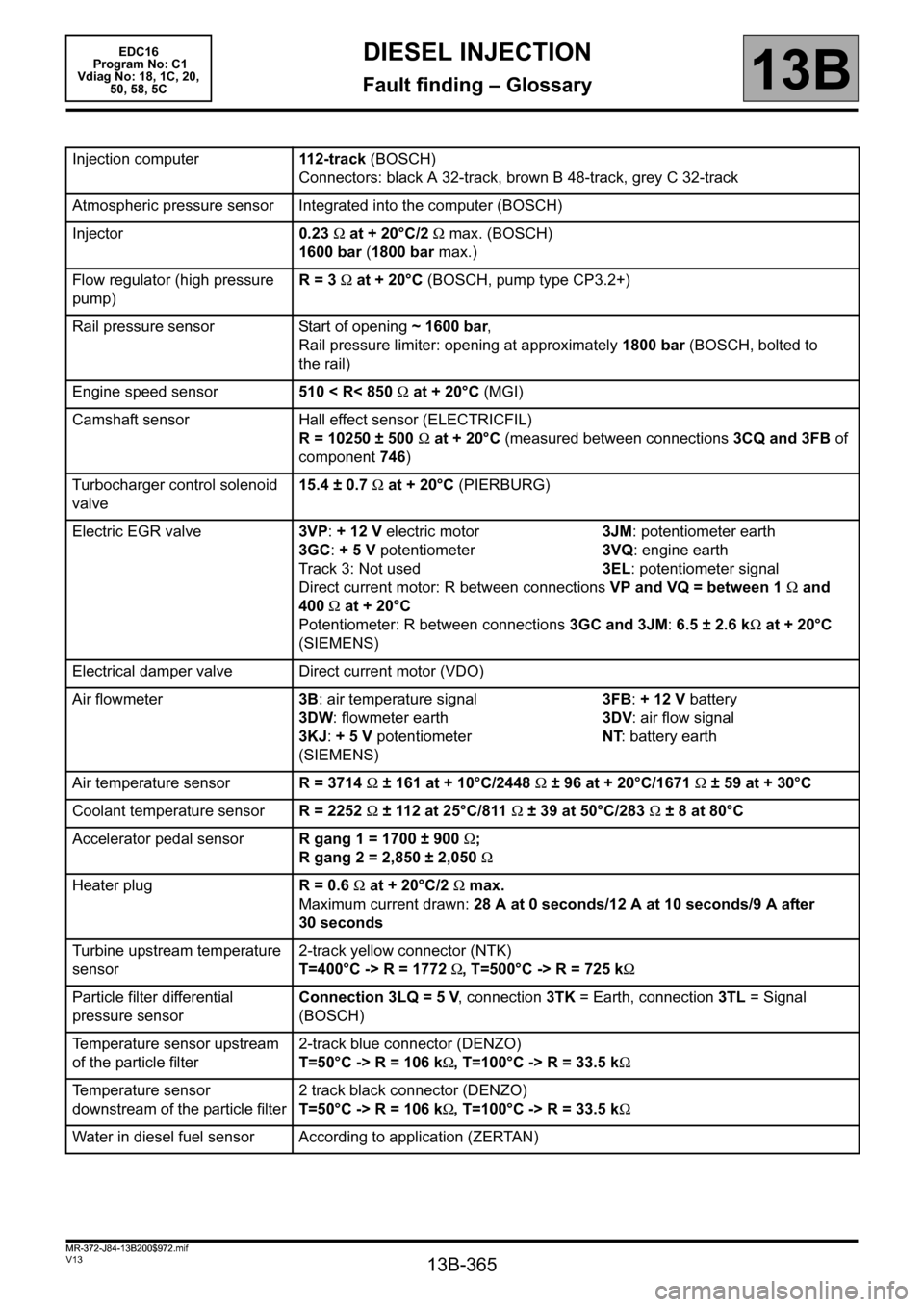
Fault finding – Glossary
Injection computer112-track (BOSCH)
Connectors: black A 32-track, brown B 48-track, grey C 32-track
Atmospheric pressure sensor Integrated into the computer (BOSCH)
Injector0.23 Ω at + 20°C/2 Ω max. (BOSCH)
1600 bar (1800 bar max.)
Flow regulator (high pressure
pump)R = 3 Ω at + 20°C (BOSCH, pump type CP3.2+)
Rail pressure sensor Start of opening ~ 1600 bar,
Rail pressure limiter: opening at approximately 1800 bar (BOSCH, bolted to
the rail)
Engine speed sensor510 < R< 850 Ω at + 20°C (MGI)
Camshaft sensor Hall effect sensor (ELECTRICFIL)
R = 10250 ± 500 Ω at + 20°C (measured between connections 3CQ and 3FB of
component 746)
Turbocharger control solenoid
valve15.4 ± 0.7 Ω at + 20°C (PIERBURG)
Electric EGR valve3VP: + 12 V electric motor 3JM: potentiometer earth
3GC: + 5 V potentiometer 3VQ: engine earth
Track 3: Not used 3EL: potentiometer signal
Direct current motor: R between connections VP and VQ = between 1 Ω and
400 Ω at + 20°C
Potentiometer: R between connections 3GC and 3JM: 6.5 ± 2.6 kΩ at + 20°C
(SIEMENS)
Electrical damper valve Direct current motor (VDO)
Air flowmeter3B: air temperature signal 3FB: + 12 V battery
3DW: flowmeter earth 3DV: air flow signal
3KJ: + 5 V potentiometer NT: battery earth
(SIEMENS)
Air temperature sensorR = 3714
Ω ± 161 at + 10°C/2448 Ω ± 96 at + 20°C/1671 Ω ± 59 at + 30°C
Coolant temperature sensorR = 2252 Ω ± 112 at 25°C/811 Ω ± 39 at 50°C/283 Ω ± 8 at 80°C
Accelerator pedal sensorR gang 1 = 1700 ± 900 Ω;
R gang 2 = 2,850 ± 2,050Ω
Heater plugR = 0.6 Ω at + 20°C/2 Ω max.
Maximum current drawn: 28 A at 0 seconds/12 A at 10 seconds/9 A after
30 seconds
Turbine upstream temperature
sensor2-track yellow connector (NTK)
T=400°C -> R = 1772 Ω, T=500°C -> R = 725 kΩ
Particle filter differential
pressure sensorConnection 3LQ = 5 V, connection 3TK = Earth, connection 3TL = Signal
(BOSCH)
Temperature sensor upstream
of the particle filter2-track blue connector (DENZO)
T=50°C -> R = 106 kΩ, T=100°C -> R = 33.5 kΩ
Temperature sensor
downstream of the particle filter2 track black connector (DENZO)
T=50°C -> R = 106 kΩ, T=100°C -> R = 33.5 kΩ
Water in diesel fuel sensor According to application (ZERTAN)
MR-372-J84-13B200$972.mif
EDC16
Program No: C1
Vdiag No: 18, 1C, 20,
50, 58, 5C