Page 262 of 472
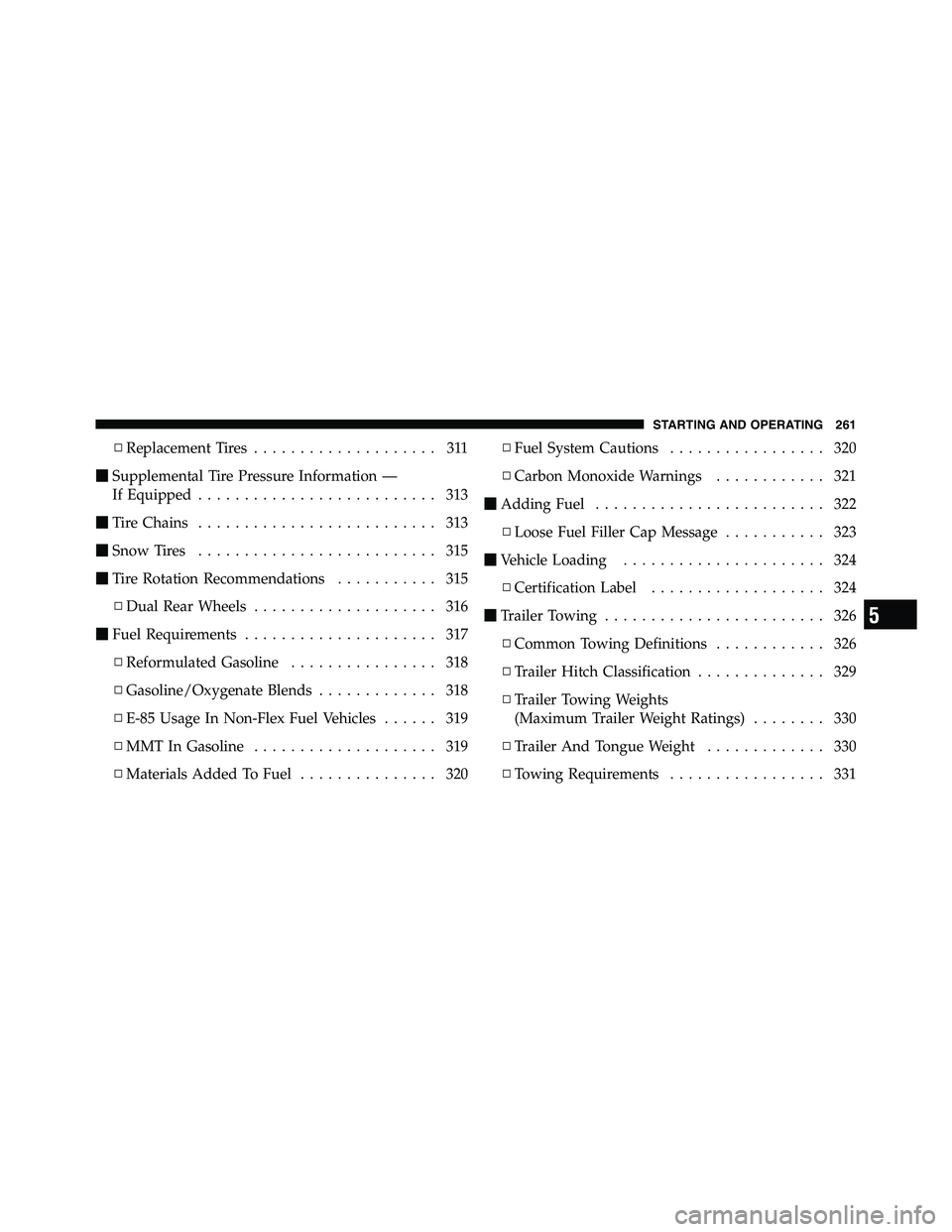
▫ Replacement Tires .................... 311
� Supplemental Tire Pressure Information —
If Equipped .......................... 313
� Tire Chains .......................... 313
� Snow Tires .......................... 315
� Tire Rotation Recommendations ........... 315
▫ Dual Rear Wheels .................... 316
� Fuel Requirements ..................... 317
▫ Reformulated Gasoline ................ 318
▫ Gasoline/Oxygenate Blends ............. 318
▫ E-85 Usage In Non-Flex Fuel Vehicles ...... 319
▫ MMT In Gasoline .................... 319
▫ Materials Added To Fuel ............... 320 ▫ Fuel System Cautions ................. 320
▫ Carbon Monoxide Warnings ............ 321
� Adding Fuel ......................... 322
▫ Loose Fuel Filler Cap Message ........... 323
� Vehicle Loading ...................... 324
▫ Certification Label ................... 324
� Trailer Towing ........................ 326
▫ Common Towing Definitions ............ 326
▫ Trailer Hitch Classification .............. 329
▫ Trailer Towing Weights
(Maximum Trailer Weight Ratings) ........ 330
▫ Trailer And Tongue Weight ............. 330
▫ Towing Requirements ................. 331
5 STARTING AND OPERATING 261
Page 263 of 472
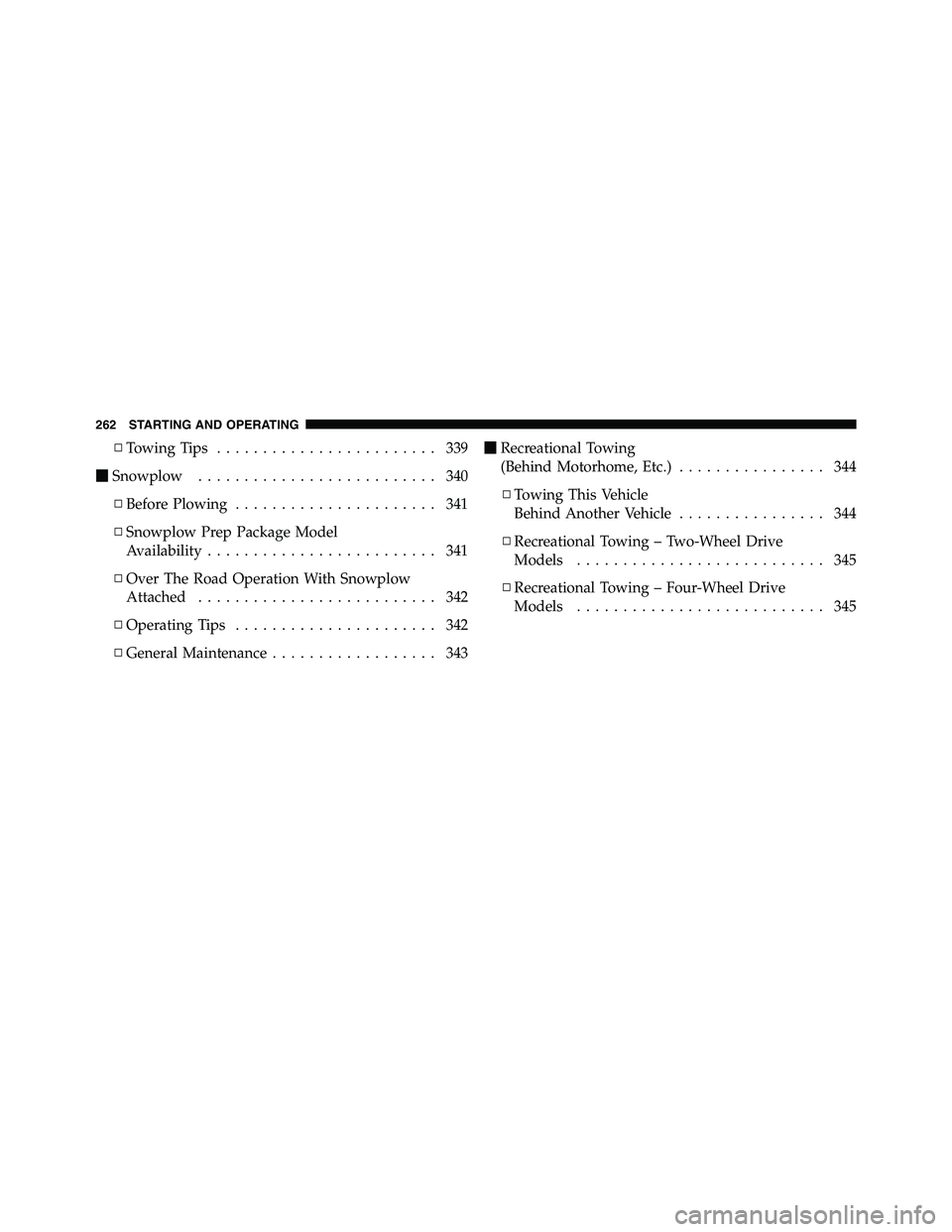
▫ Towing Tips ........................ 339
� Snowplow .......................... 340
▫ Before Plowing ...................... 341
▫ Snowplow Prep Package Model
Availability ......................... 341
▫ Over The Road Operation With Snowplow
Attached .......................... 342
▫ Operating Tips ...................... 342
▫ General Maintenance .................. 343 � Recreational Towing
(Behind Motorhome, Etc.) ................ 344
▫ Towing This Vehicle
Behind Another Vehicle ................ 344
▫ Recreational Towing – Two-Wheel Drive
Models ........................... 345
▫ Recreational Towing – Four-Wheel Drive
Models ........................... 345262 STARTING AND OPERATING
Page 268 of 472

WARNING! (Continued)• Unintended movement of a vehicle could injure
those in and near the vehicle. As with all vehicles,
you should never exit a vehicle while the engine is
running. Before exiting a vehicle, you should
always shift the transmission into PARK, remove
the key fob from the ignition, and apply the
parking brake. Once the key fob is removed from
the ignition, the shift lever is locked in the PARK
position, securing the vehicle against unwanted
movement. Furthermore, you should never leave
unattended children inside a vehicle.
Key Ignition Park Interlock
This vehicle is equipped with a Key Ignition Park Inter-
lock which requires the shift lever to be placed in PARK
prior to rotating the ignition switch to the LOCK posi-
tion. The key fob can only be removed from the ignition switch when the ignition switch is in the LOCK position
and once removed the shift lever is locked in PARK.
Brake/Transmission Shift Interlock System
This vehicle is equipped with a Brake Transmission Shift
Interlock System (BTSI) that holds the shift lever in the
PARK position when the ignition switch is in the LOCK
position. To move the shift lever out of the PARK
position, the ignition switch must be turned to any other
ignition switch position (ACC, ON, or START) (engine
running or not) and the brake pedal must be pressed.
Brake/Transmission Interlock Manual Override
There is an override for the BTSI that allows you to move
the shift lever out of the PARK position if an electrical
system malfunction occurs (i.e., dead battery).
1. Turn the ignition switch to the ACC or ON position
without starting the engine.
2. Tilt the steering wheel to the full up position
5 STARTING AND OPERATING 267
Page 271 of 472

the transmission and display 5 (ERS 5 is the same as
normal fourth gear). Another tap down (-) will shift the
transmission down to ERS 4 (direct gear).
To exit ERS mode, press and hold the top of the switch/
shift lever in the (+) direction until “D” is once again
highlighted in the instrument cluster display.
WARNING!Do not downshift for additional engine braking on a
slippery surface. The drive wheels could lose their
grip and the vehicle could skid.
Screen Display 12345D
Actual Gear(s)
Allowed 1 1-2 1-3 1-4 1-5 1-5 NOTE: To select the proper gear position for maximum
deceleration (engine braking), press and hold the ERS (-)
button. The transmission will shift to the lowest range
possible without overspeeding the engine.
Gear Ranges
Do not race the engine when shifting from PARK or
NEUTRAL position into another gear range.
PARK
This range supplements the parking brake by locking the
transmission. The engine can be started in this range.
Never use PARK while the vehicle is in motion. Apply
the parking brake when leaving the vehicle in this range.
Always apply the parking brake first, then place the shift
lever in the PARK position. On four-wheel drive vehicles,
be sure that the transfer case is in a DRIVE position.270 STARTING AND OPERATING
Page 275 of 472

the upper gears. When the vehicle speed drops or during
acceleration when the transmission downshifts to second
gear, the clutch automatically disengages.
NOTE:
• The torque converter clutch will not engage until the
transmission fluid and engine coolant (antifreeze) are
warm [usually after 1 to 3 miles (1.6 to 4.8 km) of
driving]. Because the engine speed is higher when the
torque converter clutch is not engaged, it may seem as
if the transmission is not shifting into Overdrive when
cold. This is normal. Pressing the “TOW/HAUL”
switch when the transmission is sufficiently warm will
demonstrate that the transmission is able to shift into
and out of Overdrive.
• If the vehicle has not been driven in several days, the
first few seconds of operation after shifting the trans-
mission into gear may seem sluggish. This is due to the
fluid partially draining from the torque converter into the transmission. This condition is normal and will not
cause damage to the transmission. The torque con-
verter will refill within five seconds of shifting from
PARK into any other gear position.
FOUR-WHEEL DRIVE OPERATION —
IF EQUIPPED
Four-wheel drive trucks are equipped with either a
manually shifted transfer case or an electronically shifted
transfer case. Refer to the operating instructions for your
transfer case, located in this section for further informa-
tion.
Manually Shifted Transfer Case – If Equipped
The transfer case provides four mode positions.
• Two-wheel drive high range (2H)
• Four-wheel drive high range (4H)
• Neutral (N)274 STARTING AND OPERATING
Page 276 of 472

• Four-wheel drive low range (4L)
This transfer case is intended to be driven in the 2H
position for normal street and highway conditions such
as dry, hard surfaced roads.
When additional traction is required, the 4H and 4L
positions can be used to lock the front and rear drive-
shafts together and force the front and rear wheels to
rotate at the same speed. This is accomplished by simply
moving the shift lever to the desired positions. The 4H
and 4L positions are intended for loose, slippery road
surfaces only. Driving in the 4H and 4L positions on dry,
hard surfaced roads may cause increased tire wear and
damage to the driveline components.
The “Transfer Case Position Indicator Light” in the
instrument cluster will alert the driver that the vehicle is
in four-wheel drive and that the front and rear drive-
shafts are locked together. This light will illuminate when the transfer case is shifted into either the 4H or 4L
position. There is no light for the 2H or NEUTRAL
positions.
When operating your vehicle in 4L, the engine speed is
approximately three times that of the 2H or 4H positions
at a given road speed. Take care not to overspeed the
engine and do not exceed 25 mph (40 km/h).
Proper operation of four-wheel drive vehicles depends
on tires of equal size, type and circumference on each
wheel. Any difference will adversely affect shifting and
can cause damage to the transfer case.
NOTE: Do not attempt to make a shift while only the
front or rear wheels are spinning. The transfer case is not
equipped with a synchronizer and therefore the front and
rear driveshaft speeds must be equal for the shift to take
place. Shifting while only the front or rear wheels are
spinning can cause damage to the transfer case.
5 STARTING AND OPERATING 275
Page 277 of 472

Because four-wheel drive provides improved traction,
there is a tendency to exceed safe turning and stopping
speeds. Do not go faster than road conditions permit.
NOTE: Delayed shifts out of four-wheel drive may be
experienced due to uneven tire wear, low or uneven tire
pressures, excessive vehicle loading, or cold tempera-
tures.
WARNING!You or others could be injured if you leave the
vehicle unattended with the transfer case in the
NEUTRAL position without first fully engaging the
parking brake. The transfer case NEUTRAL position
disengages both the front and rear driveshafts from
the powertrain and will allow the vehicle to move
regardless of the transmission position. The parking
brake should always be applied when the driver is
not in the vehicle. For additional information on the appropriate use of each
transfer case mode position, see the information below:
2H
Rear-Wheel Drive High Range - This range is for normal
street and highway driving on dry hard surfaced roads.
4H
Four-Wheel Drive High Range - This range locks the
front and rear driveshafts together forcing the front and
rear wheels to rotate at the same speed. Additional
traction for loose, slippery road surfaces only.
N
Neutral - This range disengages the front and rear
driveshafts from the powertrain. To be used for flat
towing behind another vehicle. Refer to “Recreational
Towing” in “Starting and Operating” for further
information.276 STARTING AND OPERATING
Page 278 of 472

4L
Four-Wheel Drive Low Range - This range locks the front
and rear driveshafts together forcing the front and rear
wheels to rotate at the same speed. Additional traction
and maximum pulling power for loose, slippery road
surfaces only. Do not exceed 25 mph (40 km/h).
Shifting Procedure – Manually Shifted Transfer
Case
2H ⇔ 4H
Shifting between 2H and 4H can be made with the
vehicle stopped or in motion. If the vehicle is in motion,
shifts can be made up to 55 mph (88 km/h). With the
vehicle in motion, the transfer case will engage/
disengage faster if you momentarily release the accelera-
tor pedal after completing the shift. Apply a constant
force when shifting the transfer case lever. 2H or 4H ⇔ 4L
With the vehicle rolling at 2 to 3 mph (3 to 5 km/h), shift
the transmission into NEUTRAL. While the vehicle is
coasting at 2 to 3 mph (3 to 5 km/h), shift the transfer
case lever firmly to the desired position. Do not pause in
transfer case NEUTRAL.
NOTE:
• Pausing in transfer case NEUTRAL in vehicles
equipped with an automatic transmission may require
shutting the engine OFF to avoid gear clash while
completing the shift. If difficulty occurs, shift the
transmission into NEUTRAL, hold foot on brake, and
turn the engine OFF. Make shift to the desired mode.
• Shifting into or out of 4L is possible with the vehicle
completely stopped, however difficulty may occur due
to the mating clutch teeth not being properly aligned.
Several attempts may be required for clutch teeth
alignment and shift completion to occur. The preferred
5 STARTING AND OPERATING 277