Page 151 of 472
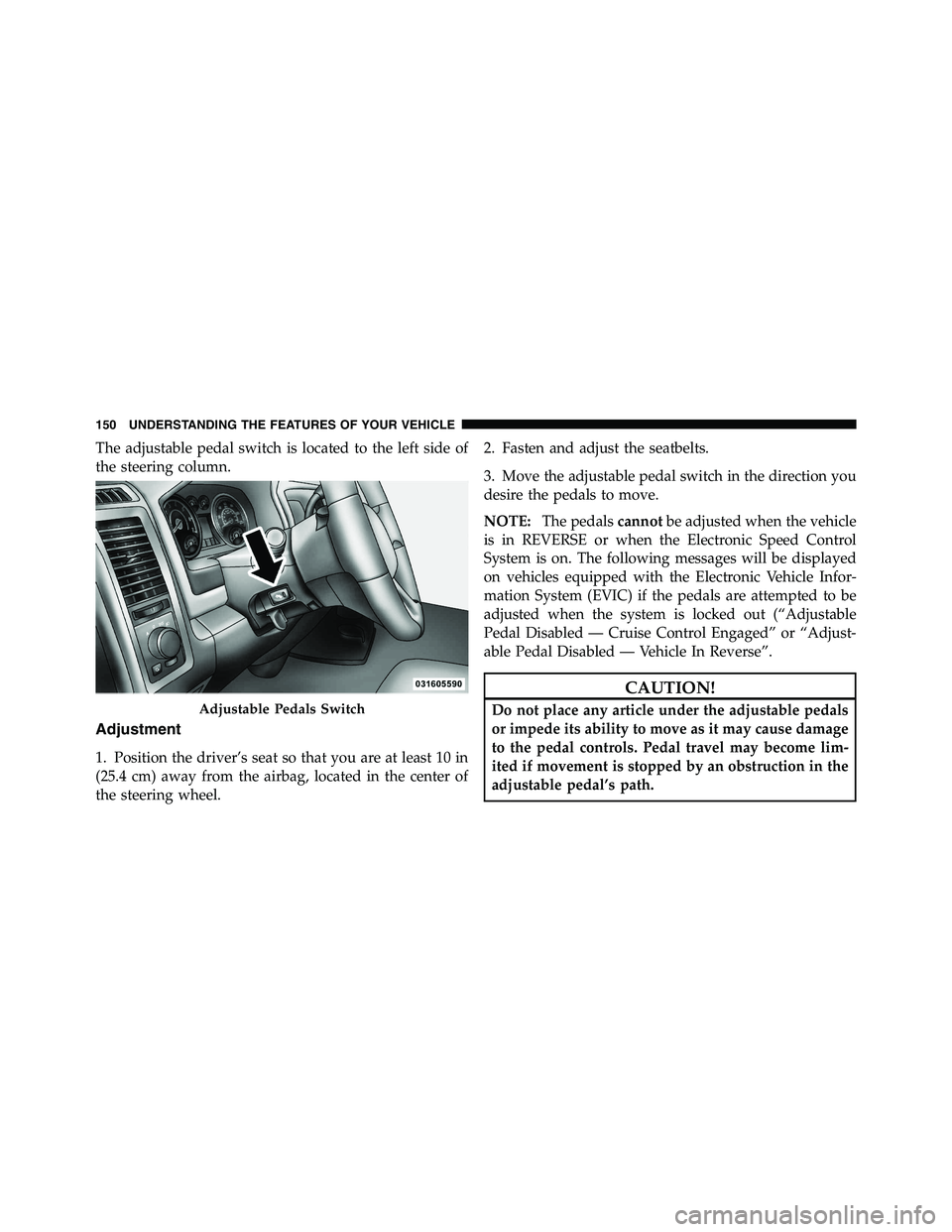
The adjustable pedal switch is located to the left side of
the steering column.
Adjustment
1. Position the driver’s seat so that you are at least 10 in
(25.4 cm) away from the airbag, located in the center of
the steering wheel. 2. Fasten and adjust the seatbelts.
3. Move the adjustable pedal switch in the direction you
desire the pedals to move.
NOTE: The pedals cannot be adjusted when the vehicle
is in REVERSE or when the Electronic Speed Control
System is on. The following messages will be displayed
on vehicles equipped with the Electronic Vehicle Infor-
mation System (EVIC) if the pedals are attempted to be
adjusted when the system is locked out (“Adjustable
Pedal Disabled — Cruise Control Engaged” or “Adjust-
able Pedal Disabled — Vehicle In Reverse”.
CAUTION!Do not place any article under the adjustable pedals
or impede its ability to move as it may cause damage
to the pedal controls. Pedal travel may become lim-
ited if movement is stopped by an obstruction in the
adjustable pedal’s path.Adjustable Pedals Switch150 UNDERSTANDING THE FEATURES OF YOUR VEHICLE
Page 152 of 472

WARNING!Do not adjust the pedals while the vehicle is moving.
You could lose control and have an accident. Always
adjust the pedals while the vehicle is parked.
HEATED STEERING WHEEL — IF EQUIPPED
The steering wheel contains a heating element that helps
warm your hands in cold weather. The heated steering
wheel has only one temperature setting. Once the heated
steering wheel has been turned on it will operate for
approximately 58 to 70 minutes before automatically
shutting off. The heated steering wheel can shut off early
or may not turn on when the steering wheel is already
warm.
The heated steering wheel switch is located on the switch
bank below the climate controls. Press the switch to turn on the heated
steering wheel. The light on the switch
will illuminate to indicate the steering
wheel heater is on. Pressing the switch
a second time will turn off the heated
steering wheel and light indicator.
NOTE: The engine must be running for the heated
steering wheel to operate.
Vehicles Equipped with Remote Start
On models that are equipped with remote start, the
heated steering wheel seat can be programmed to come
on during a remote start. Refer to “Remote Starting
System — If Equipped” in “Things to Know Before
Starting Your Vehicle” for further information.
3 UNDERSTANDING THE FEATURES OF YOUR VEHICLE 151
Page 153 of 472

WARNING!• Persons who are unable to feel pain to the skin
because of advanced age, chronic illness, diabetes,
spinal cord injury, medication, alcohol use, ex-
haustion, or other physical conditions must exer-
cise care when using the steering wheel heater. It
may cause burns even at low temperatures, espe-
cially if used for long periods.
• Do not place anything on the steering wheel that
insulates against heat, such as a blanket or cush-
ion. This may cause the steering wheel heater to
overheat.
ELECTRONIC SPEED CONTROL — IF EQUIPPED
When engaged, Electronic Speed Control takes over the
accelerator operation at speeds greater than 25 mph
(40 km/h). The Electronic Speed Control lever is located
on the right side of the steering wheel. NOTE: In order to ensure proper operation, the Elec-
tronic Speed Control System has been designed to shut
down if multiple Speed Control functions are operated at
the same time. If this occurs, the Electronic Speed Control
System can be reactivated by pushing the Electronic
Speed Control ON/OFF button and resetting the desired
vehicle set speed. Electronic Speed Control Lever152 UNDERSTANDING THE FEATURES OF YOUR VEHICLE
Page 176 of 472

� Uconnect™ Multimedia (Satellite Radio) —
If Equipped (REN/RER/RES Radios Only) .... 240
▫ System Activation .................... 240
▫ Electronic Serial Number/Sirius
Identification Number (ESN/SID) ......... 241
▫ Selecting Uconnect™ Multimedia (Satellite)
Mode ............................. 241
▫ Satellite Antenna ..................... 241
▫ Reception Quality .................... 242
▫ Operating Instructions - Uconnect™
Multimedia (Satellite) Mode ............. 242
▫ Operating Instructions - Uconnect™ Phone
(If Equipped) ....................... 244
� Steering Wheel Audio Controls — If Equipped . . 245
▫ Radio Operation ..................... 245 ▫ CD Player ......................... 246
� CD/DVD Disc Maintenance .............. 246
� Radio Operation And Cellular Phones ....... 247
� Climate Controls ...................... 247
▫ Manual Heating And Air Conditioning
System ............................ 248
▫ Automatic Temperature Control (ATC) —
If Equipped ........................ 252
▫ Summer Operation ................... 256
▫ Winter Operation .................... 257
▫ Vacation/Storage .................... 257
▫ Window Fogging And Frosting .......... 257
▫ Outside Air Intake ................... 257
▫ Operating Tips ...................... 2584 UNDERSTANDING YOUR INSTRUMENT PANEL 175
Page 181 of 472

CAUTION!Driving with a hot engine cooling system could
damage your vehicle. If temperature gauge reads “H”
pull over and stop the vehicle. Idle the vehicle with
the air conditioner turned off until the pointer drops
back into the normal range. If the pointer remains on
the “H” and you hear continuous chimes, turn the
engine off immediately, and call an authorized deal-
ership for service.
WARNING!A hot engine cooling system is dangerous. You or
others could be badly burned by steam or boiling
coolant. You may want to call an authorized dealer-
ship for service if your vehicle overheats. If you
decide to look under the hood yourself, see “Main-
taining Your Vehicle”. Follow the warnings under the
Cooling System Pressure Cap paragraph. 5. Speedometer
The speedometer shows the vehicle speed in miles per
hour and/or kilometers per hour (mph/km/h).
6. 4 LOW
This light alerts the driver that the vehicle is in
the four-wheel drive LOW mode. The front and
rear driveshafts are mechanically locked to-
gether forcing the front and rear wheels to
rotate at the same speed. Low range provides a greater
gear reduction ratio to provide increased torque at the
wheels.
7. Electronic Throttle Control (ETC) Light
This light informs you of a problem with the
Electronic Throttle Control (ETC) system. The
light will come on when the ignition is first
turned to ON/RUN and remain on briefly as a
bulb check. If the light does not come on during starting,
have the system checked by an authorized dealer.180 UNDERSTANDING YOUR INSTRUMENT PANEL
Page 182 of 472

If a problem is detected, the light will come on while the
engine is running. Cycle the ignition key when the
vehicle has completely stopped and the shift lever is
placed in the PARK position, the light should turn off.
If the light remains lit with the engine running, your
vehicle will usually be drivable; however, see an autho-
rized dealer for service as soon as possible. If the light is
flashing when the engine is running, immediate service is
required and you may experience reduced performance,
an elevated/rough idle or engine stall and your vehicle
may require towing.
For vehicles equipped with a premium cluster this indi-
cator will display in the Electronic Vehicle Information
Center (EVIC). Refer to ”Electronic Vehicle Information
Center (EVIC) — If Equipped” for further information. 8. 4WD Indicator
This light indicates the vehicle is in four-wheel
drive and 4LOCK. 4WD allows all four wheels
to receive torque from the engine simulta-
neously.
9. SERV (Service) 4WD
The SERV 4WD light monitors the electric shift
four-wheel drive system. If the SERV 4WD
light stays on or comes on during driving, it
means that the four-wheel drive system is not
functioning properly and that service is required.
For vehicles equipped with a premium cluster this indi-
cator will display in the Electronic Vehicle Information
Center (EVIC). Refer to ”Electronic Vehicle Information
Center (EVIC) — If Equipped” for further information.
4 UNDERSTANDING YOUR INSTRUMENT PANEL 181
Page 192 of 472

27. Transmission Temperature Warning Light
This light indicates that there is excessive trans-
mission fluid temperature that might occur
with severe usage such as trailer towing. It may
also occur when operating the vehicle in a high
torque converter slip condition, such as 4-wheel-drive
operation (e.g., snow plowing, off- road operation). If this
light comes on, stop the vehicle and run the engine at idle
or faster, with the transmission in NEUTRAL until the
light goes off.
CAUTION!Continuous driving with the Transmission Tempera-
ture Warning Light illuminated will eventually cause
severe transmission damage or transmission failure. WARNING!Continued operation with the Transmission Tem-
perature Warning Light illuminated could cause the
fluid to boil over, come in contact with hot engine or
exhaust components causing a fire that may result in
personal injury.
For vehicles equipped with a premium cluster this warn-
ing light will display in the Electronic Vehicle Informa-
tion Center (EVIC). Refer to ”Electronic Vehicle Informa-
tion Center (EVIC) — If Equipped” for further
information.
28. Seat Belt Reminder Light
When the ignition switch is first turned to ON/
RUN, this light will turn on for five to eight
seconds as a bulb check. During the bulb check, if
the driver’s seat belt is unbuckled, a chime will sound.
After the bulb check or when driving, if the driver’s seat 4 UNDERSTANDING YOUR INSTRUMENT PANEL 191
Page 194 of 472
NOTE: The compass on your vehicle is self-calibrating,
eliminating the need to manually calibrate the compass. This system conveniently allows the driver to select a
variety of useful information by pressing the switches
mounted on the steering wheel. The EVIC consists of the
following:
• Vehicle Info display
• Vehicle information warning message displays
• Customer-Programmable Features (System Setup)
• Compass display
• Outside temperature display
• Trip computer functions
• Distance To Empty (DTE) display
• Average Fuel Economy
• Audio Modes displayElectronic Vehicle Information Center (EVIC)
4 UNDERSTANDING YOUR INSTRUMENT PANEL 193
