Page 72 of 170

REVERSE
This range should be used only after the vehicle has come
to a complete stop.
NEUTRAL
Use this range when the vehicle is standing for prolonged
periods with the engine running. The engine may be
started in this range. Set the parking brake if you must
leave the vehicle.
DRIVE
This range provides all forward gears, including fourth
gear direct, fifth and sixth. Use this range for most city
and highway driving. Upshifts into both overdrive gears,
fifth and sixth, will be delayed when the transmission
fluid temperature is between -4°F (-20°C) and 41°F (5°C).
During very cold conditions when the transmission fluid
is below -4°F (-20°C), the transmission will be limited to
third gear. Normal operation will return after the trans-
mission fluid warms up.NOTE:
Use caution when operating a heavily loaded
vehicle in second or first gear selections in high ambients
as torque converter slip can impose significant additional
heat load on the cooling system.
Overdrive Operation
The Overdrive automatic transmission contains an elec-
tronically controlled fifth and sixth gear. The transmis-
sion will automatically shift from DRIVE to fifth or sixth
gear if the following conditions are present:
•the shift lever is in DRIVE;
•the engine coolant has reached normal operating tem-
perature;
•vehicle speed is above approximately 38 mph
(61 km/h) for fifth gear and 50 mph (80 km/h) for
sixth gear;
•the “TOW/HAUL” switch has not been activated
(sixth gear is inhibited in “TOW/HAUL” mode);
4
STARTING AND OPERATING 71
Page 73 of 170

•transmission has reached normal operating
temperature.
NOTE: If the vehicle is started in extremely cold tem-
peratures, the transmission shift schedule initially re-
stricts transmission operation in forward gear ranges to
third gear until the transmission fluid temperature rises
to a suitable level. During this condition, the ability of the
vehicle to accelerate under heavily loaded conditions
may be reduced. Refer to the “Note” under “Torque
Converter Clutch” in this section.
If the transmission temperature gets extremely hot, the
transmission will automatically select the most desirable
gear for operation at this temperature. If the transmission
temperature becomes hot enough, the “Transmission
Temperature Warning Light” may illuminate. After cool
down, the transmission will resume normal operation. The transmission will downshift from Overdrive to Drive
if the accelerator pedal is fully pressed at vehicle speeds
above approximately 35 to 40 mph (57 to 65 km/h).
When To Use “TOW/HAUL” Mode
When driving in hilly areas, towing a trailer, carrying a
heavy load, etc., and frequent transmission shifting oc-
curs, press the “TOW/HAUL” switch once to select the
“TOW/HAUL” mode. This will improve performance
and reduce the potential for transmission overheating or
failure due to excessive shifting. When operating in
“TOW/HAUL” mode, sixth gear is disabled and 2-3 and
3-4 and 4–5 shift patterns are modified. Shifts into
Overdrive (fifth gear) are allowed during steady cruise
(for improved fuel economy). When “TOW/HAUL”
mode is selected, the transmission may automatically
downshift into a lower gear to improve engine braking
performance when the throttle pedal is not pressed.
72 STARTING AND OPERATING
Page 75 of 170
![Ram 3500 2011 Diesel Supplement NOTE:
•The torque converter clutch will not engage until the
transmission fluid and engine coolant are warm [usu-
ally after 1-3 miles (1.6 - 4.8 km) of driving]. Because
the engine speed is higher](/manual-img/34/12592/w960_12592-74.png "Ram 3500 2011 Diesel Supplement NOTE:
•The torque converter clutch will not engage until the
transmission fluid and engine coolant are warm [usu-
ally after 1-3 miles (1.6 - 4.8 km) of driving]. Because
the engine speed is higher")
NOTE:
•The torque converter clutch will not engage until the
transmission fluid and engine coolant are warm [usu-
ally after 1-3 miles (1.6 - 4.8 km) of driving]. Because
the engine speed is higher when the torque converter
clutch is not engaged, it may seem as if the transmis-
sion is not shifting into Overdrive when cold. This is
normal. Pressing the “TOW/HAUL” switch when the
transmission is sufficiently warm will demonstrate
that the transmission is able to shift into and out of
Overdrive.
•If the vehicle has not been driven in several days, the
first few seconds of operation after shifting the trans-
mission into gear may seem sluggish. This is due to the
fluid partially draining from the torque converter into
the transmission. This condition is normal and will not
cause damage to the transmission. The torque con-
verter will refill within five seconds of shifting from
PARK into any other gear position.
MANUAL TRANSMISSION — IF EQUIPPED
WARNING!
You or others could be injured if you leave the
vehicle unattended without having the parking
brake fully applied. The parking brake should al-
ways be applied when the driver is not in the vehicle,
especially on an incline.
CAUTION!
Never drive with your foot resting on the clutch
pedal, or attempt to hold the vehicle on a hill with the
clutch pedal partially engaged, as this will cause
abnormal wear on the clutch.
NOTE: During cold weather, you may experience in-
creased effort in shifting until the transmission fluid
warms up. This is normal.
74 STARTING AND OPERATING
Page 91 of 170

JUMP STARTING
WARNING!
•To prevent personal injury or damage to clothing,
do not allow battery fluid to contact eyes, skin or
fabrics. Do not lean over a battery when connect-
ing jumper cables or allow cable clamps to touch
each other. Keep open flames or sparks away from
battery vent holes. Always wear eye protection
when working with batteries.
•Do not use a booster battery or any other booster
source that has a greater than 12 Volt system, i.e.,
do not use a 24 Volt power source.NOTE:
Replacement batteries should both be of equal
size to prevent damage to the vehicle’s charging system.
Your vehicle is equipped with two 12 Volt batteries. If it
becomes necessary to use a booster battery with jumper
cables to start a vehicle’s engine because its batteries are
discharged, the following procedure should be used:
Set the parking brake and place an automatic transmis-
sion in PARK (or NEUTRAL for a manual transmission).
Turn off lights, heater and other electrical loads. Observe
charge indicator (if equipped) in both batteries. If the
indicator (if equipped) is light or yellow on either battery,
replace that battery.
90 WHAT TO DO IN EMERGENCIES
Page 96 of 170
MAINTAINING YOUR VEHICLE
CONTENTS
�Engine Compartment — 6.7L Diesel ......... 97
� Maintenance Procedures .................. 98
▫ Engine Oil .......................... 98
▫ Engine Air Cleaner Filter ............... 102
▫ Draining Fuel/Water Separator Filter ...... 104
▫ Priming If The Engine Has Run Out Of
Fuel .............................. 108
▫ Intervention Regeneration Strategy – EVIC
Message Process Flow ................. 109
▫ Diesel Exhaust Fluid – Chassis Cab Only . . . 112 ▫
Maintenance-Free Batteries ............. 112
▫ Cooling System ..................... 113
▫ Charge Air Cooler – Inter-Cooler ......... 119
▫ Brake System ....................... 119
▫ Clutch Hydraulic System ............... 121
▫ Transfer Case – If Equipped ............. 121
▫ Manual Transmission – If Equipped ....... 121
▫ Automatic Transmission – If Equipped ..... 122
▫ Noise Control System Required Maintenance
& Warranty ........................ 125
6
Page 98 of 170
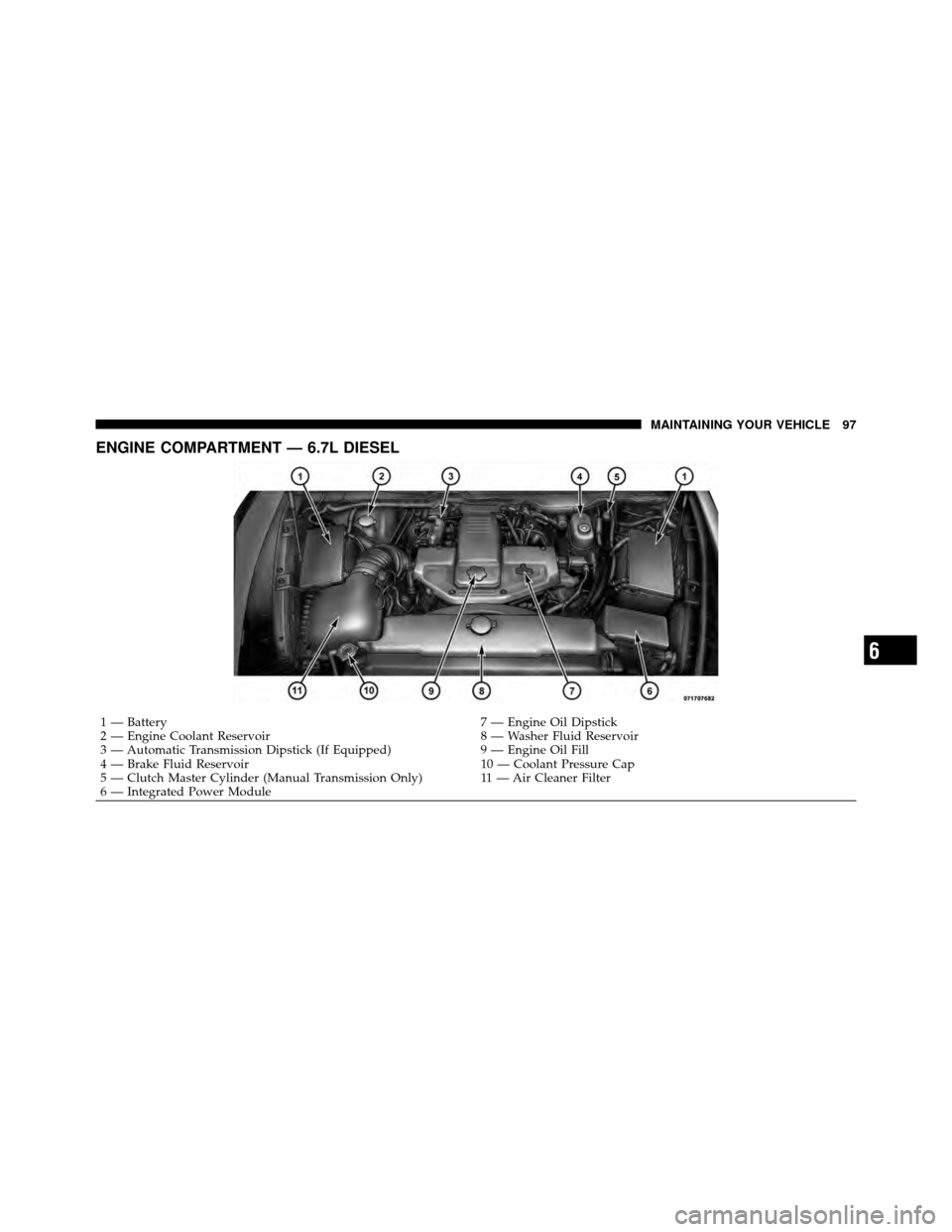
ENGINE COMPARTMENT — 6.7L DIESEL
1 — Battery7 — Engine Oil Dipstick
2 — Engine Coolant Reservoir 8 — Washer Fluid Reservoir
3 — Automatic Transmission Dipstick (If Equipped) 9 — Engine Oil Fill
4 — Brake Fluid Reservoir 10 — Coolant Pressure Cap
5 — Clutch Master Cylinder (Manual Transmission Only) 11 — Air Cleaner Filter
6 — Integrated Power Module
6
MAINTAINING YOUR VEHICLE 97
Page 99 of 170

MAINTENANCE PROCEDURES
The pages that follow contain therequiredmaintenance
services determined by the engineers who designed your
vehicle.
Besides those maintenance items specified in the fixed
maintenance schedule, there are other components which
may require servicing or replacement in the future.
CAUTION!
•Failure to properly maintain your vehicle or per-
form repairs and service when necessary could
result in more costly repairs, damage to other
components or negatively impact vehicle perfor-
mance. Immediately have potential malfunctions
examined by an authorized Chrysler Group LLC
dealership or qualified repair center.
(Continued)
CAUTION! (Continued)
•Your vehicle has been built with improved fluids
that protect the performance and durability of
your vehicle and also allow extended maintenance
intervals. Do not use chemical flushes in these
components as the chemicals can damage your
engine, transmission, power steering or air condi-
tioning. Such damage is not covered by the New
Vehicle Limited Warranty. If a flush is needed
because of component malfunction, use only the
specified fluid for the flushing procedure.
Engine Oil
Checking Oil Level
To assure proper lubrication of your vehicle’s engine, the
engine oil must be maintained at the correct level. Check
the oil level at regular intervals. The best time to check
the oil level is before starting the engine after it has been
98 MAINTAINING YOUR VEHICLE
Page 122 of 170
WARNING! (Continued)
•Do not allow petroleum based fluid to contami-
nate the brake fluid. Brake seal components could
be damaged, causing partial or complete brake
failure. This could result in an accident.
Clutch Hydraulic System
The clutch hydraulic system is a sealed maintenance-free
system. In the event of leakage or other malfunction, the
system must be replaced.
Transfer Case – If Equipped
Drain And Refill
Refer to “Maintenance Schedule” for the proper mainte-
nance intervals.
Lubricant Selection
Refer to “Fluids, Lubricants, and Genuine Parts” in
“Maintaining Your Vehicle” for further information.
Fluid Level Check
This fluid level can be checked by removing the filler
plug. The fluid level should be to the bottom edge of the
filler plug hole with the vehicle in a level position.
Manual Transmission – If Equipped
Lubricant Selection
Refer to “Fluids, Lubricants, and Genuine Parts” in
“Maintaining Your Vehicle” for further information.
Fluid Level Check
The fluid level can be checked by removing the filler
plug. If the level of the lubricant is more than 1/2 in
(12 mm) below the bottom of the filler hole while the
vehicle is on level ground, enough lubricant should be
added to bring the level to 1/4 in (6 mm) below the
bottom of the filler hole.6
MAINTAINING YOUR VEHICLE 121