Page 4 of 232

2
Contents
Key 17
Doors 20
Tailgate 22
Rear roof fl ap 25
Central locking 26
Instrument panel 27
Adjusting the time 28
Warning lamps 29
Fuel gauge 35
Coolant 35
Tyre under-infl ation
detection 36
Service indicator 37
Lighting rheostat 38
Gearbox 39
Gear shift indicator 39
6-speed electronic
gearbox system 40
Steering wheel
adjustment 42
Stop & Start 43
Starting and stopping 46
Hill start assist 47Lighting control 48
wipers 51
Cruise control 53
Speed limiter 56
Heating/Manual air
conditioning 59
automatic 61
De-icing and demisting 63
Front seats 65
Rear bench seat 67
Rear seats
(5 seat version) 70
Rear seats
(7 seat version) 73
Adjustments 80
Front layout 82
Zenith roof 86
Roof bars 91
Courtesy lights 92
Torch 93
Load space cover
(5 seat version) 94
Load space cover
(7 seat version) 98
Interior rack 100
Mirrors 102
Electric windows 104
2. READY TO SET OFF
17-47
4. SAFETY
105-126
Presentation 4
Communication 4
Exterior 6
Instruments and controls 8
Centre console 9
Sitting comfortably 10
Visibility 11
Driving safely 12
Passenger compartment
space 13
Rear fi ttings 14
Child safety 15
Ventilation 16
1. FAMILIARISATION
4-16
Hazard warning lamps 105
Parking brake 105
Rear parking
assistance 106
Anti-lock braking system
(ABS) 108
Emergency braking
assistance 108
Traction control (ASR) and
stability control (ESP) 109
"Grip control" 110
Seat belts 113
Airbags 116
Disarming
the passenger airbag 119
Child seats 120
Recommended seats 121
Installing 122
Isofi x seats 125
Child lock 126
COMFORT 48-104
Page 10 of 232
8
Interior
INSTRUMENTS AND CONTROLS
1.
Lighting and direction indicator
stalk.
2.
Instrument panel with screen.
3.
Wipers, screenwash, trip
computer controls.
4.
Ignition.
5.
Audio equipment.
6.
Driver's airbag, horn.
7.
Steering wheel height and reach
adjustment.
8.
Cruise control, speed limiter
switch.
9.
Control panel, parking sensors,
headlamp beam adjustment,
ESP, Stop & Start.
10.
Bonnet release.
11 .
Electric door mirror adjustment.
Page 29 of 232
READY TO SET OFF
22
Instruments and controls
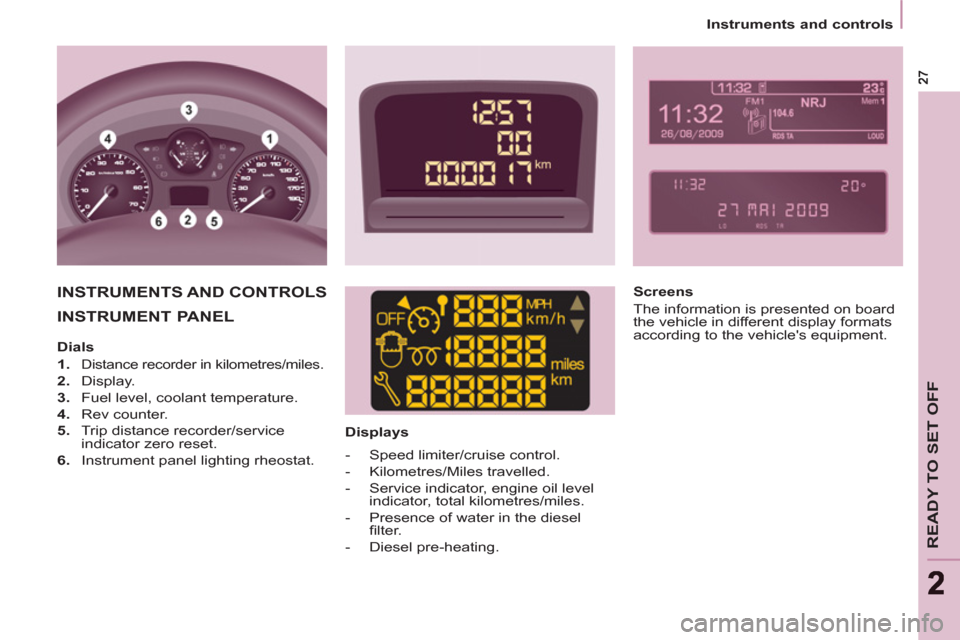
INSTRUMENT PANEL
Displays
INSTRUMENTS AND CONTROLS
Screens
The information is presented on board
the vehicle in different display formats
according to the vehicle's equipment.
Dials
1.
Distance recorder in kilometres/miles.
2. Display.
3. Fuel level, coolant temperature.
4. Rev counter.
5. Trip distance recorder/service
indicator zero reset.
6. Instrument panel lighting rheostat.
- Speed limiter/cruise control.
- Kilometres/Miles travelled.
- Service indicator, engine oil level
indicator, total kilometres/miles.
- Presence of water in the diesel
fi lter.
- Diesel pre-heating.
Page 30 of 232

28
Instruments and controls
Centre console with display
Instrument panel without display
- turn to the right to increase the
hours (hold the button to the right
for rapid scrolling),
- turn to the left: 24 H or 12 H is
displayed,
- turn to the right to select 24 H or 12 H,
- turn to the left to complete the time
adjustment.
After approximately 30 seconds
without any action, the display returns
to the normal display.
ADJUSTING THE TIME
To adjust the time and date
indicated on the display, refer to
the "Adjusting the date and time"
section of chapter 9.
Centre console without display
The display - time sequence
is linked according to model
(version). The access to
the "Date" adjustment is
only active when the model
version offers a date in words. To adjust the time of the clock,
use the left-hand button on
the instrument panel then
carry out the operations in the
following order:
- turn to the left: the minutes fl ash,
- turn to the right to increase the
minutes (hold the button to the right
for rapid scrolling),
- turn to the left: the hours fl ash,
Page 36 of 232

34
Instruments and controls
Warning lamp in the
screen
is
indicates
Solution - action
Cruise
control
on. cruise control selected. Manual selection. Chapter 3, "Steering mounted
controls" section.
Speed limiter
on. speed limiter selected. Manual selection. Chapter 3, "Steering mounted
controls" section.
Diesel
pre-heating
on. climatic conditions requiring
pre-heating. Wait until the warning lamp goes off before
operating the starter.
Presence of
water in the
Diesel fi lter
on and
accompanied by
a message in the
screen.
water in the Diesel fi lter. Have the fi lter bled by a PEUGEOT dealer
without delay. Chapter 6, "Checks" section.
According to country.
Service
spanner
on. that a service will be due
shortly. Refer to the list of checks in the Maintenance and
Warranty Guide. Have the service carried out by
a PEUGEOT dealer.
Time
fl ashing. adjustment of the time. Use the left-hand button on the instrument panel.
Chapter 2, at the beginning of the "Instruments
and controls" section.
Page 38 of 232
36
Instruments and controls
Puncture
Stop immediately, avoiding any sudden
movement of the steering wheel and
the brakes.
Change the damaged (punctured or
very defl ated) tyre, and have the tyre
pressure checked as soon as possible.
Sensor(s) not detected
Under-infl ation detection is absent
from one (or several) tyre(s). Contact a
PEUGEOT dealer to replace the faulty
sensor(s).
This message is also displayed when
one of the tyres is away from the
vehicle (being repaired) or when a
wheel without a sensor is fi tted.
All repairs and changing of tyres on a
wheel fi tted with this system must be
carried out by a PEUGEOT dealer.
The tyre under-infl ation detection
system is a driving aid which does
not take the place of vigilance or the
responsibility of the driver.
This system does not remove the need
to have the tyre pressure checked
regularly (including the spare wheel), to
ensure that the dynamic performance
of the vehicle remains at its best and
to avoid premature wear of the tyres,
in particular in the case of arduous
driving (heavy load, high speed).
The system may temporarily be
disturbed by radio broadcasts on a
frequency close to it.
TYRE UNDER-INFLATION
DETECTION EMISSION CONTROL
Flat tyre
Check the tyre pressure as soon as
possible.
Refer to the "Changing a wheel"
section of chapter 7.
If the damaged tyre is temporarily
stored inside the vehicle, it will again
emit this message to remind you of the
necessity of having it repaired. This will
prevent another warning of the same
type being displayed.
Sensors check the tyre pressure during
driving (speed higher than 12 mph
[20 km/h]) and trigger a warning in the
event of a malfunction or puncture.
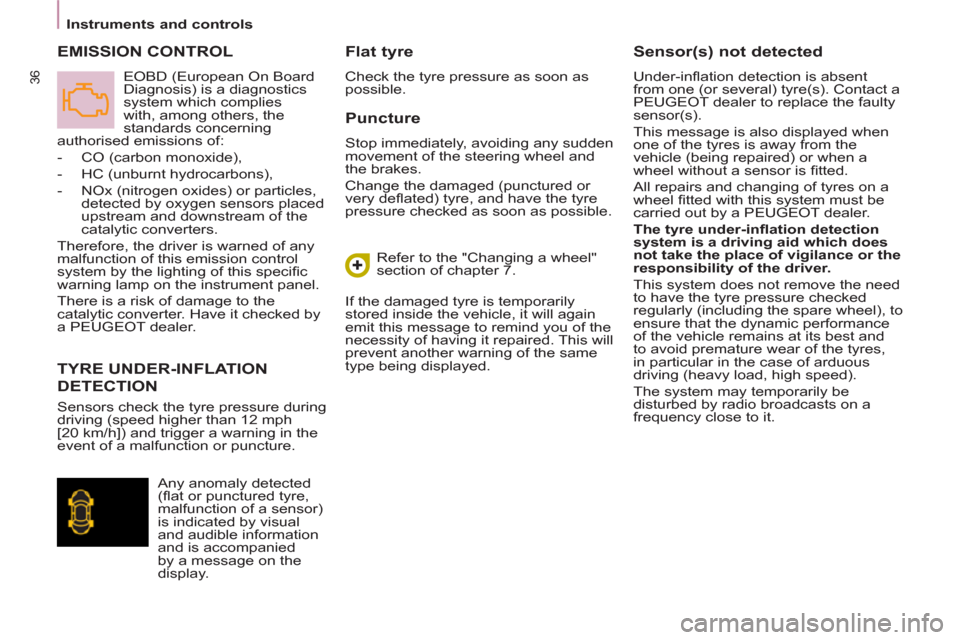
Any anomaly detected
(fl at or punctured tyre,
malfunction of a sensor)
is indicated by visual
and audible information
and is accompanied
by a message on the
display. EOBD (European On Board
Diagnosis) is a diagnostics
system which complies
with, among others, the
standards concerning
authorised emissions of:
- CO (carbon monoxide),
- HC (unburnt hydrocarbons),
- NOx (nitrogen oxides) or particles,
detected by oxygen sensors placed
upstream and downstream of the
catalytic converters.
Therefore, the driver is warned of any
malfunction of this emission control
system by the lighting of this specifi c
warning lamp on the instrument panel.
There is a risk of damage to the
catalytic converter. Have it checked by
a PEUGEOT dealer.
Page 42 of 232
40
Gearbox and steering wheel
6-SPEED ELECTRONIC GEARBOX SYSTEM
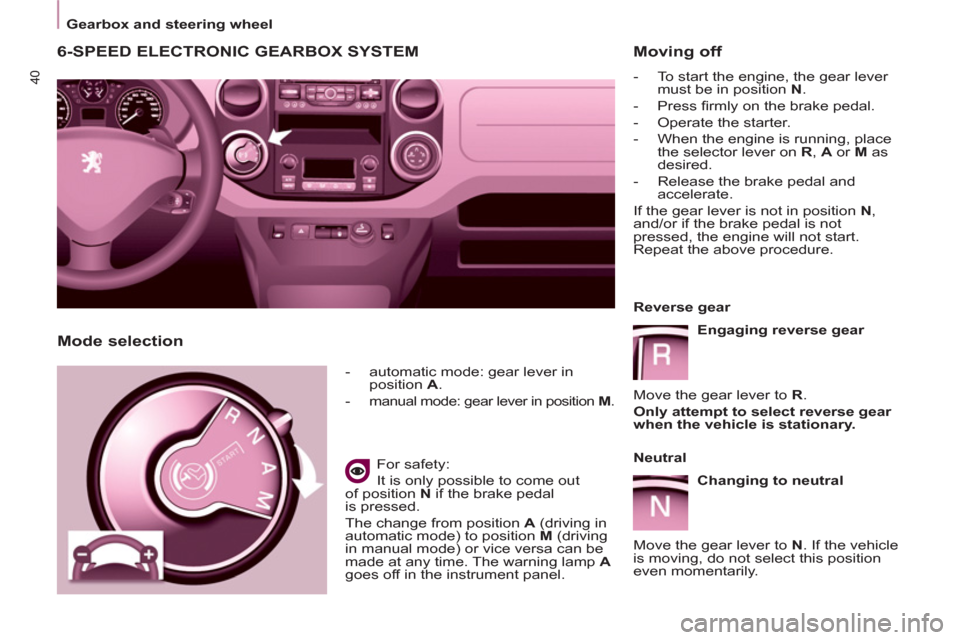
- automatic mode: gear lever in
position A
.
-
manual mode: gear lever in position M
.
For safety:
It is only possible to come out
of position N
if the brake pedal
is pressed.
The change from position A
(driving in
automatic mode) to position M
(driving
in manual mode) or vice versa can be
made at any time. The warning lamp A
goes off in the instrument panel.
Moving off
- To start the engine, the gear lever
must be in position N
.
- Press fi rmly on the brake pedal.
- Operate the starter.
- When the engine is running, place
the selector lever on R
, A
or M
as
desired.
- Release the brake pedal and
accelerate.
If the gear lever is not in position N
,
and/or if the brake pedal is not
pressed, the engine will not start.
Repeat the above procedure.
Mode selection
Reverse gear
Engaging reverse gear
Move the gear lever to R
.
Only attempt to select reverse gear
when the vehicle is stationary.
Neutral
Changing to neutral
Move the gear lever to N
. If the vehicle
is moving, do not select this position
even momentarily.
Page 44 of 232
42
Gearbox and steering wheel
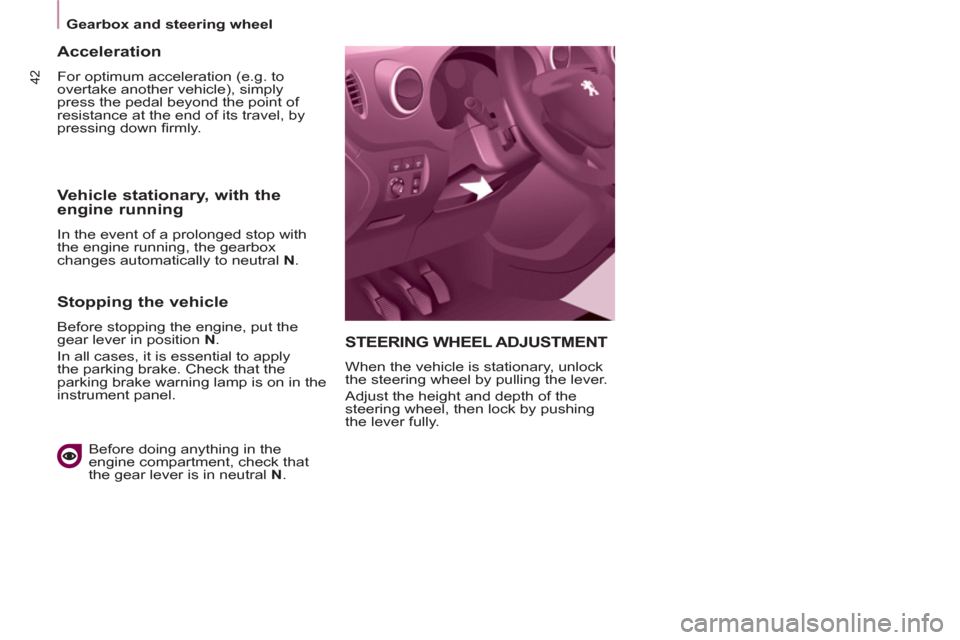
STEERING WHEEL ADJUSTMENT
When the vehicle is stationary, unlock
the steering wheel by pulling the lever.
Adjust the height and depth of the
steering wheel, then lock by pushing
the lever fully.
Acceleration
For optimum acceleration (e.g. to
overtake another vehicle), simply
press the pedal beyond the point of
resistance at the end of its travel, by
pressing down fi rmly.
Vehicle stationary, with the
engine running
In the event of a prolonged stop with
the engine running, the gearbox
changes automatically to neutral N
.
Stopping the vehicle
Before stopping the engine, put the
gear lever in position N
.
In all cases, it is essential to apply
the parking brake. Check that the
parking brake warning lamp is on in the
instrument panel.
Before doing anything in the
engine compartment, check that
the gear lever is in neutral N
.