2011 Peugeot Partner brake
[x] Cancel search: brakePage 54 of 200
52
Steering mounted controls
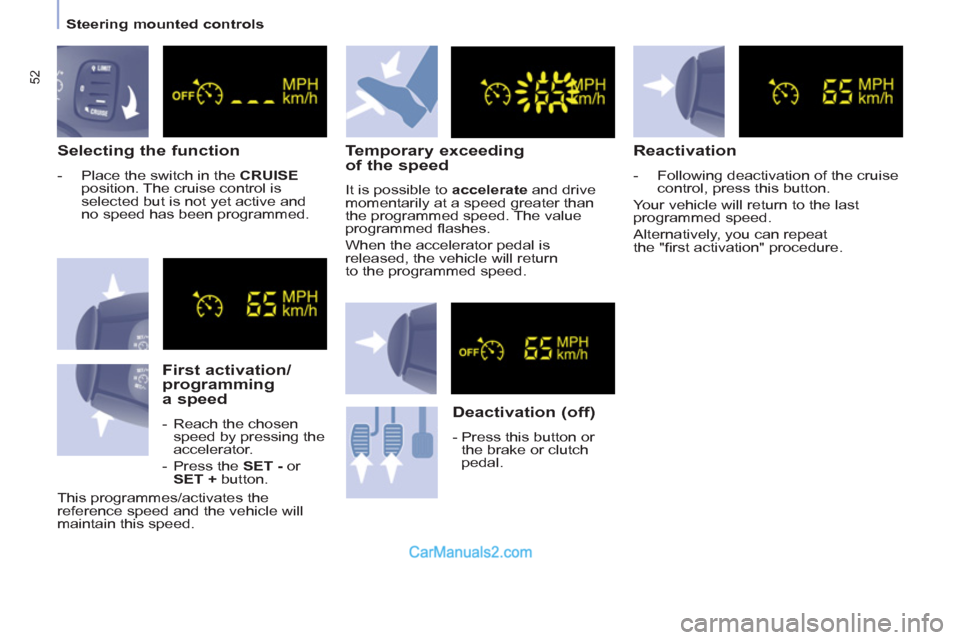
Selecting the function
- Place the switch in the CRUISE
position. The cruise control is
selected but is not yet active and
no speed has been programmed.
First activation/
programming
a speed
- Reach the chosen
speed by pressing the
accelerator.
- Press the SET -
or
SET +
button.
This programmes/activates the
reference speed and the vehicle will
maintain this speed.
Temporary exceeding
of the speed
It is possible to accelerate
and drive
momentarily at a speed greater than
the programmed speed. The value
programmed fl ashes.
When the accelerator pedal is
released, the vehicle will return
to the programmed speed.
Deactivation (off)
- Press this button or
the brake or clutch
pedal.
Reactivation
- Following deactivation of the cruise
control, press this button.
Your vehicle will return to the last
programmed speed.
Alternatively, you can repeat
the "fi rst activation" procedure.
Page 82 of 200
80
Driving safely
DRIVING SAFELY
HORN
Press the centre of the steering wheel.
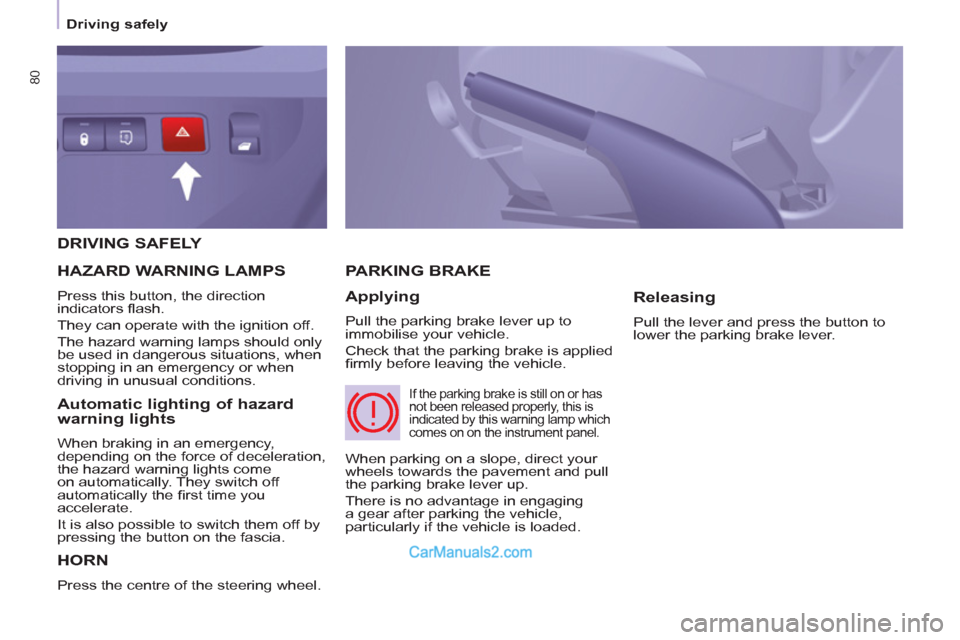
PARKING BRAKE
Applying
Pull the parking brake lever up to
immobilise your vehicle.
Check that the parking brake is applied
fi rmly before leaving the vehicle.
Releasing
Pull the lever and press the button to
lower the parking brake lever.
HAZARD WARNING LAMPS
Press this button, the direction
indicators fl ash.
They can operate with the ignition off.
The hazard warning lamps should only
be used in dangerous situations, when
stopping in an emergency or when
driving in unusual conditions.
When parking on a slope, direct your
wheels towards the pavement and pull
the parking brake lever up.
There is no advantage in engaging
a gear after parking the vehicle,
particularly if the vehicle is loaded.
If the parking brake is still on or has
not been released properly, this is
indicated by this warning lamp which
comes on on the instrument panel.
Automatic lighting of hazard
warning lights
When braking in an emergency,
depending on the force of deceleration,
the hazard warning lights come
on automatically. They switch off
automatically the fi rst time you
accelerate.
It is also possible to switch them off by
pressing the button on the fascia.
Page 85 of 200
ABS
ABS
83
SAFETY
4
Driving safely
ANTI-LOCK BRAKING SYSTEM
(ABS - EBFD)
The ABS and EBFD (electronic brake
force distribution) systems improve the
stability and manoeuvrability of your
vehicle on braking, in particular on
poor or slippery surfaces.
The ABS prevents locking of the
wheels, the EBFD provides control of
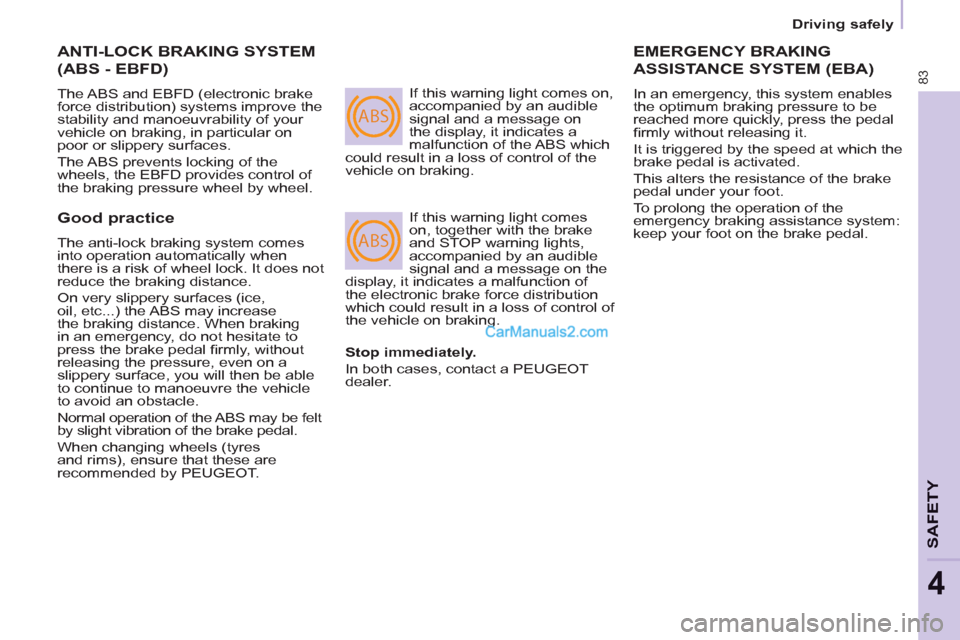
the braking pressure wheel by wheel. If this warning light comes on,
accompanied by an audible
signal and a message on
the display, it indicates a
malfunction of the ABS which
could result in a loss of control of the
vehicle on braking.
If this warning light comes
on, together with the brake
and STOP warning lights,
accompanied by an audible
signal and a message on the
display, it indicates a malfunction of
the electronic brake force distribution
which could result in a loss of control of
the vehicle on braking.
EMERGENCY BRAKING
ASSISTANCE SYSTEM
(EBA)
In an emergency, this system enables
the optimum braking pressure to be
reached more quickly, press the pedal
fi rmly without releasing it.
It is triggered by the speed at which the
brake pedal is activated.
This alters the resistance of the brake
pedal under your foot.
To prolong the operation of the
emergency braking assistance system:
keep your foot on the brake pedal.
Good practice
The anti-lock braking system comes
into operation automatically when
there is a risk of wheel lock. It does not
reduce the braking distance.
On very slippery surfaces (ice,
oil, etc...) the ABS may increase
the braking distance. When braking
in an emergency, do not hesitate to
press the brake pedal fi rmly, without
releasing the pressure, even on a
slippery surface, you will then be able
to continue to manoeuvre the vehicle
to avoid an obstacle.
Normal operation of the ABS may be felt
by slight vibration of the brake pedal.
When changing wheels (tyres
and rims), ensure that these are
recommended by PEUGEOT.
Stop immediately.
In both cases, contact a PEUGEOT
dealer.
Page 86 of 200
ESP OFF
84
Driving safely
TRACTION CONTROL (ASR)
AND DYNAMIC STABILITY
CONTROL
(ESP)
These systems are linked and
complement the ABS.
The ASR system is very useful for
maintaining optimum drive and
avoiding losses of control of the vehicle
on acceleration.
The system optimises drive to prevent
the wheels skidding, by acting on the
brakes of the drive wheels and on the
engine. It also allows the directional
stability of the vehicle to be improved
on acceleration.
Use the ESP to hold your course
without attempting to countersteer.
If there is a variation between the
trajectory followed by the vehicle and
that required by the driver, the ESP
system automatically acts on the
engine and the brake of one or more
wheels, in order to put the vehicle back
on course.
Disarming the ASR/ESP
systems
In certain exceptional conditions
(starting the vehicle when stuck in mud
or snow, or on loose ground...), it could
prove useful to disarm the ASR and
ESP systems to make the wheels spin
and regain grip.
Operating check
Good practice
The ASR/ESP systems offer increased
safety during normal driving, but
should not incite the driver to take risks
or to drive at high speed.
The operation of these systems is
ensured if the recommendations
of the manufacturer regarding
the wheels (tyres and rims), the
braking components, the electronic
components and the fi tting and repair
procedures within the PEUGEOT
network are observed.
After an impact, have these systems
checked by a PEUGEOT dealer.
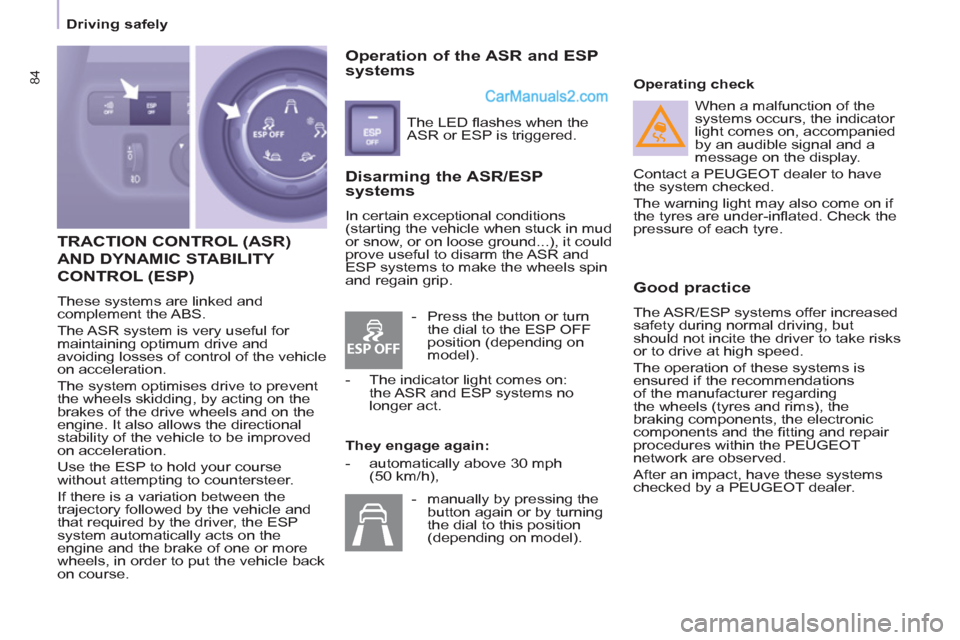
Operation of the ASR and ESP
systems
The LED fl ashes when the
ASR or ESP is triggered.
They engage again:
- automatically above 30 mph
(50 km/h), When a malfunction of the
systems occurs, the indicator
light comes on, accompanied
by an audible signal and a
message on the display.
Contact a PEUGEOT dealer to have
the system checked.
The warning light may also come on if
the tyres are under-infl ated. Check the
pressure of each tyre.
- Press the button or turn
the dial to the ESP OFF
position (depending on
model).
- The indicator light comes on:
the ASR and ESP systems no
longer act.
- manually by pressing the
button again or by turning
the dial to this position
(depending on model).
Page 101 of 200
99
Towing a trailer
ACCESSORIE
S
5
Good Practice
In certain cases of particularly arduous
use (towing the maximum load up a
steep slope in high temperatures), the
engine automatically limits its power. In
this case, the automatic cutting off of
the air conditioning allows the engine
power to be recovered.
Tyres
Check the tyre pressures of the
towing vehicle (see the "Identifi cation
features" section of chapter 8) and of
the trailer, observing the recommended
pressure.
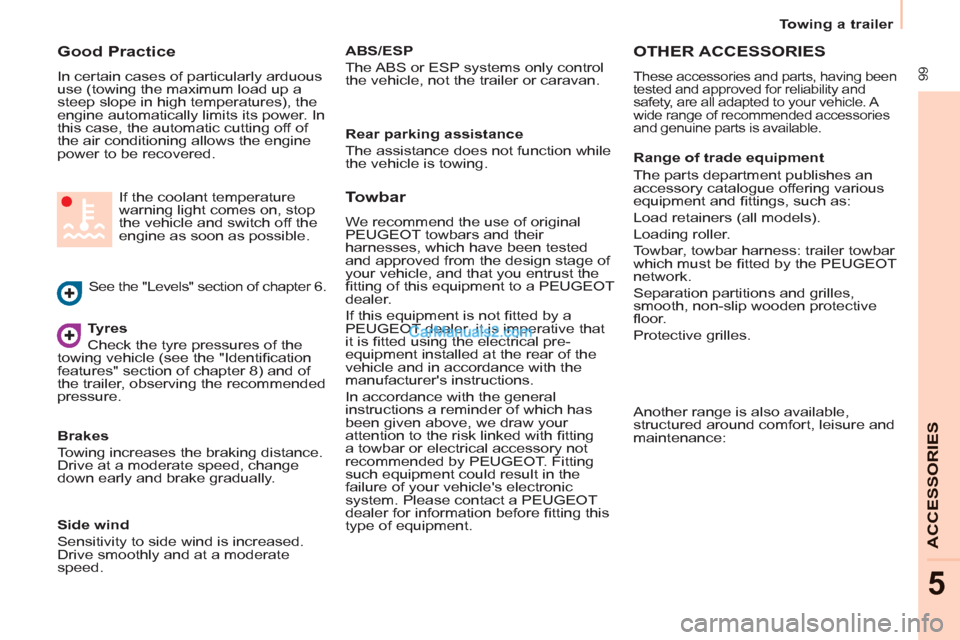
See the "Levels" section of chapter 6. If the coolant temperature
warning light comes on, stop
the vehicle and switch off the
engine as soon as possible.
Brakes
Towing increases the braking distance.
Drive at a moderate speed, change
down early and brake gradually.
Towbar
We recommend the use of original
PEUGEOT towbars and their
harnesses, which have been tested
and approved from the design stage of
your vehicle, and that you entrust the
fi tting of this equipment to a PEUGEOT
dealer.
If this equipment is not fi tted by a
PEUGEOT dealer, it is imperative that
it is fi tted using the electrical pre-
equipment installed at the rear of the
vehicle and in accordance with the
manufacturer's instructions.
In accordance with the general
instructions a reminder of which has
been given above, we draw your
attention to the risk linked with fi tting
a towbar or electrical accessory not
recommended by PEUGEOT. Fitting
such equipment could result in the
failure of your vehicle's electronic
system. Please contact a PEUGEOT
dealer for information before fi tting this
type of equipment.
OTHER ACCESSORIES
These accessories and parts, having been
tested and approved for reliability and
safety, are all adapted to your vehicle. A
wide range of recommended accessories
and genuine parts is available.
Range of trade equipment
The parts department publishes an
accessory catalogue offering various
equipment and fi ttings, such as:
Load retainers (all models).
Loading roller.
Towbar, towbar harness: trailer towbar
which must be fi tted by the PEUGEOT
network.
Separation partitions and grilles,
smooth, non-slip wooden protective
fl oor.
Protective grilles.
Side wind
Sensitivity to side wind is increased.
Drive smoothly and at a moderate
speed.
ABS/ESP
The ABS or ESP systems only control
the vehicle, not the trailer or caravan.
Rear parking assistance
The assistance does not function while
the vehicle is towing.
Another range is also available,
structured around comfort, leisure and
maintenance:
Page 105 of 200
103
CHECK
S
6
Under the bonnet
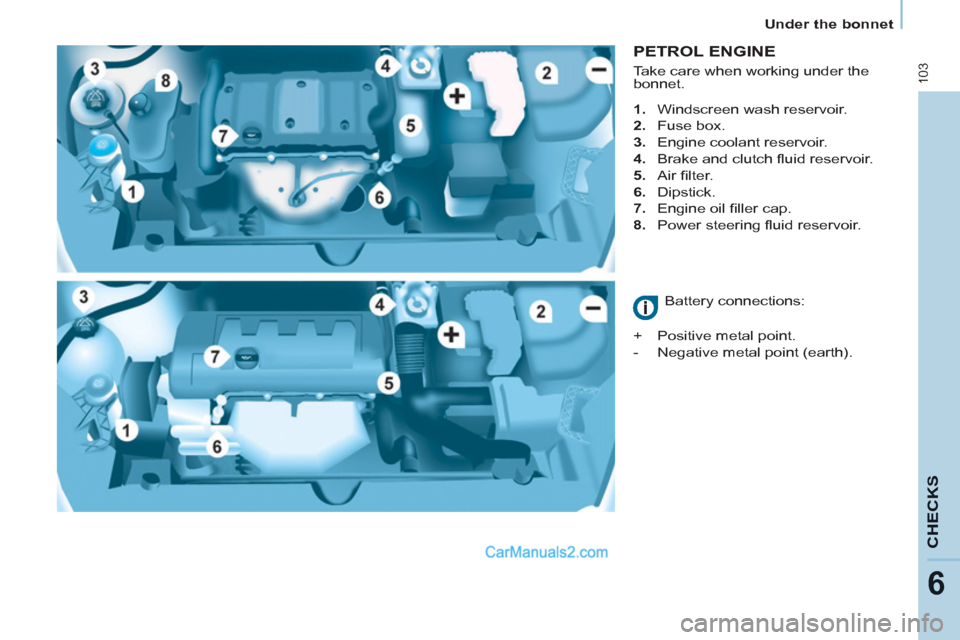
PETROL ENGINE
1.
Windscreen wash reservoir.
2.
Fuse box.
3.
Engine coolant reservoir.
4.
Brake and clutch fl uid reservoir.
5.
Air fi lter.
6.
Dipstick.
7.
Engine oil fi ller cap.
8.
Power steering fl uid reservoir.
Battery connections:
+ Positive metal point.
- Negative metal point (earth). Take care when working under the
bonnet.
Page 106 of 200
104
Under the bonnet
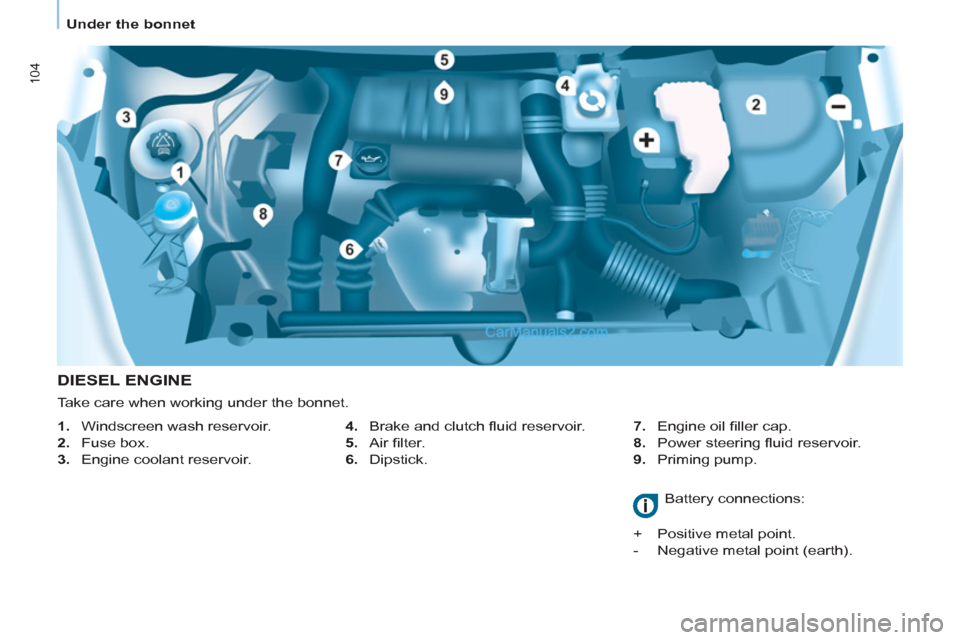
DIESEL ENGINE
4.
Brake and clutch fl uid reservoir.
5.
Air fi lter.
6.
Dipstick.
7.
Engine oil fi ller cap.
8.
Power steering fl uid reservoir.
9.
Priming pump.
1.
Windscreen wash reservoir.
2.
Fuse box.
3.
Engine coolant reservoir.
Battery connections:
+ Positive metal point.
- Negative metal point (earth). Take care when working under the bonnet.
104
Page 107 of 200
105
CHECK
S
6
Levels
LEVELS
Oil change
This must be carried out at the
intervals specifi ed and the viscosity
grade of the oil selected must fulfi l the
requirements in the manufacturer's
servicing schedule. Ask for advice from
a PEUGEOT dealer.
Remove the dipstick before fi lling.
Check the level after fi lling (never
exceed the max mark).
Refi t the oil fi ller cap before closing the
bonnet.
Changing the brake fluid
The brake fl uid must be changed at
the intervals stated, according to the
manufacturer's servicing schedule.
Use fl uids recommended by the
manufacturer, which fulfi l DOT4
standards.
The level must be between the MIN
and MAX marks on the reservoir.
If fl uid has to be added frequently,
this indicates a fault which must be
checked by a PEUGEOT dealer as
soon as possible.
Warning lamps
If you have to remove/refi t the
engine style cover, handle it with
care to avoid damaging the fi xing
clips.
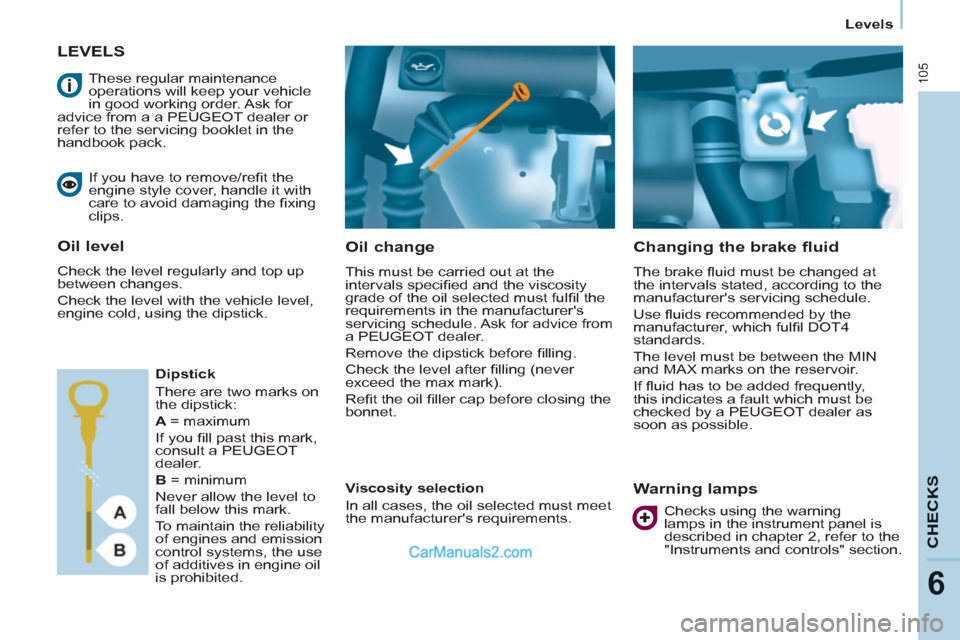
Oil level
Check the level regularly and top up
between changes.
Check the level with the vehicle level,
engine cold, using the dipstick.
Dipstick
There are two marks on
the dipstick:
A = maximum
If you fi ll past this mark,
consult a PEUGEOT
dealer.
B = minimum
Never allow the level to
fall below this mark.
To maintain the reliability
of engines and emission
control systems, the use
of additives in engine oil
is prohibited.
Viscosity selection
In all cases, the oil selected must meet
the manufacturer's requirements.
These regular maintenance
operations will keep your vehicle
in good working order. Ask for
advice from a a PEUGEOT dealer or
refer to the servicing booklet in the
handbook pack.
Checks using the warning
lamps in the instrument panel is
described in chapter 2, refer to the
"Instruments and controls" section.