2011 Peugeot Bipper check
[x] Cancel search: checkPage 125 of 180

12
3
5
SAFETY
Airbags
For the airbags to be fully effective,
observe the following safety rules:
Sit in a normal upright position.
Wear a correctly adjusted seat belt.
Do not leave anything between the
occupants and the airbags (a child, pet,
object...). This could hamper the operation
of the airbags or injure the occupants.
After an accident or if the vehicle has been
stolen or broken into, have the airbag
systems checked.
All work on the airbag systems must be
carried out by a PEUGEOT or a qualified
workshop.
Even if all of the precautions mentioned are
observed, a risk of injury or of slight burns
to the head, chest or arms when an airbag
is deployed cannot be ruled out. In fact,
the bag inflates almost instantly (within a
few milliseconds) then deflates within the
same time, discharging the hot gas through
openings provided for this purpose.
Front airbags
Do not drive holding the steering wheel
by its spokes or resting your hands on the
centre part of the wheel.
Passengers must not place their feet on the
dashboard.
Smoke as little as possible as deployment
of the airbags can cause burns or the risk of
injury from a cigarette or pipe.
Never remove or pierce the steering wheel
or hit it violently.
Lateral airbags
Only put approved covers on the seats,
compatible with the deployment of lateral
airbags. For information on the range of seat
covers suitable for your vehicle, you can
contact a PEUGEOT dealer. Refer to the
"Accessories" section.
Do not fix or attach anything to the seat
backs. This could cause injury to the chest
or arms when the lateral airbag inflates.
Do not sit with the upper part of the body
any nearer to the door than necessary.
Page 134 of 180

132
Towing a trailer
In certain cases of particularly arduous
use (towing the maximum load up a steep
slope in high temperatures), the engine
automatically limits its power. In this case,
automatic cutting off of the air conditioning
allows the engine power to be saved.
If the coolant temperature
warning lamp comes on, stop the
vehicle and switch off the engine
as soon as possible.
See the "Levels" section of chapter 7.
Tyres:
check the tyre pressures of the
towing vehicle (see the "Identification
markings" section of chapter 7) and of
the trailer, observing the recommended
pressures.
Brakes:
towing increases the braking
distance. Drive at a moderate speed,
change down early and brake gradually.
Side wind:
sensitivity to side wind is
increased. Drive smoothly and at a
moderate speed.
ABS:
the system only controls the vehicle,
not the trailer.
Rear parking sensors:
the sensors
will be deactivated automatically when
an genuine PEUGEOT towbar is used
(see the "Rear parking sensors" section of
chapter 3).
Towbar
We recommend the use of original
PEUGEOT towbars and their harnesses,
which have been tested and approved from
the design stage of your vehicle, and that
the fitting of this equipment is entrusted to a
PEUGEOT dealer or a qualified workshop.
If this equipment is not fitted by a PEUGEOT
dealer, it is essential that it is fitted using
the electrical pre-equipment located at
the rear of the vehicle and following the
manufacturer's instructions.
The operation of the rear parking sensors is
deactivated automatically when the trailer
cable connector is inserted in the towbar
socket.
When the trailer cable is removed, the rear
parking sensors are re-activated.
Distribution of loads
Distribute the load in the trailer so that the
heaviest objects are as close as possible
to the axle and the nose weight is close to
the maximum authorised without, however,
exceeding it. The air density decreases with
altitude, so reducing the performance of
the engine. The maximum towed load must
be reduced by 10 % for each 1 000 metres
of altitude. Refer to the "Technical data"
chapter for details of the weights and towed
loads applicable to your vehicle and also to
the administrative documents
(V5 registration document, ...).
Page 137 of 180

135
7
QUICK HELP
Battery
BATTERY
Models without Stop & Start
A.
Metallic positive point of your vehicle.
B.
Slave battery.
C.
Earth of your vehicle.
D.
Metallic positive point on your vehicle.
Charging the battery using a battery charger
Starting using another battery
- Connect the red cable to the metallic
point A
then to the positive (+) terminal of
the slave battery B
.
- Connect one end of the green or black
cable to the negative (-) terminal of the
slave battery B
.
- Connect the other end of the green or
black cable to the earth point C
on your
vehicle (never to the metallic point D
of
your vehicle).
- Operate the starter, let the engine run.
- Wait for the engine to return to idle, then
disconnect the cables.
Never charge a battery without first
disconnecting the terminals.
- Disconnect the two quick-fi t battery terminals.
- Follow the instructions for use given by
the battery charger manufacturer.
- Check that the battery posts and
terminals are clean. If they are covered
with sulphate (white or greenish deposit),
disconnect them and clean them.
- Reconnect the two quick-fit terminals,
starting with the negative (-) terminal.
Page 138 of 180

136
Battery
Models with Stop & Start
A.
Protective cover.
B.
Positive metallic point on your vehicle.
C.
Slave battery.
D.
Earth on your vehicle.
E.
Terminal release button.
F.
Check sensor button.
G.
State of charge sensor.
H.
Metal negative point of your vehicle.
Charging the battery using a battery charger
- Follow the instructions for use given by
the battery charger manufacturer.
- Check that the battery posts and
terminals are clean. If they are covered
with sulphate (white or greenish deposit),
disconnect them and clean them.
- Reconnect connector F
of the check
sensor G
.
- Refit the protective cover A
to the
metallic point B
.
Starting using another battery
- Remove the protective cover A
from the
metallic point B
.
- Connect the red cable to metallic point B
,
then the (+) terminal to the slave battery C
.
- Connect one end of the green or black
cable to the (-) terminal of the slave
battery C
.
- Connect the other end of the green or
black cable to the earth point D
of your
vehicle (never to the metallic point H
of
your vehicle).
- Operate the starter, let the engine run.
- Wait for the engine to return to idle, then
disconnect the cables.
- Refit the protective cover A
to the
metallic point B
.
Do not disconnect the battery to charge
it.
- Press the release button E
to disconnect
the terminal F
.
- Disconnect the connector F
of the check
sensor G
.
- Remove the protective cover A
from the
metallic point B
.
- Connect the charger cables: (+) on
the metallic point B
; (-) on the metallic
point H
. Never remove the check sensor G
from the metallic point H
, except
when replacing the battery.
Page 139 of 180
137
7
QUICK HELP
Battery
Batteries contain harmful substances
such as sulphuric acid and lead. They
must be disposed of in accordance with the
law and must not, in any circumstances be
discarded with household waste.
Take used batteries to an authorised waste
disposal site.
It is advisable to disconnect the battery
if the vehicle is not to be used for a
period of more than one month. To do
this on models with Stop & Start:
- press the release button E
to disconnect
connector F
,
- disconnect connector F
of check sensor G
.
Never remove the check sensor G
from the
metallic point H
, except when replacing the
battery.
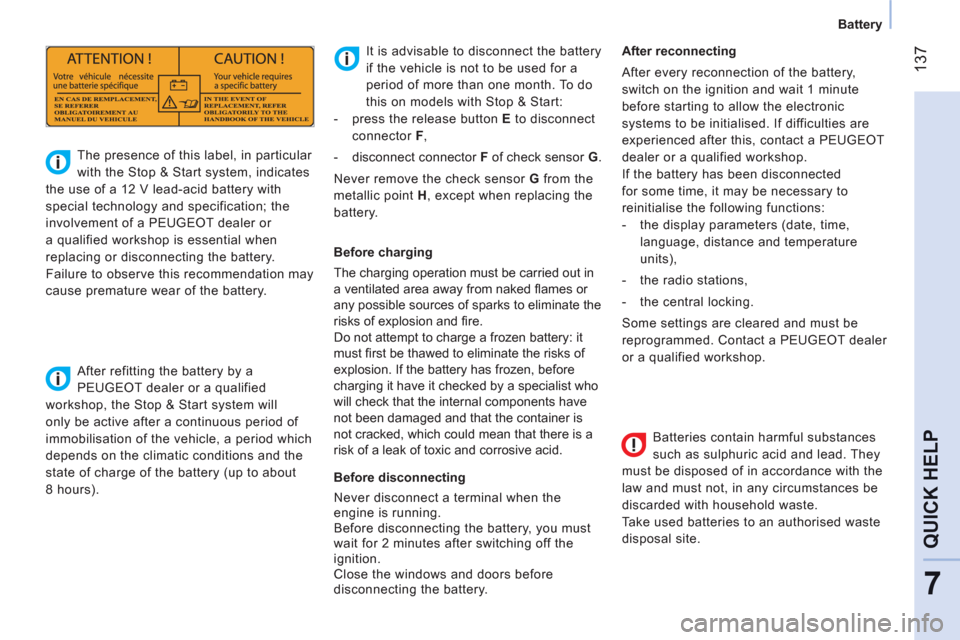
The presence of this label, in particular
with the Stop & Start system, indicates
the use of a 12 V lead-acid battery with
special technology and specification; the
involvement of a PEUGEOT dealer or
a qualified workshop is essential when
replacing or disconnecting the battery.
Failure to observe this recommendation may
cause premature wear of the battery.
After refitting the battery by a
PEUGEOT dealer or a qualified
workshop, the Stop & Start system will
only be active after a continuous period of
immobilisation of the vehicle, a period which
depends on the climatic conditions and the
state of charge of the battery (up to about
8 hours).
Before charging
The charging operation must be carried out in
a ventilated area away from naked fl ames or
any possible sources of sparks to eliminate the
risks of explosion and fi re.
Do not attempt to charge a frozen battery: it
must fi rst be thawed to eliminate the risks of
explosion. If the battery has frozen, before
charging it have it checked by a specialist who
will check that the internal components have
not been damaged and that the container is
not cracked, which could mean that there is a
risk of a leak of toxic and corrosive acid.
Before disconnecting
Never disconnect a terminal when the
engine is running.
Before disconnecting the battery, you must
wait for 2 minutes after switching off the
ignition.
Close the windows and doors before
disconnecting the battery.
After reconnecting
After every reconnection of the battery,
switch on the ignition and wait 1 minute
before starting to allow the electronic
systems to be initialised. If difficulties are
experienced after this, contact a PEUGEOT
dealer or a qualified workshop.
If the battery has been disconnected
for some time, it may be necessary to
reinitialise the following functions:
- the display parameters (date, time,
language, distance and temperature
units),
- the radio stations,
- the central locking.
Some settings are cleared and must be
reprogrammed. Contact a PEUGEOT dealer
or a qualified workshop.
Page 142 of 180

14
0
Changing a wheel
Refitting a wheel
6.
Put the trim back in place, starting by
placing its notch facing the valve, and
press with the palm of your hand.
7.
Stow the tools and the wheel.
8.
Check the wheel inflation pressure (see
"Identification") and have the balance
checked. Refer to the "Identifi cation markings"
section of chapter 8 to locate the tyre label.
Have the tightening of the bolts and the
pressure of the spare wheel checked by a
PEUGEOT dealer or a qualified workshop
without delay.
1.
Put the wheel in place using the centring
guide 2
to assist you.
2.
Screw in the 3 bolts by hand and remove
the centring guide. Position the 4th bolt.
3.
Pre-tighten using the wheelbrace 1
.
4.
Fold the jack 4
and detach it.
5.
Tighten the wheel bolts using the
wheelbrace. Also, have the original wheel repaired
and refitted by a PEUGEOT dealer
or a qualified workshop as soon as
possible.
Page 143 of 180
14
1
7
QUICK HELP
Changing a wheel
TEMPORARY PUNCTURE REPAIR KIT
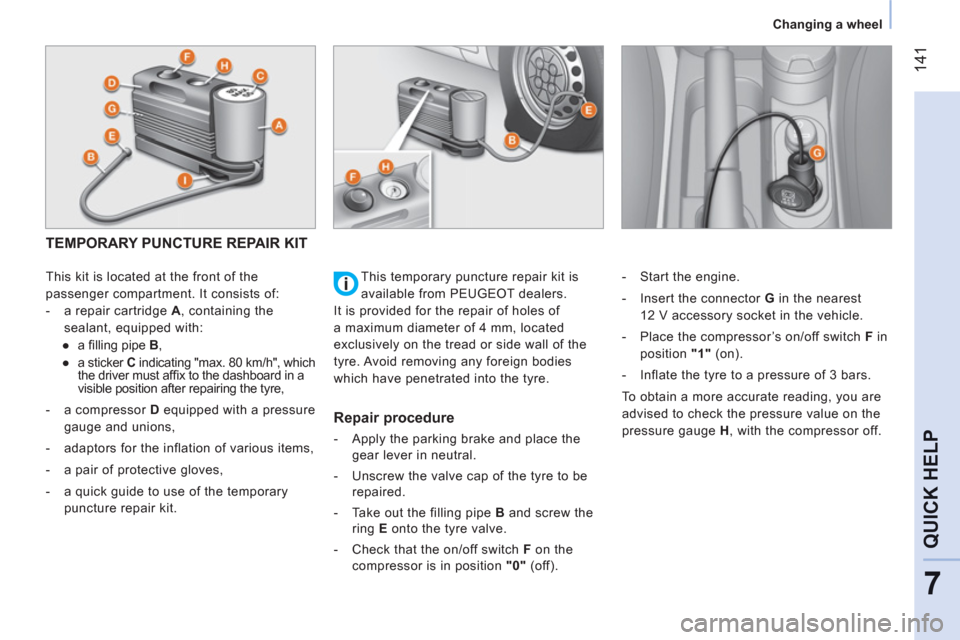
This kit is located at the front of the
passenger compartment. It consists of:
- a repair cartridge A
, containing the
sealant, equipped with:
●
a fi lling pipe B
,
●
a sticker C
indicating "max. 80 km/h", which
the driver must affi x to the dashboard in a
visible position after repairing the tyre,
- a compressor D
equipped with a pressure
gauge and unions,
- adaptors for the inflation of various items,
- a pair of protective gloves,
- a quick guide to use of the temporary
puncture repair kit.
Repair procedure
- Apply the parking brake and place the
gear lever in neutral.
- Unscrew the valve cap of the tyre to be
repaired.
- Take out the filling pipe B
and screw the
ring E
onto the tyre valve.
- Check that the on/off switch F
on the
compressor is in position "0"
(off).
- Start the engine.
- Insert the connector G
in the nearest
12 V accessory socket in the vehicle.
- Place the compressor’s on/off switch F
in
position "1"
(on).
- Inflate the tyre to a pressure of 3 bars.
To obtain a more accurate reading, you are
advised to check the pressure value on the
pressure gauge H
, with the compressor off. This temporary puncture repair kit is
available from PEUGEOT dealers.
It is provided for the repair of holes of
a maximum diameter of 4 mm, located
exclusively on the tread or side wall of the
tyre. Avoid removing any foreign bodies
which have penetrated into the tyre.
Page 144 of 180

142
Changing a wheel
- If a pressure of at least 1.5 bars
is not
reached within 5 minutes
:
●
disconnect the compressor from the
valve and from the 12 V accessory
socket,
●
move the vehicle forward by
approximately 10 metres to distribute the
fi lling fl uid inside the tyre,
●
then repeat the infl ation operation.
- If a pressure of at least 1.8 bars
is not
reached within 10 minutes
:
●
stop the repair procedure; the tyre has
suffered too much damage and cannot
be repaired,
●
contact a PEUGEOT dealer or a qualifi ed
workshop.
- If the tyre has been inflated to a pressure
of 3 bars
, set off again immediately.
After driving for approximately 10 minutes,
stop and check the pressure of the tyre
again.
Re-inflate the tyre to the correct pressure if
necessary and contact a PEUGEOT dealer
or a qualified workshop as soon as possible.
You must inform the technician that you
have repaired the tyre using the temporary
puncture repair kit and show him its
instructions.
Checking and correcting the pressure
For checking and correcting the pressure of
a tyre, use the compressor as follows:
- disconnect the pipe I
,
- connect it directly to the tyre valve,
the cartridge will then be connected to the
compressor and the sealant will not be
injected.
Replacing the repair cartridge
Disconnect the pipe I
.
Turn the empty cartridge anticlockwise and
lift it.
Insert the new cartridge and turn it
clockwise.
Reconnect the pipe I
and connect the pipe B
in its location.
The repair cartridge contains ethylene-
glycol, a product which is harmful if
swallowed and which causes irritation to the
eyes.
Keep this product out of reach of children.
After use, take the cartridge to a PEUGEOT
dealer or to an authorised waste disposal
site. If the tyre has to be deflated:
- connect the pipe I
to the tyre valve,
- press the yellow button, located in the
centre of the switch F
on the compressor.