2011 PEUGEOT 5008 brake
[x] Cancel search: brakePage 131 of 340
SA
F
129
TYRE UNDER-INFLATION DETECTION
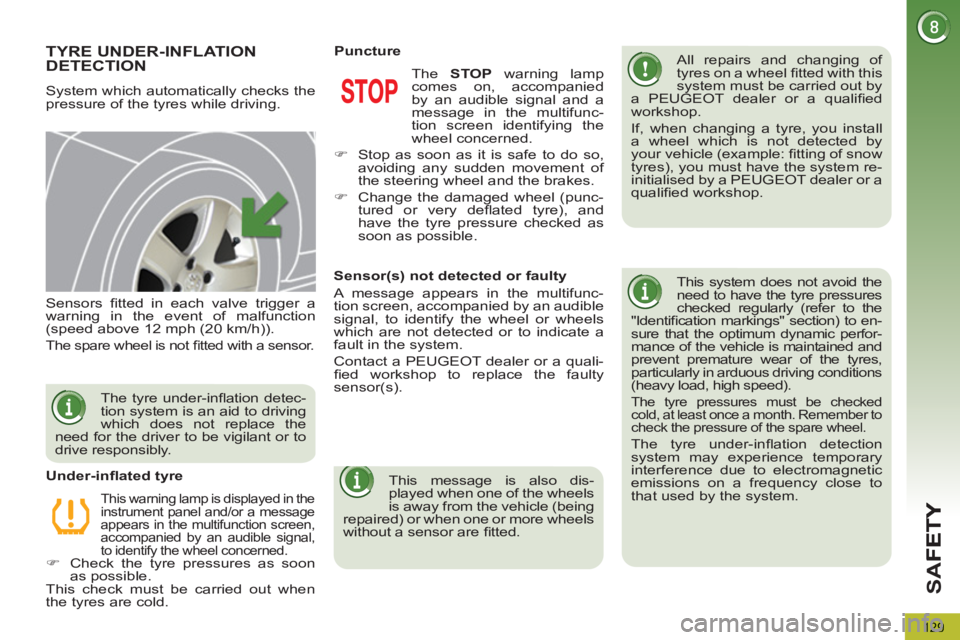
System which automatically checks the
pressure of the tyres while driving.
All repairs and changing of
tyres on a wheel fi tted with this
system must be carried out by
a PEUGEOT dealer or a qualifi ed
workshop.
If, when changing a tyre, you install
a wheel which is not detected by
your vehicle (example: fi tting of snow
tyres), you must have the system re-
initialised by a PEUGEOT dealer or a
qualifi ed workshop.
This system does not avoid the
need to have the tyre pressures
checked regularly (refer to the
"Identifi cation markings" section) to en-
sure that the optimum dynamic perfor-
mance of the vehicle is maintained and
prevent premature wear of the tyres,
particularly in arduous driving conditions
(heavy load, high speed).
The tyre pressures must be checked
cold, at least once a month. Remember to
check the pressure of the spare wheel.
The tyre under-infl ation detection
system may experience temporary
interference due to electromagnetic
emissions on a frequency close to
that used by the system.
Sensors fi tted in each valve trigger a
warning in the event of malfunction
(speed above 12 mph (20 km/h)).
The spare wheel is not fi tted with a sensor.
This warning lamp is displayed in the
instrument panel and/or a message
appears in the multifunction screen,
accompanied by an audible signal,
to identify the wheel concerned.
)
Check the tyre pressures as soon
as possible.
This check must be carried out when
the tyres are cold.
Under-infl ated tyre The STOP
warning lamp
comes on, accompanied
by an audible signal and a
message in the multifunc-
tion screen identifying the
wheel concerned.
)
Stop as soon as it is safe to do so,
avoiding any sudden movement of
the steering wheel and the brakes.
)
Change the damaged wheel (punc-
tured or very defl ated tyre), and
have the tyre pressure checked as
soon as possible.
Puncture
The tyre under-infl ation detec-
tion system is an aid to driving
which does not replace the
need for the driver to be vigilant or to
drive responsibly.
Sensor(s) not detected or faulty
A message appears in the multifunc-
tion screen, accompanied by an audible
signal, to identify the wheel or wheels
which are not detected or to indicate a
fault in the system.
Contact a PEUGEOT dealer or a quali-
fi ed workshop to replace the faulty
sensor(s).
This message is also dis-
played when one of the wheels
is away from the vehicle (being
repaired) or when one or more wheels
without a sensor are fi tted.
Page 132 of 340
SA
F
130
ELECTRONIC STABILITY PROGRAMME (ESC)
Electronic Stability Programme (ESC:
Electronic Stability Control) incorporating
the following systems:
- the anti-lock braking system (ABS)
and the electronic brake force distri-
bution (EBFD),
- the emergency braking assistance,
- the anti-slip regulation (ASR) or
traction control,
- the dynamic stability control (DSC).
Definitions
Anti-skid regulation (ASR)
The ASR system (also known as Trac-
tion Control) optimises traction in order
to avoid wheel slip by acting on the
brakes of the driving wheels and on the
engine. It also improves the directional
stability of the vehicle on acceleration.
Dynamic stability control (DSC)
If there is a difference between the path
followed by the vehicle and that re-
quired by the driver, the DSC monitors
each wheel and automatically acts on
the brake of one or more wheels and
on the engine to return the vehicle to
the required path, within the limits of the
laws of physics.
Emergency braking assistance
In an emergency, this system enables
you to reach the optimum braking pres-
sure more quickly and therefore reduce
the stopping distance.
It is triggered in relation to the speed at
which the brake pedal is pressed. This
is felt by a reduction in the resistance of
the pedal and an increase in the effec-
tiveness of the braking.
Anti-lock braking system (ABS) and
electronic brake force distribution (EBFD)
This system improves the stability and
manoeuvrability of your vehicle when
braking and offers improved control in
corners, in particular on poor or slippery
road surfaces.
The ABS prevents wheel lock in the
event of emergency braking.
The electronic brake force distribution
system manages the braking pressure
wheel by wheel.
When this warning lamp
comes on, accompanied by an
audible signal and a message,
it indicates that there is a fault
with the ABS, which could cause loss of
control of the vehicle when braking.
When this warning lamp
comes on, coupled with the
STOP
warning lamp, accom-
panied by an audible signal
and a message, it indicates that there
is a fault with the electronic brake force
distribution (EBFD), which could cause
loss of control of the vehicle when braking.
You must stop as soon as it is safe to do so.
In both cases, contact a PEUGEOT
dealer or a qualifi ed workshop.
When changing wheels (tyres
and rims), make sure that
these are approved for your
vehicle.
Normal operation of the ABS may
make itself felt by slight vibrations of
the brake pedal.
In emergency braking, press
very fi rmly without releasing
the pressure.
Anti-lock braking system (ABS) and
electronic brake force distribution
(EBFD)
Snow driving assistance(Intelligent Traction Control)
Your vehicle has a system to help driving
on snow: Intelligent Traction Control.
This automatic system continuously
checks for situations of diffi cult surface
adhesion that could make it diffi cult to
move off or make progress on deep
fresh snow or compacted snow.
In these situations, Intelligent Traction
Control
limits the amount of wheel slip to
provide the best traction and trajectory control.
In extremely severe conditions (deep snow,
mud…), it can be useful to temporarily de-
activate the ESP/ASR
systems to allow a
degree of wheel spin and so recover grip.
It is recommended that the system be
reactivated as soon as possible.
Snow tyres are strongly recommended on
surfaces offering low levels of adhesion.
Page 142 of 340
140
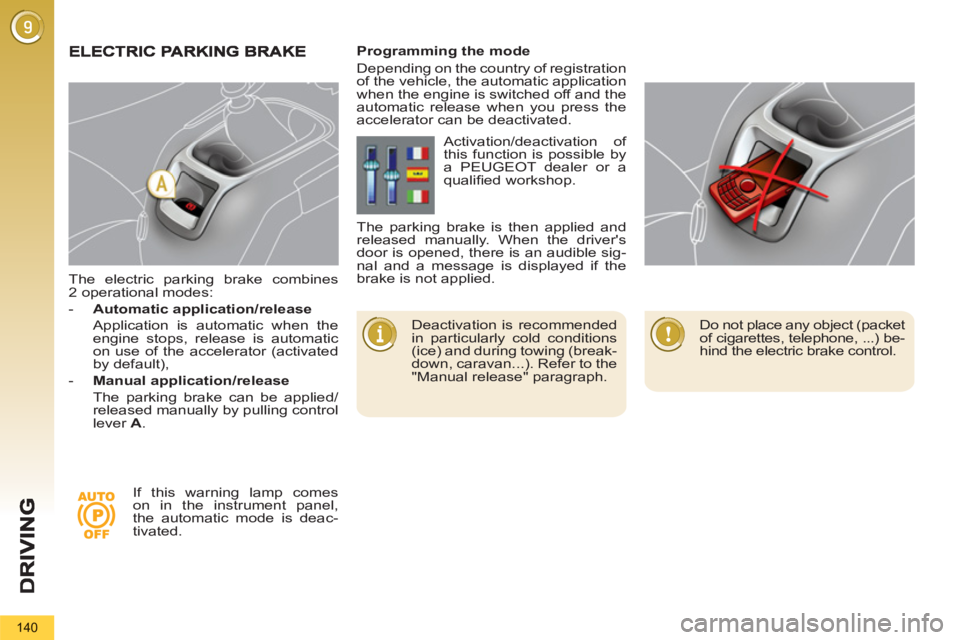
The electric parking brake combines
2 operational modes:
- Automatic application/release
Application is automatic when the
engine stops, release is automatic
on use of the accelerator (activated
by default),
- Manual application/release
The parking brake can be applied/
released manually by pulling control
lever A
.
Deactivation is recommended
in particularly cold conditions
(ice) and during towing (break-
down, caravan...). Refer to the
"Manual release" paragraph.
Programming the mode
Depending on the country of registration
of the vehicle, the automatic application
when the engine is switched off and the
automatic release when you press the
accelerator can be deactivated.
If this warning lamp comes
on in the instrument panel,
the automatic mode is deac-
tivated. Activation/deactivation of
this function is possible by
a PEUGEOT dealer or a
qualifi ed workshop.
The parking brake is then applied and
released manually. When the driver's
door is opened, there is an audible sig-
nal and a message is displayed if the
brake is not applied.
Do not place any object (packet
of cigarettes, telephone, ...) be-
hind the electric brake control.
Page 143 of 340
D
R
141
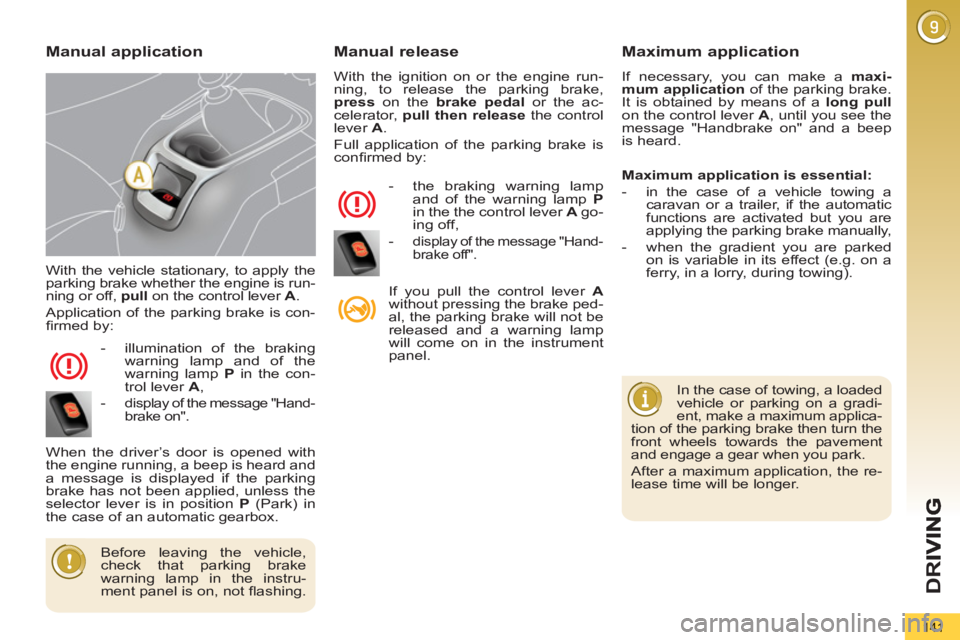
With the vehicle stationary, to apply the
parking brake whether the engine is run-
ning or off, pull
on the control lever A
.
Application of the parking brake is con-
fi rmed by:
- illumination of the braking
warning lamp and of the
warning lamp P
in the con-
trol lever A
,
-
display of the message "Hand-
brake on".
When the driver’s door is opened with
the engine running, a beep is heard and
a message is displayed if the parking
brake has not been applied, unless the
selector lever is in position P
(Park) in
the case of an automatic gearbox.
Manual release
With the ignition on or the engine run-
ning, to release the parking brake,
press
on the brake
pedal
or the ac-
celerator, pull then release
the control
lever A
.
Full application of the parking brake is
confi rmed by:
- the braking warning lamp
and of the warning lamp P
in the the control lever A
go-
ing off,
-
display of the message "Hand-
brake off".
If you pull the control lever A
without pressing the brake ped-
al, the parking brake will not be
released and a warning lamp
will come on in the instrument
panel.
Manual applicationMaximum application
If necessary, you can make a maxi-
mum application
of the parking brake.
It is obtained by means of a long pull
on the control lever A
, until you see the
message "Handbrake on" and a beep
is heard.
In the case of towing, a loaded
vehicle or parking on a gradi-
ent, make a maximum applica-
tion of the parking brake then turn the
front wheels towards the pavement
and engage a gear when you park.
After a maximum application, the re-
lease time will be longer.
Before leaving the vehicle,
check that parking brake
warning lamp in the instru-
ment panel is on, not fl ashing.
Maximum application is essential:
- in the case of a vehicle towing a
caravan or a trailer, if the automatic
functions are activated but you are
applying the parking brake manually,
- when the gradient you are parked
on is variable in its effect (e.g. on a
ferry, in a lorry, during towing).
Page 144 of 340
D
R
I
142
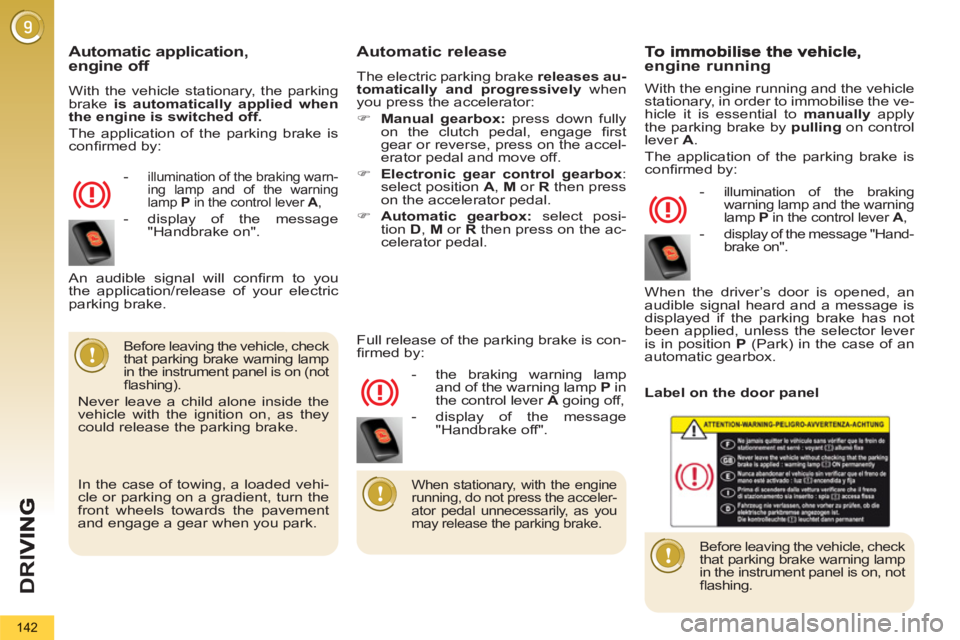
Automatic application,engine off
With the vehicle stationary, the parking
brake is automatically applied when
the engine is switched off.
The application of the parking brake is
confi rmed by:
-
illumination of the braking warn-
ing lamp and of the warning
lamp P
in the control lever A
,
- display of the message
"Handbrake on".
Automatic release
The electric parking brake releases au-
tomatically and progressively
when
you press the accelerator:
)
Manual gearbox:
press down fully
on the clutch pedal, engage fi rst
gear or reverse, press on the accel-
erator pedal and move off.
)
Electronic gear control gearbox
:
select position A
, M
or R
then press
on the accelerator pedal.
)
Automatic gearbox:
select posi-
tion D
, M
or R
then press on the ac-
celerator pedal.
Before leaving the vehicle, check
that parking brake warning lamp
in the instrument panel is on (not
fl ashing).
Never leave a child alone inside the
vehicle with the ignition on, as they
could release the parking brake.
- the braking warning lamp
and of the warning lamp P
in
the control lever A
going off,
- display of the message
"Handbrake off". An audible signal will confi rm to you
the application/release of your electric
parking brake.
Full release of the parking brake is con-
fi rmed by:
engine running
With the engine running and the vehicle
stationary, in order to immobilise the ve-
hicle it is essential to manually
apply
the parking brake by pulling
on control
lever A
.
The application of the parking brake is
confi rmed by:
-
illumination of the braking
warning lamp and the warning
lamp P
in the control lever A
,
- display of the message "Hand-
brake on".
When the driver’s door is opened, an
audible signal heard and a message is
displayed if the parking brake has not
been applied, unless the selector lever
is in position P
(Park) in the case of an
automatic gearbox.
Before leaving the vehicle, check
that parking brake warning lamp
in the instrument panel is on, not
fl ashing.
When stationary, with the engine
running, do not press the acceler-
ator pedal unnecessarily, as you
may release the parking brake.
In the case of towing, a loaded vehi-
cle or parking on a gradient, turn the
front wheels towards the pavement
and engage a gear when you park.
Label on the door panel
Page 145 of 340
D
R
143
Particular situations
In certain situations (e.g. start-
ing the engine), the parking brake
can automatically alter its force. This
is normal operation.
To advance your vehicle a few cen-
timetres without starting the engine,
but with the ignition on, press on the
brake pedal and release the park-
ing brake by pulling
then releasing
control lever A
. The full release of
the parking brake is confi rmed by the
warning lamp in the control lever A
and the warning lamp in the instru-
ment panel going off and the display
of the message "Handbrake off".
If a parking brake fault occurs while
applied
or if the battery runs fl at, an
emergency release is always pos-
sible.
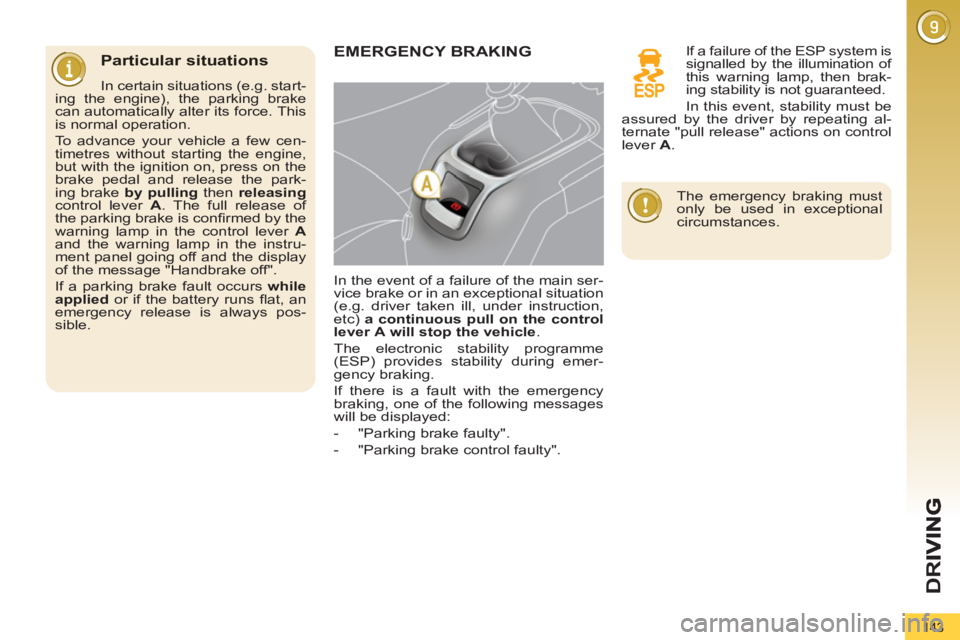
EMERGENCY BRAKING
In the event of a failure of the main ser-
vice brake or in an exceptional situation
(e.g. driver taken ill, under instruction,
etc) a continuous pull
on the control
lever
A
will stop the vehicle
.
The electronic stability programme
(ESP) provides stability during emer-
gency braking.
If there is a fault with the emergency
braking, one of the following messages
will be displayed:
- "Parking brake faulty".
- "Parking brake control faulty".
If a failure of the ESP system is
signalled by the illumination of
this warning lamp, then brak-
ing stability is not guaranteed.
In this event, stability must be
assured by the driver by repeating al-
ternate "pull release" actions on control
lever A
.
The emergency braking must
only be used in exceptional
circumstances.
Page 146 of 340
D
R
I
144
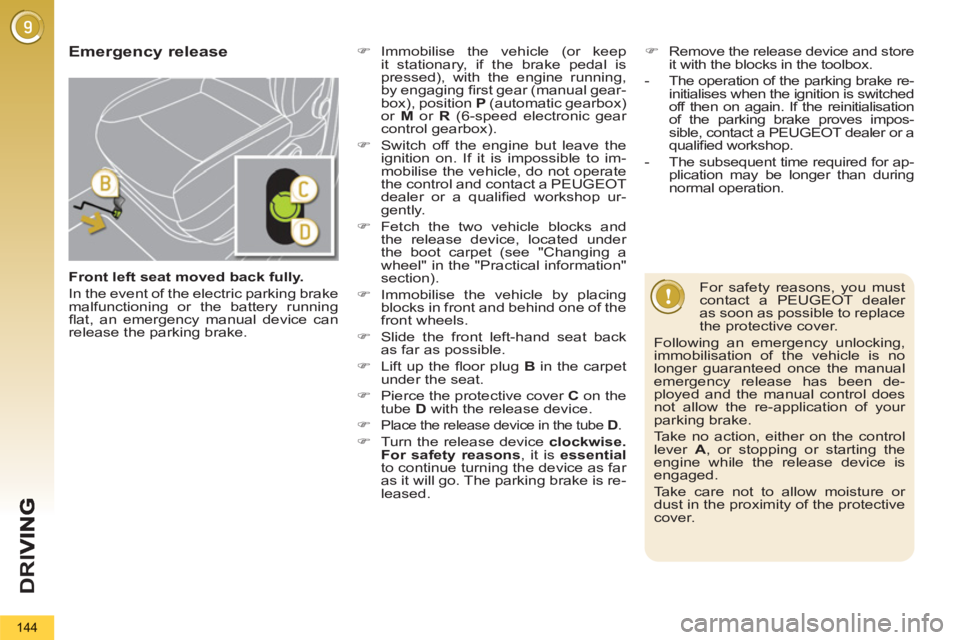
Front left seat moved back fully.
In the event of the electric parking brake
malfunctioning or the battery running
fl at, an emergency manual device can
release the parking brake.
Emergency release
)
Immobilise the vehicle (or keep
it stationary, if the brake pedal is
pressed), with the engine running,
by engaging fi rst gear (manual gear-
box), position P
(automatic gearbox)
or M
or R
(6-speed electronic gear
control gearbox).
)
Switch off the engine but leave the
ignition on. If it is impossible to im-
mobilise the vehicle, do not operate
the control and contact a PEUGEOT
dealer or a qualifi ed workshop ur-
gently.
)
Fetch the two vehicle blocks and
the release device, located under
the boot carpet (see "Changing a
wheel" in the "Practical information"
section).
)
Immobilise the vehicle by placing
blocks in front and behind one of the
front wheels.
)
Slide the front left-hand seat back
as far as possible.
)
Lift up the fl oor plug B
in the carpet
under the seat.
)
Pierce the protective cover C
on the
tube D
with the release device.
)
Place the release device in the tube D
.
)
Turn the release device clockwise.
For safety reasons
, it is essential
to continue turning the device as far
as it will go. The parking brake is re-
leased.
)
Remove the release device and store
it with the blocks in the toolbox.
- The operation of the parking brake re-
initialises when the ignition is switched
off then on again. If the reinitialisation
of the parking brake proves impos-
sible, contact a PEUGEOT dealer or a
qualifi ed workshop.
- The subsequent time required for ap-
plication may be longer than during
normal operation.
For safety reasons, you must
contact a PEUGEOT dealer
as soon as possible to replace
the protective cover.
Following an emergency unlocking,
immobilisation of the vehicle is no
longer guaranteed once the manual
emergency release has been de-
ployed and the manual control does
not allow the re-application of your
parking brake.
Take no action, either on the control
lever A
, or stopping or starting the
engine while the release device is
engaged.
Take care not to allow moisture or
dust in the proximity of the protective
cover.
Page 147 of 340
D
R
145
HILL START ASSIST
System which keeps your vehicle im-
mobilised temporarily (approximately
2 seconds) when starting on a gradi-
ent, the time it takes to move your foot
from the brake pedal to the accelerator
pedal.
This system only operates when:
- the vehicle is completely stationary,
with your foot on the brake pedal,
- in particular conditions on a slope,
- with the driver’s door closed.
The hill start assist system cannot be
deactivated.
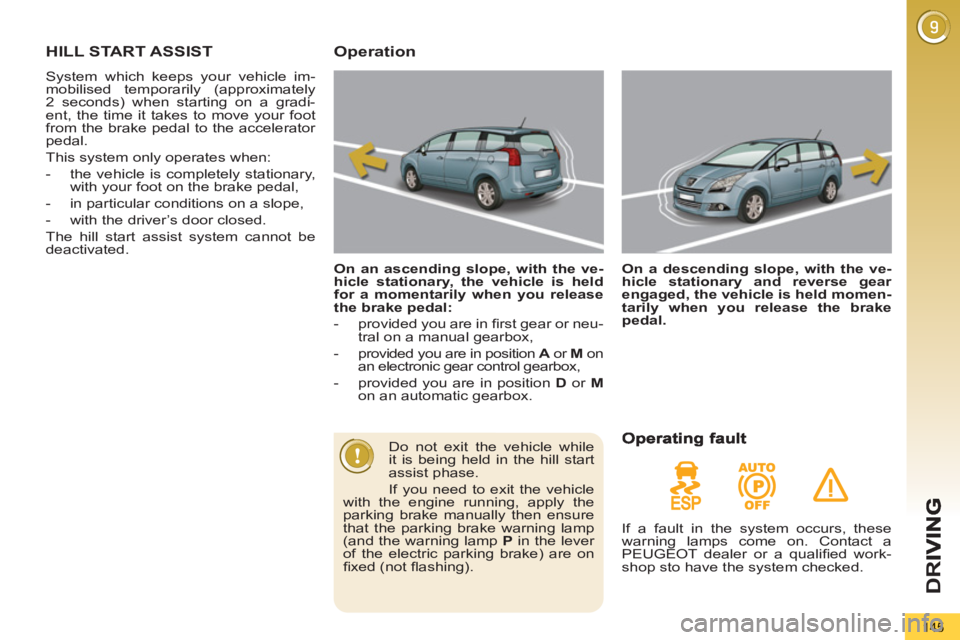
Operation
On an ascending slope, with the ve-
hicle stationary, the vehicle is held
for a momentarily when you release
the brake pedal:
- provided you are in fi rst gear or neu-
tral on a manual gearbox,
- provided you are in position A
or M
on
an electronic gear control gearbox,
- provided you are in position D
or M
on an automatic gearbox.
On a descending slope, with the ve-
hicle stationary and reverse gear
engaged, the vehicle is held momen-
tarily when you release the brake
pedal.
Do not exit the vehicle while
it is being held in the hill start
assist phase.
If you need to exit the vehicle
with the engine running, apply the
parking brake manually then ensure
that the parking brake warning lamp
(and the warning lamp P
in the lever
of the electric parking brake) are on
fi xed (not fl ashing).
If a fault in the system occurs, these
warning lamps come on. Contact a
PEUGEOT dealer or a qualifi ed work-
shop sto have the system checked.